
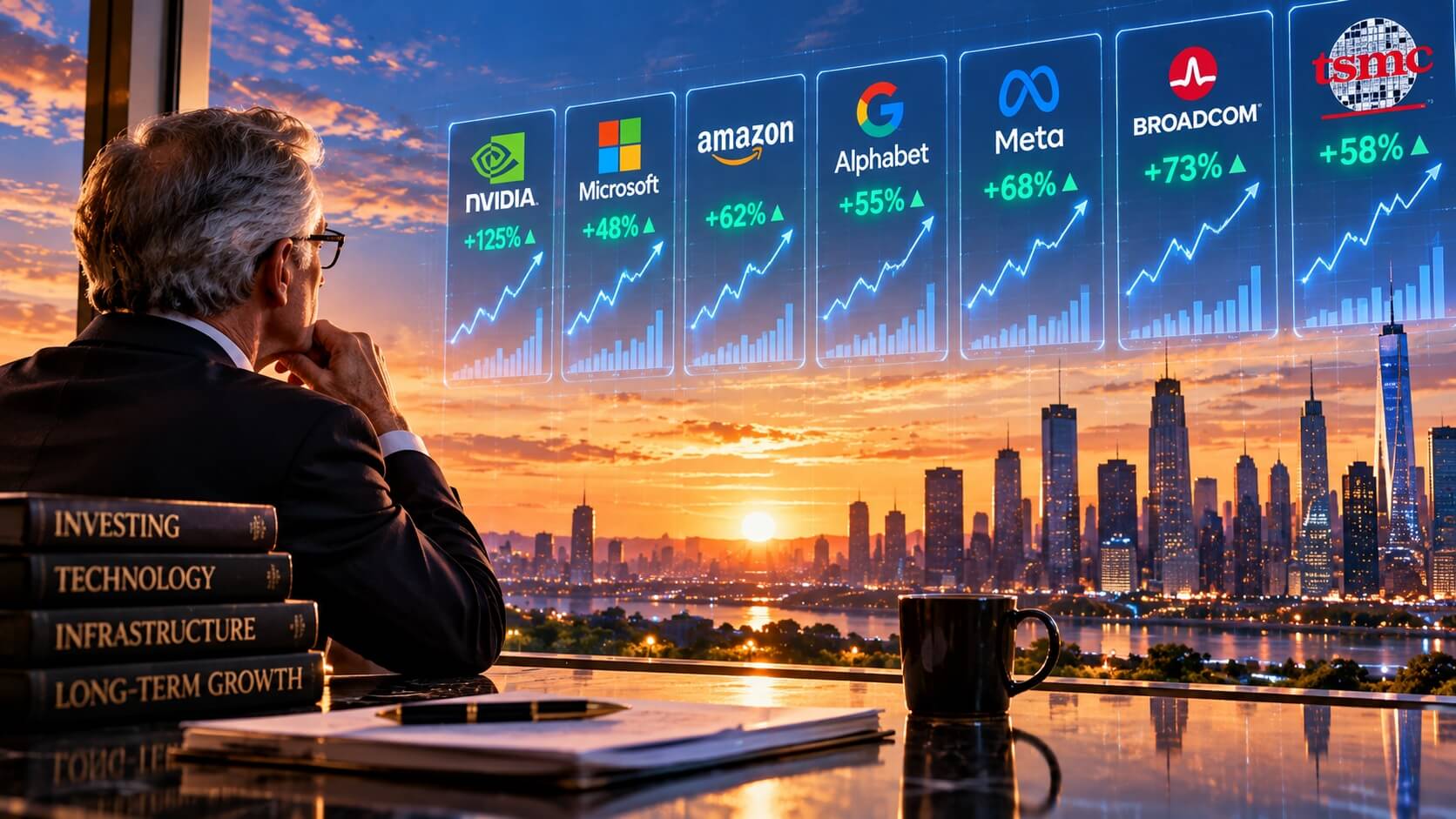
Which AI stocks are billionaires buying? Institutional investment filings for the second quarter of 2026 show that several billionaire-associated investment firms increased their exposure to AI-related companies. Appaloosa LP, associated with David Tepper, reported larger positions in Amazon, Taiwan Semiconductor Manufacturing Company (TSMC), Alphabet, Meta Platforms, and NVIDIA. Berkshire Hathaway also made a substantial investment in Alphabet.
These companies represent different parts of the AI economy, including cloud computing, advanced semiconductors, AI software, and data center infrastructure.
However, billionaire-managed investment firms are not all buying the same stocks. Some increased technology holdings while others reduced positions. Regulatory filings also report historical holdings, not real-time trades.
For retail investors, these disclosures are useful for identifying companies worth researching. They are not proof that a stock is undervalued or that copying a famous investor will produce similar returns.
Which AI Stocks Are Billionaire Investors Buying?
AI investing extends well beyond NVIDIA. Companies developing artificial intelligence depend on cloud platforms, advanced semiconductors, networking equipment, and the infrastructure needed to operate large computing systems.
Comparisons of institutional holdings reported for March 31 and June 30, 2026, reveal several increases in AI-related positions.
| Investment Firm | AI-Related Stock | Ticker | Q2 2026 Reported Change |
|---|---|---|---|
| Appaloosa LP | Amazon | AMZN | +680,000 shares |
| Appaloosa LP | TSMC | TSM | +322,500 American depositary shares |
| Appaloosa LP | Alphabet Class C | GOOG | +117,300 shares |
| Appaloosa LP | Meta Platforms | META | +238,500 shares |
| Appaloosa LP | NVIDIA | NVDA | +53,500 shares |
Reporting period: Quarter ended June 30, 2026. The figures represent changes in reported holdings compared with the previous quarter, not necessarily the complete number of shares purchased during the period.
For example, Appaloosa's reported Amazon position increased from 4.32 million to 5 million shares, while its TSMC position increased from approximately 1.33 million to 1.65 million American depositary shares.
These changes illustrate how a billionaire-associated investment firm can increase exposure to several AI-related businesses without concentrating exclusively on NVIDIA.
Investors should still distinguish between a firm's reported holdings and the personal investments of its founder. A change in an institutional portfolio also does not reveal the investment manager's exact purchase prices or motivations.
What Are the Biggest Recent Billionaire AI Investments?
Two examples from the second quarter of 2026 illustrate how large investment firms increased their exposure to companies connected to artificial intelligence.
Berkshire Hathaway and Alphabet
Berkshire Hathaway, the investment company long associated with Warren Buffett, significantly expanded its investment in Alphabet during the second quarter of 2026.
According to Alphabet's second-quarter 2026 Form 10-Q, the company completed a $10 billion private placement on June 4, 2026. An affiliate of Berkshire Hathaway received 14 million Class A shares and 14 million Class C shares.
This transaction is documented in Alphabet's regulatory filing and provides direct evidence of a substantial investment rather than simply historical ownership.
Alphabet's June 2026 announcement also identified expanding AI computing infrastructure as an intended use of proceeds from its equity financing. This connects the transaction to Alphabet's broader infrastructure expansion, although it does not establish Berkshire's complete investment rationale.
Investors should distinguish this private placement from Berkshire's other reported Alphabet holdings. Different reporting entities and investment arrangements should not automatically be treated as separate purchases.
Alphabet offers exposure to several parts of the AI economy:
- Google Cloud: Provides computing infrastructure and AI services to businesses.
- Google Search: Incorporates AI into search products and advertising services.
- Custom processors: Google's Tensor Processing Units support demanding AI workloads.
- Gemini: AI models and applications integrated into Google products.
Alphabet also generates substantial revenue outside AI, particularly through advertising. Investors therefore need to evaluate the company's overall earnings, growth prospects, and valuation rather than treating it as a pure AI stock.
Investor takeaway: Berkshire's $10 billion Alphabet investment is a documented example of increased exposure to a major AI-related company. However, the transaction does not establish that artificial intelligence was Berkshire's only investment motivation. Nor should the decision automatically be attributed personally to Warren Buffett.
David Tepper's Appaloosa and AI-Related Companies
Appaloosa LP, associated with billionaire investor David Tepper, reported increases in several AI-related holdings during the second quarter of 2026.
Its Form 13F for the quarter ended June 30, 2026, was filed on August 14, 2026. Comparisons with the previous quarter show:
- Amazon: The reported position increased by 680,000 shares to 5 million shares. Amazon provides cloud computing, AI services, and custom processors through AWS.
- TSMC: The reported position increased by 322,500 American depositary shares to 1.65 million. TSMC manufactures advanced semiconductors used in AI computing systems.
- Alphabet: The reported Class C position increased by 117,300 shares to 1.85 million shares. Alphabet participates in AI through Google Cloud, Gemini, search, and custom processors.
- Meta Platforms: The reported position increased by 238,500 shares to 675,000 shares. Meta uses AI in advertising, recommendations, and digital products while investing in computing infrastructure.
- NVIDIA: The reported position increased by 53,500 shares to 1.525 million shares. NVIDIA supplies processors and networking technology used in AI computing.
These figures demonstrate that Appaloosa's reported exposure increased across multiple AI-related businesses during the quarter.
However, the increases do not establish why the firm made those investments. AI growth expectations, valuation, portfolio allocation, or other considerations may have influenced its decisions.
Appaloosa's institutional holdings also should not automatically be described as Tepper's personal stock purchases.
Not Every Billionaire-Managed Firm Is Buying More AI Stocks
Professional investors can reach different conclusions about the same technology trend, and a single firm can increase some AI-related holdings while reducing others.
For example, Appaloosa's second-quarter 2026 disclosures showed that its reported Micron Technology position decreased by 690,000 shares, from 1.665 million to 975,000 shares, even as its reported Amazon and TSMC positions increased.
This illustrates why investors should not interpret exposure to artificial intelligence as a single investment decision.
One firm may increase semiconductor exposure because it expects strong demand for AI hardware. Another may reduce a similar position because the stock has appreciated significantly or represents too much of its portfolio.
Neither decision necessarily means the manager has changed its long-term opinion about artificial intelligence.
The lesson: There is no single billionaire investment strategy for AI. Reported purchases and sales must be evaluated individually, using the appropriate filing period.
How Can You Find Out What AI Stocks Billionaires Are Buying?
In the United States, qualifying institutional investment managers generally file Form 13F with the Securities and Exchange Commission (SEC) every quarter.
These reports disclose certain securities held by investment managers, making them a useful starting point for researching billionaire-associated investment firms.
What Does a 13F Filing Reveal?
A Form 13F generally identifies:
- The reportable securities held by the investment manager.
- The number of shares or other reportable units.
- The reported market value of each position.
- The reporting date and investment manager.
Comparing two consecutive filings can help investors identify changes in reported positions.
For example, suppose a firm reports 1 million shares of an AI company at the end of March and 1.5 million at the end of June. Its reported holdings increased by 500,000 shares.
However, investors must check for stock splits, corporate actions, and reporting changes before concluding that the difference represents additional purchases.
Why Are 13F Filings Delayed?
Form 13F reports are generally due within 45 days after the end of each calendar quarter.
A report submitted in November, for example, may describe holdings as of September 30. By the time investors read it, the manager may have increased, reduced, or sold those positions.
Form 13F also has important limitations. It does not provide a complete picture of an investment firm's portfolio, including most short positions and many other financial instruments. Certain holdings may also receive confidential treatment.
Investor takeaway: Form 13F is a historical ownership disclosure, not a real-time record of billionaire trading activity.
Which Billionaire Investors Are Known for Technology Investments?
Several prominent investors attract attention because their firms have held major technology companies. Their investment approaches differ, and historical ownership does not establish current buying activity.
Warren Buffett and Berkshire Hathaway
Warren Buffett is known for investing in established businesses with durable competitive advantages, strong financial performance, and attractive long-term economics.
Berkshire Hathaway's technology exposure demonstrates that a company does not need to be exclusively focused on AI to benefit from the technology.
Investors should distinguish Berkshire's reported portfolio holdings from Buffett's personal investment decisions.
David Tepper and Appaloosa Management
David Tepper founded Appaloosa Management, an investment firm that has invested across technology and other sectors.
Its regulatory filings can help investors examine exposure to cloud computing, semiconductor manufacturers, and other businesses connected to AI demand.
However, a reported position does not reveal whether AI, valuation, expected earnings, or another factor motivated the investment.
Stanley Druckenmiller and Duquesne Family Office
Stanley Druckenmiller is known for combining macroeconomic analysis with investments in individual companies.
His firm's historical technology and semiconductor investments have attracted attention during periods of rapid industry growth.
Because portfolio positions can change between reporting periods, investors should use the latest available disclosures rather than relying on older headlines.
Bill Ackman and Pershing Square
Bill Ackman's Pershing Square Capital Management is known for maintaining a relatively concentrated portfolio.
Its investment approach emphasizes business quality, competitive advantages, and valuation.
When examining technology holdings, investors should distinguish a company's AI opportunities from the broader investment thesis supporting its ownership.
Chase Coleman and Tiger Global
Chase Coleman founded Tiger Global Management, a firm closely associated with technology and internet investments.
Tiger Global illustrates why technology-focused investors should not automatically be described as permanent buyers of AI stocks.
Portfolio managers may increase or reduce technology exposure depending on valuations, expected returns, and portfolio risk.
Why Are Billionaires Interested in AI Infrastructure?
AI infrastructure attracts investment attention because developing and operating artificial intelligence requires substantial computing capacity.
The companies supplying processors, networking equipment, electricity systems, and cooling technology may benefit from expanding demand, although business growth does not guarantee attractive stock returns. For a broader overview of these businesses and the ways investors can gain exposure, see AI Infrastructure Companies: Who They Are and How to Invest.
AI Processors
NVIDIA and AMD develop processors used to train and run AI models. Their opportunities depend on customer spending, product performance, competition, and demand for computing capacity.
Cloud Computing
Microsoft, Amazon, and Alphabet operate cloud platforms that provide computing resources and AI services to businesses.
They may benefit from growing AI adoption but must also finance costly data center expansion.
Networking and Specialized Chips
Broadcom supplies custom semiconductors and networking technology, while Arista Networks develops high-performance networking equipment for data centers.
These products help large computing systems transfer data efficiently between processors and servers.
Electricity and Cooling
Vertiv and Eaton provide equipment supporting data center power distribution, electrical infrastructure, and thermal management.
Demand for their products can increase as data centers expand, although project delays and changes in customer spending can affect results.
For a comparison of individual opportunities, see Best AI Infrastructure Stocks to Invest In.
Are Billionaires Buying NVIDIA Because of AI?
NVIDIA is one of the companies most directly exposed to AI computing demand. Appaloosa's reported NVIDIA position increased during the second quarter of 2026, providing a documented example of increased institutional exposure.
However, an investment firm increasing its NVIDIA holdings does not prove that AI was its only reason for investing.
NVIDIA supplies processors, networking technology, and computing systems used to train and run artificial intelligence models.
When evaluating the stock, professional investors may consider:
- Expected revenue and earnings growth.
- Competitive advantages in hardware and software.
- Demand from major cloud computing customers.
- Current valuation relative to future earnings.
- Portfolio concentration and risk.
A manager may reduce NVIDIA holdings to control portfolio risk even while remaining optimistic about the company's business.
Likewise, increasing a position does not prove that its shares are undervalued.
Confidence in NVIDIA's business is different from confidence in the price paid for its stock.
Are Billionaires Investing in AI Beyond NVIDIA?
Yes. The second-quarter 2026 changes reported by Appaloosa provide examples of increased exposure to Amazon, TSMC, Alphabet, and Meta Platforms, in addition to NVIDIA.
AI-related investment opportunities extend across several industries, including cloud computing, semiconductor manufacturing, specialized chips, software, and data center infrastructure.
Alphabet and Amazon offer exposure to cloud-based AI services. TSMC manufactures advanced semiconductors, while Broadcom develops specialized processors and networking products.
Meta Platforms uses AI to improve advertising and recommendations while investing heavily in computing capacity.
Infrastructure suppliers such as Vertiv and Eaton provide another way to examine the economic effects of data center expansion.
However, a company's participation in the AI economy does not establish that a specific billionaire currently owns its shares. That claim must be supported by the relevant investment manager's latest available disclosures.
Do Billionaire Investors Prefer AI Stocks or AI ETFs?
There is no universal preference. Some professional investors hold concentrated positions in individual companies, while others use diversified funds and more complex portfolio strategies.
Individual stocks provide direct exposure to specific businesses but introduce company-specific risk.
Exchange-traded funds (ETFs) allow investors to hold multiple companies through a single investment. Their diversification benefits depend on how the fund is constructed.
For example, an AI ETF concentrated in semiconductor companies could still suffer substantial losses if AI hardware spending slows.
Retail investors should not assume that a billionaire's concentrated portfolio is appropriate for their own investment goals or risk tolerance.
Can You Make Money by Copying Billionaire AI Stock Purchases?
Copying billionaire AI holdings can generate investment ideas, but it does not guarantee profits. One major problem is that institutional disclosures are delayed.
Other limitations include:
- Unknown purchase prices: The original investor may have acquired shares at a much lower valuation.
- Incomplete information: Public filings do not reveal every investment, short position, or hedge.
- Different objectives: Institutional managers may have financial goals and risk limits unlike those of retail investors.
- Changing positions: A manager may sell shares before the next quarterly disclosure.
- Investment losses: Even highly successful professional investors make mistakes.
Consider a hypothetical example. An investment firm purchases an AI stock at $100 per share. By the time its position becomes public, the stock trades at $150.
A retail investor buying at $150 faces a different valuation from the original investor. The business may still grow, but the return will depend on future earnings and the price paid.
Knowing who owns a stock is less important than understanding what the stock is worth today.
How Can You Tell Whether a Billionaire's AI Stock Is Undervalued?
A famous investor's ownership does not establish that a stock is inexpensive. Retail investors should examine the company's financial performance, growth prospects, and valuation.
| Financial Measure | What It Helps Evaluate |
|---|---|
| Revenue growth | Whether demand for the company's products and services is increasing |
| Operating margin | How much operating profit the business generates from its sales |
| Free cash flow | Cash remaining after capital expenditures |
| Forward P/E | Share price relative to expected earnings |
| Capital spending | How much the business must invest in infrastructure and expansion |
| Debt | Financial obligations and the company's ability to fund future growth |
Different AI businesses require different valuation approaches.
For example, NVIDIA's financial performance depends heavily on semiconductor demand and product competitiveness. Amazon's results reflect cloud computing, retail operations, advertising, and substantial infrastructure investment.
Comparing these companies using a single valuation measure can therefore be misleading.
A stock can also appear inexpensive because investors expect slower earnings growth or greater business risk.
For a more detailed explanation, see Undervalued AI Infrastructure Stocks: What to Look For.
What Should Retail Investors Look for in Billionaire AI Holdings?
Institutional disclosures are most useful when investors combine ownership information with independent business analysis.
1. Was the Position Actually Increased?
Compare consecutive Form 13F filings. Check reported share counts and account for stock splits and other corporate actions.
2. How Important Is the Position?
Examine the holding's size relative to the firm's other reported positions. A large allocation may indicate meaningful exposure, but its market value can also rise simply because the stock price increases.
3. What Does the Company Actually Do?
Determine whether the business develops AI processors, operates cloud infrastructure, provides software, or supplies supporting equipment.
4. Is the Business Growing Profitably?
Review revenue, operating income, free cash flow, and capital expenditures. Look for evidence that AI-related demand is translating into sustainable financial results.
5. Is the Current Valuation Reasonable?
Consider how much future growth the share price already reflects. Even a successful company can produce disappointing investment returns if expectations are too optimistic.
These questions help investors use billionaire portfolio disclosures as research tools rather than automatic trading signals.
What Are the Risks of Following Billionaire AI Investments?
Concentration Risk
Several AI-related companies may depend on spending by the same large cloud providers. Holding semiconductor, networking, and cooling stocks does not necessarily protect investors from a broad slowdown in data center investment.
Valuation Risk
Popular AI stocks may trade at prices reflecting ambitious growth expectations. Even strong earnings can disappoint investors if future results fall short of those expectations.
Technology Risk
New processors, more efficient AI models, and changing customer requirements could weaken the competitive position of established suppliers.
Institutional Portfolio Changes
Investment managers can reduce or sell positions before the public learns about those changes. Quarterly reporting delays make it difficult to reproduce their original investment strategies.
Misinterpreting Investment Motives
A portfolio manager may own a technology company for reasons unrelated to AI, including valuation, cash generation, or diversification. Assuming every technology holding is an AI investment can lead to incorrect conclusions.
Where Can Investors Verify Billionaire AI Stock Holdings?
The SEC's EDGAR database provides official Form 13F filings submitted by institutional investment managers.
To research a billionaire-associated firm's reported holdings, search for the investment manager's legal reporting name and locate its latest available Form 13F-HR.
For the second-quarter 2026 examples discussed in this article, relevant records include Berkshire Hathaway's institutional disclosures and Appaloosa LP's Form 13F for the period ended June 30, 2026.
Alphabet's Form 10-Q for the same period also provides direct documentation of the June 2026 private placement involving a Berkshire Hathaway affiliate.
Pay attention to three dates:
- Quarter-end date: When the reported holdings were measured.
- Filing date: When the information became publicly available.
- Research date: When you are evaluating the information.
For example, a report submitted in November describing holdings as of September 30 should not be presented as evidence of purchases made in November.
To determine whether a firm increased a position, compare its latest filing with the previous quarter, verify the reporting entity, and check for corporate actions affecting share counts.
Official disclosures are generally a more reliable starting point than headlines that omit reporting dates or confuse historical ownership with recent buying.
Should You Follow Billionaires Into AI Stocks?
Billionaire investment activity can help retail investors identify AI-related companies worth researching, but it should not replace independent financial analysis.
The second-quarter 2026 filings provide concrete examples of increased institutional exposure to AI-related businesses, including Appaloosa's larger positions in Amazon, TSMC, Alphabet, Meta Platforms, and NVIDIA, and Berkshire Hathaway's $10 billion Alphabet investment.
These companies participate in different parts of the AI economy. Their potential investment returns depend on earnings growth, competitive advantages, capital spending, and current valuations.
Institutional filings can show where professional managers reported holding capital at a particular date. They cannot establish whether those investments remain unchanged, why each decision was made, or whether buying the same stocks today would produce attractive returns.
The most useful lesson from billionaire AI investing is not which stock to copy. It is how to identify businesses with durable opportunities and evaluate whether their prospects justify today's share prices.
That approach provides a stronger foundation for investment research than reacting to headlines about billionaire stock purchases.
Disclaimer: This article is for informational and educational purposes only. It does not constitute personalized financial advice or a recommendation to buy or sell securities. Institutional holdings may change, and historical filings do not establish current positions. All investments involve risk, including the possible loss of principal.