
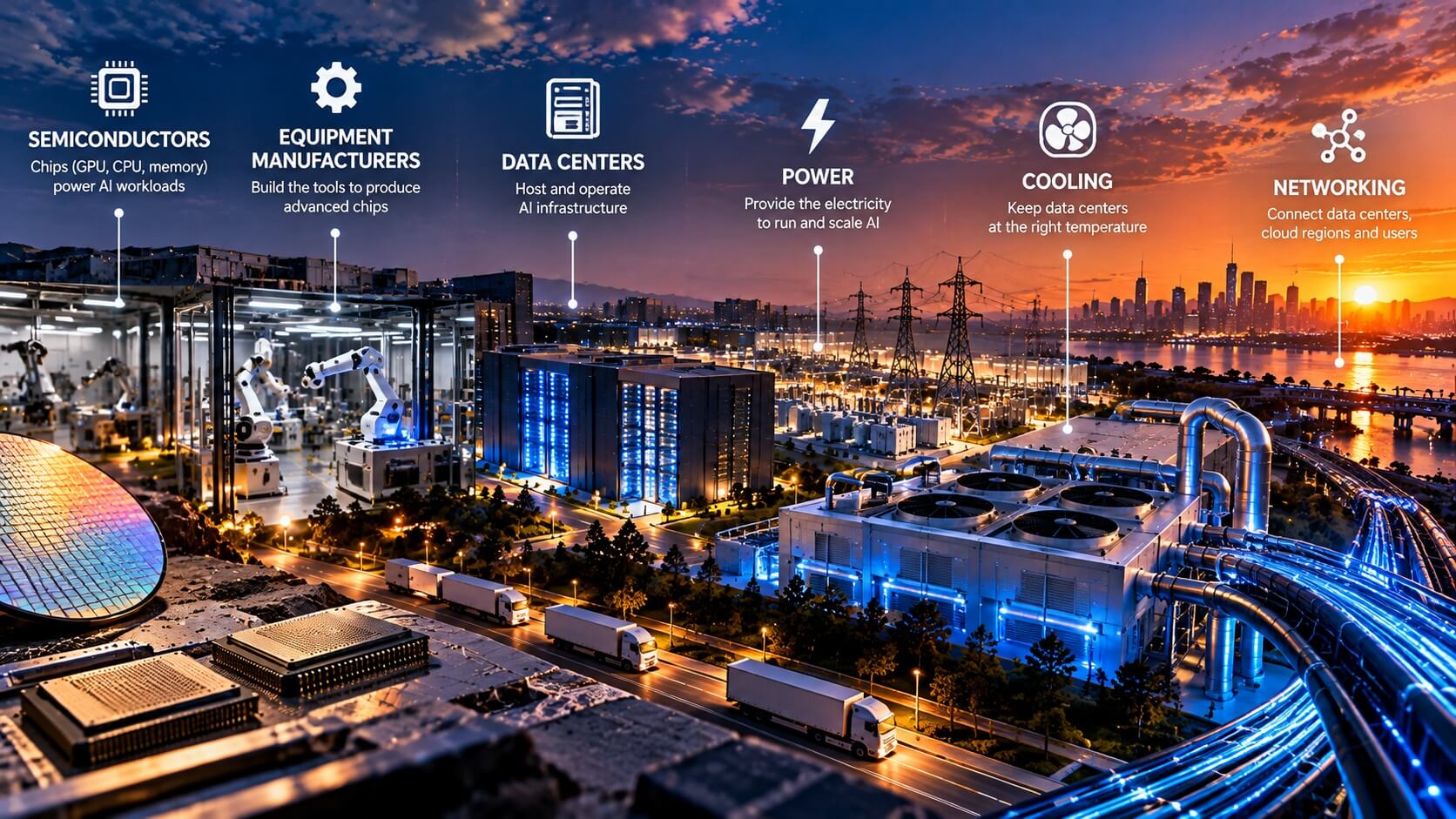
Which companies are building AI infrastructure? NVIDIA, AMD, and Broadcom supply the chips powering artificial intelligence. Microsoft, Amazon, Alphabet, and Meta build and operate large computing facilities. Equinix and Digital Realty provide data center infrastructure, while Vertiv, Eaton, Schneider Electric, and Arista Networks supply essential power, cooling, and networking technologies.
These companies have different roles. Some earn revenue by selling equipment, others operate data centers, and others invest heavily in infrastructure to deliver cloud and AI services.
For investors, understanding who builds each part of AI infrastructure—and how each company makes money—is more useful than simply identifying the biggest names in artificial intelligence.
Who Are the Main Companies Building AI Infrastructure?
AI infrastructure combines computing hardware, physical facilities, electricity, cooling, and networking. No single company provides everything.
The following publicly traded companies participate in different parts of the supply chain.
| Company | Ticker | Main Role in AI Infrastructure |
|---|---|---|
| NVIDIA | NVDA | AI processors, computing systems, and networking |
| AMD | AMD | AI accelerators and server processors |
| Broadcom | AVGO | Custom AI chips and networking technology |
| Microsoft | MSFT | Azure cloud infrastructure and AI data centers |
| Amazon | AMZN | AWS data centers and AI computing services |
| Alphabet | GOOGL | Google Cloud, AI data centers, and custom processors |
| Meta Platforms | META | Large-scale AI computing infrastructure |
| Equinix | EQIX | Data center facilities and connectivity |
| Digital Realty | DLR | Data center ownership and leasing |
| Vertiv | VRT | Data center cooling and power equipment |
| Eaton | ETN | Electrical equipment and power management |
| Schneider Electric | SU (Paris) | Electrical distribution and data center infrastructure |
| Arista Networks | ANET | High-speed data center networking |
This is a comparison of business roles, not a ranking by company size or investment potential.
One important distinction is that equipment suppliers generate revenue from selling infrastructure, while cloud providers spend money building it and must earn a return by selling services or improving their existing businesses.
What Infrastructure Does Artificial Intelligence Actually Need?
Imagine a company developing an AI assistant.
It needs powerful processors to run calculations, servers to organize computing resources, and networking equipment to transfer data.
Those systems must operate inside facilities with reliable electricity and cooling. Software and cloud services then make the computing capacity accessible to users.
The main infrastructure can be divided into five layers.
| Infrastructure Layer | What It Does | Example Companies |
|---|---|---|
| Computing hardware | Processes AI workloads | NVIDIA, AMD, Broadcom |
| Data centers and cloud | Houses and operates computing systems | Microsoft, Amazon, Alphabet |
| Networking | Connects processors, servers, and facilities | Arista Networks, Broadcom, NVIDIA |
| Power infrastructure | Delivers and manages electricity | Eaton, Schneider Electric, Vertiv |
| Cooling | Removes heat from computing equipment | Vertiv, Schneider Electric |
These layers are interconnected. More powerful computing systems can increase demand for electricity, cooling, and high-speed networking.
That is why AI infrastructure investment extends well beyond semiconductor companies. For a broader guide to the businesses involved and ways to invest in them, see AI Infrastructure Companies: Who They Are and How to Invest.
Which Companies Make the Chips Used in AI Data Centers?
AI processors perform the calculations needed to train artificial intelligence models and generate responses when people use AI applications.
NVIDIA, AMD, and Broadcom participate in this market through different products and business strategies.
NVIDIA: AI computing systems
NVIDIA is a major supplier of graphics processing units, or GPUs, used in AI computing.
GPUs perform many calculations in parallel, making them particularly useful for demanding AI workloads.
NVIDIA also supplies networking equipment, software, and integrated computing systems. Its business therefore extends beyond selling individual processors.
Cloud providers and other organizations purchase NVIDIA technology to expand computing capacity.
For investors, important factors include hardware demand, competition, profit margins, and the strength of NVIDIA's software ecosystem.
However, even strong business performance does not guarantee attractive stock returns at every valuation.
AMD: An alternative AI processor supplier
Advanced Micro Devices develops AI accelerators and server processors used in computing systems.
Its opportunity includes customers seeking additional suppliers, competitive pricing, and alternatives to established hardware platforms.
AMD's ability to expand its AI business depends on product performance, software compatibility, customer adoption, and competition.
Broadcom: Custom AI processors
Broadcom develops semiconductor and networking technologies, including custom processors designed for specific customer requirements.
Large technology companies sometimes develop specialized chips optimized for their own AI workloads.
Broadcom participates by helping customers design and supply this hardware. It also provides networking technology used to connect computing systems.
Its wider business includes enterprise software and semiconductor products unrelated to AI.
Investor takeaway: NVIDIA, AMD, and Broadcom all benefit from demand for AI computing hardware, but their products, customers, and competitive risks differ.
Who Actually Builds and Operates AI Data Centers?
Microsoft, Amazon, Alphabet, and Meta are major technology companies investing in large-scale AI computing infrastructure.
They are often called hyperscalers because they can operate and expand computing systems across enormous networks of data centers.
Microsoft: Azure and AI computing
Microsoft operates Azure, a major cloud computing platform providing processing power, storage, networking, and related services.
AI increases demand for specialized computing capacity, prompting investment in data centers, processors, and supporting infrastructure.
For investors, the central question is whether growth in Azure and AI services can generate sufficient revenue and profit to justify that spending.
Amazon: AWS infrastructure
Amazon Web Services, or AWS, provides cloud computing services to businesses and organizations.
Its data centers support conventional computing workloads and increasingly demanding AI applications.
Amazon also develops specialized AI processors, including Trainium and Inferentia.
This gives the company two roles: operating computing infrastructure and developing hardware for its cloud platform.
Financial returns depend on customer demand, infrastructure costs, pricing, and competition.
Alphabet: Google Cloud and custom chips
Alphabet operates Google Cloud and develops Tensor Processing Units, or TPUs, for machine learning workloads.
Its infrastructure supports both external cloud customers and internal products.
For investors, this means AI infrastructure spending must be evaluated alongside the financial performance of Alphabet's broader businesses.
Meta: Infrastructure for its own AI products
Meta invests in computing capacity for AI development and applications across its platforms.
Unlike cloud providers that sell computing services to external customers, much of Meta's infrastructure supports its own products.
Its financial benefits may therefore appear through advertising performance, user engagement, operating efficiency, or new services rather than direct infrastructure sales.
The companies spending the most on AI infrastructure are not necessarily the companies earning the most revenue from selling it.
Which Companies Own and Operate Data Center Facilities?
Some businesses specialize in providing data center space, connectivity, and supporting services instead of manufacturing processors or operating major public cloud platforms.
Equinix: Data centers and connectivity
Equinix operates data centers where businesses can connect to cloud platforms, communications networks, and other digital services.
Its facilities provide space, power, and connectivity for customer equipment.
AI growth may increase demand for certain services, although not every Equinix facility or customer is focused on AI.
Digital Realty: Large-scale data center infrastructure
Digital Realty owns and operates data center properties serving technology companies and enterprises.
Its business includes leasing facilities and providing infrastructure supporting computing operations.
Demand for AI-capable data centers may create expansion opportunities, but new facilities require substantial investment.
Electricity availability, construction costs, financing, and customer commitments influence potential returns.
Why these companies matter to investors
Equinix and Digital Realty are real estate investment trusts, or REITs.
Their financial characteristics differ from those of chipmakers and equipment suppliers.
Investors commonly examine leasing demand, occupancy, debt, cash flow, and funds from operations (FFO), a financial measure used to evaluate real estate businesses.
Data center REITs can benefit from expanding digital infrastructure demand, but they remain exposed to real estate and financing risks.
Who Builds the Electrical Infrastructure for AI Data Centers?
AI data centers require reliable electricity for processors, servers, networking equipment, and cooling systems.
Beyond connecting to the electrical grid, facilities need equipment to distribute power safely, manage electrical systems, and maintain operations during disruptions.
Eaton: Power distribution and management
Eaton supplies electrical equipment used in data centers, commercial buildings, industrial facilities, and other markets.
Its products help distribute and manage electricity.
Expanding data center capacity can increase demand for these systems, but Eaton's overall performance also depends on broader industrial and commercial markets.
Schneider Electric: Electrical and digital infrastructure
Schneider Electric provides electrical distribution, power management, automation, and infrastructure technologies.
Its equipment and services support data centers as well as many other types of facilities.
Demand for higher-density computing may increase opportunities in electrical infrastructure, although the company's financial results also reflect its wider industrial and energy businesses.
Why electrical suppliers are important
Even when demand for AI processors is strong, data center construction can be delayed by insufficient electricity capacity or grid connection problems.
Electrical equipment suppliers may benefit from projects addressing those constraints.
However, equipment orders depend on construction schedules, customer budgets, and the timing of infrastructure investment.
Which Companies Build AI Data Center Cooling Systems?
AI computing equipment generates heat that must be removed to maintain reliable operation.
As facilities install more powerful processors, cooling requirements can become more demanding.
Vertiv: Cooling and power infrastructure
Vertiv supplies thermal management and power equipment used in data centers.
Its technologies help operators manage heat and maintain appropriate operating conditions.
High-density AI computing systems can increase demand for advanced cooling approaches, including liquid cooling.
Vertiv may benefit from new data center construction and upgrades to existing facilities.
Schneider Electric and other suppliers
Schneider Electric also provides technologies supporting data center cooling and operations.
Other businesses supply components, equipment, and installation services.
Facilities may use air cooling, liquid cooling, or combinations of both, depending on computing density, building design, and operating requirements.
Why cooling matters financially
Cooling systems represent an important construction and operating cost for data centers.
Growing demand for advanced cooling equipment could support supplier revenue, but profitability also depends on pricing, competition, installation costs, and technological changes.
Investors should distinguish rising demand for cooling equipment from actual growth in a supplier's earnings and cash flow.
Which Companies Build AI Data Center Networks?
AI computing systems connect large numbers of processors and servers that must exchange data quickly.
Networking equipment enables that communication and can influence how efficiently large computing clusters operate.
Arista Networks: High-speed networking
Arista Networks supplies networking hardware and software used in cloud and data center environments.
Its products help connect servers and computing systems.
As AI clusters expand, demand for high-performance networking may increase.
Arista's growth opportunities depend partly on infrastructure investment by major cloud customers and its ability to compete for networking contracts.
Broadcom and NVIDIA: Networking technology
Broadcom supplies networking chips and related technologies used in data centers.
NVIDIA also offers networking products supporting large AI computing systems.
These businesses participate at different levels, from supplying components to providing integrated networking solutions.
For investors, networking is a distinct AI infrastructure market closely connected to demand for processors and computing capacity.
Who Manufactures the Equipment Used to Make AI Chips?
Before an AI processor reaches a data center, it must be manufactured using highly specialized equipment and production facilities.
Companies such as ASML, Applied Materials, and Lam Research supply technologies used in semiconductor manufacturing.
ASML provides lithography systems used in advanced chip production. Applied Materials and Lam Research supply equipment for other important manufacturing processes.
These businesses may benefit when semiconductor manufacturers invest in production capacity and advanced technologies.
However, their revenue depends on spending across multiple semiconductor markets, not only AI.
Taiwan Semiconductor Manufacturing Company (TSMC) is another central participant because it manufactures advanced chips designed by customers.
The company designing an AI processor is not necessarily the company manufacturing it.
Chip designers, manufacturers, equipment suppliers, and materials providers occupy different positions in the supply chain, each with distinct opportunities and risks.
Are Companies Building AI Infrastructure Making Money From It?
AI infrastructure spending creates revenue opportunities, but profitability depends on how each business operates.
Consider a chip supplier selling processors to a cloud provider. An electrical equipment manufacturer supplies power systems for the same project.
The cloud provider then installs the equipment and sells computing services to customers.
All three participate in AI infrastructure, but their revenue models differ.
| Business Type | How It Earns Revenue | Important Financial Consideration |
|---|---|---|
| Chip supplier | Sells processors and related systems | Product demand and profit margins |
| Equipment supplier | Sells power, cooling, or networking equipment | Orders, pricing, and operating costs |
| Cloud provider | Sells computing and cloud services | Revenue generated from expensive infrastructure |
| Data center operator | Leases facilities or provides infrastructure services | Occupancy, financing, and capital spending |
A supplier may generate revenue when equipment is delivered, while a cloud provider may need years of customer payments to recover infrastructure costs.
A data center owner may depend on long-term leases and financing conditions.
That is why rapid growth in AI infrastructure investment does not automatically produce equally strong profits for every company involved.
What Could Limit the Growth of AI Infrastructure Companies?
Several factors could constrain infrastructure expansion and affect company earnings.
Electricity availability
Some regions may struggle to provide enough power for new data centers. Grid connection delays can postpone construction or operations.
Construction costs
Data centers require buildings, land, electrical systems, cooling equipment, and skilled labor. Rising costs can reduce project returns.
Semiconductor supply
Advanced chip production depends on specialized manufacturing capacity and suppliers. Disruptions can limit equipment availability.
Customer concentration
Some suppliers depend heavily on a small number of large technology customers. Changes in their spending plans can significantly affect revenue.
Uncertain returns on AI investment
Cloud providers and other technology companies must eventually generate sufficient financial benefits from their infrastructure investments.
If demand or profitability disappoints, future spending could slow.
These constraints can affect different businesses in different ways, making company-specific research essential.
Which AI Infrastructure Companies Are Best Positioned to Benefit?
No single company is guaranteed to benefit most from AI infrastructure expansion.
NVIDIA has a strong position in AI computing systems, while Broadcom participates in custom processors and networking.
Microsoft, Amazon, and Alphabet operate cloud platforms that can sell computing services.
Vertiv and Eaton provide essential power and cooling infrastructure, while Equinix and Digital Realty supply data center facilities.
Arista Networks participates in high-speed networking.
Each company offers a different form of exposure, but an important industry position does not automatically make its stock an attractive investment.
Investors must also consider revenue growth, profitability, competitive advantages, and valuation.
For a comparison focused on future growth potential, see Most Promising AI Infrastructure Companies.
Can Retail Investors Invest in Companies Building AI Infrastructure?
Yes. Many AI infrastructure companies are publicly traded and accessible through brokerage accounts.
Some brokers also support fractional shares, allowing investors to purchase portions of eligible stocks.
However, owning several AI infrastructure companies does not guarantee broad diversification.
For example, an investor holding NVIDIA, Broadcom, Arista Networks, and Vertiv owns businesses operating in different markets.
Yet all four could be affected if major cloud providers reduce AI infrastructure spending.
Investors should therefore examine overlapping business risks, not just the number of companies in a portfolio.
They should also distinguish suppliers earning revenue from infrastructure sales from cloud companies investing heavily to build capacity.
For a closer look at individual stocks, see Best AI Infrastructure Stocks to Invest In.
What Should Investors Watch as AI Infrastructure Expands?
Several indicators can help investors determine whether infrastructure expansion is translating into sustainable business results.
- Cloud capital spending: Investment in property, equipment, and computing capacity shows how aggressively major technology companies are expanding, although not all spending is AI-specific.
- Semiconductor demand: Revenue, orders, and customer adoption provide evidence of demand for computing hardware.
- Data center construction: New facilities, leasing commitments, and capacity expansion indicate demand for physical infrastructure.
- Electrical and cooling equipment orders: Supplier results show whether data center projects are generating revenue for supporting industries.
- Profitability and cash flow: Strong sales growth matters less if companies cannot generate sustainable financial returns.
- Technology changes: More efficient AI models and new computing architectures could alter future infrastructure requirements.
Tracking these developments is more useful than assuming every company associated with artificial intelligence will benefit equally.
Who Is Really Building the Future of AI?
AI infrastructure is being developed by an interconnected network of companies rather than one technology leader.
NVIDIA, AMD, and Broadcom supply computing technology. Microsoft, Amazon, Alphabet, and Meta build and operate large-scale AI systems.
Equinix and Digital Realty provide data center facilities. Vertiv, Eaton, and Schneider Electric supply power and cooling technologies, while Arista Networks helps connect computing equipment.
Semiconductor manufacturers and equipment suppliers support the production of the advanced chips used throughout the industry.
For investors, the essential distinction is between companies selling AI infrastructure, companies operating it, and companies spending money to build it.
Those roles determine how businesses generate revenue, what costs they face, and how they may benefit from continued AI adoption.
Understanding the complete supply chain provides a stronger foundation for evaluating AI infrastructure investments than following the most popular AI stocks alone.
Disclaimer: This article is for informational and educational purposes only and does not constitute personalized financial advice or a recommendation to buy or sell securities. All investments involve risk, including the possible loss of principal.