
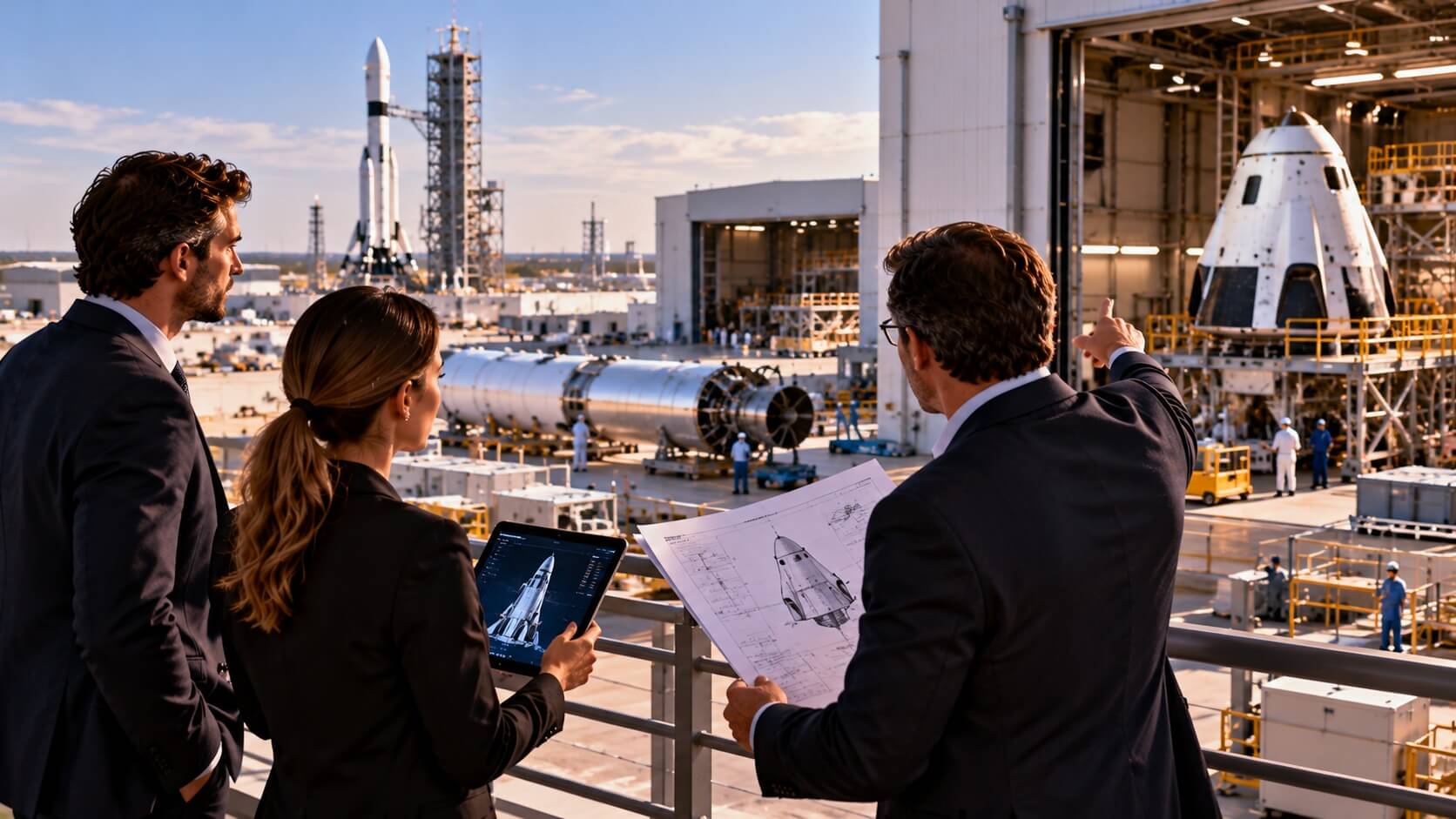
SpaceX could be an attractive long-term investment for investors who believe in the growth of satellite communications, reusable rockets, and space infrastructure. However, whether SpaceX is a good stock to buy right now depends heavily on its valuation, financial performance, capital requirements, and the expectations already reflected in its share price.
SpaceX became publicly traded on June 12, 2026, under the Nasdaq ticker SPCX, with an initial public offering price of $135 per share.
Since becoming a public company, investors have gained greater access to its financial information and the ability to buy shares through ordinary brokerage accounts.
The investment case is compelling in several respects. SpaceX has established a leading position in commercial launch services, built a substantial satellite communications business through Starlink, and continues to invest in technologies that could expand its future markets.
But these advantages come with significant risks.
The company operates capital-intensive businesses, faces ambitious development schedules, and trades at a valuation that requires investors to consider how much future growth is already priced in.
For retail investors, the central question is not simply whether SpaceX is a successful company. It is whether buying its shares at the current market valuation offers an attractive balance between potential returns and downside risk.
Why Do Investors Want to Buy SpaceX Stock?
SpaceX attracts investor attention because it combines several businesses that could benefit from the expansion of the space economy.
Unlike companies focused on a single space-related product, SpaceX operates across launch services, spacecraft development, satellite communications, and advanced technology infrastructure.
Its activities include:
- Falcon rockets used to launch commercial and government payloads.
- Starship, a next-generation launch system under development.
- Starlink, a global satellite communications network.
- Spacecraft and transportation services for government and commercial customers.
- Artificial intelligence and related technology infrastructure.
These activities give SpaceX exposure to multiple markets rather than a single source of demand.
However, they also make the business more complex to evaluate.
A launch service provider, a satellite broadband operator, and an artificial intelligence infrastructure business have different cost structures, growth prospects, and competitive challenges.
Investors need to understand how these activities contribute to revenue, profitability, and cash requirements.
For a comparison with other publicly traded companies operating in the industry, see Space Stocks Explained: A Guide to the Companies Investors Should Know.
What Makes SpaceX an Attractive Investment?
Several characteristics support the long-term investment case for SpaceX.
A Strong Position in Commercial Rocket Launches
SpaceX has developed a major position in the commercial launch market through its reusable rocket technology.
Reusability allows rocket components to be recovered and flown again, potentially reducing the cost of accessing space.
Lower launch costs can make satellite deployment more economically practical and support demand for additional missions.
SpaceX also benefits from operating its own satellite network, which creates internal demand for launch services.
This combination of launch capabilities and satellite operations can provide operational advantages.
However, leadership in launch services does not guarantee attractive stock returns.
Investors must still consider pricing, operating costs, competition, and how much value the market already assigns to this business.
Starlink and Recurring Communications Revenue
Starlink is one of the most important elements of the SpaceX investment case.
The satellite network provides broadband connectivity to consumers, businesses, and government customers across numerous markets.
Unlike launch contracts, which generate revenue from individual missions, satellite communications can create ongoing customer relationships.
Recurring service revenue may improve business predictability as the customer base expands.
Starlink also operates in markets where conventional communications infrastructure can be limited or expensive to deploy.
These characteristics create opportunities for long-term growth.
However, the business must continue investing in satellites, network capacity, ground infrastructure, and customer equipment.
Subscriber growth alone does not determine profitability.
Investors should examine how revenue growth compares with operating costs and the capital required to maintain and expand the network.
Exposure to Multiple Growth Markets
SpaceX is not dependent exclusively on rocket launches.
Its activities span satellite connectivity, transportation infrastructure, government services, and other advanced technologies.
This creates opportunities for the company to participate in several developing markets.
However, diversification across businesses does not eliminate risk.
Expanding into new activities can require substantial investment and management attention.
The company must demonstrate that these investments can eventually generate returns sufficient to justify their costs.
Is SpaceX Financially Strong?
SpaceX's financial position is an important part of the investment decision.
Following its public listing, investors gained access to regular financial disclosures that provide greater visibility into its revenue, expenses, assets, and cash flow.
The company's third-quarter 2026 financial disclosures showed substantial business growth, particularly in satellite connectivity.
For the three months ended September 30, 2026, SpaceX reported revenue growth of approximately 69.5% compared with the corresponding period in 2025.
Starlink consumer subscriber growth and expanding enterprise and government services contributed to this performance.
The company also reported its first quarterly profit as a public company.
These developments are encouraging because they indicate that parts of the business are expanding commercially.
However, revenue growth and accounting profitability are only part of the financial picture.
Why Cash Flow Matters
SpaceX continues to invest heavily in satellite infrastructure, Starship development, and artificial intelligence infrastructure.
During the first nine months of 2026, the company spent approximately $48.1 billion on capital expenditures and recorded nearly $35 billion in negative free cash flow.
This means that substantial investment requirements exceeded the cash generated by its operations over that period.
For investors, the distinction matters.
A company can report strong revenue growth and even positive earnings while consuming large amounts of cash.
That does not automatically make the investment unattractive, especially when spending supports future growth.
But investors need to assess whether those investments will eventually generate sufficient financial returns.
Important questions include:
- How quickly can operating cash flow grow?
- Will capital expenditures remain elevated?
- Can Starlink generate increasing cash flow as the network expands?
- How much additional funding might future projects require?
- Can new businesses become profitable without excessive financial risk?
SpaceX's financial strength should therefore be evaluated using both its earnings and its cash flow.
Is SpaceX Stock Overvalued?
Valuation is one of the most important considerations for anyone thinking about buying SpaceX shares.
A company can have an excellent business and still be an unattractive investment if its stock price assumes unrealistic future growth.
SpaceX's public offering valued the company at approximately $1.77 trillion, based on the valuation reported around its June 2026 market debut.
By late October 2026, its market valuation was approximately $2.16 trillion.
This represents a substantial valuation for a company operating in industries that continue to require significant capital investment.
Investors are therefore paying not only for existing operations but also for expectations about future expansion.
Those expectations may include continued Starlink growth, greater launch activity, successful Starship development, and contributions from newer businesses.
The difficulty is determining how much of that future success is already reflected in the share price.
Why a High Valuation Can Be Risky
Consider two hypothetical companies.
Company A grows revenue by 30% annually and trades at a valuation that assumes 15% growth.
Company B grows revenue by 50% annually but trades at a valuation that assumes 70% growth.
Although Company B is growing faster, its stock may face greater downside risk if actual results disappoint investors.
This illustrates why business growth and stock performance are not the same thing.
SpaceX could continue expanding its operations while its shares underperform if investors reduce the valuation they are willing to pay.
Conversely, stronger-than-expected growth or improved profitability could support a higher valuation.
For a detailed examination of share prices, market capitalization, and future expectations, read SpaceX Stock Price and Valuation: What Investors Need to Know.
What Are the Biggest Risks of Buying SpaceX Stock?
Despite its competitive advantages, SpaceX faces several risks that could affect its financial performance and share price.
High Capital Expenditure
SpaceX must continue investing in rockets, satellites, infrastructure, and new technologies.
These investments may create future growth opportunities, but they also consume cash.
If returns take longer than expected, the company could experience financial pressure.
Starship Development Risk
Starship is an ambitious transportation system designed to expand launch capabilities.
Its long-term potential is significant, but development involves technical, regulatory, and commercial uncertainty.
Delays or higher-than-expected costs could affect financial expectations.
Investors should distinguish demonstrated operating capabilities from future technological objectives.
Satellite Communications Competition
Starlink operates in a competitive communications market.
Other satellite operators, telecommunications providers, and emerging technologies may compete for customers.
Competition can affect pricing, subscriber growth, and profitability.
Regulatory and Government Exposure
SpaceX operates in industries subject to extensive regulation.
Launch licensing, spectrum allocation, national security requirements, and government contracts can influence its operations.
Regulatory changes or contract developments may create financial uncertainty.
Valuation and Market Expectations
A substantial market capitalization creates high expectations.
Even strong operational results may not support the stock price if growth falls short of investor assumptions.
Changes in interest rates, investor sentiment, or broader equity market conditions can also affect valuation.
Expansion Beyond Traditional Space Activities
SpaceX's investments in artificial intelligence and related infrastructure create additional opportunities but also introduce new competitive and financial risks.
Investors should evaluate whether these activities strengthen the company's long-term economics or increase its exposure to capital-intensive markets.
Should You Buy SpaceX Stock Now or Wait?
There is no universally correct answer.
The decision depends on an investor's expectations, risk tolerance, time horizon, and assessment of valuation.
Buying immediately may appeal to investors who believe the company's long-term growth potential is greater than the market currently anticipates.
Waiting may appeal to those who want more evidence of improving cash flow, clearer financial results, or a more attractive valuation.
Neither approach guarantees a better outcome.
A stock can continue rising even when it appears expensive.
It can also decline substantially despite strong long-term business prospects.
Rather than attempting to predict the next short-term price movement, investors can evaluate several scenarios.
| Scenario | Business Development | Potential Investment Implication |
|---|---|---|
| Bull case | Strong Starlink growth, successful new technologies, improving cash flow | Could support premium valuation and share-price appreciation |
| Base case | Continued growth with high investment requirements | Returns depend heavily on valuation and execution |
| Bear case | Slower growth, delays, rising costs, or weaker margins | Could lead to valuation compression and significant losses |
These scenarios are illustrative, not price forecasts.
Their purpose is to help investors understand what must happen for the investment to perform well.
A useful decision-making process involves identifying the assumptions behind each scenario and comparing them with the company's current valuation.
Is SpaceX a Good Long-Term Investment?
SpaceX may appeal to long-term investors because several of its markets have the potential to expand over many years.
Satellite communications can reach additional customers and support new services.
Reusable launch systems can contribute to the development of orbital infrastructure.
Government and commercial demand may create opportunities for transportation, spacecraft, and related technologies.
However, a long investment horizon does not eliminate risk.
Technological progress may take longer than expected.
Competition may reduce margins.
New projects may require more capital than initially anticipated.
And even if SpaceX becomes substantially larger, shareholders may earn disappointing returns if they purchased shares at an excessive valuation.
Long-term investors should therefore evaluate the company's ability to generate sustainable free cash flow rather than relying exclusively on revenue growth or technological milestones.
How Does SpaceX Compare With Other Space Stocks?
SpaceX offers a different investment profile from smaller publicly traded space companies.
Rocket Lab participates in launch services and spacecraft systems.
AST SpaceMobile focuses on satellite-to-phone connectivity.
Planet Labs provides Earth observation data and related services.
Established aerospace companies participate in government space programs alongside other business activities.
These companies differ in scale, financial resources, profitability, and exposure to particular markets.
Smaller companies may offer substantial growth opportunities, but they can also face greater financing and execution risks.
SpaceX has a broader operating platform and significant commercial activities, yet its large market valuation creates a different challenge for investors.
The best investment is not necessarily the largest company or the one with the most ambitious technology.
It is the company whose future financial performance can justify its current valuation while providing an acceptable level of risk.
What Should Investors Watch Before Buying SpaceX?
Several developments can help investors assess whether the SpaceX investment case is strengthening or weakening.
Starlink revenue and subscriber growth: These indicators help measure the expansion of its communications business.
Operating margins: Improving margins may indicate that revenue growth is translating into better operating economics.
Free cash flow: This reveals whether the company is moving toward generating more cash than it spends.
Capital expenditure: Investors should monitor how much funding is required for satellites, launch systems, and other infrastructure.
Starship milestones: Technical progress may influence expectations about future launch capabilities.
Competition: Developments in satellite communications and launch services can affect long-term growth assumptions.
Valuation: Investors should compare market capitalization with realistic expectations for revenue, earnings, and cash flow.
Strategic transactions: Potential acquisitions, mergers, or changes in business structure may alter the company's financial and investment profile.
These indicators are more useful than relying on short-term stock price movements alone.
What Companies Does SpaceX Own?
Understanding SpaceX's business structure can help investors evaluate where the company's revenue, operating costs, and growth opportunities originate.
SpaceX is best known for its Falcon launch vehicles and Starship development program, but its operations extend beyond rocket launches.
Starlink provides satellite communications services, while Starshield focuses on capabilities designed for government and national security applications.
SpaceX also develops spacecraft and supporting technologies used in commercial and government missions.
These activities do not all operate under identical business models.
Launch services generate revenue from transportation contracts, while satellite communications can create recurring customer revenue. Development programs may require significant investment before generating commercial returns.
Investors should also distinguish between subsidiaries, operating divisions, commercial brands, and separately owned companies associated with Elon Musk.
Understanding these distinctions helps avoid attributing revenue, assets, or business opportunities to SpaceX without confirming the relevant ownership relationships.
For a detailed explanation of the company's subsidiaries and operating businesses, read What Companies Does SpaceX Own? Subsidiaries and Businesses Explained.
Is SpaceX Worth Buying at Its Current Valuation?
SpaceX combines several characteristics that can make a company attractive to long-term investors: established technological capabilities, substantial commercial operations, recognizable products, and exposure to growing markets.
Its launch business and Starlink network provide a foundation for continued expansion.
However, the investment case also involves substantial capital requirements, technological uncertainty, competition, and a demanding market valuation.
The company's strong revenue growth is encouraging, but investors must determine whether future earnings and cash flow can justify the price of its shares.
A reasonable assessment should consider both what SpaceX has already achieved and what remains uncertain.
For investors with a long time horizon and a high tolerance for volatility, SpaceX may deserve serious research.
For those prioritizing predictable cash flow, lower valuation risk, or limited exposure to speculative growth, its financial characteristics may be less suitable.
Ultimately, the question is not whether SpaceX has an exciting future.
It is whether the company can generate enough economic value to justify the expectations embedded in its stock price.
Financial disclaimer: This article is for informational and educational purposes only and does not constitute financial or investment advice. Investing in individual stocks involves substantial risk, including potential loss of capital. Investors should conduct independent research and consider their financial circumstances and risk tolerance before making investment decisions.