
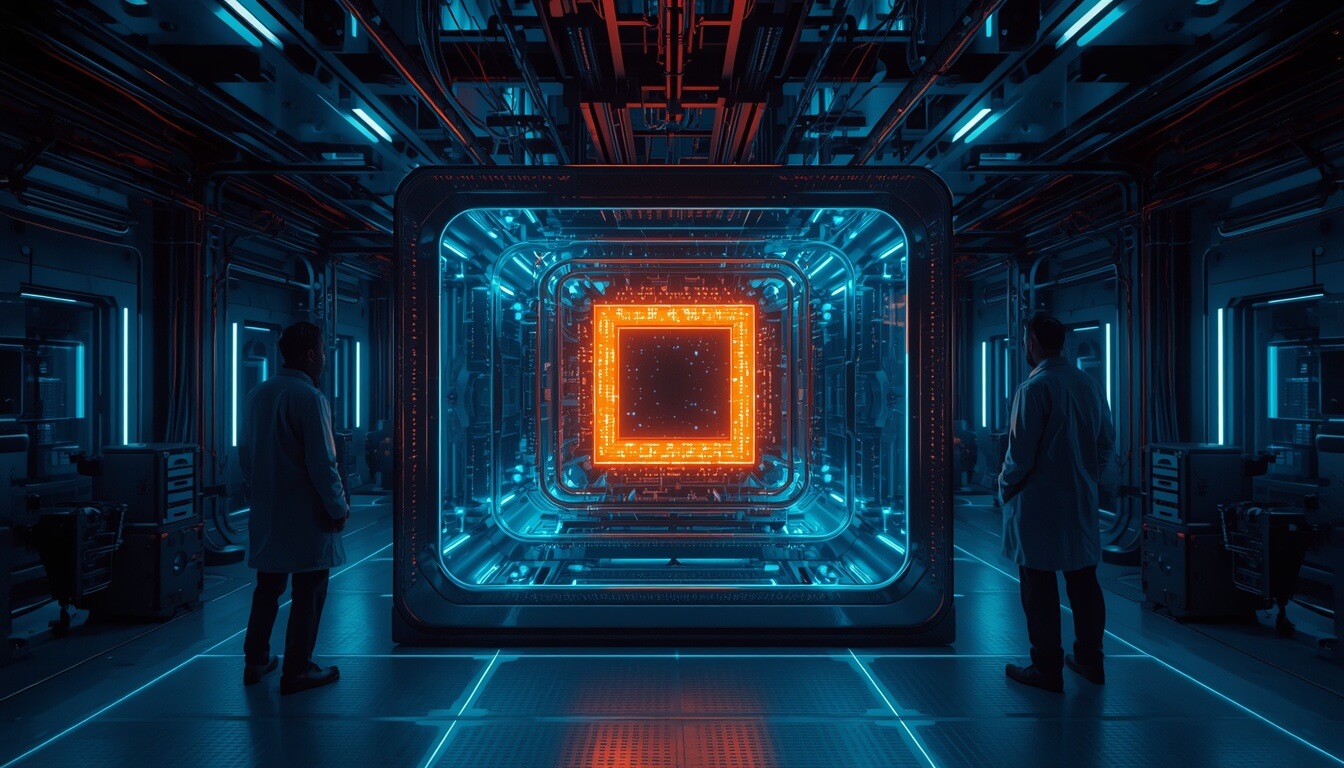
Quantum computing is one of the most ambitious areas of emerging technology. Unlike conventional computers, which process information using bits represented as zeros and ones, quantum computers use quantum mechanical effects to process information in fundamentally different ways.
The technology is still developing, and practical quantum computers capable of solving large real-world problems remain a work in progress. However, researchers and technology companies are investing heavily in the field because quantum machines could eventually perform certain types of calculations that are extremely difficult for classical computers.
Understanding why quantum computing could matter requires looking beyond the idea of simply building a faster computer. Quantum computers are based on a different computational model, with potential advantages in specific classes of problems rather than across computing as a whole.
Quantum computing is not about building a faster computer. It is about introducing a fundamentally different way of processing information for specific classes of problems.
From Bits to Qubits
Traditional computers process information using bits. A bit has two possible states: 0 or 1. Modern processors manipulate billions of these binary states through logic gates, allowing computers to run software, analyze data, communicate over networks and control complex systems.
Quantum computers use qubits, or quantum bits. A qubit can exist in a combination of quantum states before it is measured. This property is known as superposition.
Superposition does not simply mean that a quantum computer can store an unlimited number of conventional bits in the same physical space. Instead, it allows quantum algorithms to manipulate probability amplitudes in ways that have no direct equivalent in conventional binary computing.
Another important property is entanglement, a quantum phenomenon in which the states of multiple qubits can become correlated. Quantum algorithms can use these relationships to perform certain calculations through operations on a system of interconnected qubits.
These principles create the foundation for quantum computation.
Why More Qubits Are Not Enough
It is tempting to measure progress in quantum computing simply by counting qubits. In reality, the number of qubits is only one part of the problem.
Quantum states are extremely sensitive to their environment. Interactions with heat, electromagnetic radiation, vibration and other sources of interference can introduce errors into calculations. This phenomenon, known as decoherence, is one of the central technical challenges facing quantum computing.
As quantum processors become larger, controlling errors becomes increasingly important. A useful quantum computer therefore needs not only many qubits, but also reliable operations, accurate control systems and effective error correction.
This is why the industry is focusing increasingly on metrics such as gate fidelity, coherence times, error rates and logical qubits.
A logical qubit is constructed from multiple physical qubits using quantum error-correction techniques. Building a useful fault-tolerant quantum computer may require very large numbers of physical qubits to create a much smaller number of high-quality logical qubits.
Quantum Computing Is Not a Replacement for Classical Computers
Quantum computing is unlikely to replace laptops, smartphones, servers or conventional data centers.
Classical computers remain extremely effective for general-purpose computing. They are inexpensive, reliable and capable of running an enormous range of applications.
Quantum processors are instead being developed as specialized computational systems that could work alongside classical machines.
A future computing architecture could therefore combine conventional processors, GPUs, specialized accelerators and quantum processors. Classical systems could prepare data and control the computation, while quantum hardware could be used for specific workloads where quantum algorithms provide an advantage.
This makes quantum computing more comparable to the development of specialized accelerators than to the disappearance of conventional computing.
Where Could Quantum Computers Provide an Advantage?
The potential applications of quantum computing are concentrated in areas involving particularly difficult mathematical or physical problems.
| Application area | Why quantum could help |
|---|---|
| Optimization | Problems involving enormous numbers of possible combinations, such as transportation networks, supply chains, manufacturing schedules and portfolio construction |
| Quantum simulation | Simulating molecules, materials and chemical reactions that become computationally expensive for classical computers as the number of interacting particles increases |
| Cryptography | Some quantum algorithms could theoretically threaten widely used public-key cryptographic systems, driving interest in post-quantum cryptography |
Potential applications include materials science, drug discovery, battery research and chemical engineering.
The potential impact therefore extends well beyond the technology sector.
The Importance of Quantum Algorithms
Hardware alone will not determine whether quantum computing becomes commercially useful.
Quantum computers require algorithms specifically designed to exploit quantum mechanical properties. Some algorithms offer theoretical speedups for particular mathematical problems, while others are being investigated for optimization, simulation and machine-learning applications.
This means that progress depends on several areas developing simultaneously:
- Hardware engineering
- Quantum error correction
- Algorithms
- Software tools
- Classical infrastructure
The software ecosystem is therefore becoming an increasingly important part of the quantum-computing industry. Developers need programming frameworks, simulators, compilers and cloud interfaces that allow researchers to experiment with quantum processors without necessarily owning the underlying hardware.
Cloud access is particularly important because quantum processors are expensive and technically complex systems. Providing remote access allows researchers, universities and companies to test algorithms on real quantum hardware while the technology continues to mature.
A Race Across Multiple Technologies
There is no single approach to building a quantum computer. Different companies and research institutions are pursuing different hardware architectures, including superconducting qubits, trapped ions, neutral atoms, photonic systems and other approaches. Each architecture has different engineering characteristics and technical challenges.
This diversity makes the development of quantum computing resemble an evolving technology ecosystem rather than a single race toward one predetermined machine.
The companies pursuing these approaches are becoming an important part of the story. Their strategies, hardware architectures and progress are explored in The Companies Racing to Build Useful Quantum Computers.
From Laboratory Technology to Commercial Infrastructure
The biggest question is not whether quantum mechanics can be used to perform computation. Scientists have already demonstrated quantum computation experimentally.
The more difficult question is whether quantum computers can become sufficiently reliable and scalable to solve economically valuable problems that classical computers cannot handle efficiently. That transition could take years.
Quantum computing therefore represents a long-term technology-development cycle involving research laboratories, semiconductor manufacturing, cryogenic systems, specialized electronics, software platforms and cloud infrastructure.
The eventual economic impact will depend on which applications achieve practical quantum advantage and whether the cost of operating quantum systems can be justified by the value of the problems they solve.
Financial institutions, manufacturers, pharmaceutical companies, energy companies and logistics providers are already studying potential applications. The broader implications are discussed in What Could Quantum Computing Mean for Financial Markets and Industry?.
Why Quantum Computing Matters
Quantum computing could change computing not because quantum processors will make every calculation faster, but because they introduce a fundamentally different way of processing information. The distinction is important.
Classical computers are likely to remain the foundation of digital infrastructure for decades. Quantum processors, if they achieve sufficient reliability and scale, could become specialized tools for problems involving complex simulations, optimization, cryptography and other computational tasks.
The technology is still in an early stage. Significant obstacles remain, particularly around error correction, scalability, hardware stability and the development of useful algorithms.
But these challenges are also why quantum computing is attracting attention across academia and industry. The field sits at the intersection of physics, computer science, engineering and industrial technology.
If researchers can overcome the engineering barriers, quantum computing could introduce a new layer of computational infrastructure alongside the classical systems that power today's digital economy.