
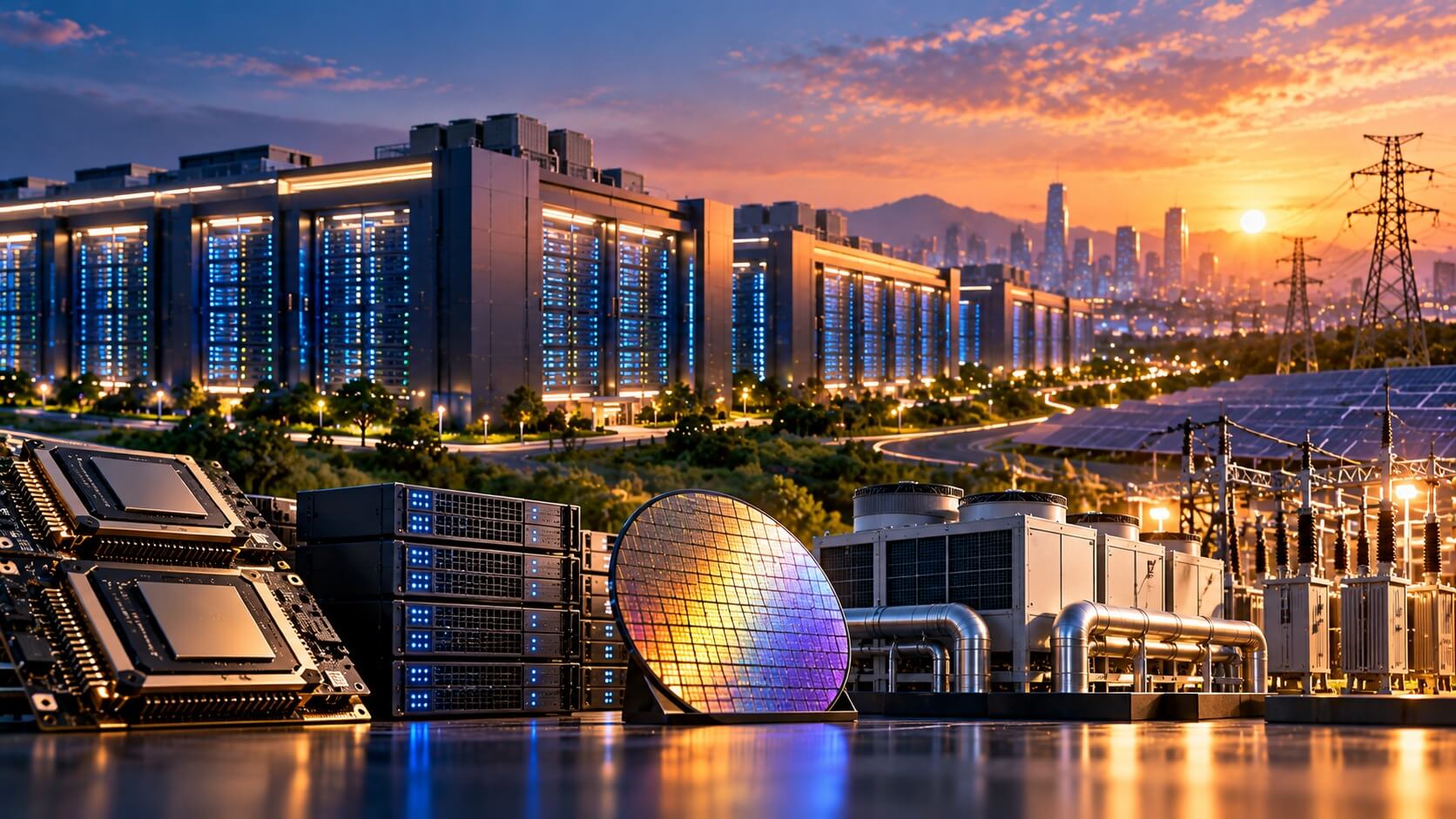
The biggest AI infrastructure companies include NVIDIA, Microsoft, Amazon, Alphabet, Broadcom, TSMC, AMD, Oracle, Vertiv, and Eaton. These businesses provide the processors, cloud computing capacity, networking, electrical equipment, and cooling systems needed to develop and operate artificial intelligence.
There is no single ranking that identifies the biggest company across every part of AI infrastructure. NVIDIA is a leading supplier of AI computing hardware, Microsoft and Amazon operate major cloud platforms, TSMC manufactures advanced chips, and Vertiv supplies essential data center equipment.
Company size, AI-related revenue, manufacturing capacity, and infrastructure spending measure different things. Understanding each company's role provides a clearer picture of the industry than comparing market capitalization alone.
Who Are the Biggest Players in AI Infrastructure?
AI infrastructure consists of interconnected industries rather than one market dominated by a single group of companies.
The following businesses are major participants across the supply chain.
| Company | Ticker | Main Role in AI Infrastructure |
|---|---|---|
| NVIDIA | NVDA | AI processors, computing systems, networking |
| Microsoft | MSFT | Azure cloud and AI data centers |
| Amazon | AMZN | AWS cloud infrastructure and custom AI chips |
| Alphabet | GOOGL | Google Cloud, AI computing, custom processors |
| Broadcom | AVGO | Custom AI chips and networking |
| TSMC | TSM | Advanced semiconductor manufacturing |
| AMD | AMD | AI accelerators and server processors |
| Oracle | ORCL | Cloud infrastructure and AI computing capacity |
| Vertiv | VRT | Data center cooling and power equipment |
| Eaton | ETN | Electrical distribution and power management |
This is not a ranking by market capitalization or AI-specific revenue.
Some companies operate enormous diversified technology businesses. Others are smaller but supply equipment essential to the AI infrastructure industry.
The distinction matters because total company revenue does not reveal how much a business actually earns from AI.
NVIDIA: The Company Supplying AI Computing Power
NVIDIA is a leading supplier of the computing technology used to train and run advanced AI models.
Its graphics processing units (GPUs) can perform many calculations simultaneously, making them useful for demanding AI workloads.
NVIDIA also supplies networking equipment, integrated computing systems, and software that helps developers use its hardware.
How Big Is NVIDIA's Business?
NVIDIA reported approximately $130.5 billion in revenue for fiscal 2025, an increase of 114% from the previous fiscal year.
Data center products accounted for most of that revenue, reflecting strong demand for advanced computing and networking technology.
These figures illustrate the scale of NVIDIA's business during that reporting period, but data center revenue is not identical to AI-specific revenue.
Historical growth also does not guarantee similar future results.
Why Does NVIDIA Matter?
Cloud providers, AI developers, and enterprises need powerful processors to train models and operate AI applications.
NVIDIA supplies hardware and software used for these workloads. Its established software ecosystem also makes it easier for customers to continue developing applications around its technology.
However, competitors and major cloud companies are developing alternative processors.
NVIDIA's future position depends on performance, pricing, software compatibility, and its ability to remain competitive as AI computing requirements evolve.
Microsoft: One of the Largest AI Cloud Infrastructure Operators
Microsoft operates Azure, a major cloud platform that provides computing, storage, networking, databases, and AI-related services.
Instead of purchasing and maintaining their own servers, businesses can rent computing resources from Azure.
Microsoft operates and expands the infrastructure supporting those services.
How Large Is Microsoft's Cloud Business?
Microsoft reported $168.9 billion in Microsoft Cloud revenue for fiscal 2025, an increase of 23% from the previous fiscal year.
Azure and other cloud services revenue grew 34% during the same fiscal year.
Microsoft Cloud is a broad financial measure that includes several commercial cloud products. It should not be confused with revenue generated exclusively by Azure infrastructure or AI services.
Nevertheless, these figures illustrate the scale of Microsoft's cloud operations.
Why Does Microsoft Matter?
Microsoft plays two important roles in AI infrastructure.
It purchases and operates large amounts of computing equipment while also selling access to computing capacity through Azure.
This makes Microsoft both a customer of infrastructure suppliers and a provider of AI computing services.
The main financial challenge is generating sufficient customer revenue to justify expensive infrastructure investments.
If capacity expands faster than demand, depreciation expenses and capital spending can pressure investment returns.
Amazon: AWS and the Infrastructure Behind Enterprise AI
Amazon participates in AI infrastructure primarily through Amazon Web Services (AWS).
AWS provides computing, storage, networking, databases, and specialized infrastructure to businesses, developers, and government organizations.
Customers can use these services to train AI models and run applications without building their own computing facilities.
What Makes Amazon Different?
Amazon develops custom processors, including Trainium chips designed for AI workloads.
These processors give AWS additional control over computing performance, costs, and the services offered to customers.
Amazon therefore operates cloud infrastructure while also developing some of the technology used inside it.
This differs from semiconductor companies that primarily sell processors to external customers.
Why Does Amazon Matter?
AWS has an established customer base and a broad range of computing services.
As businesses adopt AI, some may increase their use of cloud infrastructure rather than investing in private data centers.
However, providing that capacity requires substantial investment.
AWS profitability depends on customer demand, infrastructure utilization, pricing, and operating costs.
Amazon's retail, advertising, and other operations also influence the company's overall financial performance.
Alphabet: Google Cloud and Specialized AI Processors
Alphabet, Google's parent company, operates Google Cloud and develops specialized AI computing technology.
Google Cloud provides computing services to businesses and developers, while Google's own products require substantial computing resources.
Alphabet also develops Tensor Processing Units (TPUs), processors designed for machine learning workloads.
Why Are Google's Custom Chips Important?
Custom processors allow cloud operators to optimize computing systems for particular workloads.
They can improve efficiency, offer alternative pricing options, and reduce dependence on external chip suppliers for some applications.
However, custom processors do not replace every other type of computing hardware.
Different AI applications have different performance, cost, and software requirements.
How Does Alphabet Make Money From AI Infrastructure?
Alphabet generates revenue when customers purchase Google Cloud services.
Its internal infrastructure also supports products such as Search, YouTube, and other digital services.
This makes Alphabet both an infrastructure provider and a major user of AI computing.
Investors should distinguish Google Cloud's performance from Alphabet's larger advertising operations.
Broadcom: Custom AI Chips and Data Center Networking
Broadcom supplies semiconductor technology used in networking and specialized computing systems.
Two areas are particularly relevant to AI infrastructure: custom accelerators and networking equipment.
Custom accelerators are processors designed around the requirements of specific customers. Networking equipment connects processors and servers so they can exchange information efficiently.
Why Does Networking Matter for AI?
Large AI computing systems may use thousands of processors working together.
Those processors must exchange data quickly. Slow communication can prevent expensive computing equipment from operating efficiently.
Broadcom supplies networking technology used in large data centers, along with custom semiconductor solutions for major customers.
What Makes Broadcom Important?
Broadcom benefits from demand for both specialized AI processors and the networks connecting computing systems.
Its opportunities depend on custom chip development, customer infrastructure spending, and demand for faster data center networking.
However, Broadcom also operates substantial businesses outside AI infrastructure.
Investors should distinguish AI-related semiconductor growth from the company's overall financial performance.
TSMC: The Manufacturer Behind Advanced AI Chips
Taiwan Semiconductor Manufacturing Company (TSMC) manufactures chips designed by other semiconductor businesses.
Unlike NVIDIA and Broadcom, which design processors and related products, TSMC specializes in manufacturing technology and production capacity.
That makes it a critical supplier to the global semiconductor industry.
How Big Is TSMC?
TSMC reported approximately $90.1 billion in revenue for 2024, up 30% in U.S. dollar terms from the previous year.
Advanced manufacturing technologies accounted for 69% of its wafer revenue in 2024.
These figures illustrate TSMC's manufacturing scale, although its products serve smartphones, automobiles, high-performance computing, and other markets.
Why Is TSMC Important for AI?
Advanced AI processors require sophisticated semiconductor manufacturing processes.
TSMC provides production capabilities used by major chip designers.
It also develops advanced packaging technology, which helps combine and connect components inside high-performance computing systems.
As a result, TSMC can benefit from demand across multiple semiconductor designers rather than relying on a single branded AI processor.
What Are the Risks?
Advanced semiconductor manufacturing requires substantial investment in factories, equipment, and technology.
TSMC also faces manufacturing complexity, semiconductor industry cycles, trade restrictions, and geopolitical risks involving Taiwan.
Its importance to AI infrastructure does not eliminate these challenges.
AMD: An Alternative Supplier of AI Computing Hardware
Advanced Micro Devices (AMD) designs processors used in personal computers, servers, and high-performance computing.
Its AI infrastructure products include Instinct accelerators and EPYC server processors.
Why Does AMD Matter?
Large computing customers often want alternatives when purchasing expensive processors.
Competition can influence pricing, product development, and the availability of different computing platforms.
AMD provides another source of processors for data centers and AI workloads.
Its growth opportunities depend on winning customers, improving software compatibility, and delivering competitive performance.
However, established competitors have significant advantages, and successful product development does not automatically guarantee substantial market share or profits.
AMD represents exposure to competition in AI computing rather than a guarantee that customers will move away from existing suppliers.
Oracle: Cloud Infrastructure for AI Workloads
Oracle operates Oracle Cloud Infrastructure (OCI), alongside its established database and enterprise software businesses.
OCI provides computing, storage, networking, and other services, including infrastructure designed for demanding AI workloads.
Why Is Oracle Relevant?
AI developers and enterprise customers require large amounts of computing capacity.
Oracle participates in supplying that capacity through its cloud infrastructure operations.
Its business differs from the largest cloud providers because enterprise databases and software remain important sources of revenue.
What Should Investors Understand?
Expanding cloud infrastructure can create revenue opportunities, but it requires substantial capital spending.
Investors should distinguish announced contracts and future customer commitments from revenue already recognized.
They should also examine deployment schedules, capacity utilization, financing requirements, and whether new infrastructure generates sufficient cash flow.
Large customer commitments do not eliminate execution or financial risk.
Vertiv: The Company Helping AI Data Centers Stay Cool
AI computing requires more than advanced processors.
Powerful servers generate substantial heat and need reliable electricity.
Vertiv supplies power management systems, cooling technology, and related services that help data centers operate.
How Big Is Vertiv?
Vertiv reported approximately $8.0 billion in revenue for 2024, compared with about $6.9 billion in 2023.
That represents growth of approximately 16%.
These figures illustrate the scale of Vertiv's infrastructure business, although its revenue is not exclusively related to AI.
Why Does Vertiv Matter?
As computing systems become more powerful, cooling and electrical infrastructure become increasingly important.
Vertiv can benefit from new data center construction and upgrades to existing facilities.
Unlike a semiconductor manufacturer, it does not depend on selling a particular AI processor.
However, its results remain sensitive to infrastructure spending, project execution, competition, and customer demand.
Eaton: Electrical Equipment for Expanding Data Centers
Eaton is a diversified power management company supplying electrical equipment to commercial, industrial, and data center customers.
AI infrastructure creates demand for reliable electrical systems because powerful computing equipment requires substantial electricity.
What Does Eaton Supply?
Eaton provides electrical distribution equipment, circuit protection systems, and power management solutions.
These products help data centers receive and distribute electricity safely and reliably.
Why Does Eaton Matter?
Building more computing capacity requires sufficient electrical infrastructure.
That creates opportunities for businesses supplying power distribution and management equipment.
Eaton also serves markets outside AI infrastructure, reducing its dependence on one particular industry.
However, broader industrial demand, construction activity, and economic conditions still influence its performance.
Which Other Companies Are Important to AI Infrastructure?
Several additional businesses provide important technology and facilities supporting AI computing.
ASML (ASML) supplies advanced lithography equipment used by semiconductor manufacturers to produce sophisticated chips.
Micron Technology (MU) manufactures memory products, including high-bandwidth memory used alongside advanced AI processors.
Arista Networks (ANET) provides networking equipment and software for large data centers.
Digital Realty (DLR) owns and operates data center properties.
Equinix (EQIX) provides data center facilities and connectivity services.
These companies demonstrate how AI infrastructure extends across semiconductor equipment, memory, networking, and physical facilities.
How Do These Companies Work Together?
Consider a hypothetical cloud provider building a new AI data center.
The project requires processors, networking equipment, manufacturing technology, electrical systems, cooling, and physical facilities.
| Infrastructure Requirement | Example Companies | What They Provide |
|---|---|---|
| AI computing processors | NVIDIA, AMD | Chips and computing systems |
| Custom chips and networking | Broadcom | Specialized processors and connectivity |
| Semiconductor manufacturing | TSMC | Manufacturing for chip designers |
| Cloud services | Microsoft, Amazon, Alphabet, Oracle | Computing capacity sold to customers |
| Cooling and power equipment | Vertiv | Critical data center infrastructure |
| Electrical distribution | Eaton | Power management equipment |
| Data center facilities | Equinix, Digital Realty | Physical space and related infrastructure |
These are illustrative relationships, not a list of suppliers for a particular project.
A cloud provider may purchase processors from one company, networking equipment from another, and cooling systems from a third.
Suppliers can generate revenue from construction and equipment orders before the cloud provider earns sufficient income from the completed facility.
This explains why companies participating in the same AI infrastructure expansion can experience very different financial outcomes.
Which AI Infrastructure Companies Are the Biggest by Revenue?
Company-wide revenue provides one measure of business scale, but it is not a reliable ranking of AI infrastructure activity.
Amazon, Microsoft, and Alphabet generate substantial revenue from operations outside AI infrastructure.
NVIDIA has more direct exposure to AI computing hardware, while TSMC manufactures semiconductors for multiple industries.
Vertiv and Eaton supply equipment to data centers and other markets.
For example, comparing Amazon's total company revenue with NVIDIA's semiconductor revenue would not reveal which company generates more sales specifically from AI infrastructure.
Investors should distinguish three measures:
- Total company revenue: Sales across all business activities.
- AI-related revenue: Sales attributable to AI products and services, when companies disclose them.
- Infrastructure spending: Money invested in equipment, facilities, and computing capacity.
These measures answer different questions and should not be treated as interchangeable.
Why Are Cloud Companies Spending So Much on AI Infrastructure?
Cloud providers invest in AI infrastructure because businesses need computing capacity to train models and run applications.
Expanding that capacity requires processors, networking equipment, storage systems, data center facilities, and reliable electricity.
Microsoft, Amazon, Alphabet, and Oracle can benefit by selling computing services to customers, but they must invest before all the resulting revenue is earned.
If capacity is insufficient, they may struggle to meet customer demand.
If they build too much, expensive infrastructure may remain underused.
This balance affects the entire supply chain. Cloud spending creates orders for suppliers, but future investment depends partly on whether the infrastructure generates acceptable financial returns.
Are the Biggest AI Infrastructure Companies Also the Best Investments?
Not necessarily. A company's importance to AI infrastructure does not determine whether its stock is attractively valued.
NVIDIA may hold a strong position in AI computing, but its investment performance depends on earnings growth, competition, and valuation.
Microsoft may benefit from growing cloud demand while facing substantial infrastructure costs.
Vertiv may experience strong equipment demand, but its share price can still decline if future results disappoint investors.
Three questions help evaluate these businesses:
How much does the company benefit from AI infrastructure?
Look for evidence in reported revenue, customer demand, orders, and financial disclosures.
Can it convert that demand into sustainable profits?
Revenue growth matters more when it produces earnings and cash flow.
How much are investors already paying for expected growth?
Even an excellent business can be a disappointing investment when its valuation assumes unrealistic results.
For a detailed framework, read How to Compare AI Infrastructure Companies.
How Can Retail Investors Get Exposure to These Companies?
Investors can buy individual AI infrastructure stocks or use funds that hold multiple businesses.
Individual shares provide direct exposure to selected companies, while exchange-traded funds (ETFs) can spread an investment across semiconductor manufacturers, technology companies, or digital infrastructure providers.
However, fund holdings matter.
An ETF marketed around artificial intelligence may focus on software applications or automation rather than the computing infrastructure behind AI.
Owning several funds can also create overlapping exposure to the same major technology companies.
For a practical explanation of the available approaches, see How to Invest in AI Infrastructure: Stocks, ETFs, and Funds.
What Could Change the AI Infrastructure Industry?
Several developments could reshape competition and demand.
More Efficient AI Computing
New processors, improved software, and more efficient AI models could reduce the computing resources needed for individual tasks.
Lower computing costs may encourage broader adoption, but they can also change demand for particular hardware products.
More Custom Chips
Major cloud providers are developing processors optimized for their own computing requirements.
This creates opportunities for semiconductor designers and manufacturers while increasing competition for established suppliers.
Electricity and Construction Constraints
Power availability, grid connections, cooling requirements, and construction delays can limit how quickly data centers become operational.
These constraints may create demand for certain equipment suppliers while delaying projects elsewhere in the industry.
Changes in Cloud Spending
If major cloud operators reduce capital expenditures, semiconductor and equipment suppliers could experience weaker orders.
Stronger-than-expected customer demand could support additional infrastructure investment.
Geopolitical and Supply Chain Risks
Advanced semiconductor manufacturing is concentrated in a limited number of locations.
Trade restrictions, geopolitical tensions, and manufacturing disruptions can affect companies throughout the AI supply chain.
What Should Investors Watch Next?
The most useful financial indicators depend on each company's role in AI infrastructure.
- NVIDIA, AMD, and Broadcom: Data center revenue, customer demand, product adoption, and competition.
- TSMC: Advanced manufacturing demand, production capacity, and capital expenditures.
- Microsoft, Amazon, Alphabet, and Oracle: Cloud revenue growth, infrastructure utilization, and returns on capital spending.
- Vertiv and Eaton: Data center orders, revenue growth, operating margins, and project execution.
Across the industry, investors should distinguish infrastructure spending from supplier revenue and shareholder returns.
Infrastructure spending measures how much companies invest in computing capacity and supporting systems.
Supplier revenue measures the sales generated by companies providing equipment and services.
Shareholder returns depend on business performance, cash generation, and the valuation of each company's stock.
These measures are connected, but they are not the same.
What Are the Most Important AI Infrastructure Companies to Understand?
For retail investors researching the industry, several companies illustrate its main components.
NVIDIA and AMD supply advanced computing processors.
Microsoft, Amazon, Alphabet, and Oracle operate cloud infrastructure that customers use for AI applications.
Broadcom provides custom processors and networking technology, while TSMC manufactures advanced chips designed by semiconductor companies.
Vertiv and Eaton supply essential power, cooling, and electrical infrastructure.
Together, these businesses demonstrate that AI infrastructure extends far beyond the companies developing AI applications.
It includes the manufacturers, cloud operators, and equipment suppliers required to turn artificial intelligence into a functioning commercial technology.
The biggest company is not automatically the best investment. Understanding each business's role, financial exposure, competitive position, and risks provides a stronger foundation for evaluating AI infrastructure than simply following the most recognizable technology names.
Disclaimer: This article is for informational and educational purposes only and does not constitute financial advice or a recommendation to buy or sell securities. All investments involve risk, including possible loss of principal.