
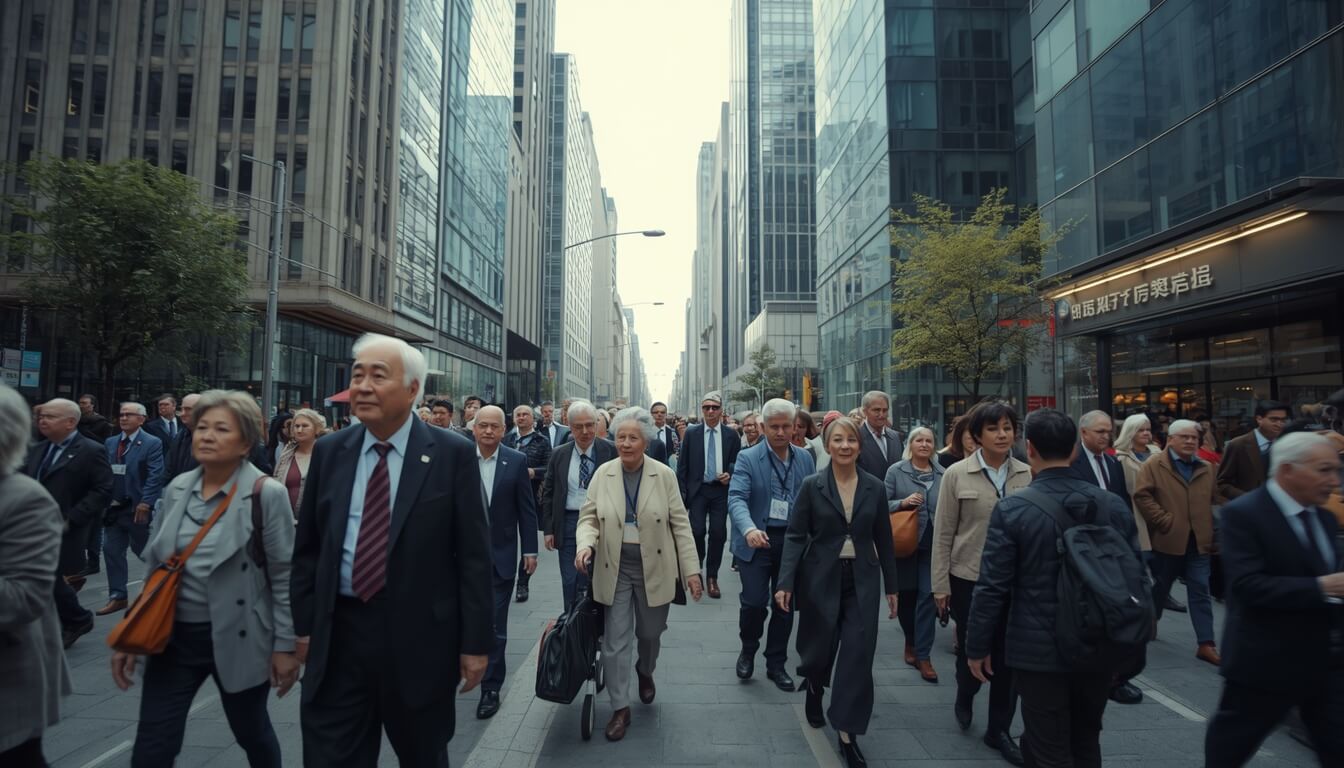
Population aging is becoming one of the most important demographic transformations shaping the global economy. Across many countries, people are living longer while birth rates have fallen, gradually changing the age structure of national populations. The result is a larger share of older people relative to the working-age population, with consequences that extend well beyond demographics.
The aging process is particularly advanced in countries such as Japan, Italy, Germany and South Korea, but it is increasingly visible across much of Europe, North America and parts of Asia. At the same time, several emerging economies are moving through the same transition at a faster pace than earlier generations of countries did. This makes population aging a global economic phenomenon rather than an issue confined to wealthy nations.
The effects are likely to influence consumption, savings, investment, employment, public finances, healthcare and the structure of entire industries. Understanding the demographic shift is therefore an important starting point for examining how economies may evolve over the coming decades.
A Major Change in the World's Age Structure
Population aging occurs when the proportion of older people increases relative to younger and working-age groups. Two forces are particularly important:
- Longer life expectancy — a consequence of improvements in healthcare, nutrition, sanitation and living standards.
- Declining fertility — when families have fewer children, younger generations become smaller relative to older generations.
Over several decades, the combination gradually changes the structure of the entire population. Countries that once had relatively young populations can experience a substantial shift toward older age groups within a few decades.
This transformation matters because modern economies are organized around relationships between generations: workers generate income and tax revenue, households save and consume, companies invest and employ people, while governments provide pensions, healthcare and other public services.
As the balance between age groups changes, these relationships also begin to change.
From Demographic Change to Economic Change
An aging population does not automatically mean economic decline. Older societies can remain productive, wealthy and technologically advanced. However, the composition of economic activity can change significantly.
One of the clearest effects is on consumption. Younger households tend to spend heavily on housing, education, transportation and household formation. Older households often have different spending priorities, with greater demand for healthcare, financial services, leisure, assisted living and products designed around accessibility.
This can gradually alter the industries that receive capital and generate employment. The shift can already be observed in the growing importance of what is sometimes called the “silver economy” — the collection of goods and services aimed at older consumers. Healthcare is an obvious example, but the concept extends to pharmaceuticals, medical technology, insurance, tourism, home adaptation, mobility services, financial planning and technologies that support independent living.
The savings and investment landscape can also change. During working years, households typically accumulate financial assets for retirement. After retirement, they may gradually draw down those assets. If the share of retirees becomes significantly larger, aggregate saving patterns can change.
The relationship between demographics, savings and investment is complex, however. Productivity growth, pension structures, immigration, household behavior and government policy can all influence the outcome.
The Importance of the Working-Age Population
One of the central economic questions surrounding demographic aging concerns the size and composition of the workforce.
If fewer young people enter employment while larger cohorts retire, businesses may face tighter labor markets. This can increase the importance of automation, artificial intelligence, robotics and other technologies capable of raising output per worker.
At the same time, older workers may remain economically active for longer. Improvements in health and changes in retirement patterns can allow people to remain employed beyond traditional retirement ages. This creates an important distinction between chronological aging and economic participation. A society can become older without experiencing an equivalent reduction in its effective workforce if participation rates increase or retirement ages change.
The interaction between demographic change, employment and productivity is explored in greater detail in How Aging Societies Could Reshape Labor Markets and Productivity.
Immigration can also influence demographic outcomes. Countries receiving working-age migrants may partially offset declining domestic birth rates and expand their labor forces. The scale of this effect depends on immigration levels, age composition, participation rates and the ability of economies to integrate new workers.
Housing, Urbanization and Household Structure
Population aging can also affect the physical structure of economies.
Older populations may change housing demand, particularly where households become smaller. A society with fewer children and more single-person households can require a different mix of apartments, assisted-living facilities and accessible homes.
Urban planning may evolve as well. Older residents can place greater value on proximity to healthcare, public transportation, shops and essential services. Cities may therefore face increasing pressure to adapt infrastructure to changing mobility patterns.
The transformation can extend to rural areas. Some regions with declining and aging populations may experience a shrinking local workforce and reduced demand for schools and other services designed around younger populations. This can reinforce regional economic disparities if younger workers and families continue to concentrate in larger cities.
Population aging is therefore not only a national economic issue. It can produce significant differences between regions within the same country.
Technology and the Economics of Longer Lives
Technology may become one of the most important mechanisms through which societies respond to demographic aging.
Automation can potentially compensate for a smaller workforce by increasing output per employee. Robotics may become more important in manufacturing, logistics, healthcare and domestic assistance. Artificial intelligence could help organizations automate administrative tasks and support workers in sectors facing labor shortages.
Healthcare technology may also play a role in extending healthy life expectancy rather than simply increasing total years of life. Digital monitoring, diagnostic technologies, medical devices and new treatments could allow older people to remain independent for longer. These developments could create new industries while transforming established ones.
The economic significance of this transformation is closely connected to public expenditure. Longer lives can mean longer periods of pension payments and greater demand for healthcare and long-term care. The resulting fiscal challenges are examined in Healthcare, Pensions and the Rising Economic Cost of Aging.
A Global Trend With Different Regional Paths
Population aging is not occurring at the same speed everywhere.
Japan has become one of the world's most prominent examples of an aging society, while many European countries are also experiencing substantial demographic shifts. South Korea has experienced particularly rapid declines in fertility, creating the possibility of significant changes in its population structure.
China is also entering a period in which demographic aging is becoming increasingly important. Because of its population size, changes in China's age structure can have implications for labor supply, consumption and economic growth well beyond its borders.
Other countries remain relatively young. Many economies in Africa and parts of South Asia still have large younger populations and therefore face different demographic opportunities and challenges.
This divergence means that the global economy could increasingly contain two contrasting demographic environments: aging economies dealing with labor shortages and rising age-related expenditure, and younger economies with expanding working-age populations.
That difference could influence migration, investment flows, manufacturing locations and the geography of economic growth.
Why Population Aging Matters for the Long-Term Economy
The global aging process is fundamentally a structural change rather than a short-term economic cycle. Demographic trends tend to develop slowly, but once established they can influence economic conditions for decades.
The implications extend across nearly every major component of an economy: the supply of labor, consumer demand, household savings, investment, housing, healthcare, government spending and taxation.
Yet the final economic outcome is not predetermined. Productivity growth can offset part of the impact of a shrinking workforce. Higher labor-force participation can increase the number of economically active people. Immigration can alter population structures, while technological progress can change the amount of output generated by each worker.
At the same time, governments and companies will need to adapt to a population in which older consumers represent an increasingly important share of total demand.
Population aging should therefore be viewed not simply as a challenge associated with retirement, but as a broad transformation of the economic system. The next question is how businesses and labor markets respond when the demographic structure changes. That issue becomes particularly important as countries attempt to maintain productivity and economic output with slower growth in the working-age population.