
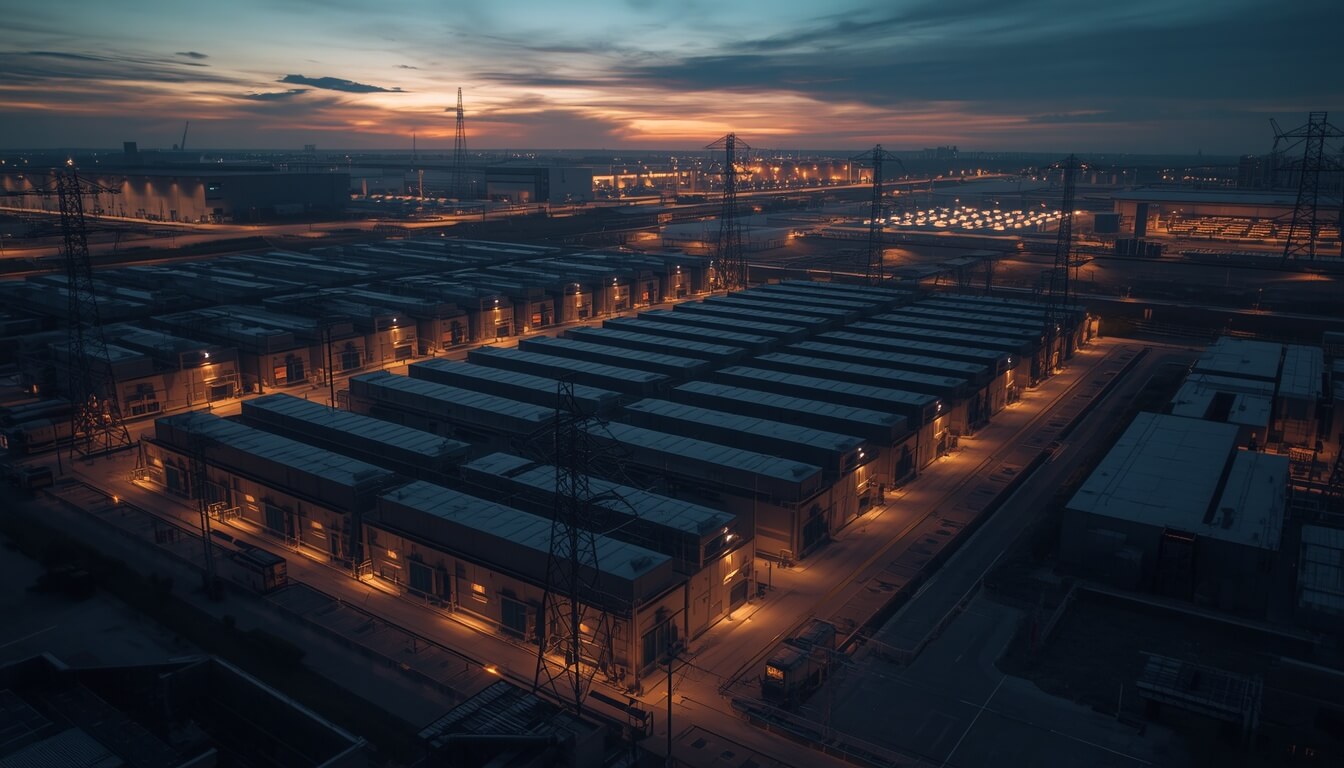
Artificial intelligence is often described as a software revolution. Yet behind every AI model, automated workflow and digital assistant sits a substantial physical infrastructure system.
Advanced artificial intelligence requires computing power, data centers, semiconductors, networking equipment, storage capacity and electricity. As AI adoption expands across businesses and industries, demand for these physical resources is becoming an increasingly important part of the global technology economy.
This creates a fundamental connection between the digital and physical worlds. AI applications may be delivered through software, but their expansion depends on factories, power plants, fiber networks, cooling systems and specialized computing facilities.
The resulting investment cycle could extend well beyond the companies developing AI models. Semiconductor manufacturers, data-center operators, utilities, construction companies, network providers and equipment suppliers can all become part of the infrastructure ecosystem supporting the AI economy.
Understanding this infrastructure is therefore essential to understanding how artificial intelligence could scale globally. The broader economic transformation driving this demand is examined in Artificial Intelligence and the Transformation of the Global Economy, which explores how AI is becoming increasingly integrated into economic activity across industries.
AI Requires a Physical Foundation
Software can be replicated at extremely low marginal cost, but the computing required to develop and operate sophisticated AI systems cannot.
Training large models requires substantial computational resources. Once models are deployed, millions of users and business applications can generate additional workloads. Inference — the process of using trained models to generate outputs — can therefore become an important source of ongoing computing demand.
This creates several infrastructure requirements. Data centers need servers equipped with advanced processors and accelerators. Those machines require high-speed networking and storage systems. They generate heat and therefore require increasingly sophisticated cooling technologies. Most importantly, they need reliable electricity.
As AI workloads become larger and more widely distributed, infrastructure capacity can become a constraint on adoption. This is one reason the economics of AI cannot be understood solely through software development. The availability and cost of physical resources may influence how quickly companies can deploy AI at scale.
The Data Center Expansion
Data centers form one of the most visible components of the AI infrastructure boom.
Traditional cloud computing already created substantial demand for large-scale data centers. AI introduces additional requirements because high-performance computing systems can consume significantly more power and generate more heat than many conventional workloads.
AI-oriented facilities may therefore require specialized designs:
- High-density computing equipment can increase power requirements within individual buildings.
- Cooling systems must remove large amounts of heat.
- Electrical infrastructure must be designed to provide stable and reliable power to dense computing clusters.
The result is increasing interest in new data-center capacity across major technology markets. Construction itself can become a significant economic activity. New facilities require land, engineering, electrical equipment, cooling systems, network connections and specialized construction services. The expansion of AI therefore creates a chain of demand that extends far beyond the servers themselves.
Semiconductors at the Center of AI Infrastructure
Computing hardware is another critical layer.
Advanced AI workloads depend heavily on specialized processors capable of performing large numbers of calculations efficiently. Graphics processing units and other accelerators have become particularly important for training and running modern machine-learning systems. The semiconductor industry consequently occupies a central position in the AI infrastructure chain.
However, semiconductor production is itself highly complex. Designing advanced processors requires substantial research and engineering capabilities. Manufacturing them depends on sophisticated fabrication facilities, specialized equipment and carefully controlled production environments. The supply chain also extends across multiple countries and regions.
This creates both economic opportunities and strategic dependencies. Expanding AI demand can encourage investment in semiconductor manufacturing capacity, while constraints in chip production can influence the pace at which computing infrastructure grows.
The AI economy therefore depends partly on the ability of the semiconductor industry to expand production and technological capability.
Networking Becomes More Important
Large-scale AI systems also require high-speed communication between computing resources.
Training sophisticated models can involve large numbers of processors operating together. Moving data efficiently between these systems requires advanced networking equipment and high-bandwidth connections. Inside data centers, this can involve specialized switches, optical technologies, cables and other components.
Between data centers and users, telecommunications networks provide another essential layer. As AI applications become more interactive and computationally intensive, network performance can become increasingly important. Latency, bandwidth and reliability can influence how applications are designed and where computing workloads are located.
This creates another infrastructure market connected to AI expansion. The AI economy is therefore not simply a collection of powerful computers. It is a network of computing resources connected by increasingly sophisticated communications infrastructure.
Electricity as a Strategic Input
Among all infrastructure requirements, electricity may become one of the most important.
Every AI workload ultimately requires energy. Data centers need electricity to operate servers, networking equipment and cooling systems. As computing capacity expands, electricity demand can rise accordingly. This creates a connection between AI investment and the energy sector.
Regions with available power capacity, reliable electricity grids and suitable infrastructure may have advantages when attracting new data centers. Areas with limited grid capacity may face delays even when there is strong demand for additional computing facilities.
This can increase the importance of transmission infrastructure, substations, generation capacity and grid management. AI could therefore become an additional driver of investment in electricity infrastructure, particularly in regions experiencing rapid data-center development.
The Role of Cooling Technology
Computing infrastructure does not only consume electricity; it also produces heat.
Traditional data centers have relied heavily on air-based cooling, but increasingly dense computing environments can require more advanced approaches. Liquid cooling is one example. By transferring heat more efficiently, liquid-based systems can support high-density computing environments where conventional cooling methods may become less effective.
This creates another infrastructure market connected to AI. Cooling requirements influence data-center architecture, energy consumption, water use and operating costs. As computing density increases, cooling can become an increasingly important factor in determining where and how AI infrastructure is built.
From Technology Investment to Construction Investment
The AI infrastructure cycle is therefore broader than a typical software investment cycle.
A new AI application can be developed primarily through software engineering. A new AI data center requires physical construction, electrical connections, cooling equipment, networking systems and computing hardware.
This difference has important economic consequences. Infrastructure projects can take years to plan, permit and complete. Power connections may require upgrades to local grids. Semiconductor factories require long development timelines and significant capital investment. As a result, demand for AI infrastructure can emerge faster than new capacity can be built.
This creates a potential bottleneck between technological demand and physical supply.
AI and the Transformation of Capital Expenditure
The expansion of AI is also influencing the composition of technology investment.
Historically, companies could expand digital services through relatively modest investments in software and conventional computing infrastructure. Advanced AI systems can require much larger investments in hardware and facilities. Large technology companies are consequently investing heavily in computing capacity, while specialized infrastructure providers are expanding their own facilities.
The broader capital cycle can involve data centers, semiconductor manufacturing, power infrastructure and telecommunications. These investments can have economic effects well beyond the technology industry:
- Construction activity creates demand for engineering and building services.
- Electrical infrastructure requires equipment and specialized labor.
- Semiconductor manufacturing creates demand for advanced industrial systems.
AI infrastructure can therefore function as a multiplier across several parts of the physical economy, although the scale and duration of these effects remain uncertain.
The Geographic Dimension of AI Infrastructure
Infrastructure also influences where the AI economy develops.
Data centers require suitable locations with access to electricity, telecommunications networks and land. Some regions may have abundant energy resources, while others may have strong fiber connectivity or established technology ecosystems. These factors can influence the geographic distribution of computing capacity.
Governments may also seek to attract data-center investment and semiconductor manufacturing because of the potential economic activity associated with these projects. At the same time, infrastructure concentration can create dependencies. If large portions of computing capacity or semiconductor production are concentrated in a small number of regions, disruptions can affect businesses and consumers far beyond those locations.
The geography of AI infrastructure is therefore becoming an increasingly relevant part of global economic planning.
The Connection Between Productivity and Infrastructure
Infrastructure investment matters because computing capacity is ultimately a means of enabling AI applications.
As discussed in Why AI Could Reshape Productivity Across Entire Industries, the economic impact of AI depends partly on whether businesses can integrate the technology into productive workflows. Infrastructure determines whether that integration can occur at scale.
If computing capacity is expensive or difficult to access, companies may limit AI deployment. If infrastructure becomes more abundant and efficient, a larger number of businesses may be able to incorporate AI into their operations. This creates a relationship between infrastructure investment and productivity: more infrastructure can enable more AI adoption, while greater AI adoption can create demand for still more infrastructure.
The Broader AI Investment Ecosystem
The infrastructure supporting artificial intelligence can be divided into several interconnected layers:
| Layer | Key Components |
|---|---|
| Hardware | Semiconductors, processors, memory and networking components. |
| Facility | Data centers, cooling systems, electrical equipment and physical security. |
| Connectivity | Fiber networks, telecommunications systems and high-bandwidth links. |
| Energy | Power generation, transmission networks, substations and grid-management systems. |
| Platform | Cloud platforms, AI models and applications used by businesses and consumers. |
Each layer depends on the others. A shortage of advanced processors can limit data-center expansion. Insufficient electricity capacity can delay new facilities. Limited networking capacity can constrain distributed computing. Lack of computing resources can restrict AI application deployment.
The AI economy therefore functions as an interconnected infrastructure system rather than a single technology market.
Bottlenecks and Investment Challenges
The infrastructure boom also creates challenges.
Large projects require significant capital. Construction can encounter permitting restrictions, land constraints or shortages of specialized equipment. Electricity connections can take time to develop. Semiconductor capacity cannot be expanded instantly.
There are also questions about the long-term utilization of infrastructure. AI technology is developing rapidly, and hardware architectures can change. Investments made today must remain economically useful as computing requirements evolve. This creates uncertainty for companies deciding how much capacity to build and where to build it. The infrastructure cycle could therefore involve both periods of rapid expansion and periods of adjustment.
A New Layer of Economic Infrastructure
Artificial intelligence is increasingly being treated as a digital capability, but its expansion depends on a much broader industrial system.
The global AI economy requires semiconductors to provide computing power, data centers to house that computing capacity, networks to connect systems, cooling infrastructure to manage heat and electricity infrastructure to keep everything operating. This makes AI infrastructure an important economic trend in its own right.
The significance extends beyond technology companies. Infrastructure investment can affect energy markets, construction, industrial manufacturing, telecommunications and regional development. Ultimately, the scale of the AI transformation will depend not only on how capable AI models become, but also on whether the physical infrastructure supporting them can expand efficiently.
Artificial intelligence may represent a new layer of economic infrastructure, but building that layer requires a very old economic activity: investment in physical capacity.
The coming years will therefore involve two transformations happening simultaneously. Businesses will be experimenting with how AI can change productivity and production, while industries across the physical economy build the computing, energy and network infrastructure required to make those applications possible.
The relationship between these two processes may determine how deeply artificial intelligence becomes embedded in the global economy.