
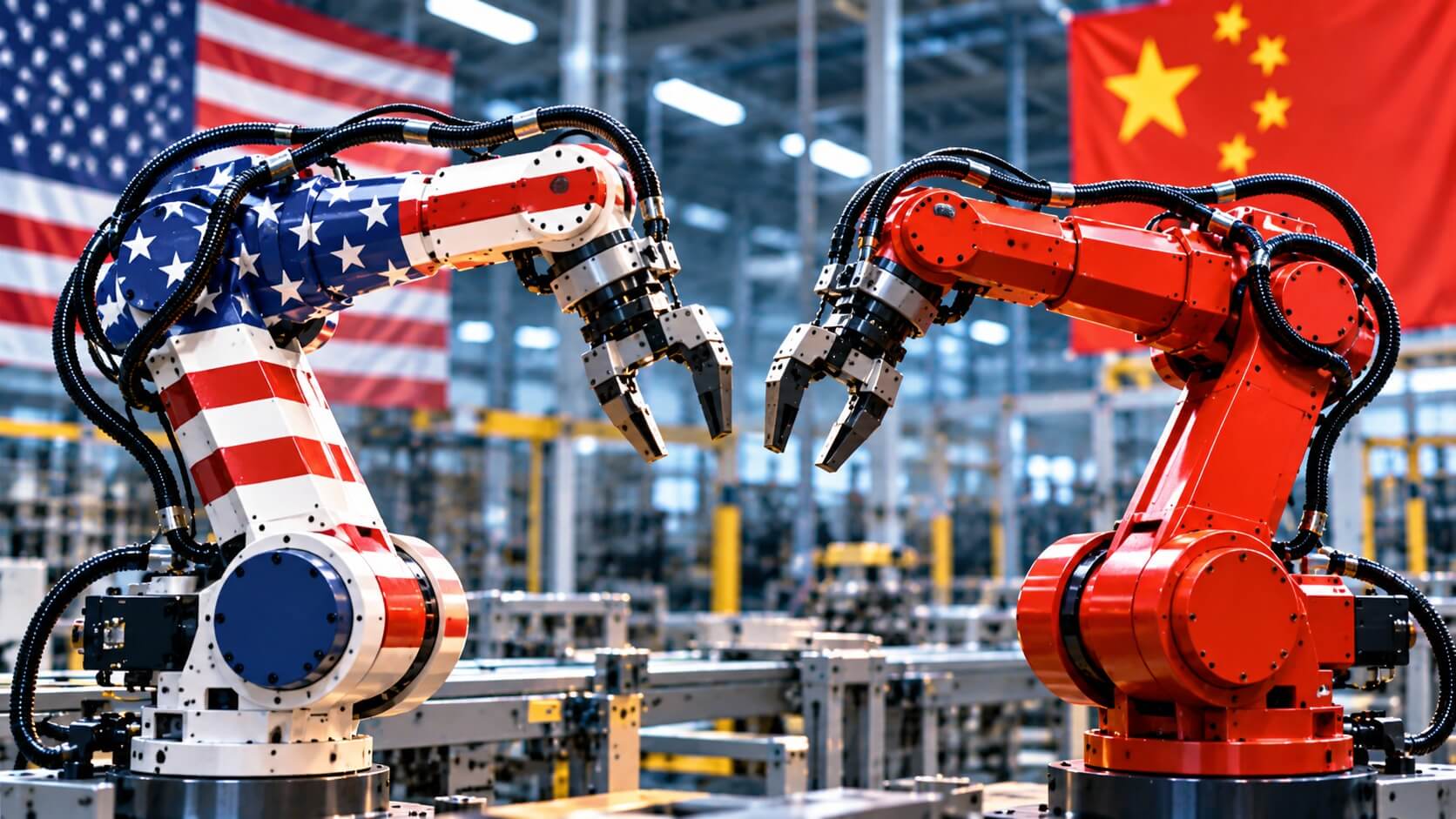
China leads the United States in industrial robot installations, total robots operating in factories, and the scale of its domestic manufacturing automation market. The United States, however, has important strengths in artificial intelligence, advanced computing, robotics software, and research.
Neither country leads every part of the robotics industry.
China has a significant advantage in deploying robots across its enormous manufacturing sector, while American technology companies are influential in developing the AI systems, computing platforms, and software that could power future generations of robots.
For investors, the distinction matters because leadership in robot manufacturing, industrial automation, humanoid robotics, and AI does not necessarily translate into the same investment opportunities.
Understanding which country is ahead requires examining several different measures rather than declaring a single winner.
Is China or the United States Ahead in Robotics?
China is ahead in the deployment of conventional industrial robots.
According to the International Federation of Robotics (IFR), China installed approximately 295,000 industrial robots in 2024, compared with approximately 34,200 in the United States.
China also had approximately 2.03 million industrial robots operating in its factories at the end of 2024.
These figures reflect China's position as the world's largest industrial robotics market.
However, robot installations measure the adoption of automation, not necessarily the technological capabilities of the companies developing the equipment.
The United States remains highly influential in AI computing, robotics software, advanced research, and technologies that can enable more capable autonomous machines.
A useful comparison therefore separates several areas of competition.
| Robotics category | China | United States |
|---|---|---|
| Annual industrial robot installations | Clear leader | Major market, substantially smaller |
| Total industrial robots in operation | Clear leader | Large installed base |
| Domestic manufacturing scale | Very large | Smaller manufacturing base |
| Industrial robot manufacturing | Expanding domestic industry | Relies partly on international suppliers |
| AI computing and robotics software | Growing capabilities | Major strengths |
| Humanoid robotics | Active development and commercialization efforts | Active development and commercialization efforts |
| Robotics research | Significant investment and research activity | Strong universities, laboratories, and technology companies |
This comparison highlights different strengths rather than a definitive ranking of overall technological superiority.
Why Does China Have So Many More Industrial Robots?
China's advantage in industrial robot installations is closely connected to the scale of its manufacturing economy.
The country manufactures enormous quantities of automobiles, electronics, machinery, appliances, and consumer products.
Many of these industries rely on repetitive manufacturing operations that can be automated.
Manufacturing Scale
China has a much larger manufacturing production ecosystem than the United States in several important categories.
A larger number of factories and production lines creates more opportunities to install industrial robots.
This means China's installation leadership partly reflects the size of its industrial economy.
It does not automatically mean that every Chinese factory is more automated than every American factory.
Industrial Policy
China has made industrial modernization and domestic robotics development important policy priorities.
Government initiatives have encouraged automation, technological development, and investment in advanced manufacturing.
These efforts can help domestic robotics companies expand production and develop new capabilities.
However, government support does not guarantee that all investments will produce attractive financial returns.
Domestic Robotics Manufacturers
Chinese robotics manufacturers have increased their presence in the domestic market.
Companies such as ESTUN Automation and SIASUN Robot & Automation compete in industrial robotics and automation equipment.
According to IFR reporting for 2024, Chinese suppliers accounted for approximately 57% of industrial robot installations in China.
This represents a significant change in a market historically served heavily by established Japanese and European manufacturers.
For investors, the expansion of domestic suppliers creates opportunities but also raises questions about competition, pricing, and profitability.
Where Does the United States Have an Advantage?
The United States has significant strengths in technologies that support robotics development.
These include artificial intelligence, semiconductor design, computing infrastructure, software, and advanced research.
Although American companies are not the dominant manufacturers of conventional industrial robotic arms, they participate in technologies that may become increasingly important to future robotics systems.
Artificial Intelligence
AI can help robots interpret visual information, recognize objects, plan movements, and respond to changing environments.
These capabilities could expand automation beyond highly repetitive tasks performed in carefully controlled settings.
American technology companies are major participants in AI development.
However, progress in AI software does not automatically translate into commercially successful physical robots.
Real-world machines must also meet demanding requirements for reliability, safety, cost, and performance.
Advanced Computing
Robots increasingly rely on computing systems to process sensor data, interpret their surroundings, and coordinate movements.
Companies developing advanced processors and AI computing platforms may benefit from robotics development.
Nvidia is an important example because its technology is used in robotics research, simulation, and AI development.
Nevertheless, robotics remains only one potential application of its broader computing business.
Robotics Research
American universities, research institutions, and technology companies contribute to robotics development.
Research areas include autonomous navigation, robotic manipulation, computer vision, machine learning, and human-robot interaction.
These capabilities may support future commercial products.
However, research leadership and commercial market leadership are different.
A successful demonstration does not necessarily establish that a robot can be manufactured economically or deployed reliably at scale.
Who Manufactures Better Industrial Robots?
There is no universal answer because industrial robots are designed for different tasks.
A robot used to weld automobile components has different requirements from one designed to assemble electronics or handle delicate products.
Industrial customers typically evaluate equipment based on:
- Precision and repeatability.
- Reliability and operating uptime.
- Payload capacity.
- Speed and production efficiency.
- Software compatibility.
- Safety requirements.
- Maintenance and technical support.
- Total cost of ownership.
The established global industrial robotics market includes manufacturers such as FANUC, Yaskawa Electric, KUKA, and ABB Robotics.
These companies have historical roots primarily in Japan and Europe rather than the United States or China.
Chinese manufacturers are increasingly competitive in several industrial automation categories.
American companies contribute important software, computing, sensing, and automation technologies.
Consequently, comparing only American and Chinese manufacturers overlooks the international structure of the robotics industry.
A factory in China may use Japanese robots containing components from multiple countries.
An American factory may operate German or Japanese robotic equipment supported by American software.
Robotics is a global supply chain, not simply a competition between two national industries.
Who Is Ahead in Humanoid Robots, China or the US?
Humanoid robotics is one of the most closely watched areas of competition between the United States and China.
Unlike conventional industrial robotic arms, humanoid robots are designed with body structures resembling aspects of the human form.
Developers hope these machines will eventually perform a wider range of physical tasks in factories, warehouses, and other environments.
Both countries have companies pursuing this opportunity.
American Humanoid Robotics Companies
Several American companies are developing humanoid robots.
Tesla is developing Optimus, a humanoid robot intended for potential applications in manufacturing and other physical work.
Figure AI is working on general-purpose humanoid robots and AI-based robotic capabilities.
Agility Robotics has developed Digit, a bipedal robot designed for applications involving material movement and logistics workflows.
These companies have different technological approaches, commercial strategies, and stages of deployment.
Importantly, not all are publicly traded.
Investors should also distinguish announcements, demonstrations, pilot programs, and commercially established operations.
Chinese Humanoid Robotics Companies
China has a growing humanoid robotics ecosystem.
Companies such as Unitree Robotics, UBTECH Robotics, and other developers are pursuing humanoid and advanced mobile robotic systems.
Chinese manufacturers may benefit from access to electronics production, component supply chains, and domestic manufacturing capabilities.
The country's industrial ecosystem could support efforts to reduce production costs and increase manufacturing scale.
However, the commercial viability of humanoid robots remains uncertain.
Producing a functioning prototype is different from deploying thousands of reliable machines that deliver measurable economic benefits.
Which Country Has the Best Humanoid Robots?
There is no universally accepted ranking that establishes one country as having the best humanoid robots.
Performance depends on the task being evaluated.
A robot that demonstrates impressive walking or balancing abilities may not be the most effective machine for repetitive industrial work.
Similarly, a robot capable of manipulating objects in a laboratory may face difficulties operating continuously in a real factory.
Meaningful comparisons should consider:
- Ability to complete useful tasks.
- Reliability over extended operating periods.
- Manipulation and movement capabilities.
- Safety around people.
- Battery life and energy efficiency.
- Manufacturing cost.
- Maintenance requirements.
- Commercial deployment at scale.
For investors, evidence of sustained, economically useful deployment is more important than visually impressive demonstrations.
Can China Manufacture Robots More Cheaply Than the United States?
China has structural advantages in several areas of manufacturing.
These include extensive supplier networks, electronics manufacturing capacity, production infrastructure, and access to domestic industrial customers.
Such advantages may help Chinese robotics manufacturers reduce production costs in certain product categories.
However, it would be inaccurate to conclude that every Chinese robot is cheaper than every American alternative.
Industrial robot pricing depends on design, components, production volume, performance, software, and customer support.
A low equipment price does not necessarily mean a low total operating cost.
Why Manufacturing Costs Matter
Robotics adoption depends partly on affordability.
If manufacturers can purchase and deploy robots at lower total costs, more automation projects may become economically attractive.
This could increase demand across manufacturing industries.
However, lower prices can have mixed effects on robotics companies.
They may encourage adoption while reducing profit margins for manufacturers facing intense competition.
For investors, shipment growth and revenue growth should therefore be evaluated alongside profitability.
Could AI Change the Balance Between the US and China?
Artificial intelligence could become an increasingly important competitive factor in robotics.
Traditional industrial robots generally operate through predefined movements and carefully programmed sequences.
AI-based systems may improve the ability of robots to recognize objects, interpret changing environments, and adapt to more complex tasks.
This could expand automation into applications that have historically been difficult to automate.
America's AI Ecosystem
The United States has major companies developing AI models, computing platforms, and software tools.
These technologies may support robotics development across different industries.
American companies could benefit by supplying the infrastructure used to train, simulate, and operate intelligent robots.
However, AI leadership does not guarantee that American manufacturers will dominate physical robot production.
China's Manufacturing Ecosystem
China has extensive manufacturing capabilities and a large domestic market for automation.
These strengths could help companies test, produce, and deploy robotic systems.
Manufacturing experience may become especially valuable if advanced robots require large-scale production of motors, sensors, batteries, and mechanical components.
Why Both Strengths Matter
Developing advanced robotics requires combining software intelligence with physical engineering.
A sophisticated AI model is not sufficient without reliable motors, sensors, mechanical systems, and safety controls.
Likewise, inexpensive hardware may offer limited value if it cannot perform useful tasks effectively.
The future robotics market may reward companies capable of integrating both areas.
It may also create opportunities for specialized suppliers rather than a single dominant manufacturer.
How Does Robotics Competition Affect Manufacturing Jobs?
Automation can change the types of work performed in factories.
Industrial robots are particularly effective at repetitive, physically demanding, and highly standardized tasks.
They can reduce the need for certain manual activities while increasing demand for technical skills related to installation, programming, maintenance, and system supervision.
However, the employment effects are complex.
Jobs That Can Be Automated
Some repetitive manufacturing tasks may require fewer workers after automation.
The impact depends on production processes, labor costs, and the extent to which robots replace or complement human work.
New Technical Requirements
Automated factories need technicians, engineers, maintenance personnel, and employees capable of operating sophisticated systems.
These roles can require different skills from traditional production work.
Manufacturing Competitiveness
Automation may help manufacturers remain competitive in countries with relatively high labor costs.
In some circumstances, it can support domestic production by improving efficiency.
However, robotics does not automatically bring manufacturing jobs back to a particular country.
Production decisions also depend on energy costs, supply chains, infrastructure, market access, and trade policy.
For investors, the important economic question is whether automation improves productivity and profitability rather than simply whether it reduces headcount.
What Are the Geopolitical Risks in Robotics?
Robotics is increasingly connected to broader technological and economic competition.
The United States and China compete in advanced manufacturing, semiconductors, artificial intelligence, and other strategic technologies.
This creates potential risks for companies operating internationally.
Export Restrictions
Restrictions affecting advanced semiconductors, computing technology, or other components can influence robotics development.
Companies may face limitations on selling certain products or accessing particular technologies.
Tariffs and Trade Policy
Tariffs can increase the cost of imported equipment and components.
They may also encourage manufacturers to reconsider supply chains or production locations.
Supply Chain Dependence
Robotics systems rely on specialized components, including motors, precision gearboxes, sensors, controllers, and semiconductors.
Disruptions to international supply chains can affect production schedules and equipment costs.
Government Support and Competition
Industrial policies can encourage domestic robotics development.
However, subsidies and increased investment may also contribute to excess manufacturing capacity or pricing pressure.
For investors, government support should not be treated as a guarantee of commercial success.
Regulatory Differences
Industrial robots must satisfy applicable safety requirements.
Autonomous and humanoid systems may face additional regulatory scrutiny as their capabilities and applications expand.
Differences between national regulations could influence commercialization costs and market access.
What Does US-China Robotics Competition Mean for Investors?
The competition between the United States and China creates several different investment themes.
Industrial Robot Manufacturers
Companies producing conventional industrial robots may benefit from factory modernization and expanding automation demand.
However, they face competition, manufacturing cycles, and pressure on equipment prices.
AI and Semiconductor Suppliers
Companies providing AI computing platforms, processors, and robotics development tools may benefit from increased investment in intelligent machines.
Their financial performance may nevertheless depend primarily on much larger markets outside robotics.
Components and Motion Control
Robots require motors, sensors, drives, controllers, and precision mechanical systems.
Suppliers of these technologies can participate in automation growth without manufacturing complete robots.
Industrial Software
Software companies can benefit from the increasing complexity of automated factories.
Potential opportunities include robot programming, simulation, machine vision, and production management.
Humanoid Robotics
Humanoid robots represent a potentially significant future market, but commercial adoption remains uncertain.
Investors should distinguish actual revenue and profitability from projections about future deployment.
Diversified Robotics Investments
Funds focused on robotics and automation may provide exposure to multiple companies.
However, their holdings can include semiconductor, software, and technology businesses with limited direct industrial robotics revenue.
Investors should examine fund composition, fees, concentration, and valuation.
For a broader discussion of investment opportunities and risks, read How to Invest in Robotics: What Retail Investors Should Consider.
Could China Overtake the US in Advanced Robotics?
China already leads the United States in industrial robot installations and operational stock.
Whether it will lead in advanced robotics more broadly depends on how the industry develops.
Future competition could be influenced by:
- Advances in AI and robotics software.
- Access to computing technology.
- Manufacturing costs and supply chains.
- Availability of specialized components.
- Research and engineering capabilities.
- Commercial demand.
- Product reliability and safety.
- Ability to scale profitable production.
China's manufacturing infrastructure could provide an advantage in producing physical robots at scale.
The United States could benefit from its AI, semiconductor, and software ecosystem.
However, these advantages are not mutually exclusive.
Robotics companies may combine technologies and components developed in different countries.
International suppliers may also benefit from demand in both markets.
A definitive prediction about which country will dominate all future robotics categories would therefore be speculative.
Who Is Really Winning the Robotics Race?
The answer depends on what is being measured.
China is the clear leader in the deployment of industrial robots and has a rapidly developing domestic robotics manufacturing industry.
The United States remains a major force in AI, computing, software, and advanced robotics research.
Neither country independently controls the entire robotics value chain.
Japan and Germany remain important centers of industrial robotics manufacturing, while South Korea demonstrates exceptionally intensive automation in manufacturing.
For investors, the most useful approach is to separate industrial adoption, technology development, equipment manufacturing, and business profitability.
A country can lead in robot installations without its domestic manufacturers generating the highest profits.
Similarly, companies developing advanced robotics technology may not immediately produce substantial commercial revenue.
The global robotics industry is likely to remain competitive, with different countries and companies holding advantages in different segments.
For additional context on global installations, robot density, and manufacturing leadership, see Which Country Leads in Industrial Robotics?.
The bottom line: China leads in industrial robot deployment and manufacturing scale, while the United States has major strengths in AI, computing, and robotics software. The competition is not a simple winner-takes-all race. For investors, the companies that successfully turn robotics technology into reliable products, growing revenue, and sustainable profits may matter more than which country leads any single ranking.
To understand how these developments fit into the wider industrial automation market, explore Industrial Robotics: How the Industry Works and What Investors Should Know.
Disclaimer: This article is for informational and educational purposes only and does not constitute financial or investment advice. Robotics industry statistics refer to the reporting periods identified and may change as new data becomes available. Investing involves risk, including the potential loss of principal. Always conduct independent research before making investment decisions.