
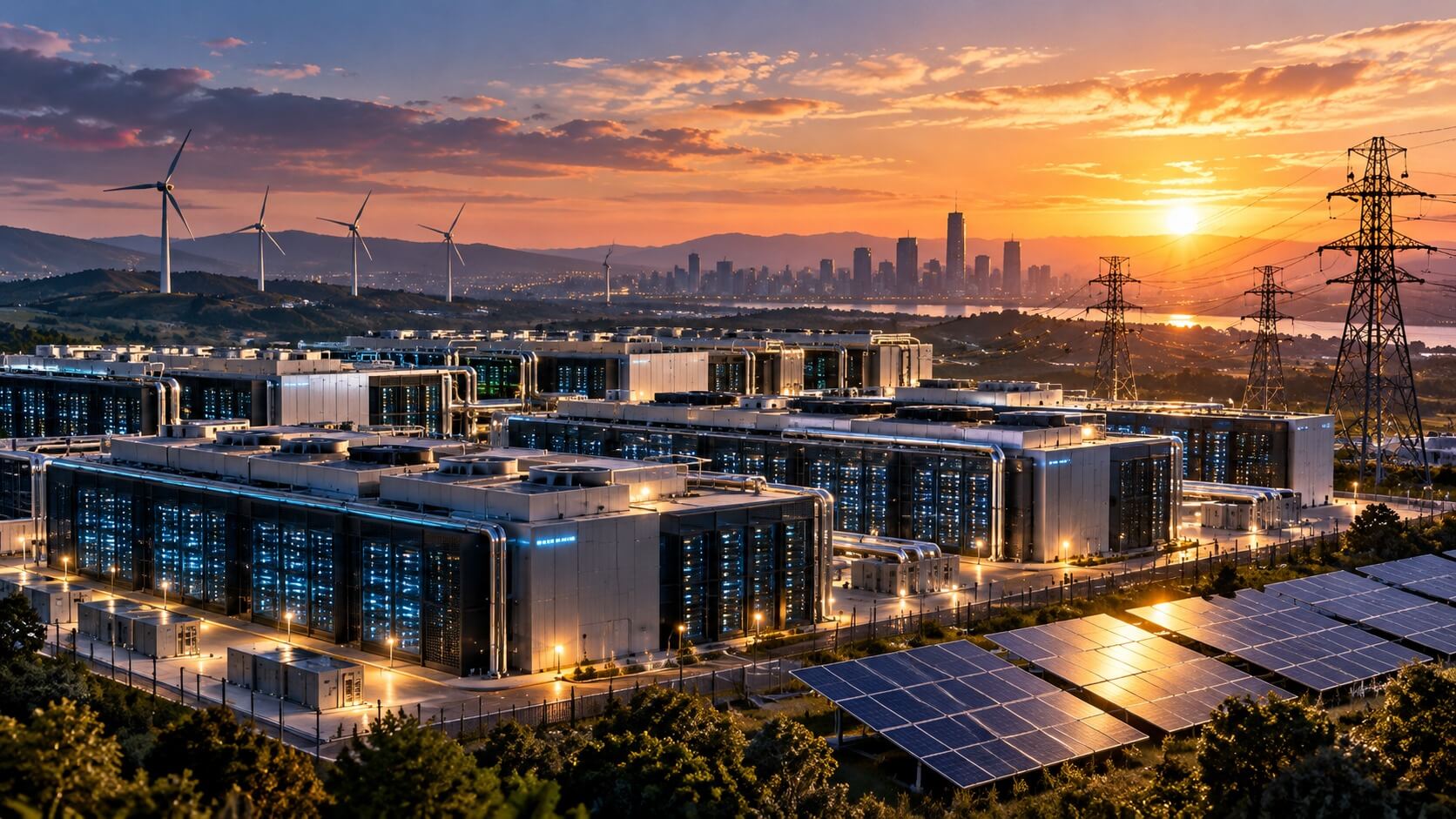
AI infrastructure faces a critical challenge: expanding computing capacity fast enough to meet demand without allowing costs, power shortages, and financial risks to undermine profitability. Data centers, advanced chips, electricity grids, cooling systems, and high-speed networks must all expand together. A shortage in any one of these areas can delay projects and increase costs.
For investors, the opportunity is significant, but so are the risks. Companies supplying essential equipment could benefit from continued AI spending, while businesses financing large infrastructure projects may struggle to earn adequate returns.
The central question is whether AI infrastructure can scale efficiently enough to turn growing demand into sustainable profits.
What Is AI Infrastructure, and Why Does Scalability Matter?
AI infrastructure includes the physical and digital systems used to train artificial intelligence models and run AI applications.
Its main components include:
- AI chips: Specialized processors, including GPUs and AI accelerators, that handle intensive computing tasks.
- Data centers: Facilities housing servers, storage, networking equipment, and supporting systems.
- Electricity infrastructure: Power generation, transmission lines, substations, and grid connections.
- Cooling systems: Equipment that removes heat from densely packed computing hardware.
- Cloud platforms: Services that provide businesses with computing capacity without requiring them to own the infrastructure.
- Networking equipment: High-speed connections that transfer information between processors, servers, and facilities.
These systems are interconnected. Purchasing thousands of AI chips accomplishes little if a data center lacks sufficient electricity, cooling, or networking capacity to operate them effectively.
Scalability means increasing useful computing capacity without allowing costs and operational complexity to grow disproportionately.
For example, doubling the number of AI servers does not necessarily double productive output. Additional servers may require expensive electrical upgrades, new cooling systems, and faster networking equipment.
For investors, the important measure is not how many chips or data centers a company announces, but how efficiently that capacity can generate revenue.
Why Are Companies Investing So Much in AI Infrastructure?
AI infrastructure spending is driven by three major sources of demand.
First, training advanced AI models requires substantial computing power, often distributed across thousands of interconnected processors.
Second, operating those models creates ongoing demand for computing capacity. This process, known as inference, generates answers, images, predictions, and other outputs from trained AI models.
Third, businesses are adopting AI across software development, customer service, healthcare, financial services, manufacturing, and other industries.
Competition also plays an important role. Companies such as Microsoft, Alphabet, Amazon, and Meta invest heavily in computing infrastructure to support their AI products, serve customers, and strengthen their competitive positions.
However, competition can encourage companies to build infrastructure before customer demand is fully established.
The difference between infrastructure spending and AI revenue
Spending money on AI infrastructure is not the same as earning money from AI.
Consider a hypothetical cloud provider investing $10 billion in additional computing infrastructure.
That investment creates immediate revenue opportunities for suppliers such as NVIDIA, electrical equipment manufacturers, construction contractors, and cooling technology companies.
But the cloud provider must eventually generate enough revenue to recover its investment, cover operating expenses, replace equipment, and earn an acceptable return.
Its profitability depends on:
- How quickly new facilities become operational.
- How much computing capacity paying customers actually use.
- The prices customers are willing to pay.
- Electricity, cooling, maintenance, and other operating costs.
- How long the equipment remains economically competitive.
A large infrastructure investment can therefore benefit equipment suppliers while placing financial pressure on the company funding the project.
Our guide to Who Is Spending the Most on AI Infrastructure? The Companies and Countries Leading the Buildout examines the companies and countries driving construction and why the concentration of spending matters.
What Are the Biggest Risks Facing AI Infrastructure?
The most significant AI infrastructure risks involve excess capacity, technological obsolescence, concentrated supply chains, and operational reliability.
1. Building too much capacity
Companies may construct more computing infrastructure than customers ultimately need.
If demand grows more slowly than expected, newly completed facilities could operate below capacity while still generating substantial electricity, maintenance, and financing costs.
Underutilized infrastructure can reduce profit margins, weaken cash flow, and eventually lead to asset write-downs.
This risk is particularly important when multiple companies expand simultaneously based on similar expectations of future AI adoption.
2. Equipment becoming outdated
AI processors improve rapidly, creating a potential mismatch between infrastructure investment and equipment life cycles.
Newer chips may deliver better performance per watt or lower computing costs than previous generations.
A data center building may remain useful for decades, while its servers and accelerators can become economically uncompetitive much sooner.
Companies must therefore consider not only construction costs but also how frequently expensive computing equipment may need replacement.
For investors, depreciation assumptions and hardware replacement spending can materially affect reported profitability and future cash flow.
3. Dependence on a limited number of suppliers
Advanced AI infrastructure depends on specialized manufacturers and tightly connected supply chains.
NVIDIA is a major supplier of AI accelerators, while Taiwan Semiconductor Manufacturing Company (TSMC) manufactures advanced chips for several leading semiconductor designers. High-bandwidth memory suppliers, including SK Hynix, Micron, and Samsung, also play important roles.
This concentration creates potential bottlenecks involving manufacturing capacity, advanced packaging, memory availability, and export restrictions.
Shortages of electrical transformers, switchgear, and other power equipment can create additional delays even when computing hardware is available.
A disruption at a critical supplier can affect projects across multiple companies and regions.
4. Operational failures and reliability problems
AI services require dependable infrastructure.
Hardware failures, network disruptions, overheating, software problems, and electricity interruptions can reduce availability and increase operating expenses.
Dense computing clusters also create operational challenges because failures in interconnected systems can interrupt demanding workloads.
Beyond physical infrastructure, AI applications introduce risks involving inaccurate outputs, cybersecurity, privacy, and unpredictable behavior. These issues can affect customer adoption and demand for computing services.
For a closer examination of operational and technological problems, see The Real Risks of AI: Failures, Weaknesses, and What Can Go Wrong.
Can AI Infrastructure Actually Scale Fast Enough?
AI infrastructure can continue expanding, but physical bottlenecks may prevent capacity from growing as quickly as demand.
A company might secure financing, purchase servers, and begin constructing a data center, only to discover that the local electricity grid cannot provide sufficient power for several years.
This illustrates a fundamental difference between digital demand and physical infrastructure.
AI software usage can grow rapidly. Building power plants, transmission lines, substations, and large data centers often requires much longer timelines.
The main scaling bottlenecks
| Bottleneck | Why it matters | Potential investor impact |
|---|---|---|
| Electricity availability | Large computing facilities require substantial, reliable power. | Project delays and higher energy costs. |
| Grid connections | Utilities may need additional substations and transmission capacity. | Longer development timelines. |
| Advanced chips | Manufacturing and packaging capacity are specialized. | Supply shortages and equipment price pressure. |
| Cooling systems | High-density processors produce substantial heat. | Additional construction and operating expenses. |
| Networking | Large computing clusters must exchange information efficiently. | Higher equipment spending and performance limitations. |
| Skilled labor | Construction and operation require specialized workers. | Higher labor costs and slower project completion. |
| Customer demand | New capacity must attract enough paying workloads. | Underutilization and weaker financial returns. |
These constraints do not mean AI infrastructure expansion must stop. They suggest growth may occur unevenly.
Companies with access to reliable electricity, suitable locations, equipment suppliers, and committed customers may have meaningful advantages over competitors facing delays.
For investors, execution capability can matter as much as the size of an announced investment.
Why Electricity and Cooling Are Becoming Critical Constraints
Electricity and cooling are among the clearest examples of how AI's physical requirements influence infrastructure economics.
Advanced processors consume substantial electricity and generate heat. As computing density increases, facilities may require more powerful electrical connections and specialized cooling technology.
Electricity demand extends beyond data centers
A new AI data center can require infrastructure upgrades far beyond its property boundaries.
Utilities may need to expand generation capacity, install transformers, upgrade substations, or construct transmission lines before a facility can operate at its planned capacity.
These projects involve permitting, equipment procurement, construction, and coordination with grid operators.
The International Energy Agency estimated in its 2025 Energy and AI analysis that global data center electricity consumption could approximately double by 2030, reaching around 945 terawatt-hours annually in its base-case scenario.
This projection covers data centers broadly, not AI alone, and represents a scenario rather than a guaranteed outcome.
The implication is that electricity availability could become an increasingly important factor in determining where AI infrastructure gets built and how quickly projects generate revenue.
Cooling adds another layer of cost
Traditional air cooling remains useful, but high-density AI systems can require more advanced thermal management, including direct-to-chip liquid cooling.
Companies such as Vertiv and Schneider Electric supply power and cooling infrastructure used in data center environments.
Advanced cooling systems can support more powerful computing configurations, but they may also require additional installation spending, maintenance, and facility modifications.
Water availability and local environmental restrictions can influence cooling technology choices, depending on the facility's design.
For investors, these are financial considerations as well as engineering challenges. Higher energy costs can reduce margins, delayed grid connections can postpone revenue, and insufficient cooling can limit usable computing capacity.
These challenges are examined in AI's Energy Problem: How Power and Cooling Costs Affect the AI Buildout.
Could AI Infrastructure Spending Become a Financial Bubble?
AI infrastructure could generate lasting economic value while still producing disappointing returns for some investors.
The central financial risk is that companies spend more on infrastructure than future customer revenue can justify.
This does not require AI technology to fail. Even successful technologies can experience periods of excessive investment, intense competition, and falling asset valuations.
What would make AI infrastructure spending unsustainable?
Several warning signs deserve attention:
- Revenue growing more slowly than investment: Computing capacity expands faster than paying customer demand.
- Declining computing prices: Competition or technological improvements reduce the prices cloud providers can charge.
- High replacement costs: Companies must upgrade expensive processors before recovering sufficient value from earlier investments.
- Expensive financing: Higher borrowing costs weaken project economics, particularly for heavily indebted operators.
- Excessive stock valuations: Share prices assume future growth and profitability that businesses struggle to deliver.
If these conditions develop, AI-related stocks could experience significant corrections, and companies might reduce infrastructure spending.
However, lower stock valuations would not necessarily indicate that AI infrastructure had become useless.
A facility can provide valuable computing services while delivering poor financial returns to the investors who funded its construction.
That distinction is central to Will the AI Boom Burst? How to Think About Bubble Risk in AI Infrastructure.
Who Benefits From AI Infrastructure Expansion?
AI infrastructure spending creates opportunities across several industries, but the economics differ substantially.
| Business category | Company examples | Main opportunity | Important risk |
|---|---|---|---|
| AI processors | NVIDIA, AMD | Demand for AI accelerators. | Competition, product cycles, and spending slowdowns. |
| Semiconductor manufacturing | TSMC | Production of advanced computing chips. | Capital intensity and geographic concentration. |
| Cloud infrastructure | Microsoft, Amazon, Alphabet | Revenue from computing services. | High capital spending and uncertain returns. |
| Electrical and cooling equipment | Schneider Electric, Vertiv, Eaton | Power distribution and thermal management. | Construction cycles and customer concentration. |
| Data center real estate | Equinix, Digital Realty | Leasing and operating data center capacity. | Financing costs, power constraints, and development risk. |
These companies do not benefit equally from the same level of AI spending.
An equipment supplier may generate revenue when hardware is delivered, while a data center owner may need years of customer payments to recover construction costs.
Some businesses depend heavily on new infrastructure orders. Others earn recurring revenue from facilities already operating.
Customer concentration also matters. Suppliers relying on a small number of large technology companies may face substantial revenue pressure if one major customer reduces spending.
Investors should therefore examine pricing power, customer diversification, cash generation, and capital requirements rather than assuming every company exposed to AI infrastructure will benefit equally.
What Happens if the AI Infrastructure Boom Slows Down?
A slowdown in infrastructure spending would affect different businesses in different ways.
Equipment suppliers could receive fewer orders, data center developers might postpone construction, and highly indebted operators could face financing pressure.
However, companies improving the efficiency of existing infrastructure might continue finding customers even if new construction slows.
Investors should distinguish between three scenarios:
- Slower growth: Infrastructure spending continues increasing, but at a reduced rate.
- A spending contraction: Companies reduce capital expenditures because demand or financing conditions weaken.
- A structural shift: Technological improvements change the types and quantities of infrastructure required.
Computing efficiency is particularly important.
More efficient AI models may require less computing power per task, reducing operating costs and potentially making AI services affordable to more customers.
If lower costs encourage substantially greater usage, total computing demand could still rise. If usage grows slowly, efficiency improvements could instead reduce demand for certain hardware categories.
This makes long-term forecasts uncertain, even when AI adoption continues increasing.
What Comes After the AI Boom? Sectors Investors Are Watching Next explores how investment opportunities might evolve beyond the current infrastructure spending cycle.
What Should Investors Watch in 2026 and Beyond?
The most useful indicators are those showing whether infrastructure investment is becoming productive, profitable capacity rather than simply increasing construction spending.
AI revenue compared with capital spending
Investors should compare growth in AI-related revenue with the capital expenditures required to support it.
For companies such as Microsoft, Amazon, and Alphabet, this means examining cloud revenue trends, operating profitability, capital expenditure guidance, and management commentary about AI demand.
Not every company reports AI revenue separately, making precise comparisons difficult.
Infrastructure investments also take time to generate returns, so spending and revenue should be evaluated over several reporting periods rather than a single quarter.
Data center utilization
Completed infrastructure creates economic value only when customers use it.
High utilization helps spread fixed costs across more paying workloads. Low utilization can leave companies operating expensive facilities without sufficient revenue.
Comparable utilization figures are not always publicly available. Investors can instead examine contracted capacity, occupancy where disclosed, cloud revenue, operating margins, and customer commitments.
It is also important to distinguish reserved capacity from computing services already generating revenue.
Free cash flow and financing
Heavy infrastructure investment can place pressure on free cash flow, even when a company's accounting profits remain positive.
Free cash flow generally represents cash generated from operations after capital expenditures.
Investors should examine whether companies can fund expansion through operating cash flow or increasingly depend on borrowing, leasing arrangements, or outside financing.
Debt maturity schedules, interest expenses, and long-term purchase commitments can reveal additional financial pressure.
Power availability and construction progress
A data center announcement is not equivalent to completed, revenue-generating capacity.
Investors should monitor construction milestones, grid connection agreements, electricity availability, regulatory approvals, and expected operating dates.
Delays can be financially significant because capital may already be committed while the facility remains unable to serve customers.
AI adoption and computing efficiency
Demand ultimately depends on whether businesses and consumers find AI services valuable enough to pay for them.
Investors should look for evidence of recurring customer usage, commercially successful applications, and improvements in computing efficiency.
More efficient models can lower the cost of delivering AI services, but they can also change demand for particular chips and infrastructure configurations.
The broader scenarios are examined in Where AI Is Headed: Scalability and Outlook for 2026 and Beyond.
How Can Investors Evaluate AI Infrastructure Companies?
Investors do not need to predict exactly how much AI computing capacity the world will require in ten years.
A more practical approach is to understand how each company earns money, what it must spend to grow, and how much future success is already reflected in its stock price.
| What to examine | Key question | Why it matters |
|---|---|---|
| Revenue growth | Are paying customers generating sustainable growth? | Shows commercial demand. |
| Capital expenditures | How much investment is required to support growth? | Reveals expansion costs. |
| Free cash flow | Does the company generate cash after investment spending? | Helps assess financial sustainability. |
| Debt and commitments | How dependent is the business on financing? | Highlights financial obligations and refinancing risk. |
| Customer concentration | Does revenue depend on a few major customers? | Shows vulnerability to spending cuts. |
| Competitive position | Can competitors easily replace its products or services? | Influences pricing power and margins. |
| Infrastructure constraints | Can the company secure electricity, equipment, and facilities? | Indicates execution risk. |
| Valuation | How much expected growth is already priced into the stock? | Helps assess whether the investment price is justified. |
These indicators must be evaluated together.
A company with impressive revenue growth may still be an unattractive investment if its valuation assumes unrealistic future profits.
Conversely, a slower-growing infrastructure supplier could offer a financially stronger business model through reliable cash generation, diversified customers, and manageable capital requirements.
A growing AI infrastructure industry does not guarantee strong returns for every AI infrastructure stock.
The Bigger Picture: AI Growth Depends on Economics, Not Just Technology
AI infrastructure expansion depends on more than advances in artificial intelligence.
Electricity availability, construction timelines, semiconductor supply chains, cooling capacity, financing, and customer demand all influence how quickly computing infrastructure can grow.
These constraints create opportunities for companies that solve critical infrastructure problems, but they also introduce risks for businesses investing aggressively before financial returns are established.
For investors, the key distinction is between growing demand for AI computing and profitable investment in the infrastructure supporting it.
A sustainable expansion requires enough paying customers, efficient computing systems, reliable access to essential resources, and returns that justify the capital invested.
If those conditions develop together, AI infrastructure could support years of economic activity. If investment consistently outpaces profitable demand, companies and shareholders could experience substantial losses even as AI technology continues advancing.
Disclaimer: This article is for informational and educational purposes only and does not constitute financial or investment advice. All investments involve risk, including the possible loss of principal.