
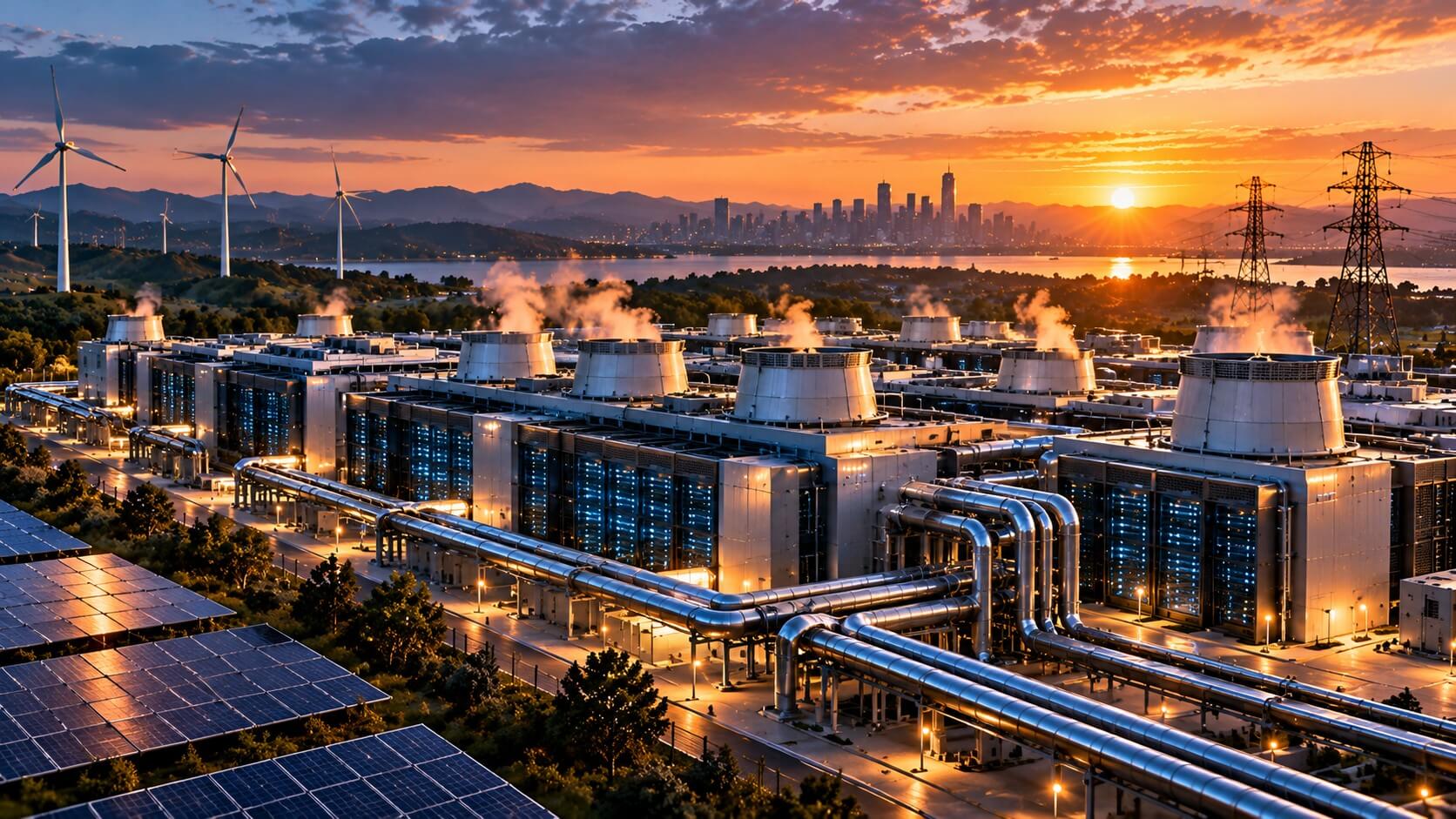
AI can have a significant environmental impact because the data centers powering it consume large amounts of electricity, require cooling, and sometimes use substantial quantities of water. As artificial intelligence expands, these demands can increase greenhouse gas emissions, strain local electricity grids, and raise infrastructure costs.
The impact varies by location. It depends on the sources of electricity, cooling technology, facility efficiency, and the pace of AI adoption. Manufacturing processors, constructing data centers, and replacing electronic equipment also contribute to AI's environmental footprint.
For investors, these are financial considerations as well as environmental ones. A company may have strong demand for AI computing but struggle to expand because electricity connections are delayed, cooling upgrades are expensive, or local communities oppose new facilities. Such constraints can affect construction schedules, operating margins, and investment returns.
How Bad Is AI for the Environment?
AI's environmental impact is growing as increasingly powerful computing systems require more electricity and supporting infrastructure.
The International Energy Agency (IEA) estimated that data centers consumed approximately 415 terawatt-hours (TWh) of electricity in 2024, or about 1.5% of global electricity consumption.
Its updated 2026 outlook projects approximately 950 TWh of annual data center electricity consumption by 2030, compared with around 485 TWh in 2025.
These figures include data centers supporting AI and other digital services. They do not represent electricity consumption attributable exclusively to artificial intelligence, although AI is an important driver of expected growth.
Electricity is only part of the environmental footprint. Other impacts include:
- Carbon emissions: Greenhouse gases produced by electricity generation, particularly when fossil fuels supply additional demand.
- Water consumption: Water used directly in certain cooling systems and indirectly in electricity generation.
- Manufacturing: Energy and raw materials required to produce processors, servers, and electrical equipment.
- Construction: Emissions, land use, and resource consumption associated with data center development.
- Electronic waste: Equipment discarded as computing hardware is upgraded or replaced.
- Local infrastructure pressure: Additional demands on electricity grids, water supplies, and surrounding communities.
The severity of these effects depends on the facility. A data center supplied largely by low-carbon electricity may produce fewer operational emissions than one relying heavily on fossil fuels. Similarly, cooling systems that minimize water consumption can reduce pressure on local supplies.
The environmental challenge is not simply how much electricity AI consumes, but how that electricity is produced, how efficiently computing resources are used, and what environmental costs accompany expansion.
Why Does AI Need So Much Electricity?
AI requires substantial electricity because its processors perform enormous numbers of calculations. Advanced models often run on thousands of specialized chips working together, while networking, storage, and cooling equipment consume additional power.
Training and inference consume energy differently
AI electricity demand comes from two major activities:
- Training: Developing or improving an AI model using large datasets and substantial computing resources. Training an advanced model can involve thousands of processors operating over an extended period.
- Inference: Using a trained model to answer questions, generate images, summarize documents, or perform other tasks.
A single inference request generally requires much less energy than training a large model. However, inference demand accumulates as millions of people and businesses repeatedly use AI services.
For cloud providers, this creates ongoing demand for computing capacity rather than a one-time expense associated with model development.
Electricity demand extends beyond processors
Data centers also require electricity for networking, storage, power conversion, cooling, and other supporting systems.
Consequently, a facility consumes more electricity than its processors alone require. Improving the efficiency of supporting equipment can reduce this overhead, but cannot eliminate it.
For investors, growing AI usage can therefore support demand across several industries, including semiconductor manufacturing, electrical equipment, cooling technology, and power infrastructure.
How Fast Is AI Electricity Demand Growing?
Global data center electricity consumption is projected to grow rapidly, although the exact pace remains uncertain.
The IEA's updated 2026 outlook projects approximately 950 TWh of annual consumption by 2030, compared with around 485 TWh in 2025.
In the United States, a June 2026 update from Lawrence Berkeley National Laboratory estimated that data centers could account for approximately 11.8% of national electricity consumption by 2030, with a scenario range of 9.5% to 15.3%.
These are projections, not guaranteed outcomes. Actual consumption will depend on AI adoption, processor efficiency, construction schedules, electricity availability, and the economics of AI services.
| Indicator | Estimate or projection | Why it matters |
|---|---|---|
| Global data center electricity use, 2024 | About 415 TWh | Establishes the scale of existing demand |
| Global data center electricity use, 2030 | About 950 TWh, updated IEA outlook | Illustrates potential demand growth |
| U.S. data center electricity share, 2030 | 11.8%, central LBNL estimate | Shows the potential importance of data centers to U.S. electricity demand |
| U.S. data center electricity share, 2030 | 9.5%–15.3%, LBNL scenario range | Highlights uncertainty in future requirements |
A terawatt-hour measures a large quantity of electricity consumption. One TWh equals one billion kilowatt-hours.
The challenge is that electricity infrastructure cannot necessarily expand as quickly as computing infrastructure.
Technology companies may be able to purchase servers within months, while constructing transmission lines, expanding substations, or developing new generation capacity can take years.
This difference between computing demand and electricity availability is becoming a major constraint on AI infrastructure development.
Why Can Electricity Availability Delay AI Data Centers?
Large AI data centers need reliable electricity supplies, often at substantial capacity. Even a completed facility cannot begin operating at its intended scale without sufficient power.
Grid connections can become bottlenecks
Before construction or expansion, developers must determine whether the local electricity network can accommodate the additional demand.
If capacity is insufficient, utilities may need to install transformers, expand substations, upgrade transmission connections, or construct additional infrastructure.
These projects require engineering, equipment procurement, permits, and construction. Delays in a critical component can postpone an entire data center development.
Electrical equipment suppliers such as Eaton, Schneider Electric, and Siemens Energy participate in different parts of this infrastructure market. Increased demand can create opportunities for suppliers, although equipment orders and profitability depend on individual projects and competitive conditions.
Power availability influences location decisions
Developers traditionally consider land prices, network connectivity, customer proximity, and operating expenses when selecting data center locations.
Electricity availability can outweigh some of these considerations.
A location offering inexpensive land may be unattractive if obtaining sufficient power requires years of grid upgrades. Conversely, an area with available capacity may attract development despite higher construction costs.
This can influence where AI infrastructure investment occurs and which regional electricity networks experience the greatest expansion.
Delays have financial consequences
Consider a company that has invested in land, buildings, and computing equipment for a new facility.
If its electricity connection is delayed, the company may be unable to generate the expected customer revenue while financing and other expenses continue.
For investors, the timing of a facility's operational launch can therefore matter as much as its planned computing capacity.
How Does AI Cooling Work, and Why Is It Expensive?
AI processors generate heat while performing calculations. Without adequate cooling, excessive temperatures can reduce performance, damage equipment, or force systems to shut down.
As computing hardware becomes more powerful and densely installed, cooling requirements become more demanding.
Air cooling
Traditional data centers often use fans and air-conditioning systems to circulate cool air around servers and remove heat.
Air cooling remains effective for many workloads, but extremely dense installations of high-performance AI processors can make it harder to remove heat efficiently.
Liquid cooling
Liquid cooling uses fluid to transport heat away from computing equipment. Direct-to-chip systems, for example, circulate coolant through components positioned close to processors.
Because liquids can transfer heat efficiently, these systems can support higher-density computing installations.
However, liquid cooling may require specialized plumbing, pumps, heat exchangers, maintenance procedures, and modifications to existing facilities.
It is not automatically cheaper than air cooling. Its economic advantages depend on equipment density, installation expenses, energy savings, and operating conditions.
Companies such as Vertiv and Schneider Electric supply thermal management technologies used in data center infrastructure, including solutions for increasingly demanding computing environments.
Cooling affects investment returns
Cooling influences both construction spending and ongoing operating expenses.
An existing facility designed for conventional servers may require substantial upgrades before accommodating high-density AI hardware.
For investors, cooling capacity can determine how much computing equipment a facility can support, how quickly it can be upgraded, and how efficiently it operates.
Does AI Use Too Much Water?
Some AI data centers consume substantial amounts of water, particularly when cooling systems rely on evaporation. However, consumption varies considerably with facility design, climate, technology, and operating practices.
It is misleading to assume that all AI facilities have the same water requirements.
Direct water consumption
Direct consumption occurs at the data center itself.
Evaporative cooling systems remove heat partly by allowing water to evaporate. This can reduce electricity requirements for cooling under suitable conditions, but it also consumes water.
Other cooling designs can substantially reduce on-site water consumption, sometimes with trade-offs involving electricity use or equipment costs.
Indirect water consumption
Data centers can also have an indirect water footprint through the electricity they purchase.
Some power plants use water for cooling and other processes. Consequently, a facility with limited on-site water consumption may still be associated with water use elsewhere in the electricity supply chain.
Why location matters
A facility operating in a water-stressed region may face greater environmental and regulatory concerns than a similar facility located where water supplies are more abundant.
Local availability, competing demand, and environmental regulations can influence project approvals.
Developers may invest in water recycling, alternative cooling systems, or other measures to reduce consumption. These solutions can improve sustainability but may involve additional costs.
For investors, water availability is particularly relevant when assessing permitting risk, operating expenses, and community acceptance.
Does AI Increase Carbon Emissions?
AI can increase carbon emissions when additional electricity demand leads to greater fossil-fuel generation.
However, emissions depend on the sources of electricity supplying data centers, the timing of consumption, and the carbon intensity of the local grid.
The IEA's 2025 Energy and AI analysis identified a mixture of coal, natural gas, renewables, and nuclear power in the electricity supply associated with data centers. The composition varies across regions.
Renewable electricity can reduce emissions
Solar, wind, and hydroelectric generation can provide lower-carbon electricity for data centers.
Technology companies may purchase renewable electricity through long-term power purchase agreements or support the development of additional generation capacity.
However, solar and wind output varies with weather and time of day, while data centers generally require reliable power around the clock.
Storage, grid connections, and other generation sources may therefore be needed to maintain reliability.
Natural gas can support additional demand
Natural gas generation can provide dispatchable electricity, meaning output can be adjusted to meet demand.
In some markets, gas-fired generation may be available sooner than other large power projects.
However, burning natural gas produces carbon dioxide, while methane emissions along the supply chain add to its climate impact.
Nuclear power offers another option
Nuclear plants provide low-carbon electricity and can operate continuously for extended periods, making them attractive for some data center power strategies.
Existing nuclear facilities may offer opportunities for long-term electricity contracts, while new nuclear projects typically involve substantial capital requirements, regulatory approvals, and lengthy development schedules.
No single electricity source automatically solves AI's energy and environmental challenges. Developers must balance reliability, cost, availability, emissions, and construction timelines.
Can AI Raise Electricity Bills for Ordinary Consumers?
AI data center expansion can contribute to higher electricity bills, but the outcome depends on how utilities finance new infrastructure and allocate costs among customers.
Large facilities may require additional power generation, substations, transmission lines, and other upgrades.
The central question is who pays for those investments.
When consumers could face higher costs
If a utility builds infrastructure primarily to serve data centers but recovers part of the expense from residential and other commercial customers, household electricity bills could increase.
Whether this occurs depends on regulatory decisions, electricity tariffs, and agreements between utilities and large customers.
When additional demand could provide benefits
Large electricity customers also generate revenue for utilities.
If data centers pay an appropriate share of infrastructure costs and improve the utilization of existing assets, additional demand may help spread certain fixed costs across a larger customer base.
Therefore, more data centers do not necessarily mean higher residential electricity prices in every market.
Why investors should pay attention
Electricity affordability can become a regulatory and political issue.
Regulators may require large data center customers to fund dedicated infrastructure, accept minimum purchase commitments, or bear a greater share of expansion costs.
Such requirements can affect the economics of new AI facilities, even when demand for computing services remains strong.
Why Are Communities Opposing Some AI Data Centers?
Data centers can bring construction spending, tax revenue, and economic activity. However, some communities oppose proposed facilities because of their electricity demand, water requirements, land use, noise, and environmental effects.
Electricity and water concerns
Residents may worry that new facilities will place additional pressure on utilities or compete with households, farms, and businesses for limited resources.
These concerns can be particularly important in regions already experiencing electricity or water constraints.
Land use and local disruption
Large campuses require land, electrical infrastructure, and supporting facilities.
Construction can increase traffic and change local landscapes. Backup generators, cooling equipment, and other machinery may also create noise or local emissions concerns.
Limited permanent employment
Construction projects can generate temporary employment, but highly automated data centers may require relatively few permanent employees compared with other large industrial facilities.
This can influence how communities weigh the economic benefits against infrastructure and environmental costs.
Consequences for developers
Community opposition does not necessarily prevent construction. However, it can contribute to permitting delays, design changes, additional mitigation expenses, or project cancellations.
For investors, local acceptance is a practical factor in evaluating whether planned computing capacity will become operational on schedule.
How Do Energy and Cooling Costs Affect AI Profitability?
Electricity and cooling costs affect AI profitability differently depending on the business model.
A cloud provider selling computing capacity has different economics from a semiconductor manufacturer or a software company purchasing AI services.
Nevertheless, the fundamental requirement is the same: revenue must justify both operating expenses and the capital invested in infrastructure.
A simplified electricity-cost example
Consider a hypothetical AI facility drawing an average of 100 megawatts of electricity throughout the year.
At that average load, annual consumption would be approximately 876,000 megawatt-hours.
| Illustrative electricity price | Annual consumption | Annual electricity cost |
|---|---|---|
| $70 per MWh | 876,000 MWh | $61.3 million |
| $90 per MWh | 876,000 MWh | $78.8 million |
The $20 per MWh difference increases annual electricity expenses by approximately $17.5 million.
This is an illustrative calculation, not an estimate for a particular facility. It assumes the stated average load represents total facility electricity consumption and excludes other contractual charges.
Actual expenses depend on electricity agreements, demand charges, operating patterns, and local market conditions.
Cooling efficiency affects total consumption
Facilities with similar computing equipment may consume different amounts of electricity because their cooling and supporting systems operate at different efficiencies.
A common measure is power usage effectiveness (PUE), calculated by dividing total facility electricity consumption by the electricity used by computing equipment.
For example, a PUE of 1.2 means that a facility consumes 1.2 units of electricity for every unit used by its computing equipment.
A lower PUE generally indicates less electricity overhead, although it does not measure water consumption, carbon emissions, or the economic value of computing work.
Energy costs influence competitive advantage
Companies with reliable, competitively priced electricity and efficient cooling may enjoy operating-cost advantages.
However, inexpensive electricity alone does not guarantee attractive returns.
Hardware purchases, depreciation, financing, maintenance, customer pricing, and infrastructure utilization also influence profitability.
Investors should therefore examine whether additional computing capacity generates sufficient revenue and cash flow to justify the total investment.
Which Companies Could Benefit From AI's Energy Problem?
AI's growing electricity and cooling requirements create opportunities for utilities, power equipment manufacturers, cooling specialists, electricity generators, and data center operators.
Companies positioned to address infrastructure constraints may benefit from additional demand, although industry growth does not guarantee higher profits or attractive stock returns.
| Industry | Company examples | Potential opportunity | Important risk |
|---|---|---|---|
| Electric utilities | Dominion Energy, American Electric Power | Electricity demand and grid investment | Regulation and cost recovery |
| Electrical equipment | Eaton, Schneider Electric | Transformers, switchgear, and power distribution | Project delays and competitive pressure |
| Cooling technology | Vertiv, Schneider Electric | Liquid cooling and thermal management | Technology changes and pricing competition |
| Power generation | Constellation Energy, Vistra | Electricity sales and long-term contracts | Power prices, capital costs, and regulation |
| Data center operators | Equinix, Digital Realty | Demand for data center capacity | High investment requirements and power constraints |
Electric utilities and power generators
Utilities may benefit from increased electricity demand and investment in transmission and distribution infrastructure.
However, regulated utilities generally earn returns under frameworks established by regulators. Higher electricity consumption does not automatically translate into proportionally higher shareholder profits.
Electricity generators may benefit from long-term supply contracts or stronger wholesale demand, but their earnings depend on market prices, generation costs, contractual terms, and capital requirements.
Electrical equipment suppliers
Companies such as Eaton and Schneider Electric provide equipment used to distribute, control, and manage electricity.
Additional data center construction and grid upgrades can support demand for these products.
Investors should examine order growth, backlog conversion, operating margins, and whether suppliers can expand production without significantly increasing costs.
Cooling specialists
Vertiv and other thermal management suppliers participate in the market for cooling and supporting infrastructure.
Higher-density AI hardware can increase demand for advanced cooling equipment, but competition, customer concentration, and changing technology can affect profitability.
Data center operators
Operators such as Equinix and Digital Realty may benefit from customer demand for additional capacity.
However, securing electricity, financing construction, and maintaining adequate occupancy remain essential to earning attractive returns.
For investors, the strongest opportunity is not necessarily the company with the greatest exposure to AI demand, but the one that can convert that demand into sustainable earnings and cash flow at a reasonable valuation.
Could AI's Energy Problem Slow the Entire AI Boom?
Yes. Electricity shortages, grid connection delays, cooling limitations, and rising infrastructure costs could slow AI expansion even if demand for AI applications remains strong.
A cloud provider may have customers ready to purchase computing services but lack sufficient operational capacity to meet their requirements.
This creates a distinction between demand for AI and the industry's ability to supply it profitably.
Construction delays
Insufficient grid capacity, electrical equipment shortages, and permitting difficulties can postpone facility openings.
These delays may push expected revenue into later periods while financing and development costs continue.
Higher operating expenses
Increasing electricity or cooling costs can reduce operating margins unless providers raise customer prices or improve efficiency.
Competition may limit how much of those expenses can be passed on to customers.
Changes in investment plans
Developers may relocate projects, redesign facilities, improve hardware efficiency, or slow expansion when infrastructure becomes too expensive or difficult to obtain.
If expected investment returns deteriorate, companies may reconsider capital spending plans.
These financial risks are explored in Will the AI Boom Burst? How to Think About Bubble Risk in AI Infrastructure.
Energy constraints do not necessarily mean AI adoption will stop. They can, however, affect how quickly computing capacity expands and which companies capture the economic benefits.
Can AI Become More Energy Efficient?
AI can become more energy efficient through improvements in processors, software, model design, cooling technology, and data center operations.
Several approaches are particularly relevant:
- More efficient processors: Advanced chips can perform more calculations per unit of electricity, reducing the energy required for certain workloads.
- Smaller and specialized models: Applications that do not require the largest AI models can sometimes use less computationally demanding alternatives.
- Software optimization: Better algorithms, model compression, and improved hardware utilization can reduce unnecessary calculations.
- Improved cooling: Efficient thermal management and facility design can lower electricity consumption outside the computing equipment.
- Smarter scheduling: Flexible workloads can sometimes run when electricity is cheaper or lower-carbon generation is more available.
Not all AI workloads offer the same flexibility. Applications requiring immediate responses cannot always delay processing until electricity conditions improve.
Why greater efficiency may not reduce total electricity demand
Efficiency improvements can reduce the electricity needed for an individual AI task without necessarily reducing total industry consumption.
When AI becomes cheaper to operate, businesses may deploy it more widely, creating additional computing demand.
This is an example of the rebound effect: lower resource consumption per unit of activity can encourage enough additional activity to offset some or all of the savings.
For investors, efficiency can improve operating economics, but it may also intensify competition and reduce the prices customers pay for computing services.
Therefore, improvements in energy efficiency should be evaluated alongside growth in usage, revenue, and infrastructure spending.
What Should Investors Watch in AI Energy and Cooling?
Investors evaluating AI infrastructure companies should monitor whether electricity, cooling, and capital requirements are compatible with projected growth and profitability.
| Indicator | What it reveals | Why it matters |
|---|---|---|
| Electricity availability | Whether planned facilities can secure sufficient power | Affects expansion timelines |
| Energy contracts | Electricity costs, supply reliability, and contractual commitments | Influences operating expenses |
| Grid connection schedules | When facilities can begin operating | Affects revenue timing |
| Cooling efficiency | How effectively facilities manage heat | Influences capacity and costs |
| Water availability | Exposure to local resource constraints | Can affect permits and operations |
| Capital expenditure | Investment required to build or upgrade infrastructure | Influences cash flow and financing needs |
| Infrastructure utilization | How much installed computing capacity is actually used | Helps assess investment returns |
| Regulatory developments | Changes in electricity pricing and environmental requirements | Can alter project economics |
These indicators should be considered together rather than individually.
For example, a company may secure inexpensive electricity but face a lengthy connection delay. Another may have reliable power but require costly cooling upgrades. A third may operate efficient facilities but struggle to generate enough customer revenue to justify its investment.
Investors can examine company earnings reports, capital expenditure guidance, announced power agreements, construction schedules, and operating margins to assess these risks.
The broader framework for evaluating these constraints is covered in AI Infrastructure Risks and Scalability: What Investors Need to Know.
What Does AI's Energy Problem Mean for the Future of Infrastructure?
Electricity availability, cooling capacity, and environmental requirements are becoming central factors in AI infrastructure development.
The next phase of expansion will depend not only on faster processors and more advanced models, but also on the ability to deliver reliable electricity and remove heat economically.
Several developments could influence the industry:
- Location decisions: Developers may increasingly favor areas with available electricity capacity, even when land or construction costs are higher.
- Grid investment: Utilities may need to expand transmission, substations, and generation infrastructure to support additional demand.
- Cooling technology: Higher-density computing equipment may increase the importance of liquid cooling and advanced thermal management.
- Environmental requirements: Water availability, emissions regulations, and community concerns may influence project approvals.
- Computing efficiency: Better hardware and software could change the amount of electricity and infrastructure required for future AI workloads.
These developments create opportunities for infrastructure suppliers while introducing uncertainty for developers and investors.
Other challenges affecting AI systems, including security, reliability, and operational failures, are examined in The Real Risks of AI: Failures, Weaknesses, and What Can Go Wrong.
For investors, energy and cooling should be treated as fundamental business requirements rather than secondary environmental considerations.
The AI Buildout Depends on Power, Cooling, and Economics
AI's environmental impact is substantial and could grow as computing demand expands. Electricity consumption, water requirements, carbon emissions, and infrastructure development all contribute to that impact.
However, the consequences differ across facilities and regions. Electricity sources determine much of the operational emissions footprint, cooling technology influences energy and water consumption, and grid availability affects where new capacity can operate.
For investors, these factors influence construction costs, revenue timing, operating margins, and the returns companies earn on infrastructure spending.
Businesses that secure reliable electricity, deploy efficient cooling, and manage capital spending effectively may gain advantages over competitors facing greater infrastructure constraints.
The central challenge is not simply producing more AI computing power. It is delivering that computing power reliably, affordably, and with manageable environmental consequences.
As the industry expands, long-term success will depend on how effectively companies balance growing AI demand with the physical and economic limits of the infrastructure supporting it.
Disclaimer: This article is for informational and educational purposes only and does not constitute financial or investment advice. All investments involve risk, including the possible loss of principal.