
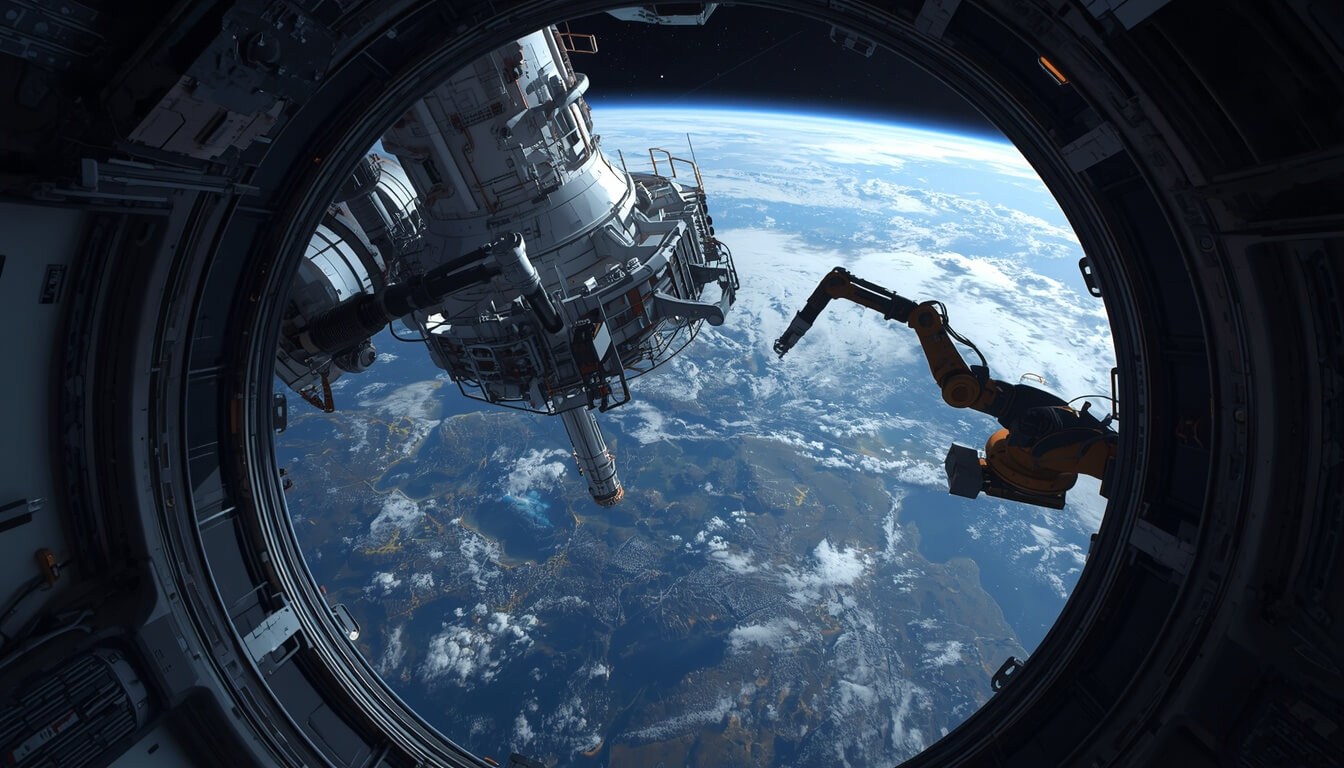
The commercial space industry has historically focused on a relatively simple objective: getting satellites into orbit and keeping them operational.
That model is beginning to expand.
As launch systems become more capable, satellite infrastructure grows and private companies develop new orbital services, space could evolve from a location for telecommunications and Earth observation into a broader industrial environment.
The transition will not happen overnight. Manufacturing in orbit remains technically difficult, expensive and dependent on infrastructure that is still being developed. Yet the direction of the industry raises a fundamental question: what could the space economy look like if companies eventually use orbit not only to operate satellites, but also to manufacture products, process materials and provide industrial services?
The answer could involve several distinct stages, beginning with today's satellite networks and gradually extending toward a more complex orbital economy.
The companies building the infrastructure required for this transition are discussed in The Companies Building the Next Generation of Space Infrastructure.
The next space economy may ultimately look less like a collection of isolated missions and more like an industrial ecosystem — one in which Earth and orbit are connected by a continuous network of transportation, data, energy and commercial infrastructure.
From Satellite Networks to Orbital Infrastructure
Today's commercial space economy is dominated by satellites.
Communications constellations provide connectivity, Earth observation satellites generate data, navigation systems support transportation and logistics, and scientific spacecraft collect information about the planet and the wider universe.
These systems are already important forms of infrastructure.
But satellites generally operate as independent assets. They are launched, deployed and expected to function for a defined period before eventually being replaced.
A more mature space economy could introduce infrastructure designed to support multiple activities at once:
- Orbital transfer vehicles could move spacecraft between different orbits.
- Servicing vehicles could inspect or repair satellites.
- Commercial stations could provide locations for research and manufacturing.
- Dedicated logistics systems could transport equipment and materials.
In this model, individual satellites would become components of a larger orbital ecosystem.
Why Manufacturing in Space Is Different
Manufacturing in orbit is attractive for one fundamental reason: the physical environment is different from that on Earth.
Microgravity can allow materials to behave in ways that are difficult to reproduce under normal terrestrial conditions. Fluids, crystals, biological materials and certain advanced manufacturing processes can potentially benefit from reduced gravitational forces.
This does not mean that every product would be cheaper or better when manufactured in space.
Launching raw materials from Earth remains expensive, and operating factories in orbit requires:
- Power
- Robotics
- Communications
- Thermal control
- Reliable transportation
The economic case therefore depends on producing something whose value is high enough to justify the additional cost of operating outside Earth.
For this reason, early space manufacturing is likely to focus on specialized products rather than ordinary mass-market goods.
Pharmaceuticals and Advanced Materials
One potential application is pharmaceutical and biotechnology research.
Microgravity can alter certain biological and chemical processes. Researchers have investigated how protein crystals form in space, for example, because improved crystal structures can sometimes assist scientific research and drug-development efforts.
Another potential area is advanced materials.
Manufacturing under microgravity may allow researchers to experiment with alloys, fibers, semiconductors or other materials under conditions that are difficult to achieve on Earth.
A technically successful experiment does not automatically become a viable industrial process. The challenge is determining whether these advantages are commercially significant enough to compensate for the cost of transportation and orbital operations.
The Importance of In-Space Servicing
Before large-scale manufacturing becomes practical, orbital servicing could become an important intermediate market.
Satellites represent significant investments. If a spacecraft experiences a problem after reaching orbit, replacing it may require launching an entirely new satellite.
Servicing technologies could change that equation.
Robotic spacecraft could potentially inspect satellites, repair certain components, replace equipment or reposition spacecraft.
Extending the useful life of an orbital asset could improve its economics while reducing the need for replacement launches.
Servicing could also support the construction of larger structures in orbit.
Instead of launching an enormous structure as a single object, components could potentially be transported separately and assembled after reaching space.
That would create demand for:
- Orbital robotics
- Docking systems
- Standardized interfaces
- Specialized transportation
Commercial Space Stations
The development of commercial space stations could represent another major step.
A permanent orbital facility could provide infrastructure for research, manufacturing, technology demonstrations and other commercial activities.
Companies would not necessarily need to own an entire space station. They could potentially rent laboratory space, manufacturing capacity or other services.
This would resemble the way companies use industrial facilities on Earth.
Commercial stations could therefore transform orbital space from an environment accessed primarily through individual missions into a location where businesses conduct recurring activities.
The economics remain uncertain because such facilities require substantial capital, reliable transportation and continuous operational support.
Nevertheless, commercial stations are an important part of the industry's longer-term development.
Space-Based Computing
Another possible direction is computing infrastructure in orbit.
Data centers on Earth require enormous amounts of electricity, cooling systems and physical infrastructure. Space offers access to continuous sunlight in certain orbital configurations, although converting that energy into practical computing capacity introduces significant engineering challenges.
Companies and researchers have therefore explored whether some computing workloads could eventually move into space.
The concept could become particularly relevant as satellite networks generate increasing quantities of data.
Instead of transmitting all raw information back to Earth, some processing could potentially take place closer to the sensors that collect it.
For Earth observation, for example, onboard computing could identify relevant information before transmitting data to ground stations, reducing bandwidth requirements.
This represents a more immediate possibility than constructing enormous orbital data centers, because modern satellites already perform some processing in space.
Orbital Logistics Could Become a New Industry
A larger commercial space economy would require logistics.
Earth-based industries depend on roads, ports, warehouses, aircraft and shipping networks. An orbital economy would require analogous infrastructure adapted to space.
- Launch vehicles would transport equipment from Earth.
- Transfer vehicles could move payloads between orbits.
- Robotic systems could manipulate objects.
- Space stations could function as destinations or hubs.
Standardized docking and refueling systems could eventually make spacecraft more interoperable.
If these capabilities mature, the economics of space activity could change significantly.
Companies would no longer need to design every mission as an isolated project. They could potentially rely on shared infrastructure and commercial services.
That could reduce barriers to entry for smaller companies.
From Earth-Based Industry to Space-Based Industry
The most ambitious scenario involves a gradual separation between some industrial processes and Earth.
Initially, Earth would remain the center of manufacturing, while space would provide specialized environments for particular processes.
Later, some high-value production could potentially occur entirely in orbit.
Further into the future, if transportation and energy systems become dramatically more capable, companies could consider using extraterrestrial resources as industrial inputs.
This could include materials extracted from the Moon or asteroids, although such activities remain highly speculative from a commercial perspective.
The economic logic would be fundamentally different from today's satellite business.
Instead of launching finished products from Earth, companies could eventually transport equipment to space and use local or orbital resources to produce goods there.
The Role of Robotics and Automation
Automation will be essential to any large-scale industrial activity in space.
Human labor is expensive and logistically complicated in orbit. Robotic systems can operate continuously and perform repetitive tasks without requiring life-support systems.
Advances in autonomous robotics could therefore determine how quickly space manufacturing develops.
Robots could assemble structures, move materials, inspect spacecraft and operate manufacturing equipment.
Artificial intelligence could further increase automation by allowing systems to monitor equipment and adapt operations with limited human intervention.
This would connect the space economy with several other emerging technology sectors:
- Robotics
- AI
- Advanced manufacturing
- Autonomous systems
The Economics Will Determine What Survives
Technological feasibility alone will not determine the future of the space economy.
Every proposed orbital business must answer basic economic questions:
| Question | Why it matters |
|---|---|
| How much does it cost to launch the equipment? | Launch costs directly affect the total investment required for any orbital facility. |
| How long will the infrastructure operate? | Operational lifetime determines how much value can be generated before replacement or repair. |
| What does it cost to maintain? | Maintenance in orbit is far more complex and expensive than on Earth. |
| How much revenue can each kilogram of manufactured product generate? | High-value, low-mass products are more likely to justify orbital manufacturing. |
| Can customers justify paying for the resulting service? | Commercial viability depends on whether the final product or service has a market. |
These questions explain why some ambitious space concepts may take decades to become commercial.
Space manufacturing may be technically possible long before it becomes economically competitive.
The industry will therefore likely develop incrementally, with the most valuable and economically defensible applications appearing first.
A Layered Space Economy
The future space economy may ultimately develop as a series of interconnected layers:
- The first layer is transportation: rockets and launch infrastructure.
- The second is orbital infrastructure: satellites, communications networks and Earth observation systems.
- The third is orbital services: servicing, transportation, logistics and commercial stations.
- The fourth could be industrial activity: manufacturing, materials processing, research and potentially computing.
Each layer depends on the previous ones.
Without affordable transportation, large orbital infrastructure is difficult to maintain. Without infrastructure, industrial operations cannot function reliably. Without customers, the economic case for large-scale investment remains weak.
This means the evolution of the space economy is likely to be cumulative rather than revolutionary.
What the Next Space Economy Could Look Like
The next space economy may therefore be considerably broader than today's satellite industry.
Communications and Earth observation could remain important foundations, but they may eventually be joined by orbital logistics, spacecraft servicing, commercial stations, advanced research, manufacturing and other industrial services.
The original transformation described in The New Space Economy: Why Space Is Becoming a Commercial Industry is therefore only the beginning of a much larger possibility.
The critical question is not whether every futuristic space concept will become reality. Many will not.
The more important question is whether the infrastructure being developed today can gradually reduce the cost and complexity of operating beyond Earth.
If it can, space could evolve from an environment used primarily for communications and observation into an increasingly interconnected commercial platform.
That transition would create opportunities across aerospace, telecommunications, computing, robotics, advanced materials and manufacturing.