
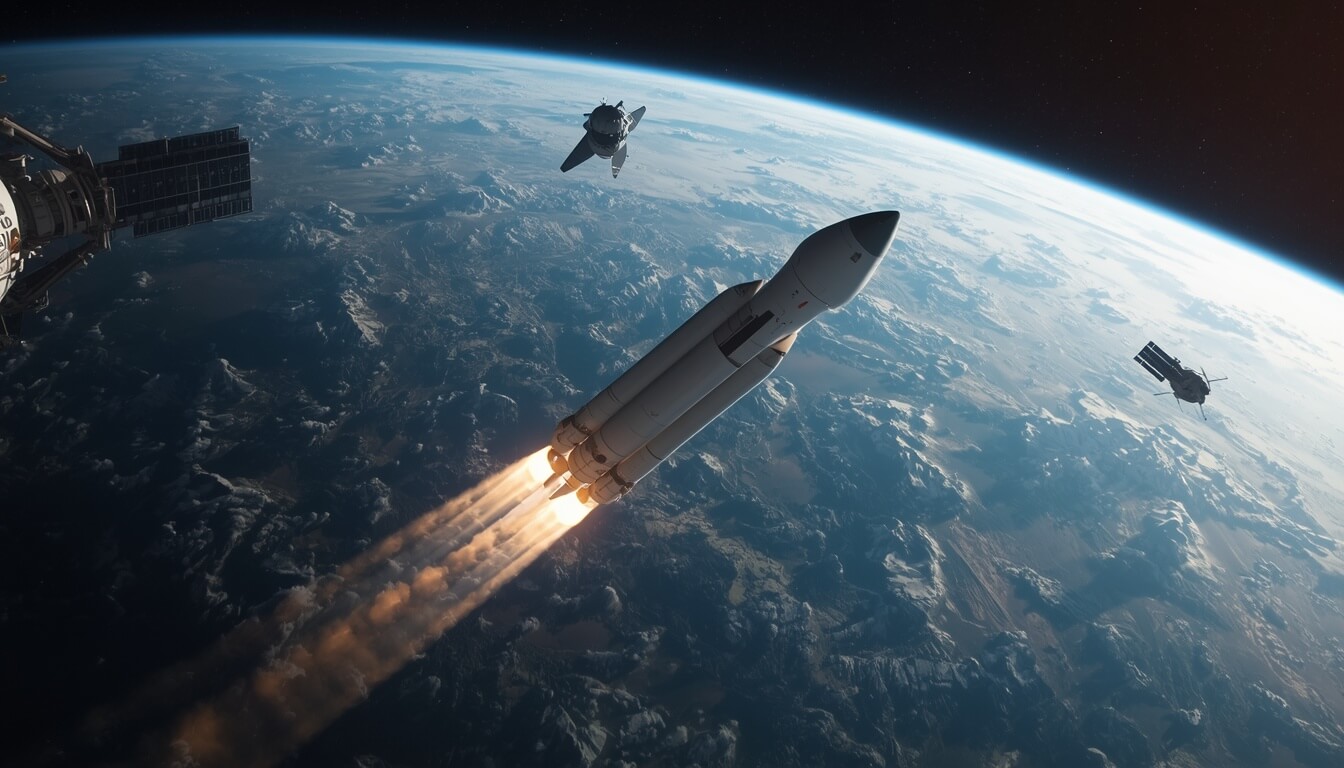
For decades, space was largely the domain of governments, national space agencies and a small number of major aerospace contractors. Launching a satellite required enormous budgets, specialized infrastructure and years of development. Commercial activity existed, but it was generally built around government-funded programs.
That model is changing.
A new space economy is emerging as private companies develop launch systems, satellite networks, Earth observation platforms, communications infrastructure and other technologies designed for commercial markets. Falling launch costs, smaller satellites, reusable rockets and advances in software are making it possible to build businesses around space-based infrastructure rather than treating space primarily as a government-funded scientific frontier.
The result is a gradual shift from a government-led space industry toward a broader commercial ecosystem.
The most important change may not be a single technological breakthrough. It may be the gradual industrialization of space — as infrastructure becomes cheaper, more standardized and more accessible.
From Government Programs to Commercial Infrastructure
The traditional space industry was built around large, highly specialized projects. Governments funded expensive missions, contracted aerospace companies to build spacecraft and controlled much of the infrastructure required to reach orbit.
Commercial space companies are increasingly approaching the market differently.
Instead of developing a single spacecraft for a specific government mission, companies can build fleets of satellites serving thousands or millions of customers. Instead of designing an expendable launch vehicle for occasional missions, launch providers can pursue reusable systems capable of flying much more frequently.
This creates a fundamentally different economic model.
Space infrastructure can increasingly resemble other technology industries: large upfront investments are followed by recurring revenue from communications, data, connectivity, navigation, observation and other services.
The transition is not happening uniformly. Launch services, satellite communications and Earth observation are already commercial markets, while areas such as in-space manufacturing and large-scale orbital infrastructure remain much earlier in their development.
The companies driving this transition are examined in The Companies Building the Next Generation of Space Infrastructure.
Why Launch Costs Matter
One of the most important changes in the space economy has been the reduction in the cost and complexity of reaching orbit.
Reusable launch technology has demonstrated that rockets do not necessarily have to be discarded after every mission. Reusability can increase launch frequency while reducing the amount of hardware that must be manufactured for each flight.
Lower launch costs have broader consequences than simply making rocket launches cheaper.
When launching a satellite becomes less expensive, companies can deploy larger constellations, replace spacecraft more frequently and experiment with new commercial services. Investors and entrepreneurs can also consider business models that would have been difficult to justify when every kilogram placed into orbit was extremely expensive.
The effect is similar to what happened in other technology industries when infrastructure costs declined: previously impractical applications become economically possible.
However, launch costs are only one part of the equation. Satellites must still be designed, manufactured, insured, operated and eventually replaced. Ground infrastructure and regulatory requirements also influence the economics of a space-based business.
Satellites Are Becoming Digital Infrastructure
Satellites were once primarily associated with television broadcasting, military communications and scientific observation.
Today, satellite systems are increasingly integrated with digital services:
- Earth observation satellites can collect imagery and environmental data used by agriculture, logistics, insurance, mapping and infrastructure companies.
- Communications satellites can provide connectivity to areas where terrestrial networks are difficult or expensive to deploy.
- Navigation satellites support transportation, logistics and countless applications embedded in smartphones and connected devices.
This means the value of a satellite is increasingly determined not only by the hardware itself but also by the data and services generated by that hardware.
A modern satellite business can therefore look more like a technology platform than a traditional aerospace project.
Companies can combine satellites, cloud computing, artificial intelligence and software to transform raw observations into commercially useful information. This creates opportunities across industries that may have little direct connection to aerospace.
The Rise of Satellite Constellations
Another major development is the shift from individual satellites toward large constellations.
A single satellite has obvious limitations. Its coverage is constrained by its orbit, location and available capacity. A network of satellites can provide more continuous coverage and greater redundancy.
This approach is particularly important for communications.
Large constellations can potentially provide broadband connectivity over large geographic areas, including locations where terrestrial infrastructure is limited. Similar networks can support specialized applications such as maritime communications, aviation connectivity and remote industrial operations.
Constellations also change the economics of satellite manufacturing. Instead of producing one extremely expensive spacecraft, companies can manufacture many standardized spacecraft using more industrialized processes.
This introduces concepts familiar from the electronics and automotive industries:
- Repetition
- Standardization
- Automation
- Economies of scale
Space Becomes Part of the Broader Infrastructure Economy
The emerging space economy should not be viewed as an isolated industry.
Its development is increasingly connected to telecommunications, energy, computing, logistics, defense, agriculture, finance and industrial infrastructure.
| Space service | Industry connection |
|---|---|
| Satellite imagery | Commodity analysis and agricultural monitoring |
| Satellite connectivity | Remote operations and industrial sites |
| Positioning data | Logistics networks and transportation |
| Space-based sensors | Weather, oceans and infrastructure monitoring |
As these services become embedded in other industries, demand for space infrastructure can grow even when customers do not consider themselves part of the space sector.
This creates an important distinction between the traditional space industry and the new space economy.
The traditional model often focused on selling spacecraft, rockets or government contracts. The emerging model increasingly focuses on selling services enabled by space infrastructure.
Private Capital Is Changing the Development Cycle
Commercial space companies also have access to forms of financing that were less important in the traditional space industry.
Venture capital, private equity and strategic corporate investment can finance companies developing launch systems, satellite constellations, Earth observation technologies and other space-related businesses.
Private investment does not eliminate the enormous technical risks associated with space. Rockets can fail, satellites can malfunction and regulatory or market conditions can change.
But private capital allows companies to pursue commercial opportunities without relying exclusively on government procurement.
Government customers nevertheless remain important. Public-sector contracts can provide early revenue, validation and long-term demand, particularly for technologies that require significant capital before commercial markets reach sufficient scale.
The emerging industry is therefore better understood as a combination of public and private demand rather than a complete replacement of government involvement.
The Next Stage: More Than Satellites
The commercial space economy is still heavily centered on launch and satellite infrastructure. But the longer-term opportunity could extend much further.
Companies are investigating technologies related to:
- In-space servicing
- Orbital logistics
- Space stations
- Advanced propulsion
- Manufacturing in microgravity
These developments could create an entirely new layer of economic activity beyond simply putting satellites into orbit.
If transportation to orbit becomes more routine and orbital infrastructure expands, companies could eventually use space as an industrial environment rather than only as a location for telecommunications and observation equipment.
That possibility raises questions about what products could be manufactured in space, which industries might benefit and whether the economics can support large-scale operations.
These questions form the basis for From Satellites to Space Manufacturing: What Could the Next Space Economy Look Like?.
Challenges Could Limit the Expansion
The commercial space economy faces substantial obstacles.
Launching spacecraft remains expensive. Satellites have finite operating lives and must survive a harsh environment. Orbital congestion and space debris create operational risks. Spectrum allocation and national regulations can constrain the deployment of satellite networks.
There is also a fundamental economic challenge: not every technically possible space application will become a profitable business.
A company may be able to build a sophisticated spacecraft, but that does not guarantee sufficient demand to recover development and deployment costs. Large constellations can require billions of dollars of capital before reaching scale.
For this reason, the future of the space economy will depend as much on business models as on engineering breakthroughs.
A New Commercial Frontier
The space industry is moving toward a model in which rockets, satellites and orbital infrastructure increasingly function as components of broader commercial services.
Lower launch costs, reusable systems, standardized satellites, large constellations and growing demand for space-derived data are creating the foundations for this transition.
As infrastructure becomes cheaper, more standardized and more accessible, additional companies can enter the market and develop applications that were previously difficult to justify economically.
The new space economy is still developing, and many of its most ambitious opportunities remain uncertain. But the direction is increasingly clear: space is becoming not only a destination for exploration, but also a potential platform for communications, data, infrastructure and eventually industrial activity.
The companies building this infrastructure will help determine how quickly that transition develops—and which parts of the emerging space economy ultimately become commercially viable.