
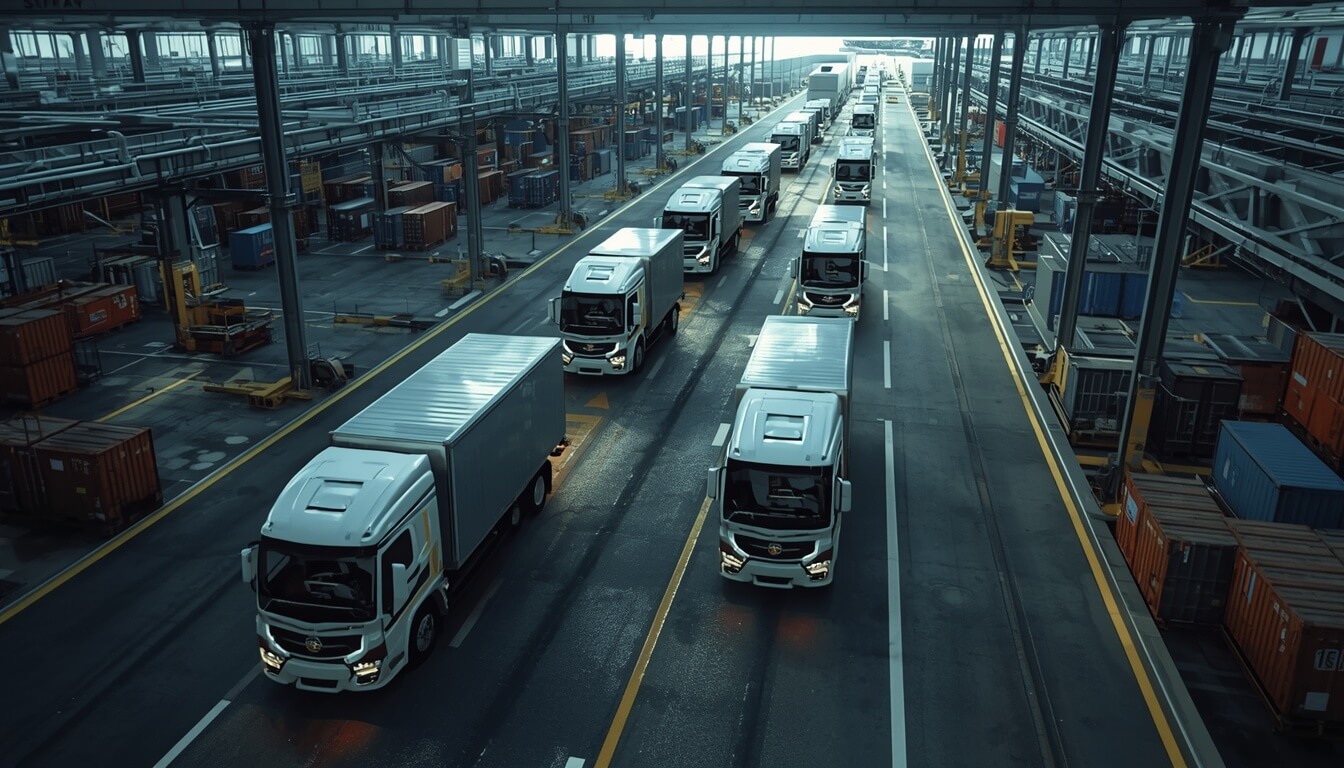
Autonomous vehicles could change transportation in ways that extend far beyond replacing the human driver.
If autonomous systems become reliable and economically viable at scale, the effects could reach almost every part of the transportation ecosystem. Passenger mobility, freight, last-mile delivery, warehouses, ports and distribution networks could all be reorganized around vehicles capable of operating with limited or no human intervention.
The transformation would not happen overnight. Autonomous transportation is likely to develop gradually, beginning with specific routes, operating areas and commercial applications before expanding into more complex environments.
The technology itself is only one part of the equation. Infrastructure, regulation, economics, fleet management and consumer behavior will all influence how quickly autonomous vehicles become integrated into everyday transportation.
The first two articles in this series examined the development of autonomous driving and the companies building the industry. For an overview of the technology and its current state, see The Rise of Autonomous Vehicles: How Close Are We to Driverless Transport. The companies developing the technology and competing across different parts of the market are examined in The Companies Building the Autonomous Driving Industry.
The most important change may not be the ability of an individual vehicle to drive itself. The larger opportunity lies in connecting autonomous vehicles with transportation networks.
From Self-Driving Cars to Autonomous Networks
Today, transportation depends heavily on human availability. A taxi requires a driver, a truck requires a driver, and many delivery operations depend on employees moving goods between distribution centers and customers.
Autonomous vehicles could potentially separate transportation from human driving labor.
A vehicle could be dispatched automatically, travel to a pickup location, transport passengers or goods, and continue to another assignment without requiring a driver for every journey.
This could allow transportation companies to manage vehicles more like fleets of automated assets.
The result would be a shift from individually operated vehicles toward coordinated transportation systems.
Autonomous Ride-Hailing
One of the most visible applications is autonomous ride-hailing.
Robotaxis could provide transportation without a human driver and could be dispatched through digital platforms in much the same way that ride-hailing services are ordered today.
If autonomous fleets become sufficiently reliable, operators could potentially keep vehicles in service for longer periods and coordinate them according to demand.
This could change the economics of urban mobility.
Instead of every passenger requiring a privately owned car, some people could increasingly rely on autonomous vehicles when they need transportation. A vehicle could serve multiple passengers throughout the day rather than remaining parked for most of its useful life.
However, the effect would depend heavily on how the services are priced and used.
| Scenario | Potential outcome |
|---|---|
| Autonomous trips become substantially cheaper | People travel more frequently and vehicle usage increases |
| Autonomous fleets are efficiently shared between multiple passengers | The number of vehicles required for a given level of transportation could decline |
The outcome is therefore not predetermined. Autonomous vehicles could reduce some inefficiencies while creating additional demand for transportation.
Changes to Vehicle Ownership
The widespread adoption of autonomous mobility could also influence the traditional concept of car ownership.
A privately owned vehicle spends most of its time parked. An autonomous vehicle, by contrast, could potentially transport other passengers or perform other services when its owner does not need it, assuming regulations and business models allow such use.
This could create new forms of vehicle utilization.
People could continue owning vehicles but use autonomous systems to share them during periods of inactivity. Alternatively, some consumers could decide that owning a vehicle is less necessary if autonomous transportation services are available on demand.
Urban areas with extensive robotaxi networks could therefore experience changes in parking demand and vehicle ownership patterns.
These changes would likely vary significantly between cities, depending on public transportation, population density, road infrastructure and local regulations.
Autonomous Trucks and Freight Transportation
Freight transportation may become one of the most economically significant applications of autonomous vehicles.
Long-haul trucking involves repetitive routes, substantial operating costs and strict scheduling requirements. Autonomous technology could potentially allow trucks to operate without a human driver on suitable routes and under defined conditions.
This does not necessarily mean that trucks would immediately travel everywhere without human involvement.
A more gradual model could involve autonomous trucks operating between logistics hubs, where routes and operating conditions are easier to control. Human drivers or other workers could then handle more complex local transportation.
An autonomous truck could transport a trailer hundreds of kilometers between two distribution centers. At the destination, a human-driven vehicle could complete the final delivery to a customer.
This approach could allow logistics companies to introduce autonomous technology without requiring the entire transportation chain to become automated at once.
The Last Mile
The final stage of delivery is often one of the most complicated parts of logistics.
A large truck can efficiently transport thousands of products over long distances, but individual packages still need to reach homes, offices and businesses.
Autonomous delivery vehicles could potentially address part of this problem.
Small autonomous vehicles or delivery robots could transport packages over short distances, while larger autonomous vans could serve multiple addresses on a route.
The economics would depend on the cost of the technology, vehicle utilization and the density of deliveries.
High-density urban areas could be particularly interesting because one autonomous vehicle could potentially serve many customers within a relatively small geographic area.
At the same time, autonomous delivery systems would still need to deal with sidewalks, pedestrians, traffic, weather, building access and other practical challenges.
Warehouses and Distribution Centers
Autonomous transportation does not have to begin on public roads.
Warehouses, distribution centers and industrial facilities are controlled environments where autonomous systems can operate under more predictable conditions.
Automated guided vehicles and autonomous mobile robots are already used in logistics operations to move goods, transport containers and support warehouse workflows.
The development of road-going autonomous vehicles could connect these systems more closely.
A future logistics network could potentially operate as a continuous automated chain:
warehouse → autonomous yard vehicle → autonomous truck → distribution center → autonomous delivery vehicle → customer
Each stage could communicate with the others through software systems managing inventory, routing and vehicle availability.
This would transform autonomous driving from an isolated vehicle technology into part of an automated supply chain.
Ports and Industrial Transportation
Ports are another environment where autonomous transportation could have a significant role.
Large ports involve repetitive movements of containers between ships, storage areas, rail terminals and trucks. These operations often take place along defined routes and within controlled facilities.
Autonomous trucks and yard vehicles could potentially move containers between different parts of a port with limited human intervention.
Similar applications could exist in mining, agriculture, construction and other industrial environments.
These environments are particularly relevant because they do not require an autonomous vehicle to solve every problem encountered on a public road.
Instead, operators can define the operating area, infrastructure and rules within which the vehicle must function.
This can make automation easier to deploy while providing real-world experience that can contribute to broader autonomous-driving development.
Infrastructure Could Change Too
The adoption of autonomous vehicles could influence infrastructure design.
Roads may eventually incorporate additional digital information, improved markings, connected traffic systems or dedicated infrastructure for automated transportation.
Traffic signals and road-management systems could potentially exchange information with vehicles, although autonomous vehicles do not necessarily require every road to become digitally connected.
Parking infrastructure could also change.
If autonomous vehicles can leave passengers and continue to another assignment, demand for parking near offices, shopping areas and transportation hubs could change.
Some parking facilities could potentially be converted to other uses, while dedicated charging and fleet-maintenance facilities could become increasingly important for electric autonomous fleets.
Electric Vehicles and Autonomous Transportation
Autonomous driving and vehicle electrification are separate technologies, but they can complement each other.
Electric vehicles are well suited to fleet applications because they can have lower energy and maintenance requirements than conventional combustion vehicles under certain operating conditions.
Fleet operators can also manage charging centrally.
An autonomous electric fleet could therefore be coordinated around charging schedules, vehicle utilization and passenger or freight demand.
For example, software could assign a vehicle to a passenger, complete the trip, send the vehicle to a charging station and then return it to service when sufficient energy is available.
This level of coordination is more difficult when vehicles are privately owned and operated independently.
The combination of electrification, automation and fleet-management software could therefore create a broader transportation platform rather than simply a collection of individual vehicles.
The Economics of Automation
The potential economic impact of autonomous transportation depends on more than eliminating the cost of a driver.
Vehicle utilization, maintenance, insurance, energy consumption, software, remote assistance, fleet management and infrastructure all contribute to operating costs.
An autonomous vehicle may require expensive sensors and computing hardware, particularly during the early stages of commercialization.
The economic equation could change as production volumes increase and technology becomes more standardized.
For logistics companies, even relatively modest reductions in operating costs could become significant when multiplied across large fleets and long distances.
However, automation will only create economic benefits if autonomous vehicles can operate reliably enough to achieve high utilization.
A vehicle that spends significant amounts of time waiting for human intervention, operating under narrow conditions or undergoing expensive maintenance may not deliver the expected advantages.
Employment and the Workforce
Transportation is also a major source of employment, which means automation could have important labor-market consequences.
Truck drivers, taxi drivers, delivery drivers and other transportation workers could see their roles change as autonomous systems become more capable.
The effects would not necessarily be limited to job losses.
New roles could emerge in fleet supervision, autonomous-system maintenance, remote assistance, vehicle servicing, data operations and infrastructure management.
Some transportation jobs could also evolve rather than disappear completely. Human workers may increasingly handle tasks that autonomous systems cannot perform reliably, such as complex loading, customer interaction or unusual delivery situations.
The scale and timing of these changes remain uncertain and would depend on technological adoption, regulation and economic incentives.
Safety and Road Capacity
One of the arguments for autonomous transportation is the possibility of reducing accidents caused by human error.
Autonomous systems do not become tired, distracted or impaired in the same way as human drivers. However, this does not mean autonomous vehicles are automatically safe in every circumstance.
Sensors can fail. Software can make mistakes. Unexpected situations can challenge the system, and cybersecurity represents an additional concern.
The relevant question is therefore not whether autonomous vehicles are perfect, but whether their overall performance can meet the safety requirements established for their operating environments.
Traffic capacity could also change.
If autonomous vehicles can maintain more consistent speeds and distances, traffic flows could potentially become more efficient in some situations. But if autonomous ride-hailing increases the number of vehicle trips, congestion could also increase.
The final result will depend on how autonomous vehicles are integrated with public transportation and urban planning.
Cities Could Be Reshaped
The long-term effects could extend into city design.
If fewer people need to own cars, some cities could potentially reduce the amount of land dedicated to parking.
If autonomous vehicles can efficiently transport passengers between public transportation stations and final destinations, they could also complement buses and rail systems.
This could create a more interconnected mobility network.
Autonomous vehicles might therefore function not as a replacement for public transportation but as an additional layer connecting different modes of transport.
For example, an autonomous shuttle could transport passengers from a residential area to a railway station, reducing the need for private car ownership while extending the effective reach of the rail network.
A New Logistics Architecture
The biggest transformation may ultimately occur behind the scenes.
Today's supply chains involve numerous handoffs between manufacturers, warehouses, freight companies, distribution centers and delivery services.
Autonomous transportation could reduce some of the friction between these stages.
Vehicles could be dispatched automatically based on inventory levels, delivery deadlines and available capacity. Logistics software could continuously optimize routes and assign vehicles to tasks.
A distribution center could potentially receive goods from autonomous trucks, process them using automated warehouse systems and dispatch autonomous delivery vehicles without requiring every stage to be coordinated manually.
This would bring transportation closer to the broader concept of an automated supply chain.
The Limits of the Transformation
Despite the potential, autonomous vehicles will not eliminate every transportation challenge.
Human supervision may remain necessary in many environments. Severe weather, unusual road conditions, construction zones and unexpected incidents can still create difficult situations.
Regulatory restrictions could also limit deployment.
Economic factors will matter as well. Companies will adopt autonomous systems when the technology provides sufficient value relative to its cost and operational complexity.
For some applications, conventional vehicles with human drivers may remain more practical for many years.
Autonomous transportation should therefore be viewed as an additional technological layer that will gradually expand into areas where its benefits justify the investment.
From Vehicles to Transportation Systems
The development of autonomous vehicles could ultimately change the way transportation is organized.
The most significant shift may not be that cars and trucks can drive without humans.
It may be that transportation becomes increasingly managed by software.
Vehicles could be assigned dynamically, routes could be optimized continuously, charging could be coordinated automatically, and logistics networks could respond to demand in real time.
This would connect autonomous driving with artificial intelligence, cloud computing, electric vehicles, robotics and digital logistics platforms.
The result could be a transportation system in which vehicles are no longer isolated machines but components of a larger automated network.
The Long-Term Outlook
Autonomous vehicles are unlikely to transform transportation in a single step.
The transition will probably occur through specific applications and operating environments. Warehouses, ports, industrial facilities, dedicated logistics routes and defined urban areas may see increasing automation before fully autonomous vehicles become common everywhere.
Passenger transportation and freight logistics may develop along different timelines and business models.
What is clear is that autonomous driving has the potential to influence far more than the automotive industry.
It could affect how people travel, how goods move between continents, how warehouses operate, how cities allocate space and how companies organize their supply chains.
The ultimate impact will depend on a combination of technological progress, economics, regulation and public adoption.
Autonomous vehicles therefore represent not simply a new generation of automobiles, but a potential transition toward transportation systems in which vehicles, infrastructure and logistics networks increasingly operate as one connected ecosystem.