
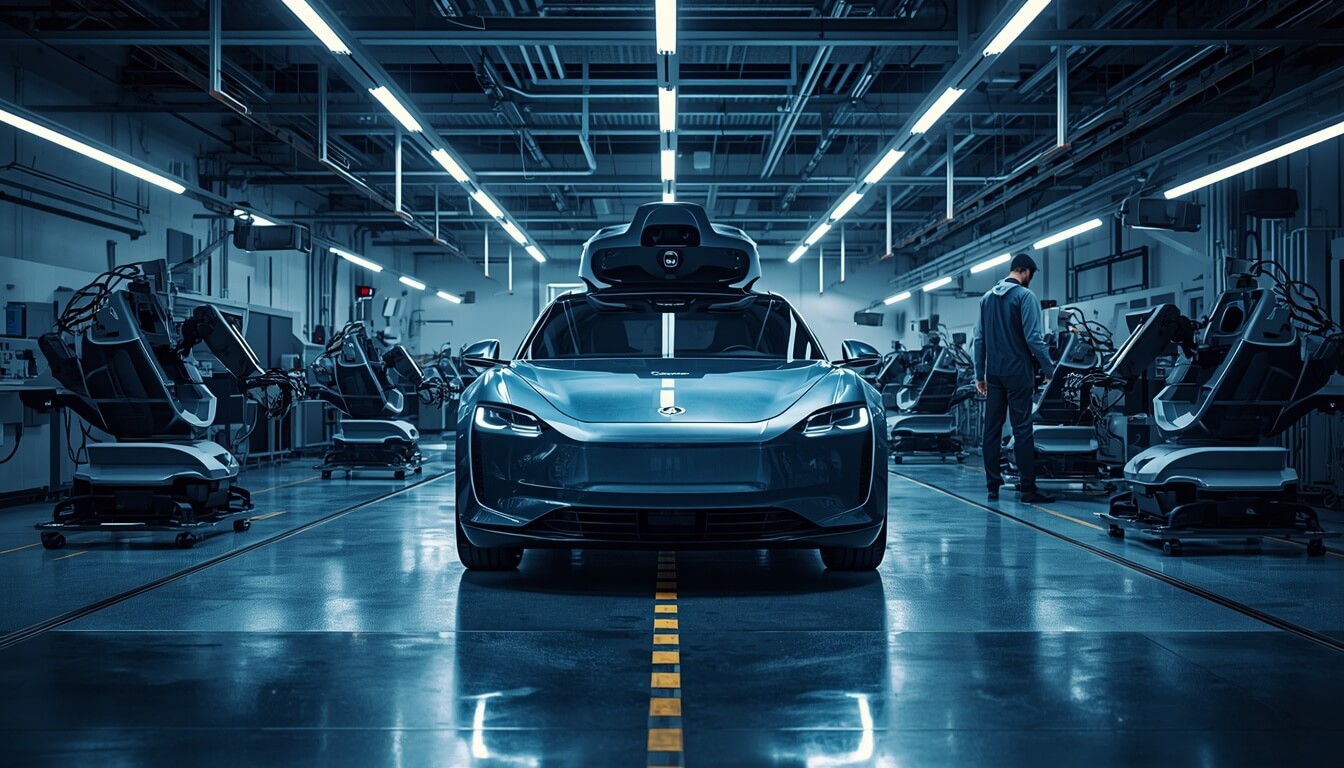
The autonomous driving industry is no longer being shaped by a single type of company.
Automakers, technology companies, artificial intelligence specialists, semiconductor manufacturers, mobility platforms and autonomous trucking startups are all competing to define how driverless transportation will develop. Some companies are building complete autonomous vehicles and operating their own fleets, while others are developing software and hardware that can eventually be integrated into vehicles produced by traditional manufacturers.
This diversity reflects the complexity of autonomous driving. Creating a vehicle capable of navigating the real world requires far more than a sophisticated algorithm. Sensors, computing hardware, artificial intelligence, mapping, vehicle engineering, fleet management, connectivity and regulatory compliance all have to work together.
The result is an emerging industrial ecosystem rather than a conventional automotive market.
Autonomous driving is not a single market. It is a stack of technologies — sensors, computing, AI, mapping, vehicles, and fleet operations — each shaped by different companies.
Waymo and the Robotaxi Model
Among the companies pursuing fully autonomous passenger transportation, Waymo occupies a distinctive position.
The Alphabet-owned company originated from Google's self-driving car project and has spent more than a decade developing its autonomous driving technology. Its Waymo Driver combines sensors, computing, artificial intelligence and detailed mapping to operate vehicles without a human driver in defined service areas.
Waymo's strategy is centered on autonomous ride-hailing rather than selling self-driving technology directly to individual consumers.
The company has progressively expanded commercial operations and partnerships while continuing to develop the underlying autonomous system. In 2026, Waymo announced plans to prepare for autonomous ride-hailing operations in Munich, illustrating how the company is beginning to expand beyond its established U.S. operating environments.
This model has an important implication for the economics of autonomous driving. Instead of selling a vehicle with autonomous capabilities once, a company operating a robotaxi fleet can potentially generate recurring revenue from every trip.
At the same time, the model requires significant investment in vehicles, maintenance, charging, fleet operations and local infrastructure.
Waymo's development therefore illustrates one of the industry's central questions: whether autonomous driving will primarily become a feature integrated into privately owned vehicles or a service accessed through commercial fleets.
Amazon's Zoox and the Purpose-Built Vehicle
Amazon's Zoox is pursuing another approach to autonomous mobility.
Rather than simply adapting an existing passenger vehicle, Zoox has developed a purpose-built robotaxi designed specifically for autonomous transportation. Its vehicle architecture eliminates the traditional front and rear orientation and is designed around passengers rather than a human driver.
In July 2026, Zoox received federal approval in the United States for paid operation of its steering-wheel-free robotaxis, an important regulatory milestone for purpose-built autonomous vehicles. The approval allows deployment under specific conditions and does not authorize the company to sell these vehicles directly to consumers.
The Zoox approach highlights a fundamental difference between autonomous vehicles and conventional cars.
If a vehicle does not require a human driver, many traditional design assumptions can change. Interior space can be reorganized, controls can be reduced or eliminated, and the vehicle can be optimized around passenger transportation.
This could eventually lead to vehicle designs that look substantially different from today's automobiles.
Tesla's Integrated Approach
Tesla represents another major strategy.
Instead of focusing exclusively on a separate robotaxi fleet, the company has developed driver-assistance and autonomous-driving capabilities around vehicles that are already part of its consumer product ecosystem.
Tesla's approach places significant emphasis on cameras, artificial intelligence and large-scale data collection from vehicles operating in the real world.
The strategic objective differs from companies whose primary product is a dedicated autonomous ride-hailing service. A system designed for millions of privately owned vehicles potentially creates a very different path to scale.
The distinction between advanced driver assistance and full autonomy remains important. A vehicle may perform increasingly sophisticated driving functions while still requiring human supervision.
This difference is one of the reasons comparisons between autonomous-driving companies can be misleading. They may be pursuing similar long-term objectives through fundamentally different technical and commercial strategies.
Mobileye: From Driver Assistance to Autonomy
Mobileye occupies another important position in the autonomous-driving ecosystem.
The company, majority-owned by Intel, has historically been a major supplier of advanced driver-assistance technology to automakers. Its business model has therefore been closely connected to integrating technology into vehicles produced by other manufacturers.
Mobileye continues to develop systems for higher levels of automation, including autonomous driving and robotaxi applications. At CES 2026, the company presented developments across advanced driver assistance, autonomous driving and physical AI.
In June 2026, Mobileye also announced plans to establish a vertically integrated robotaxi business in the United States, expanding beyond its traditional role as a technology supplier. The planned operation combines autonomous-driving technology with fleet and mobility services.
This evolution illustrates how the boundaries between automotive suppliers and mobility companies are becoming less distinct.
A company can provide software and sensors to automakers while simultaneously developing its own autonomous transportation service.
Aurora and Autonomous Trucking
Passenger robotaxis receive considerable public attention, but autonomous freight transportation may become another major application of the technology.
Aurora Innovation is one of the companies focusing heavily on this segment.
The company is developing the Aurora Driver, an autonomous driving system designed for multiple vehicle types, including freight trucks and passenger vehicles. Its commercial strategy includes working with trucking companies, vehicle manufacturers, logistics providers and other transportation businesses.
In July 2026, Aurora launched a new generation of driverless trucks operating without a person behind the wheel. The company said the launch marked the beginning of its commercial scaling phase and was targeting hundreds of driverless trucks in operation by the end of the year.
Autonomous trucking presents a different economic proposition from robotaxis.
| Segment | Operating characteristics |
|---|---|
| Robotaxis | Urban, on-demand, consumer-facing, variable routes |
| Autonomous trucking | Defined long-distance routes, commercial contracts, freight-focused |
Freight transportation already operates according to defined routes, schedules and commercial contracts. Long-distance trucking also represents a significant labor and operating cost for logistics companies.
Autonomous technology could therefore be integrated into freight networks in ways that are different from passenger mobility.
The implications for logistics are explored more extensively in How Autonomous Vehicles Could Transform Transportation and Logistics.
Wayve and the Software-Licensing Model
Not every autonomous-driving company wants to operate its own fleet.
British startup Wayve is developing an AI-centered approach based on end-to-end driving models and is pursuing partnerships with automakers and mobility companies rather than building a large consumer vehicle fleet itself. Recent agreements with major automotive companies have increased attention around this model.
The concept is similar in principle to other technology industries: develop a core technology platform and allow manufacturers or fleet operators to integrate it into their products.
If this model succeeds, autonomous-driving software could become a component supplied across multiple vehicle brands.
It would also allow automakers to concentrate on vehicle design and manufacturing while technology companies focus on artificial intelligence and autonomous driving.
Nvidia and the Computing Layer
Autonomous vehicles also depend on companies that may not manufacture vehicles at all.
High-performance computing is essential because autonomous systems must process enormous quantities of sensor information in real time.
Nvidia has become one of the most important technology suppliers in this area, providing computing platforms designed for automotive artificial intelligence and autonomous driving.
This creates another layer in the industry.
An autonomous vehicle may combine hardware from semiconductor companies, sensors from specialized suppliers, software from an autonomous-driving company and a vehicle platform from a traditional automaker.
The final product is therefore increasingly the result of collaboration between multiple technology ecosystems.
Traditional Automakers Are Becoming Technology Integrators
Automotive manufacturers remain central to the development of autonomous transportation.
Companies such as Mercedes-Benz, Toyota, Volkswagen, General Motors and others have invested in autonomous-driving programs, partnerships and advanced driver-assistance technologies.
The relationship between automakers and autonomous-driving specialists is evolving rapidly.
Some manufacturers develop substantial portions of their technology internally. Others rely more heavily on external software and AI companies.
A recent example is Mercedes-Benz's partnership with Wayve, announced in September 2026, under which Wayve's autonomous-driving technology is expected to be integrated into future Mercedes vehicles.
This type of partnership demonstrates why the autonomous-driving industry should not be viewed simply as a competition between individual companies.
The future vehicle may depend on a network of specialized companies, each responsible for a different part of the technology stack.
The Autonomous Vehicle Technology Stack
The industry can therefore be divided into several interconnected layers.
| Layer | What it provides |
|---|---|
| Vehicle platform | Chassis, electric systems, braking, steering, safety structures |
| Sensors | Cameras, radar, LiDAR, and other perception technologies |
| Computing | High-performance processing of sensor data in real time |
| AI software | Interpretation of the environment and driving decisions |
| Mapping and positioning | Information about roads, locations and spatial context |
| Fleet and mobility | Commercial services connecting vehicles with passengers or freight |
This structure means that success in autonomous transportation may not belong exclusively to the company with the most advanced vehicle.
It may instead depend on how effectively different parts of the ecosystem can be integrated.
Different Roads to the Same Destination
The autonomous-driving industry is therefore developing through several competing models.
Waymo is building a large-scale autonomous ride-hailing service. Zoox is developing purpose-built robotaxis. Tesla is integrating advanced driving technology into a large consumer vehicle ecosystem. Mobileye is combining its traditional technology-supplier role with new autonomous mobility initiatives. Aurora is concentrating heavily on autonomous freight transportation, while companies such as Wayve are pursuing AI platforms that can be integrated into vehicles and mobility services.
These strategies are not necessarily mutually exclusive.
The eventual transportation market could contain all of them.
Private cars could use increasingly sophisticated automated systems, robotaxis could operate in cities, autonomous trucks could transport freight between logistics hubs, and specialized autonomous vehicles could operate in ports, warehouses and industrial environments.
The technology developed for one application may also accelerate progress in another.
From Autonomous Vehicles to Autonomous Transportation
The emergence of these companies suggests that autonomous driving is becoming larger than the concept of a self-driving car.
The real transformation could involve the automation of entire transportation networks.
Vehicles could communicate with fleet-management systems, logistics companies could redesign distribution routes, cities could adapt infrastructure for autonomous mobility, and passengers could access transportation without owning a vehicle.
The consequences could extend into urban planning, freight logistics, employment, vehicle ownership and energy consumption.
Understanding these potential effects requires moving beyond the companies themselves and examining how autonomous vehicles could change the way people and goods move.
That broader question is the focus of How Autonomous Vehicles Could Transform Transportation and Logistics.
An Industry Still Taking Shape
The autonomous-driving market remains an evolving technological and industrial ecosystem.
There is no single architecture, business model or company that defines the entire sector. Different organizations are making different choices about sensors, artificial intelligence, vehicle design, fleet ownership, partnerships and commercialization.
What they have in common is the attempt to solve one of the most complex problems in modern technology: enabling machines to navigate the physical world safely and reliably.
The next phase of development will increasingly be measured not only by demonstrations or experimental vehicles, but by commercial deployments, operating scale, regulatory approval and the ability to make autonomous transportation economically viable.
As these systems move from controlled testing environments into real transportation networks, their impact will extend far beyond the automotive industry.
The companies building the technology are effectively competing to define the infrastructure and business models of a future in which transportation may become increasingly automated.