
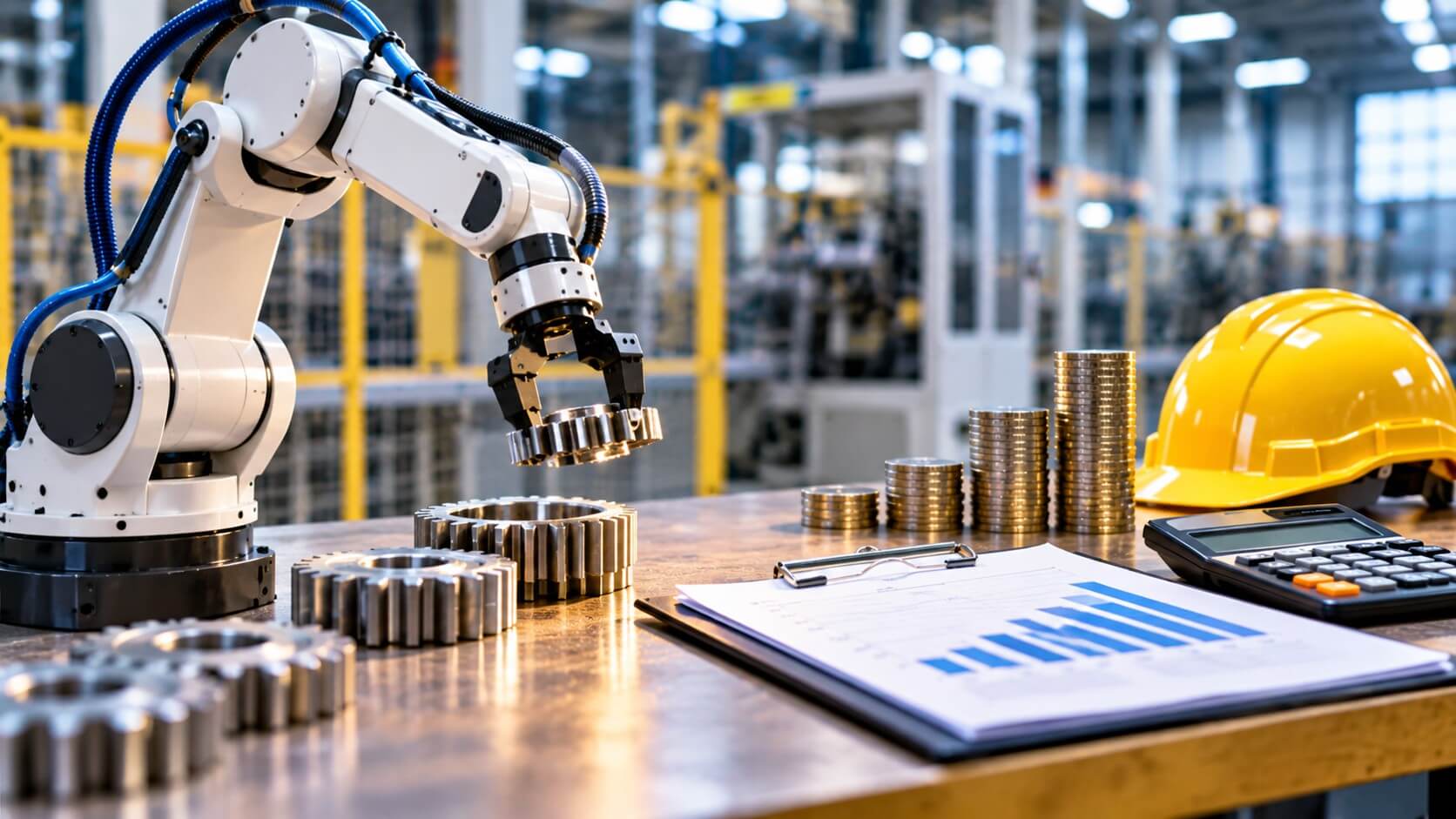
An industrial robot can cost anywhere from approximately $20,000 to more than $150,000 for the robot itself, depending on its size, payload capacity, precision, and intended application. Smaller robotic arms may cost less, while large industrial robots designed for heavy manufacturing can be considerably more expensive.
However, the purchase price is only part of the investment. Once installation, programming, safety equipment, tooling, and integration are included, a complete robotic workstation can cost $50,000 to $250,000 or more. Complex automated production lines can require substantially larger budgets.
For manufacturers, the important question is not simply how much a robot costs, but whether the productivity improvements, labor savings, and operational benefits justify the total investment.
For investors, understanding these costs helps explain how industrial robotics companies generate revenue, why some customers delay automation projects, and which parts of the industry may benefit as adoption expands.
What Is the Average Price of an Industrial Robot?
Industrial robots vary considerably in price because they are designed for different manufacturing tasks.
A small robot used to move lightweight components is fundamentally different from a large robotic arm designed to weld automobile bodies or handle heavy industrial materials.
The following ranges provide an illustrative overview of equipment costs rather than standardized manufacturer quotations.
| Robot type | Approximate robot price | Common applications |
|---|---|---|
| Small industrial robotic arm | $20,000–$50,000 | Light assembly, small-part handling |
| Collaborative robot | $20,000–$60,000 | Flexible automation, machine tending |
| Medium industrial robot | $40,000–$100,000 | Welding, assembly, material handling |
| Heavy-duty industrial robot | $80,000–$150,000+ | Automotive production, heavy material handling |
| Specialized industrial robot | Varies widely | Painting, precision processing, custom applications |
These figures are broad planning estimates, not verified current price lists. Actual quotations depend on the manufacturer, model, configuration, location, and commercial terms.
The prices generally refer to the robot and its basic control equipment, not a fully operational production system.
That distinction is essential.
A robot may be affordable as an individual machine but expensive to deploy in an existing factory.
What Determines the Price of an Industrial Robot?
Several factors influence how much a manufacturer pays for robotic equipment.
Payload Capacity
Payload refers to the maximum weight a robot can safely handle under specified operating conditions.
A robot designed to move lightweight electronic components generally requires less mechanical strength than one handling heavy automotive parts.
Higher payload requirements can increase the size, complexity, and price of the equipment.
However, payload alone does not determine cost.
Reach and Working Area
A robot's reach describes how far its arm can extend.
Robots with longer reach may require larger structures, more powerful motors, and additional engineering.
Factories must choose equipment capable of reaching the required work areas without compromising precision or safety.
Precision and Repeatability
Some manufacturing applications require extremely consistent movements.
Electronics assembly, precision machining, and certain inspection processes may demand higher levels of accuracy.
More demanding performance requirements can increase equipment costs.
Speed and Performance
High-volume manufacturing environments often require robots capable of performing repeated movements quickly and reliably.
Equipment designed for demanding production schedules may cost more than robots intended for slower operations.
Software and Control Systems
Industrial robots require controllers and programming software.
Advanced functions such as machine vision, automated inspection, and adaptive movements can add to the overall cost.
Artificial intelligence may improve certain capabilities, but the economic value depends on whether those improvements justify the additional investment.
How Much Does It Cost to Install an Industrial Robot?
Installing an industrial robot can involve substantial additional spending.
The robot must be connected to the manufacturing process, programmed for specific tasks, and equipped with the appropriate safety systems.
Typical expenses include:
- End-of-arm tooling: Grippers, welding tools, suction systems, or specialized attachments.
- Installation: Mechanical positioning, electrical connections, and equipment setup.
- Programming: Configuring movements, production sequences, and interactions with other machinery.
- Safety equipment: Guards, sensors, emergency stops, and protective systems.
- System integration: Connecting the robot to conveyors, machines, and factory software.
- Training: Preparing employees to operate and maintain the equipment.
- Testing: Verifying that the automated process meets production and safety requirements.
The complexity of the application determines how much these activities cost.
A straightforward machine-loading project may require relatively limited integration.
An automated welding station involving multiple robots, fixtures, and inspection systems can be considerably more expensive.
Example: The Cost of a Complete Robotic Workstation
Consider a hypothetical manufacturer planning to automate a repetitive material-handling task.
| Expense | Illustrative cost |
|---|---|
| Industrial robotic arm and controller | $45,000 |
| Gripper and tooling | $8,000 |
| Safety equipment | $12,000 |
| Installation and integration | $25,000 |
| Programming and testing | $10,000 |
| Training and initial setup | $5,000 |
| Total initial investment | $105,000 |
This example is illustrative and does not represent an actual supplier quotation.
It demonstrates why the complete automation project can cost more than twice the robot's purchase price.
For investors, this difference also reveals an important characteristic of the robotics industry.
Robot manufacturers are not the only businesses that generate revenue from automation projects.
Tooling suppliers, software developers, engineering companies, and system integrators can also benefit.
How Much Do Collaborative Robots Cost?
Collaborative robots, commonly called cobots, are designed for applications where robots may operate near people under appropriate safety conditions.
They are often used for:
- Machine loading and unloading.
- Light assembly.
- Packaging.
- Product inspection.
- Repetitive material handling.
- Small-batch manufacturing.
A typical collaborative robotic arm may cost approximately $20,000 to $60,000, although prices vary substantially by model and configuration.
Additional equipment and integration expenses still apply.
Are Cobots Cheaper Than Traditional Industrial Robots?
Not necessarily.
Some collaborative robots have relatively accessible purchase prices and can be easier to deploy in certain applications.
Their programming interfaces and flexible installation options may reduce implementation complexity.
However, cobots are not automatically cheaper than conventional industrial robots with comparable capabilities.
They may also have lower payload limits or operating speeds than robots designed for high-volume production.
Safety requirements do not disappear simply because a robot is marketed as collaborative.
A complete risk assessment remains necessary, and some applications still require protective equipment.
For manufacturers, the relevant comparison is the total cost and performance of the automated process, not the label attached to the robot.
How Much Does a Robotic Welding System Cost?
Robotic welding is one of the most established applications of industrial automation.
Automotive manufacturers, metalworking companies, and machinery producers use robotic welding systems to improve consistency and automate repetitive operations.
A robotic welding system generally includes more than a robotic arm.
Additional equipment can include:
- Welding power supplies.
- Welding torches and accessories.
- Workpiece fixtures.
- Positioning systems.
- Safety enclosures.
- Programming and control software.
- Fume extraction equipment.
A relatively simple robotic welding cell may require an investment of tens of thousands of dollars beyond the robot itself.
More sophisticated systems can cost hundreds of thousands of dollars.
Large automotive production lines using multiple coordinated robots can involve investments reaching millions of dollars.
The economics depend on production volume, welding complexity, equipment utilization, and the amount of manual work replaced or improved.
How Much Does Industrial Robot Maintenance Cost?
Industrial robots require ongoing maintenance to operate reliably.
Maintenance expenses depend on the robot's design, operating environment, workload, age, and service arrangements.
Common activities include:
- Lubrication and mechanical inspections.
- Replacement of worn components.
- Calibration and accuracy checks.
- Controller and software maintenance.
- Electrical inspections.
- Repair of motors, sensors, and drives.
- Preventive maintenance and technical support.
Some manufacturers purchase service contracts, while others maintain equipment using internal technical teams.
There is no universal annual maintenance percentage that accurately applies to every industrial robot.
A lightly used robot operating in a clean environment may have different requirements from a machine working continuously in a demanding manufacturing process.
Manufacturers should also consider the economic cost of unexpected downtime.
A robot failure can interrupt production, delay deliveries, and reduce the utilization of other equipment.
For investors, maintenance and aftermarket services are important because they can generate revenue after the initial equipment sale.
An established manufacturer with a large installed base may benefit from demand for replacement parts, repairs, and technical support.
How Long Does an Industrial Robot Last?
Industrial robots can remain operational for many years when properly maintained.
Some robots continue operating for well over a decade, although useful life varies by model, workload, maintenance practices, and production requirements.
A robot may also become economically outdated before it stops functioning.
For example, a manufacturer might replace working equipment because newer systems offer:
- Faster production cycles.
- Better energy efficiency.
- Improved programming capabilities.
- Greater flexibility.
- Better integration with factory software.
- Lower operating costs.
This creates two different sources of robotics demand.
The first is new automation, where a company installs robots for tasks previously performed manually.
The second is replacement and modernization, where existing automated equipment is upgraded.
Both can support industry revenue, although their importance changes with manufacturing investment cycles.
How Do Companies Calculate the Return on Investment of a Robot?
Manufacturers typically evaluate automation projects by comparing their costs with the financial benefits they expect to generate.
Potential benefits include labor savings, increased output, reduced defects, lower scrap rates, and improved equipment utilization.
A common starting point is the payback period.
The payback period estimates how long it takes for an investment to recover its initial cost through net annual savings.
Example: Industrial Robot Payback Period
Suppose a manufacturer invests $120,000 in a robotic workstation.
The company expects the system to generate $50,000 in annual operating benefits before accounting for $10,000 in additional annual operating and maintenance costs.
| Item | Hypothetical amount |
|---|---|
| Initial automation investment | $120,000 |
| Annual operating benefits | $50,000 |
| Additional annual operating costs | $10,000 |
| Net annual benefit | $40,000 |
| Simple payback period | 3 years |
The calculation is:
$120,000 ÷ $40,000 = 3 years.
This is a simplified example, not a forecast of typical industrial robot performance.
Actual investment decisions may also consider financing costs, taxes, depreciation, production variability, future repairs, and the time value of money.
A three-year payback may be attractive for one manufacturer but insufficient for another.
The outcome depends on financial priorities, risk tolerance, and alternative uses of capital.
What Can Make Automation More Profitable?
A robotic system may deliver stronger financial returns when:
- It operates across multiple production shifts.
- It replaces a highly repetitive or labor-intensive process.
- It reduces costly manufacturing defects.
- It increases output without requiring equivalent additional labor.
- It can be reused for multiple products.
- It operates reliably with limited downtime.
Conversely, a robot used only occasionally may take much longer to justify its purchase.
This explains why large manufacturers with high production volumes have historically been major robotics customers.
Why Don't All Factories Use Industrial Robots?
If automation can improve productivity, why have some manufacturers been slower to adopt it?
The answer is that not every production process offers an attractive economic return.
High Upfront Investment
Robotic equipment requires capital before the benefits are realized.
Smaller manufacturers may have limited access to financing or competing investment priorities.
Complex Production Processes
Some manufacturing tasks involve irregular objects, frequent changes, or unpredictable working conditions.
Automating these processes may require sophisticated equipment and expensive integration.
Limited Production Volumes
A robot performing the same task thousands of times per day may generate substantial savings.
A manufacturer producing small quantities of highly customized products may find automation less economical.
Technical Expertise
Robots require installation, programming, operation, and maintenance.
Companies without sufficient technical resources may struggle to implement automation effectively.
Economic Uncertainty
Manufacturers may postpone automation investments during periods of weak demand, rising financing costs, or uncertainty about future orders.
These obstacles matter to investors because long-term automation potential does not necessarily translate into steady annual equipment sales.
Are Industrial Robots Becoming Cheaper?
Industrial robot affordability has improved over time in certain market segments, supported by technological development, competition, and improvements in manufacturing efficiency.
However, it would be misleading to assume that every industrial robot becomes cheaper each year.
Prices depend on several competing forces.
Competition Between Manufacturers
Established robotics companies compete with emerging suppliers, including manufacturers in China.
Greater competition can encourage lower equipment prices and more affordable automation solutions.
Improvements in Components
Advances in motors, sensors, controllers, and electronics can improve performance and potentially reduce costs.
Manufacturing scale can also help suppliers distribute development expenses across more products.
Easier Programming
Simpler programming interfaces and more flexible automation software may reduce deployment costs.
This can be particularly important for smaller factories that lack specialized robotics engineers.
Advanced Capabilities Can Increase Costs
At the same time, robots with sophisticated sensors, higher precision, greater payload capacity, or advanced AI functions may remain expensive.
The important economic trend is therefore not simply the purchase price.
It is the relationship between the cost of automation and the productive value a robot can deliver.
A robot that costs the same as an older model but performs more useful work may represent a significant improvement in affordability.
Which Companies Benefit From Industrial Robot Spending?
The economics of industrial automation create opportunities across several types of businesses.
Industrial Robot Manufacturers
Companies such as FANUC and Yaskawa Electric generate revenue from industrial automation equipment.
Demand can benefit from new factory investments and the modernization of existing production facilities.
However, their results remain sensitive to manufacturing cycles and competitive pricing.
Component Suppliers
Robots require motors, drives, sensors, precision gearboxes, and control systems.
Companies supplying these components can benefit from automation demand without necessarily manufacturing complete robots.
Software Providers
Automation software helps manufacturers program equipment, monitor production, and coordinate factory operations.
More sophisticated systems may create opportunities for software and related services.
System Integrators
System integrators design and install complete automation solutions.
Their work can represent a substantial portion of the total project budget.
However, integration businesses can also face project execution risks, labor costs, and pressure on profit margins.
Maintenance and Service Providers
Industrial robots require servicing throughout their operating lives.
Companies offering replacement parts, repairs, and technical support can participate in spending generated by the existing installed base.
For a closer examination of the major manufacturers, read The Leading Industrial Robotics Companies: Who Dominates the Market.
What Do Industrial Robot Costs Mean for Investors?
Industrial robot pricing reveals several important characteristics of the industry.
First, automation adoption depends heavily on customer economics.
Even when robots offer technological advantages, manufacturers may delay purchases if the expected financial return is insufficient.
Second, the total value of an automation project is distributed across multiple businesses.
Robot manufacturers, component suppliers, software developers, and integrators can all participate in customer spending.
Third, lower equipment prices can have mixed effects.
More affordable robots may encourage adoption and increase demand, but price competition can also reduce manufacturers' profit margins.
Fourth, industrial robotics is exposed to capital spending cycles.
Customers may postpone new installations during economic downturns, creating volatility in orders and revenue.
Finally, companies with established service networks and large installed bases may generate revenue beyond initial equipment sales.
Investors should examine how much of a company's business depends on new robot orders versus maintenance, software, components, and other industrial activities.
For a broader discussion of publicly traded companies, investment approaches, and risks, see How to Invest in Robotics: What Retail Investors Should Consider.
Is an Industrial Robot Worth the Investment?
An industrial robot can be economically worthwhile when it delivers sufficient productivity improvements, cost savings, or operational benefits to justify its total cost.
The purchase price alone cannot determine whether a project makes financial sense.
Manufacturers must evaluate the complete system, including installation, programming, maintenance, production requirements, and expected utilization.
A relatively inexpensive robot may provide poor returns if it is rarely used.
A more expensive automated system may be attractive if it improves output, reduces defects, and operates reliably over many years.
For robotics investors, this creates an important distinction between technological potential and actual customer demand.
The companies best positioned to benefit from automation are not necessarily those offering the cheapest machines. They may be the businesses that help customers achieve the most attractive economic results.
To understand how these economics fit into the wider automation market, explore Industrial Robotics: How the Industry Works and What Investors Should Know.
The bottom line: Industrial robots can cost tens of thousands of dollars, while complete automated workstations may require investments exceeding $100,000 or substantially more. Their economic value depends on productivity, operating costs, reliability, and payback time. For investors, understanding these factors is essential to evaluating the long-term growth and profitability of industrial robotics companies.
Disclaimer: This article is for informational and educational purposes only and does not constitute financial or investment advice. Cost estimates are illustrative and actual equipment prices vary. Investing involves risk, including the potential loss of principal. Always conduct independent research before making investment decisions.