
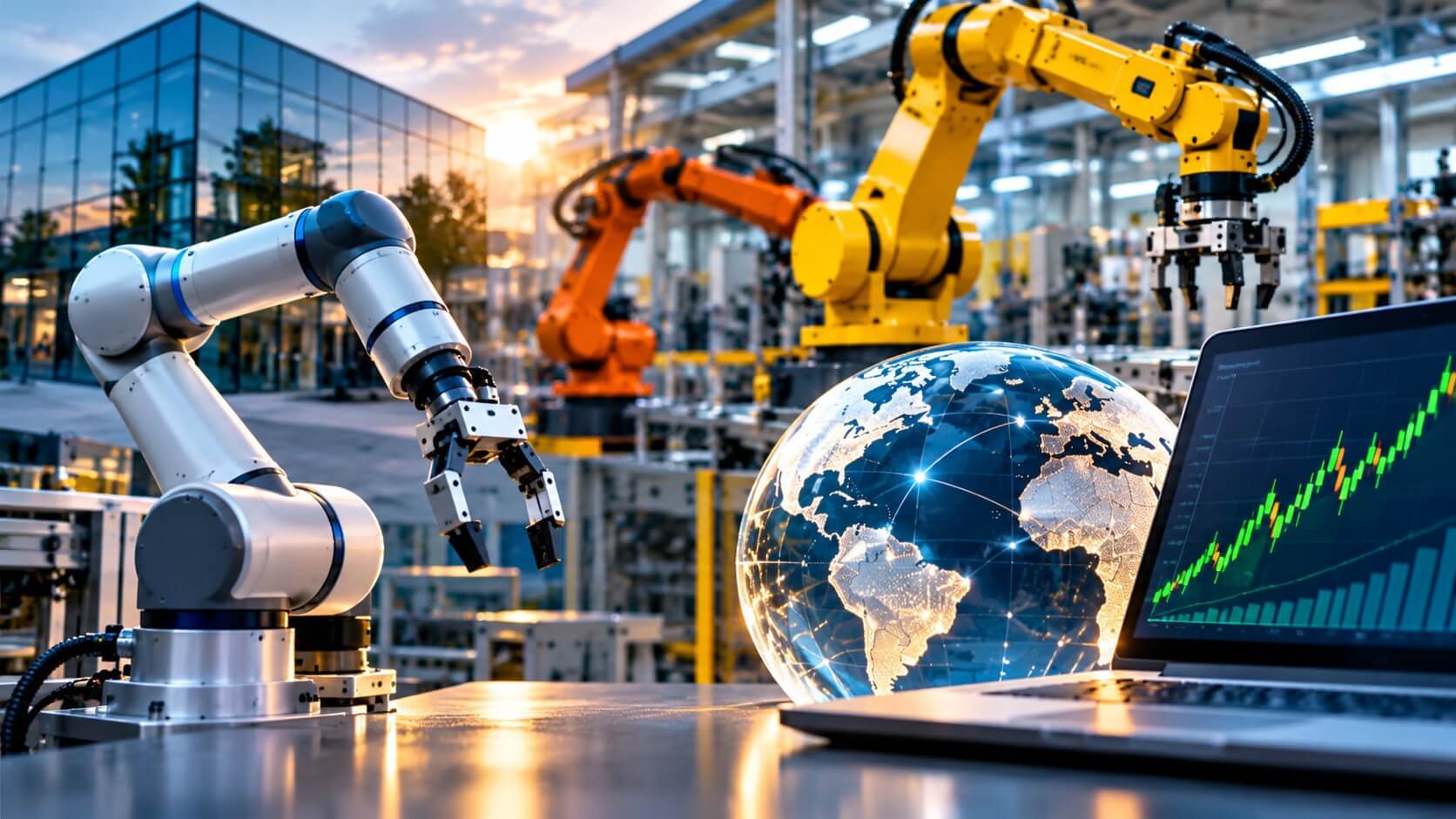
The industrial robotics industry has traditionally been dominated by four major manufacturers: FANUC, ABB Robotics, Yaskawa Electric, and KUKA. Often called the "Big Four," these companies helped establish the global market for robots used in automotive factories, electronics production, metalworking, and other manufacturing industries.
However, the competitive landscape is changing. Chinese robotics manufacturers are expanding, specialized companies are gaining ground in particular applications, and artificial intelligence is creating new opportunities for automation.
For investors, identifying the leading robotics companies is only the beginning. Market position, profitability, business diversification, ownership, and stock valuation all influence whether a robotics manufacturer represents an attractive investment opportunity.
Who Are the Big Four Industrial Robotics Companies?
The traditional Big Four are FANUC, ABB Robotics, Yaskawa Electric, and KUKA.
They are recognized for their long histories, global customer relationships, extensive product portfolios, and established positions in industrial automation.
Their businesses have important differences.
| Company | Headquarters or origin | Main strengths |
|---|---|---|
| FANUC | Japan | Industrial robots, factory automation, CNC systems |
| ABB Robotics | Switzerland | Industrial robots, automation software, integrated solutions |
| Yaskawa Electric | Japan | MOTOMAN robots, motion control, industrial drives |
| KUKA | Germany | Industrial robots, automotive automation, integrated systems |
These companies are historically influential, but the Big Four designation should not be interpreted as a current ranking by revenue, shipments, or market share.
Their positions can vary by region, application, and reporting period.
Another important distinction is ownership. Not every major robotics manufacturer is available as an independently listed stock.
FANUC: A Major Japanese Industrial Robotics Manufacturer
FANUC is one of the world's best-known industrial automation companies.
Founded in Japan, the company develops industrial robots, computer numerical control systems, and factory automation equipment.
Its robots are widely used in manufacturing operations that require precision, reliability, and repetitive movements.
What Does FANUC Manufacture?
FANUC's industrial robotics portfolio includes machines designed for:
- Automotive welding and assembly.
- Material handling.
- Machine loading and unloading.
- Painting and finishing.
- Packaging and palletizing.
- Precision manufacturing.
The company also produces CNC systems, which control machine tools used to manufacture industrial components.
This combination gives FANUC exposure to both robotics and the broader factory automation market.
Why Is FANUC Important?
FANUC benefits from an established international customer base and a long history of supplying manufacturing equipment.
Industrial customers often prioritize reliability, technical support, and compatibility with existing production systems.
These requirements can favor experienced manufacturers with proven products and global service networks.
However, FANUC remains exposed to fluctuations in manufacturing investment.
When factories reduce spending on new machinery, demand for industrial automation equipment can weaken.
Can Investors Buy FANUC Stock?
FANUC is publicly traded in Japan under ticker 6954 on the Tokyo Stock Exchange.
For investors, its appeal lies in relatively direct exposure to industrial automation, although its business is not limited to robots.
Evaluating FANUC requires examining robotics orders, factory automation demand, profitability, geographic exposure, and valuation.
ABB Robotics: An Established Global Automation Business
ABB has historically been one of the most prominent names in industrial robotics.
The Swiss industrial technology group developed a broad robotics business serving automotive manufacturers, electronics producers, and other industrial customers.
ABB Robotics offers industrial robotic arms, collaborative robots, software, and automation solutions.
What Makes ABB Robotics Important?
ABB has built expertise in combining robots with software and factory automation systems.
Its products support applications such as:
- Assembly and material handling.
- Welding and painting.
- Electronics manufacturing.
- Packaging and palletizing.
- Flexible production processes.
The company's established customer relationships and automation expertise have made it an important competitor in global robotics.
ABB's Robotics Ownership Is Changing
A major development occurred in October 2025, when ABB announced an agreement to sell its Robotics division to SoftBank Group for an enterprise value of approximately $5.375 billion.
The transaction was expected to close in mid-to-late 2026, subject to regulatory approvals and customary closing conditions.
This distinction matters because ABB's historical leadership in robotics should not automatically be interpreted as continued long-term ownership of that business.
Investors evaluating ABB must distinguish its remaining industrial technology operations from the robotics division being divested.
Similarly, investors examining SoftBank should understand that exposure to ABB Robotics would form only part of a much broader investment portfolio.
The transaction also illustrates how robotics assets can change ownership as major technology and industrial groups reposition their businesses.
Yaskawa Electric: Industrial Robots and Motion Control
Yaskawa Electric is another established Japanese industrial automation manufacturer.
The company is particularly known for its MOTOMAN industrial robots and expertise in motion control.
Motion control technology manages the precise movement of machines and mechanical systems.
It is essential for industrial robots, manufacturing equipment, and automated production lines.
What Does Yaskawa Produce?
Yaskawa's activities include:
- Industrial robotic arms.
- Servo motors and drives.
- Motion control equipment.
- Industrial automation systems.
- Electrical drive technologies.
Its robots are used in welding, handling, assembly, and other manufacturing applications.
Why Does Motion Control Matter?
Industrial robots depend on accurate, repeatable movement.
A robotic arm must position its tools precisely while controlling speed, acceleration, and force.
Motion control equipment makes these movements possible.
For investors, Yaskawa's expertise creates exposure to automation beyond complete robot sales.
Its components and control technologies can serve a broader range of industrial machinery applications.
Can Investors Buy Yaskawa Stock?
Yaskawa Electric is publicly traded in Japan under ticker 6506.
Its financial performance depends on demand for industrial robots, motion control equipment, and other automation products.
Investors should consider manufacturing investment cycles, competition, operating margins, and the company's exposure to major Asian markets.
KUKA: A German Robotics Leader With Chinese Ownership
KUKA is one of Europe's most recognized industrial robotics manufacturers.
Headquartered in Augsburg, Germany, the company has a long history of supplying robots and automation systems to industrial customers.
KUKA is particularly associated with automotive manufacturing, although its products serve numerous other industries.
What Does KUKA Specialize In?
KUKA manufactures robots and automation solutions used in:
- Automotive production.
- Welding and assembly.
- Material handling.
- Electronics manufacturing.
- General industrial automation.
- Automated production systems.
The company also provides software and engineering solutions that help customers integrate robots into manufacturing environments.
Who Owns KUKA?
KUKA is controlled by the Chinese appliance and industrial technology group Midea.
Midea acquired a controlling stake in KUKA in 2016 and subsequently completed the process of taking the company private.
As a result, KUKA is no longer independently traded on the stock market.
This is an important consideration for retail investors.
A company can be a major participant in industrial robotics without offering investors the opportunity to purchase its shares directly.
Exposure to KUKA through Midea would also involve exposure to Midea's much broader businesses.
Why Does KUKA Matter?
KUKA demonstrates the international nature of industrial robotics.
A German robotics manufacturer operating under Chinese ownership illustrates how technology expertise, manufacturing demand, and global capital are interconnected.
It also highlights the importance of distinguishing a company's geographic origins from its current ownership.
Which Other Companies Manufacture Industrial Robots?
The traditional Big Four do not represent the entire industrial robotics market.
Several other manufacturers compete in specialized applications, regional markets, and emerging categories.
Kawasaki Robotics
Kawasaki Robotics is part of Japan's Kawasaki Heavy Industries.
The business supplies industrial robots for applications including welding, handling, assembly, and painting.
Kawasaki Heavy Industries is publicly traded in Japan, but robotics represents only one part of its diversified operations.
Epson Robots
Epson manufactures industrial robots used in precision assembly, electronics manufacturing, and other applications.
Its SCARA robots are particularly relevant to compact, high-speed assembly operations.
SCARA robots are designed for controlled horizontal movement and are commonly used in repetitive manufacturing tasks.
Epson's parent company, Seiko Epson, is publicly traded in Japan.
However, robotics is only one component of its broader business.
Universal Robots
Universal Robots is a Danish manufacturer specializing in collaborative robots, often called cobots.
Cobots are designed for applications in which robots and humans can work in shared environments under appropriate safety conditions.
They are often marketed to manufacturers seeking more flexible automation systems.
Universal Robots is part of Teradyne, a publicly traded American company.
Teradyne also operates major semiconductor and electronics testing businesses, meaning its financial performance is not determined solely by robotics.
Chinese Industrial Robotics Manufacturers
China has developed a growing domestic robotics manufacturing industry.
Companies such as ESTUN Automation, SIASUN Robot & Automation, and other domestic suppliers compete across different industrial automation categories.
Chinese manufacturers benefit from proximity to one of the world's largest manufacturing markets.
They also face competition from established international brands and other domestic producers.
Their growth could reshape market share, particularly if domestic manufacturers improve performance while maintaining competitive pricing.
However, expanding shipments do not necessarily guarantee attractive profit margins.
Investors need to distinguish sales growth from sustainable profitability.
Which Company Is the Largest Industrial Robot Manufacturer?
There is no single universally applicable answer without defining what "largest" means.
Industrial robotics companies can be compared using several measures:
| Measure | What it tells investors |
|---|---|
| Annual robot shipments | How many robots a manufacturer delivers |
| Robotics revenue | Sales generated specifically by robotics operations |
| Installed base | Number of the manufacturer's robots operating worldwide |
| Market share | Share of a defined robotics market |
| Operating profit | Earnings generated by the business |
| Geographic presence | Reach across international markets |
A manufacturer may lead in cumulative installed robots without having the highest annual shipments.
Another company may generate more revenue by selling complex automation systems rather than large numbers of individual robots.
The results can also change depending on whether the analysis includes robotic arms, collaborative robots, mobile robots, or complete automation systems.
For that reason, claims that one company is the world's largest robot manufacturer should be evaluated against a specific metric and reporting period.
How Do Industrial Robotics Companies Compete?
Competition in industrial robotics involves more than the selling price of a machine.
Manufacturers must meet demanding industrial requirements.
Reliability and Precision
Factories depend on equipment operating consistently.
Unexpected downtime can interrupt production and create substantial costs.
A robot with a lower purchase price may be less attractive if it requires more maintenance or causes frequent production interruptions.
Software and Ease of Programming
Robots must be programmed and integrated into production processes.
Software that simplifies installation, programming, and maintenance can make automation more accessible.
This is especially important for smaller manufacturers without large engineering teams.
Global Support Networks
Industrial customers often operate factories in multiple countries.
Manufacturers with established service networks can provide maintenance, replacement parts, and technical assistance across different regions.
These capabilities may support long-term customer relationships.
Total Cost of Ownership
The purchase price represents only part of the cost of industrial automation.
Businesses also pay for installation, integration, programming, energy, maintenance, and equipment upgrades.
A more expensive robot may deliver better economic results if it operates more reliably or improves production efficiency.
For a detailed explanation of equipment prices and implementation costs, read How Much Does an Industrial Robot Cost? A Practical Breakdown.
Technology and Product Development
Industrial robotics manufacturers invest in improving speed, precision, flexibility, and ease of use.
Artificial intelligence, machine vision, and advanced software may expand the range of tasks robots can perform.
However, established manufacturers must balance innovation with the reliability and safety requirements of industrial customers.
Are Chinese Robotics Companies Challenging the Traditional Leaders?
Chinese robotics manufacturers are becoming increasingly important competitors.
China's enormous manufacturing sector creates substantial domestic demand for automation.
This provides local manufacturers with opportunities to develop products, gain customers, and expand production.
Government industrial policies and investment in domestic manufacturing capabilities have also supported the development of the sector.
However, the competitive landscape varies by robot type and application.
Established international manufacturers retain expertise, customer relationships, and technological advantages in numerous industrial segments.
Chinese companies may compete effectively on pricing, local service, and products designed for domestic customers.
Over time, stronger competition could increase robotics adoption by making equipment more affordable.
For manufacturers, however, lower prices can also create pressure on profitability.
The key question for investors is not simply whether Chinese robotics companies will gain market share.
It is whether individual companies can expand their businesses while generating sustainable earnings and attractive returns on invested capital.
Which Industrial Robotics Companies Are Publicly Traded?
Several major industrial robotics businesses are accessible through publicly traded parent companies.
| Company | Public-market access | Robotics exposure |
|---|---|---|
| FANUC | Tokyo Stock Exchange: 6954 | Industrial robots and factory automation |
| Yaskawa Electric | Tokyo Stock Exchange: 6506 | Industrial robots and motion control |
| ABB | SIX Swiss Exchange: ABBN | Historical robotics exposure; divestment announced |
| KUKA | Not independently listed | Owned by Midea |
| Kawasaki Robotics | Kawasaki Heavy Industries: 7012, Tokyo | Robotics within a diversified industrial group |
| Epson Robots | Seiko Epson: 6724, Tokyo | Robotics within a diversified technology business |
| Universal Robots | Teradyne: TER, Nasdaq | Collaborative robotics within a broader technology company |
Stock listings and corporate ownership can change, so investors should verify current information before making decisions.
These companies offer different degrees of exposure to industrial robotics.
Buying shares in a diversified industrial group is not equivalent to investing in a business whose revenue depends primarily on robot manufacturing.
For example, Teradyne's semiconductor testing operations can have a substantial influence on its financial results, independently of Universal Robots.
Similarly, Kawasaki Heavy Industries operates across multiple industrial sectors.
This distinction becomes particularly important when investors are attempting to build a portfolio focused on robotics.
What Should Investors Look for in a Robotics Company?
Industrial robotics is a promising long-term technology market, but market leadership alone does not guarantee strong investment returns.
Several financial and competitive factors deserve attention.
Robotics Revenue Exposure
Investors should determine how much revenue comes from robotics compared with unrelated operations.
A company with a small robotics division may not benefit significantly from industry growth at the consolidated financial level.
Profitability
Revenue growth is useful, but it does not reveal whether a company generates attractive profits.
Operating margins, cash flow, and returns on capital can help investors understand the economic quality of the business.
Customer Concentration
Robotics manufacturers serving a narrow range of industries may face greater exposure to sector-specific downturns.
Automotive manufacturing, for example, can experience significant fluctuations in capital spending.
Competitive Advantages
Established customer relationships, proprietary technology, reliable products, and global service networks can help manufacturers compete.
However, these advantages must be evaluated against pricing pressure and technological change.
Geographic Exposure
Industrial robotics is a global business.
Revenue may depend heavily on manufacturing investment in China, Japan, Europe, and North America.
Currency movements, tariffs, trade restrictions, and economic conditions can affect results.
Valuation
Even a market-leading robotics company can be an unattractive investment if its stock price already assumes exceptionally strong future growth.
Investors should compare expected earnings, business risks, and valuation rather than relying solely on industry enthusiasm.
For a broader explanation of robotics investment approaches, see How to Invest in Robotics: What Retail Investors Should Consider.
Will the Big Four Continue to Dominate Industrial Robotics?
The traditional Big Four have helped define the industrial robotics industry for decades.
Their experience, installed equipment, technical expertise, and customer relationships remain important competitive assets.
However, the market is evolving.
Chinese manufacturers are expanding their capabilities, collaborative robotics companies are addressing different customer needs, and AI-related technologies could change how robots are programmed and deployed.
Corporate ownership is changing as well, as illustrated by ABB's announced robotics divestment and KUKA's ownership by Midea.
Future leadership may therefore depend on more than manufacturing advanced robotic arms.
Companies may need to combine reliable hardware, accessible software, competitive pricing, and effective customer support.
For investors, the most important distinction is between a company that leads technologically and one that consistently converts its competitive position into profitable growth.
The industrial robotics market may continue expanding while individual manufacturers experience very different financial outcomes.
To understand the broader industry, its economics, and its long-term opportunities, explore Industrial Robotics: How the Industry Works and What Investors Should Know.
The bottom line: FANUC, ABB Robotics, Yaskawa Electric, and KUKA are the traditional leaders of industrial robotics, but competition, ownership changes, and emerging technologies are reshaping the market. Investors should evaluate each company's actual robotics exposure, profitability, competitive position, and valuation rather than assuming that industry leadership automatically translates into superior stock performance.
Disclaimer: This article is for informational and educational purposes only and does not constitute financial or investment advice. Investing involves risk, including the potential loss of principal. Always conduct independent research before making investment decisions.