
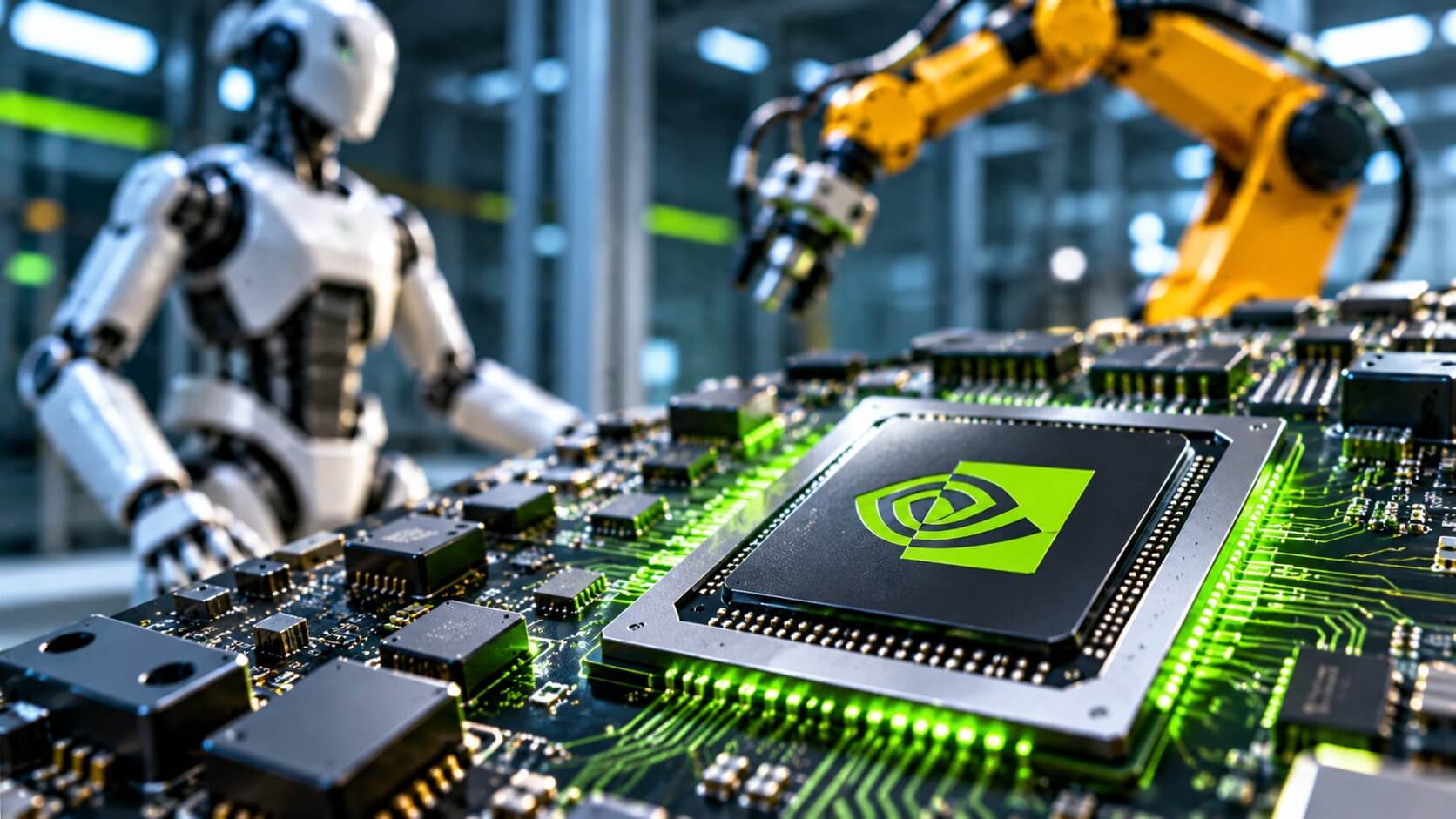
Nvidia has become an important participant in the robotics industry through artificial intelligence computing platforms, simulation software, robotics development tools, and investments in companies developing intelligent machines.
One notable example is Serve Robotics, a company developing autonomous sidewalk delivery robots. Nvidia has also supported the broader robotics ecosystem through technologies such as Isaac, Omniverse, Jetson, and its robotics foundation models.
However, Nvidia is not primarily an industrial robot manufacturer. Its robotics strategy focuses on supplying the computing infrastructure and software that developers can use to build, train, simulate, and operate increasingly capable robots.
For retail investors, this distinction is essential. Nvidia may benefit from the expansion of robotics without manufacturing the robots itself, but robotics remains only one part of its much larger AI and semiconductor business.
What Robotics Company Did Nvidia Invest In?
Serve Robotics is one of the most recognizable publicly traded robotics companies associated with an Nvidia investment.
Serve Robotics develops autonomous robots designed to deliver food and other small orders over short distances.
Its robots operate on sidewalks rather than inside conventional industrial manufacturing facilities.
The company emerged from autonomous delivery technology developed within Postmates and subsequently associated with Uber.
Serve Robotics became publicly traded on Nasdaq in 2024 under the ticker SERV.
What Was Nvidia's Connection to Serve Robotics?
Nvidia previously participated in financing associated with Serve Robotics.
In July 2024, a regulatory filing disclosed Nvidia's beneficial ownership of approximately 3.7 million Serve Robotics shares, representing roughly 10% of the company at that time.
The disclosure attracted substantial investor attention because it connected a relatively small robotics company with one of the world's most influential AI technology businesses.
However, the disclosed ownership reflected an existing investment position rather than proof of a new investment made on the filing date.
It also did not establish that Nvidia would continue holding the same number of shares indefinitely.
Investors should consult the latest regulatory filings to determine whether a previously disclosed position remains current.
What Does Serve Robotics Actually Do?
Serve Robotics develops autonomous delivery robots designed to navigate pedestrian environments.
Its technology combines robotics hardware, cameras, sensors, computing systems, and autonomous navigation software.
The company aims to automate certain short-distance delivery operations.
Potential applications include transporting restaurant orders and other small items over relatively short routes.
This business model differs significantly from industrial robotics.
A conventional factory robot usually performs a defined task within a controlled production environment.
An autonomous delivery robot must navigate changing outdoor conditions, pedestrians, obstacles, and other unpredictable situations.
The technical requirements, operating economics, and commercial risks are therefore different.
Does Nvidia's Investment Make Serve Robotics a Good Stock?
Not necessarily.
An investment by a major technology company can indicate strategic interest, but it does not guarantee commercial success or attractive shareholder returns.
Serve Robotics must still demonstrate that its technology can support a sustainable business.
Important factors include:
- Revenue growth.
- Number of commercially deployed robots.
- Utilization per robot.
- Cost per delivery.
- Operating expenses.
- Cash consumption.
- Financing requirements.
- Customer concentration.
- Competitive positioning.
Investors should also distinguish commercial partnerships, pilot programs, and announced expansion targets from revenue already generated.
A company may have promising technology while remaining financially speculative.
Why Is Nvidia Interested in Robotics?
Nvidia's interest in robotics is closely connected to its broader strategy in artificial intelligence.
Robots increasingly rely on computing systems capable of processing information from cameras, sensors, and other inputs.
Advanced robotics applications may also require AI models that help machines understand their surroundings and determine appropriate actions.
Nvidia develops hardware and software used for these workloads.
Its strategy is not limited to purchasing stakes in robotics startups.
The company also provides technologies that robotics developers can incorporate into their products.
Robotics Requires Computing Power
Modern robots can use multiple computing processes simultaneously.
These may include:
- Processing camera images.
- Detecting and identifying objects.
- Estimating distances.
- Planning movements.
- Interpreting sensor data.
- Running AI models.
- Coordinating robotic actions.
More sophisticated applications can require substantial computing resources.
Nvidia's processors and AI software platforms are designed to support demanding computational workloads.
However, not every robot requires advanced AI hardware.
Many conventional industrial robots operate effectively using established control systems without the computing capabilities associated with large AI models.
The potential market for Nvidia therefore depends partly on how widely AI-enabled robotics is adopted.
What Is Nvidia Isaac?
Nvidia Isaac is a collection of technologies designed to support robotics development.
The ecosystem includes tools for simulation, AI development, and robotics applications.
Developers can use these technologies to build and test robotic systems before deploying them in physical environments.
Why Is Simulation Important?
Training and testing robots in the real world can be expensive.
Physical robots can damage equipment, require supervision, and operate more slowly than simulated systems.
Simulation allows developers to test certain behaviors in virtual environments.
For example, engineers may simulate a robotic arm attempting to pick up objects of different shapes.
They can evaluate how the system responds to changes in object position, lighting, or movement.
Simulation can help identify problems before real-world deployment.
However, virtual testing cannot completely replace physical validation.
Differences between simulated and real-world conditions can affect robot performance.
What Is Isaac Sim?
Isaac Sim is Nvidia's robotics simulation application built on its Omniverse technologies.
It supports the creation of virtual environments where developers can test robotic systems.
Potential applications include robotic manipulation, autonomous navigation, and industrial automation research.
For investors, simulation software represents an important part of the robotics development process.
If more companies develop intelligent robots, demand for simulation and AI development infrastructure could increase.
Nevertheless, adoption of a development platform does not automatically translate into proportionate revenue or profits for its provider.
What Is Nvidia Omniverse?
Nvidia Omniverse is a platform for developing and operating applications involving physically based simulation and digital environments.
In industrial settings, it can support digital twins.
A digital twin is a virtual representation of a physical system, such as a factory, warehouse, or production line.
How Can Digital Twins Help Robotics?
Manufacturers can use virtual environments to examine how robots might operate within a facility.
For example, a company planning a new automated production line may simulate:
- Robot placement.
- Equipment movement.
- Material flows.
- Potential collisions.
- Production sequences.
- Interactions between machines.
These simulations may help engineers identify design problems and improve layouts before physical installation.
Digital twins can also support planning and testing as factories evolve.
Why Does This Matter for Nvidia?
Robotics simulation can create demand for advanced computing hardware and supporting software.
Nvidia may benefit when industrial companies adopt more sophisticated digital engineering workflows.
However, the commercial value depends on actual customer adoption and the revenue generated by the broader platform.
Investors should not assume that every factory using digital simulation will become a major Nvidia customer.
What Is Nvidia Jetson?
Nvidia Jetson is a family of embedded computing platforms designed for AI applications at the edge.
Edge computing means processing information close to where it is generated rather than sending every task to a remote data center.
For robotics, this can be important because machines may need to respond quickly to their surroundings.
How Is Jetson Used in Robotics?
Jetson platforms can support applications involving:
- Autonomous mobile robots.
- Industrial inspection.
- Computer vision.
- Warehouse automation.
- Service robots.
- Intelligent machines.
A robot equipped with suitable onboard computing hardware may process camera images and run AI models without relying entirely on a remote server.
This can reduce certain communication delays and support operation in environments with limited connectivity.
Is Jetson a Major Revenue Driver?
Nvidia does not provide investors with a simple, standalone financial measure covering all robotics-related revenue across Jetson, Isaac, Omniverse, and other products.
Robotics applications can overlap with broader embedded computing, automotive, AI, and industrial markets.
Consequently, investors should be cautious about assigning a precise valuation to Nvidia's robotics business without sufficient financial disclosure.
The strategic opportunity may be significant, but its current contribution to consolidated revenue is not necessarily easy to isolate.
What Is Nvidia's Role in Humanoid Robotics?
Humanoid robotics is another area where Nvidia is developing enabling technologies.
Humanoid robots are machines designed with physical structures resembling aspects of the human body.
Developers hope that some humanoid systems will eventually perform tasks in factories, warehouses, and other environments built around human workers.
Nvidia has introduced robotics technologies intended to support the development of increasingly capable autonomous machines.
These include its Project GR00T initiative and related AI models and development tools.
What Is Project GR00T?
Project GR00T is Nvidia's initiative focused on foundation models and technologies for humanoid robotics.
The objective is to help developers build robots capable of interpreting information and performing physical actions.
Foundation models are AI systems trained to support a range of tasks rather than one narrowly predefined operation.
In robotics, such models may eventually help machines generalize across different environments and activities.
However, humanoid robotics remains technically challenging.
A robot that performs well in a demonstration may still struggle with reliability, dexterity, safety, battery life, and cost in commercial environments.
Does Nvidia Manufacture Humanoid Robots?
Nvidia primarily supplies technologies used by robotics developers.
It is not generally positioned as a mass-market manufacturer of complete humanoid robots.
This creates a different business model from companies developing their own physical robotic systems.
Nvidia may be able to participate in the growth of multiple robotics manufacturers rather than depending on the commercial success of one robot design.
However, its financial upside will depend on the extent to which developers adopt Nvidia technologies and generate meaningful spending on its products.
Which Robotics Companies Use Nvidia Technology?
Nvidia works with a broad ecosystem of robotics developers, industrial technology companies, and research organizations.
Its technologies can support applications ranging from autonomous mobile robots to factory automation and humanoid robotics.
Companies developing intelligent machines may use Nvidia computing hardware, simulation software, or AI tools.
However, a technical collaboration is not the same as an equity investment.
This distinction is important.
A company may participate in Nvidia's robotics ecosystem without Nvidia owning shares in that business.
Similarly, the use of Nvidia technology does not mean Nvidia controls the customer's product strategy or guarantees its commercial success.
Three Different Types of Relationships
Investors should distinguish between:
Equity investments: Nvidia owns a financial stake in another company.
Technology partnerships: Companies collaborate on development, integration, or technical applications.
Customer relationships: A robotics company purchases or uses Nvidia products.
These relationships can have very different financial implications.
An equity investment may generate gains or losses based on the value of the holding.
A technology partnership may support ecosystem adoption without producing immediate material revenue.
A customer relationship may contribute to product sales, but its significance depends on the scale and economics of those sales.
How Does Nvidia Compare With Industrial Robot Manufacturers?
Nvidia's role in robotics differs from that of traditional industrial automation companies.
Manufacturers such as FANUC and Yaskawa Electric sell robotic equipment used directly in factories.
Nvidia supplies computing and software technologies that may support advanced robotics development and operation.
| Business category | Main products or services | Primary source of robotics exposure |
|---|---|---|
| Nvidia | AI computing, simulation, development platforms | Enabling technologies for intelligent robots |
| FANUC | Industrial robots, CNC, automation equipment | Factory robotics and industrial investment |
| Yaskawa Electric | Robots, drives, motion control | Industrial robots and automation components |
| Teradyne | Collaborative and mobile robots, testing equipment | Robotics businesses within a diversified company |
| Symbotic | Warehouse automation systems | Automated logistics and distribution operations |
These companies may benefit from different stages of robotics adoption.
A factory purchasing a conventional industrial robotic arm may generate revenue for an equipment manufacturer without creating substantial demand for Nvidia's most advanced AI products.
Conversely, a company developing AI-enabled humanoid robots may invest heavily in computing and simulation before selling meaningful quantities of physical machines.
For investors, this means the robotics industry contains several distinct business models rather than one uniform market.
To understand the established equipment manufacturers, see The Leading Industrial Robotics Companies: Who Dominates the Market.
Could Robotics Become a Major Growth Market for Nvidia?
Robotics could become a meaningful long-term application of AI computing.
However, the size and timing of the opportunity remain uncertain.
Several developments could influence future demand.
More Intelligent Industrial Robots
Manufacturers may adopt robots capable of handling more variable tasks.
Advanced AI could help some systems recognize objects, adapt to changing conditions, and reduce programming complexity.
Autonomous Mobile Robots
Warehouses, factories, and logistics facilities may increase their use of mobile robotic systems.
These machines can require onboard computing, navigation software, and sensor processing.
Humanoid Robotics
If humanoid robots become commercially viable at scale, developers may require substantial computing resources for training, simulation, and deployment.
However, mass adoption is not guaranteed.
Digital Factory Simulation
Industrial companies may expand their use of virtual environments to design and test automated facilities.
This could create demand for simulation software and computing infrastructure.
Robotics AI Development
Research institutions and companies may invest in training models designed to control physical machines.
These activities can require significant computing resources.
For Nvidia, the opportunity is to supply technology across multiple applications.
But investors should distinguish potential long-term markets from revenue that has already been realized.
What Are the Risks of Nvidia's Robotics Strategy?
Nvidia's robotics opportunity is not without risks.
Commercial Adoption May Be Slower Than Expected
Advanced robots must operate reliably and economically in real-world environments.
Technical progress does not necessarily lead to immediate large-scale deployment.
Competition Could Increase
Other semiconductor and technology companies are developing AI computing platforms and robotics-related software.
Robotics manufacturers may also develop proprietary technologies or choose alternative suppliers.
Robotics May Remain a Small Revenue Contributor
Even substantial growth in robotics spending may represent only a limited portion of Nvidia's consolidated business.
Investors should avoid assuming that robotics alone will determine the company's financial performance.
Hardware Requirements May Change
Not every robotics application needs high-end computing hardware.
Advances in efficient AI models or specialized processors could influence the economics of robotics computing.
Geopolitical Restrictions
Export restrictions and international trade policies can affect semiconductor markets and access to advanced computing technologies.
These risks may influence Nvidia's broader business as well as certain robotics applications.
Valuation Risk
Nvidia's share price can reflect expectations about future AI growth.
Even if robotics becomes a successful market, investors may earn disappointing returns if the stock's valuation already assumes exceptionally strong future performance.
Is Serve Robotics a Better Robotics Investment Than Nvidia?
Serve Robotics and Nvidia represent fundamentally different investment propositions.
Serve Robotics focuses on developing and commercializing autonomous delivery systems.
Nvidia operates a much larger business supplying computing infrastructure and software for AI and other applications.
Serve Robotics
Potential advantages include more direct exposure to autonomous delivery robot adoption.
However, the company faces substantial commercialization, financing, execution, and profitability risks.
Its financial results may be highly sensitive to deployment economics and the success of a relatively narrow business model.
Nvidia
Nvidia provides exposure to AI computing across many industries.
Its robotics activities are part of a broader technology ecosystem.
This diversification reduces dependence on any single robotics application, although Nvidia remains exposed to semiconductor cycles, competitive pressures, customer spending, and valuation risk.
Which Is More Attractive?
There is no universal answer.
A smaller robotics company may offer more concentrated exposure to a particular technology, but that concentration can create substantial financial risk.
A diversified technology supplier may be less dependent on the success of robotics while still benefiting from its expansion.
Investors should compare business fundamentals, cash flow, competitive advantages, financing requirements, and valuation rather than assuming that one investment is superior because it is more directly associated with robots.
How Can Retail Investors Gain Exposure to Nvidia's Robotics Ecosystem?
There are several ways to research investment opportunities connected to AI-enabled robotics.
Nvidia Shares
Purchasing Nvidia shares provides exposure to the company's broader AI computing and semiconductor operations.
Robotics represents one potential long-term growth application.
Publicly Traded Robotics Developers
Companies such as Serve Robotics offer more concentrated exposure to specific robotics applications.
However, investors should evaluate commercial progress, financial strength, and dilution risk carefully.
Industrial Automation Companies
Established manufacturers may benefit from greater automation adoption even if they do not depend on Nvidia technology.
Robotics and Automation ETFs
Exchange-traded funds can provide exposure to multiple companies associated with robotics, automation, and AI.
However, their holdings may include substantial semiconductor and general technology exposure.
Investors should examine portfolio composition, fees, concentration, and valuation.
For a broader comparison of robotics stocks, ETFs, and investment risks, read How to Invest in Robotics: What Retail Investors Should Consider.
Does Nvidia Need to Own Robotics Companies to Benefit?
No.
Nvidia's potential advantage is that its technology can be used by many different robotics developers.
A company manufacturing robots may purchase Nvidia hardware, use its simulation software, or develop applications using its AI tools.
This allows Nvidia to participate in parts of the robotics value chain without necessarily financing or manufacturing complete machines.
However, this business model also has limitations.
Developers may choose competing technologies, use less expensive processors, or develop their own systems.
The financial benefits therefore depend on Nvidia's ability to offer compelling performance, software support, and overall value.
Ownership stakes in individual robotics companies are only one element of the broader strategy.
What Should Investors Watch Next?
Investors following Nvidia's robotics activities should focus on measurable commercial developments rather than announcements alone.
Important indicators include:
- Adoption of Nvidia robotics development platforms.
- Commercial deployments of AI-enabled robots.
- Demand for embedded AI computing hardware.
- Partnerships that lead to identifiable products or revenue.
- Progress in humanoid robotics reliability and economics.
- Financial disclosures relating to robotics-related businesses.
- Competition from alternative computing and software platforms.
- Changes in Nvidia's disclosed equity investments.
It is also important to evaluate robotics developments in the context of Nvidia's overall financial performance.
The company's largest revenue drivers may remain outside robotics for a considerable period.
What Do Nvidia's Robotics Investments Really Mean?
Nvidia's involvement in robotics reflects a broader effort to expand the applications of AI computing beyond data centers and conventional software.
Its investment history includes Serve Robotics, while its technology platforms support developers working on industrial automation, autonomous machines, and humanoid robots.
The strategic opportunity is potentially significant because increasingly intelligent robots may require advanced computing, simulation, and AI development tools.
However, robotics remains an emerging commercial opportunity within Nvidia's much larger business.
Investors should distinguish equity ownership, technology partnerships, and customer relationships, and avoid treating every robotics announcement as evidence of substantial future profits.
The bottom line: Serve Robotics is a notable example of a robotics company in which Nvidia disclosed an investment. Nvidia's broader robotics strategy, however, centers on AI computing, simulation, and software platforms rather than manufacturing robots. For investors, the key question is whether robotics adoption eventually generates meaningful, profitable demand for Nvidia technology—not simply whether the company is associated with promising robotics startups.
For a wider understanding of the industrial automation market and its competitive structure, explore Industrial Robotics: How the Industry Works and What Investors Should Know.
Disclaimer: This article is for informational and educational purposes only and does not constitute financial or investment advice. References to investments and ownership positions describe historical disclosures and should not be interpreted as confirmation of current holdings. Investing involves risk, including the potential loss of principal. Always verify current regulatory filings and conduct independent research before making investment decisions.