
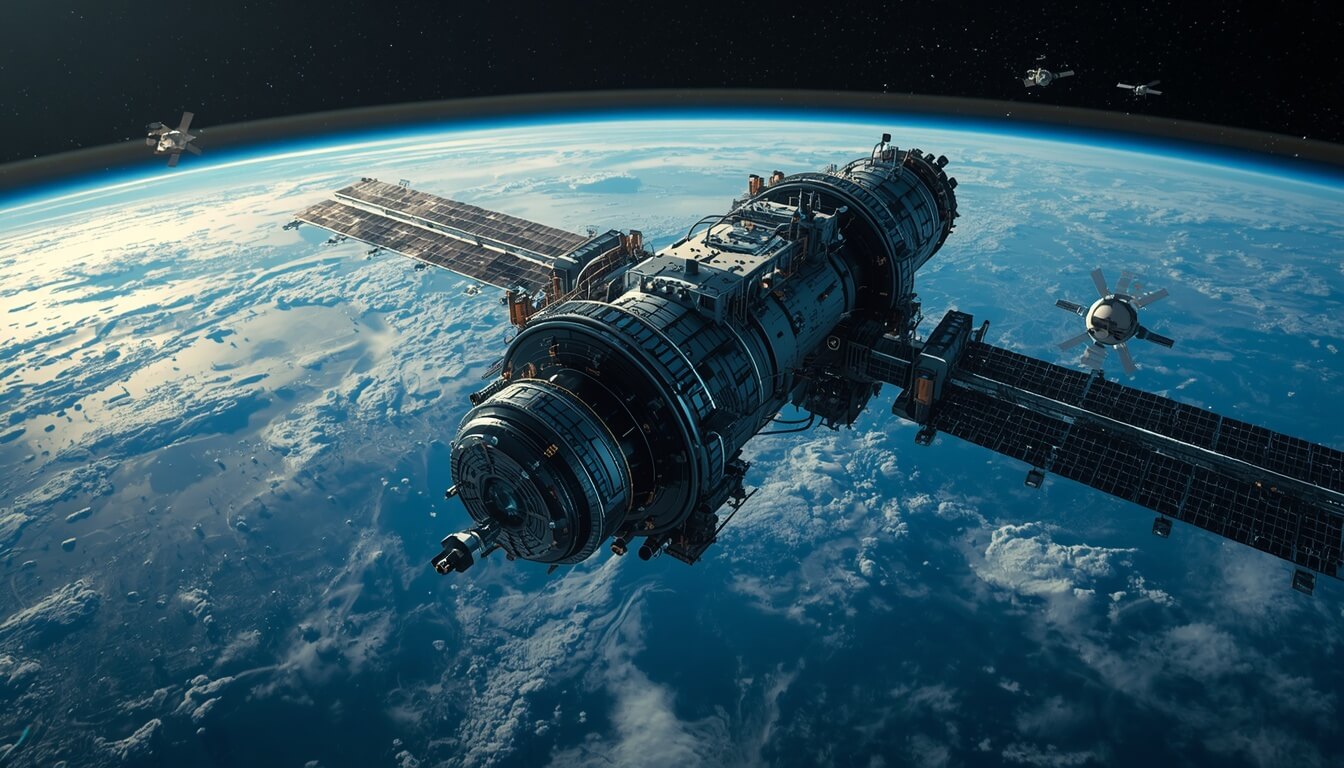
Space-based data centers are moving from a theoretical concept toward an emerging area of technology research. The basic idea is straightforward: place computing, storage and networking equipment on satellites and use orbital infrastructure to process data away from the Earth's surface.
The reasons for exploring this architecture are becoming increasingly relevant. Artificial intelligence is driving demand for computing power, while terrestrial data centers require large amounts of electricity, land, cooling infrastructure and network capacity. At the same time, satellites are generating increasing quantities of data that could potentially be processed directly in orbit.
A 2026 assessment by the U.S. Government Accountability Office identified space-based data centers as an emerging technology with potential advantages but also significant engineering and economic barriers. The agency noted that smaller systems designed to process data generated in space may become practical sooner than very large orbital facilities intended for intensive AI workloads.
The concept therefore raises a broader question: can computing infrastructure operate efficiently in an environment that is fundamentally different from a terrestrial data center?
Current research suggests that orbital data centers could become technically feasible at meaningful scale during the next several years, but substantial cost and engineering challenges remain. The question is not whether computers can operate in space — it is whether they can operate there at a cost that makes sense for customers.
How a Space-Based Data Center Would Work
A space-based data center would not simply be a conventional server room attached to a satellite.
An operational system would require several integrated components:
- computing processors
- memory
- storage
- power-generation systems
- thermal-management equipment
- communications hardware
- radiation protection
- propulsion
Solar panels would provide most of the electricity. Batteries or other energy-storage systems could supply power when the spacecraft passes through periods without direct sunlight.
The computing hardware could include CPUs, GPUs or specialized AI accelerators. Depending on the mission, the system could process Earth-observation imagery, scientific data, communications traffic or AI workloads.
High-bandwidth communication systems would connect individual satellites and provide links between orbit and Earth. Optical laser communications could become particularly important because distributed orbital computing would require large quantities of data to move between computing nodes.
The result would be closer to a distributed cloud infrastructure than to a single traditional data center.
This architecture also explains why the technology is closely connected to the companies already experimenting with computing in orbit. Their activities and business motivations are discussed in Why Companies Are Exploring Computing in Orbit.
Power Generation Is One of the Main Attractions
Electricity is becoming one of the central constraints for terrestrial computing infrastructure.
The growth of AI has increased demand for high-performance processors, and data centers are consequently becoming significant electricity consumers. The U.S. Department of Energy has projected that data centers could account for up to 12% of U.S. electricity demand by 2028.
Space offers a different energy environment.
Solar panels can generate electricity without requiring a connection to a terrestrial electrical grid. In suitable orbits, spacecraft can receive substantial exposure to sunlight and convert it directly into electrical power.
This creates an attractive theoretical model: computing capacity could be expanded by deploying additional solar generation and additional computing modules.
However, the relationship between energy and computing is not as simple as installing more solar panels.
Every additional processor requires additional electrical capacity, and nearly all of the electricity consumed by computing hardware ultimately becomes heat.
That creates the next major challenge.
Cooling in Space Is Surprisingly Difficult
Space is extremely cold, but this does not mean that spacecraft can easily cool powerful computers.
On Earth, heat can be transferred through air or liquid cooling systems and eventually rejected into the surrounding atmosphere or through cooling towers and other infrastructure.
In the vacuum of space, there is no atmosphere to carry heat away through convection.
Heat must ultimately be radiated into space.
This requires large radiators, and their size increases as computing power increases.
BCG estimates that a 100-kilowatt orbital computing system could require a radiator area of roughly 400 square meters under one analyzed architecture. The consultancy identifies cooling as one of the major technical bottlenecks for large-scale orbital computing.
More computing requires more electricity. More electricity produces more heat. More heat requires larger radiators. Larger radiators increase spacecraft mass and complexity. Thermal management could become one of the factors limiting the density of computing hardware in orbit.
Radiation and Hardware Reliability
Another fundamental difference is radiation.
Terrestrial data centers operate inside controlled environments where servers can be replaced relatively easily. Electronics in orbit are exposed to radiation that can cause temporary errors, degrade components and potentially damage hardware permanently.
A space-based data center therefore needs strategies for radiation protection and fault tolerance.
These can include shielding, radiation-tolerant components, redundancy, error correction and software designed to recover from hardware faults.
Each solution can increase mass, power consumption or complexity.
The consequences of hardware failure are also different.
A failed server in a terrestrial facility can usually be replaced by a technician. A failed computing module in orbit may require an entire satellite to be retired unless the system has been specifically designed for servicing.
BCG's economic analysis highlights satellite failure rates as an important variable because the cost structure of orbital infrastructure is heavily influenced by hardware that cannot be repaired as easily as terrestrial equipment.
Launch Costs Define the Economics
Perhaps the most obvious economic challenge is getting the infrastructure into orbit.
A terrestrial data center can receive servers, cables, cooling equipment and replacement components through conventional logistics.
An orbital data center requires a launch vehicle.
This means that the cost of every kilogram becomes important.
| Infrastructure | Estimated 20-year total cost of ownership per MW |
|---|---|
| Space-based | Approximately $660 million to $750 million |
| Terrestrial | Approximately $230 million to $300 million |
These figures are model-based estimates from BCG's 2026 analysis, not guaranteed future prices, but they illustrate the scale of the economic challenge.
The business case therefore depends on several variables moving simultaneously: launch costs, spacecraft mass, computing efficiency, hardware lifetime, satellite manufacturing costs and electricity prices on Earth.
The Economics May Favor Specific Workloads
The fact that orbital computing can be more expensive does not automatically make it commercially irrelevant.
A technology does not need to be cheaper in every application to create a viable market.
Space-based computing could have particular value where the advantages of processing in orbit compensate for the higher infrastructure costs.
One example is space-generated data.
Earth-observation satellites produce enormous quantities of imagery and sensor information. Sending every piece of raw data to Earth requires communications capacity and time.
An orbital computing system could analyze the information before transmission.
Instead of sending hundreds of gigabytes of raw imagery, a satellite could identify relevant objects or events and transmit a smaller amount of processed information.
The U.S. Government Accountability Office identifies this as one of the potential benefits of space-based computing.
Other possible applications include scientific missions, communications optimization and specialized AI processing.
This suggests that the first successful markets may be those where location matters.
Latency and Communications
Communication is another important factor.
A terrestrial data center can connect to users through fiber-optic networks with extremely high bandwidth and predictable latency.
A satellite has a fundamentally different communications environment.
The distance between orbit and Earth introduces latency, while satellite-to-satellite links can add further complexity.
For certain workloads, this may not matter.
An AI model processing a batch of satellite images does not necessarily require millisecond-level interaction with a human user.
For interactive cloud applications, however, latency could become a significant disadvantage.
This is one reason why orbital data centers are unlikely to function as simple replacements for every terrestrial cloud region.
The architecture needs to match the workload.
Orbital Congestion and Space Debris
Another challenge is environmental rather than computational.
Earth orbit is becoming increasingly crowded.
Thousands of satellites are already operating, and additional large constellations are being planned. Adding large numbers of computing satellites could increase the probability of collisions and complicate orbital management.
The GAO specifically identifies collision risk and the increasing number of satellites as important concerns associated with space-based data centers.
A large orbital computing network would therefore require sophisticated tracking, collision avoidance and end-of-life procedures.
The issue is particularly important because data centers could require many satellites rather than a single spacecraft.
A distributed architecture might need hundreds, thousands or eventually tens of thousands of nodes.
At that scale, orbital management becomes an infrastructure problem in its own right.
Manufacturing at Massive Scale
Even if the engineering problems are solved, manufacturing remains a major challenge.
A terrestrial data center can be expanded by ordering additional servers and constructing additional facilities.
A large orbital network could require enormous quantities of satellite buses, solar arrays, radiators, processors, communication systems and other components.
Those components must be produced at high volume while meeting strict reliability requirements.
BCG argues that scaling production from prototypes to large fleets is itself a major technological challenge and that successful operators may need significant vertical integration across satellite manufacturing, launch, infrastructure and computing operations.
This means that the future of orbital computing may depend as much on industrial manufacturing as on breakthrough spacecraft technology.
Maintenance Is Different in Orbit
Maintenance could become one of the biggest structural differences between terrestrial and orbital infrastructure.
A terrestrial data center is designed around regular maintenance. Engineers can replace servers, upgrade networking equipment and repair cooling systems.
In orbit, physical access is extremely limited.
A spacecraft can therefore be designed with redundancy, modular components and automated fault recovery, but these solutions cannot completely eliminate the problem of hardware aging.
A future orbital data center might consequently operate more like a large fleet of replaceable computing satellites.
Instead of repairing every failed unit, operators could continuously launch new satellites while older units are retired.
That model could make reliability manageable, but it would also create a recurring manufacturing and launch requirement.
Security and Regulation
Space-based data centers would also introduce regulatory and security questions.
Satellites operate under national and international frameworks governing spectrum, orbital positions, registration and space activities.
Large computing constellations could increase the importance of these rules because they would combine telecommunications, computing infrastructure and potentially sensitive data.
Cybersecurity would also be critical.
A compromised terrestrial server can often be isolated physically or replaced quickly. A compromised satellite may remain in orbit and continue operating remotely.
Distributed architectures would therefore need strong authentication, encryption, secure software updates and mechanisms for isolating compromised nodes.
These issues become more important if orbital computing is used for commercial cloud services, government applications or sensitive data.
Space-Based and Terrestrial Data Centers Could Coexist
The evidence currently points toward a complementary relationship rather than a simple replacement.
A 2026 review published in Progress in Aerospace Sciences describes space-based data centers as a potential complement to terrestrial data centers and compares the two architectures across energy, cooling, latency, security, costs, environmental effects and other factors.
BCG reaches a similar conclusion in its 2026 analysis, arguing that orbital data centers could become technically feasible at scale while maintaining a cost premium compared with terrestrial infrastructure.
Terrestrial facilities remain well suited to applications requiring extremely high internal networking capacity, convenient maintenance and direct access to users.
Orbital systems could instead specialize in workloads where space provides a structural advantage.
The future may therefore involve a hybrid computing environment in which Earth and orbit perform different parts of the global data-processing workload.
What Would Have to Change?
Several developments would be required before space-based data centers could become a large commercial industry:
- Launch costs would need to fall significantly.
- Spacecraft would need to become lighter and easier to manufacture at scale.
- Processors would need to deliver more computing power per unit of energy and mass.
- Thermal-management systems would need to become more efficient.
- Radiation protection and fault-tolerance systems would need to improve.
- High-bandwidth communication networks would need to support large quantities of data moving between satellites and Earth.
- Operators would need reliable methods for replacing obsolete or failed satellites.
No single breakthrough is sufficient. The technology represents a system-level engineering challenge in which improvements in one area affect the economics of the others.
The Economic Question Remains Central
The most important question is not whether computers can operate in space. They can.
The more difficult question is whether they can operate there at a cost that makes sense for customers.
That distinction separates technological feasibility from commercial viability.
Current research suggests that orbital data centers could become technically feasible at meaningful scale during the next several years, but substantial cost and engineering challenges remain. BCG's analysis estimates that even aggressive improvements in launch costs, spacecraft mass and reliability may leave some cost premium compared with terrestrial infrastructure.
This does not eliminate the potential market. Instead, it points toward a more specialized development path.
Space-based computing may first become valuable for workloads that naturally originate in space, workloads that benefit from processing before transmission to Earth, and applications where terrestrial power or infrastructure constraints create particular advantages.
From Concept to Infrastructure
The development of space-based data centers represents a convergence of several industries.
It combines aerospace engineering with semiconductors, cloud computing, artificial intelligence, satellite communications and energy systems.
The technology is still developing, but the underlying direction is becoming clearer.
The first generation is likely to consist of specialized orbital computing systems rather than enormous replacements for terrestrial cloud facilities. Over time, larger networks could emerge if launch costs decline, satellite manufacturing scales and thermal management improves.
The broader story is therefore not simply about putting servers into space.
It is about determining whether computing infrastructure can be distributed across two fundamentally different environments: Earth and orbit.
The answer will depend on technology, economics and the specific workload being processed.
The possibility introduced in Could Data Centers Eventually Move Into Space? is therefore becoming a practical engineering question rather than purely a science-fiction concept.
The companies discussed in Why Companies Are Exploring Computing in Orbit are testing different approaches to this problem. Their experiments will help determine whether orbital computing remains a specialized technology or develops into a new layer of global digital infrastructure.
For now, the technology remains early, the economics remain uncertain, and the challenges are substantial. But the combination of growing AI demand, increasing satellite data and advances in launch and computing technology is creating a credible reason to continue investigating what a data center above Earth could eventually become.