
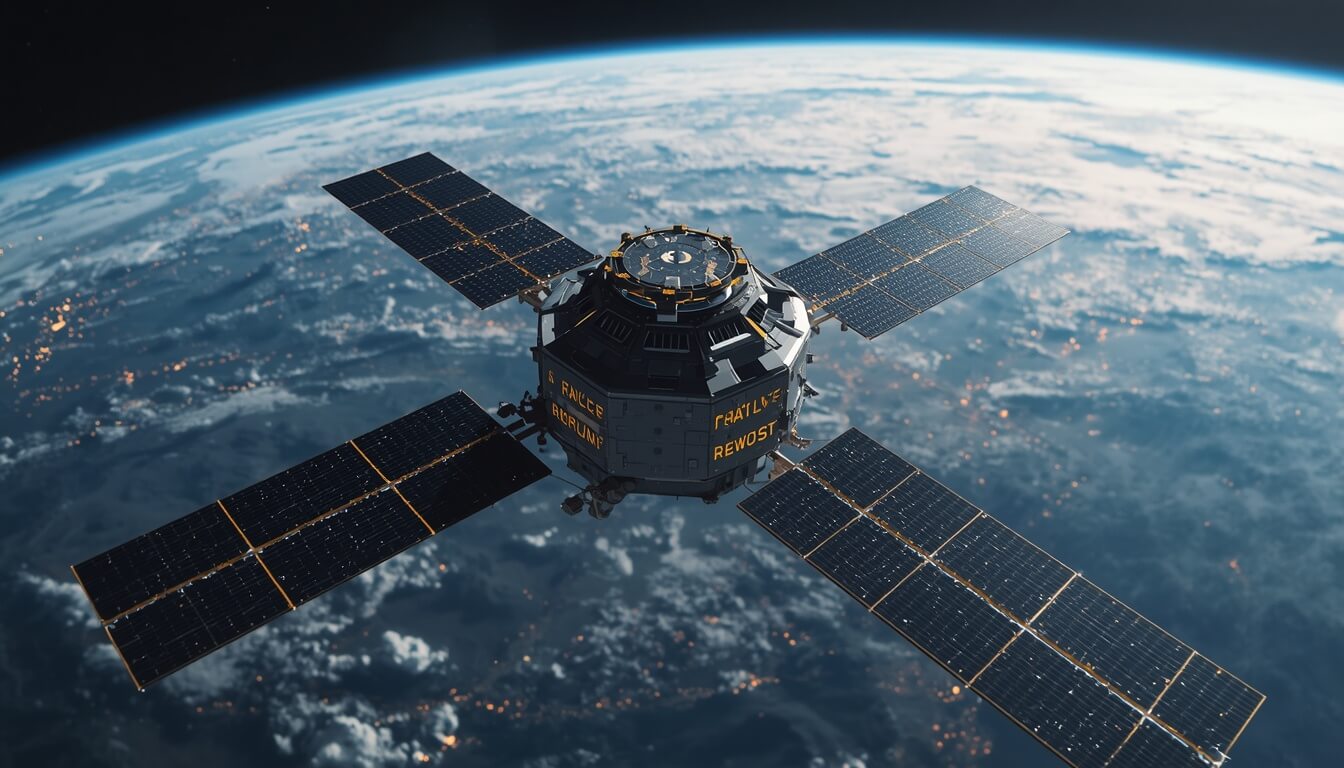
The idea of moving computing infrastructure into orbit is becoming increasingly visible across the technology and space industries. Companies are investigating whether satellites could do more than transmit communications or collect information from space. They could also process, store and distribute data.
The motivation is closely connected to the rapid expansion of artificial intelligence. AI systems require increasing amounts of computing power, electricity and physical infrastructure. At the same time, building conventional data centers on Earth is becoming more complex because of power availability, land requirements, cooling needs and grid constraints.
This is creating interest in an alternative location for computing infrastructure: space.
Several companies are now working on different versions of the concept. Google is researching Project Suncatcher, while Blue Origin has proposed Project Sunrise. SpaceX has also outlined plans involving very large numbers of satellites capable of supporting orbital computing. Startups such as Starcloud, Sophia Space and Orbital are pursuing smaller-scale approaches. NVIDIA is also developing computing platforms specifically designed for space applications.
The objective, however, is not simply to move today's terrestrial data centers into orbit. Companies are exploring space because certain characteristics of the orbital environment could eventually solve specific problems that are becoming more difficult on Earth.
The idea of computing in orbit is part of a broader question about whether some digital infrastructure could eventually move beyond Earth. The technological foundations and the potential evolution of this concept are examined in Could Data Centers Eventually Move Into Space?.
The first customers for orbital computing may not be companies looking for ordinary cloud services. Early demand is more likely to come from organizations already operating in space, where the data is generated and processed close to the source.
AI Is Changing the Economics of Computing
Artificial intelligence has transformed the scale of computing infrastructure required by technology companies.
Training and operating advanced AI models requires large numbers of processors, particularly GPUs and specialized accelerators. These systems consume significant amounts of electricity and generate substantial quantities of heat.
As demand grows, companies need to build more computing capacity. This creates a physical infrastructure problem.
A terrestrial data center requires a suitable location, electricity, networking connections, cooling infrastructure and sufficient space for the equipment. In areas where electricity generation and grid capacity are constrained, adding another large facility can take years.
Space offers a fundamentally different environment.
Solar energy is available above the atmosphere without requiring conventional terrestrial power plants or competing for land. Companies exploring orbital computing therefore see the possibility of connecting future computing capacity directly to a large and continuously available energy source.
This does not automatically make space-based computing cheaper. Launching hardware into orbit, protecting it from radiation, managing heat and replacing failed equipment all introduce costs that do not exist in the same form on Earth.
The business case therefore depends on whether the advantages can eventually compensate for those additional costs.
Computing Where the Data Is Created
One of the most immediate reasons for putting computing hardware into orbit is not terrestrial AI at all.
It is the growing quantity of data generated in space.
Earth-observation satellites collect enormous volumes of imagery and sensor information. Communications satellites continuously handle network traffic. Scientific spacecraft generate data that can be difficult and expensive to transmit continuously to Earth.
Instead of sending everything to a terrestrial data center, an orbital computing system could analyze information before transmitting it.
For example, an Earth-observation satellite could identify objects, changes in terrain or particular atmospheric conditions using onboard AI. Instead of sending every raw image to Earth, it could transmit the relevant results or a smaller selection of data.
This is an example of edge computing in space.
The concept is already moving beyond theory. Companies are testing satellites equipped with powerful processors and optical communication links, creating an intermediate step between traditional satellites and larger orbital computing systems.
For companies, this creates a potentially valuable early market because the customer does not need to move an existing terrestrial workload into space. The data is already there.
The Energy Argument
Energy is one of the strongest long-term arguments behind orbital computing.
Terrestrial data centers require a continuous supply of electricity. As AI workloads grow, the amount of electricity required by new facilities can become a major constraint.
Space-based systems could generate electricity using solar panels without requiring the same type of terrestrial grid connection.
This is one of the reasons several companies are investigating the technology. Google has described Project Suncatcher as a research project involving satellites carrying its Tensor Processing Units, while other companies are developing dedicated orbital computing platforms.
However, the energy argument needs to be viewed together with the engineering requirements.
Solar energy does not eliminate the need for batteries, power-management systems or large solar arrays. More importantly, electricity consumed by processors eventually becomes heat.
Space does not provide conventional air cooling.
Heat has to be rejected through radiation, which means that an orbital data center needs dedicated thermal-management systems.
Consequently, the relationship between computing power and energy is more complicated than simply installing solar panels in orbit.
Companies Are Testing Different Business Models
There is currently no single model for orbital computing.
Some companies are approaching the technology through specialized satellites.
Starcloud, for example, has demonstrated computing with a powerful NVIDIA GPU in orbit and is developing larger orbital computing systems. Its approach focuses specifically on providing computing infrastructure beyond Earth.
Other companies are approaching the market through satellite networking.
Kepler Communications is developing orbital compute capabilities integrated with its communications architecture. This could allow computing resources to operate as part of a distributed network rather than as isolated satellites.
Google is taking a research-oriented approach through Project Suncatcher, investigating how AI accelerators could operate in coordinated satellite formations.
Blue Origin has proposed a much larger architecture. Its Project Sunrise concept involves a large satellite network intended to perform advanced computation in orbit and shift some resource-intensive computing away from terrestrial infrastructure.
SpaceX has also presented plans involving orbital computing at a much larger scale.
These approaches are very different, but they share the same basic idea: computing could eventually become a distributed infrastructure layer in orbit.
Why Startups Are Moving First
Startups have another potential advantage: they can design their entire architecture around orbital computing from the beginning.
A traditional satellite company may regard computing as one component of a spacecraft. A dedicated orbital data-center company can instead design the spacecraft around processors, power generation, thermal management, storage and communications.
This approach is being pursued by companies such as Starcloud, Sophia Space and Orbital.
The advantage of this approach is specialization.
The disadvantage is that these companies must solve almost every part of the infrastructure problem themselves, including launch, spacecraft reliability, communications, regulation, cybersecurity and customer access.
The Role of NVIDIA and the Semiconductor Industry
Another important development is the adaptation of computing hardware for space.
NVIDIA has been working with companies involved in space missions to bring accelerated computing platforms into orbital environments. These developments include applications involving AI, Earth observation, communications and other forms of onboard processing.
This matters because orbital computing depends not only on spacecraft technology but also on the continued miniaturization and efficiency of processors.
A conventional data-center GPU is designed to operate inside a controlled terrestrial environment. Space hardware has to deal with restrictions on size, weight and power, as well as radiation and thermal constraints.
More efficient processors therefore make the entire concept more practical.
As semiconductor performance improves, companies can potentially obtain more computing capacity without increasing spacecraft mass and power requirements at the same rate.
Launch Costs Remain a Major Question
Despite the enthusiasm surrounding orbital computing, companies still face a fundamental economic obstacle: getting hardware into orbit.
A terrestrial data center can receive new servers through conventional logistics. A satellite data center requires a launch vehicle.
This means launch prices and launch availability directly affect the economics of computing in space.
The industry is benefiting from reusable rockets and growing launch capacity, but launch infrastructure itself remains a major component of the cost structure.
This illustrates an important point: interest from technology companies does not mean that orbital computing has already reached commercial maturity.
Many of the largest proposals remain experimental or developmental.
The First Customers May Be Different From Expected
The first customers for orbital computing may not be companies looking for ordinary cloud computing.
Instead, early demand could come from organizations already operating in space:
- Earth-observation companies could use orbital AI to process images.
- Satellite operators could use onboard computing to optimize communications.
- Scientific missions could analyze experimental data before sending it to Earth.
- Defense and security organizations could process satellite imagery closer to the source.
- Space stations and future lunar infrastructure could also require local storage and computing.
This is why the early development of orbital computing may resemble the development of edge computing rather than the construction of a traditional cloud region.
The computing infrastructure moves closer to the data instead of simply trying to reproduce a terrestrial data center in another location.
From Experiments to Infrastructure
The transition from experimental hardware to a commercially viable infrastructure network will be the critical stage.
A demonstration involving one GPU in orbit proves that computing can work in space. It does not prove that thousands of GPUs can operate economically for years.
To reach that stage, companies will need reliable launch systems, standardized spacecraft, efficient power generation, thermal management, radiation protection, high-bandwidth communications and methods for replacing or deorbiting hardware.
They will also need customers willing to pay for the service.
The economic question therefore becomes central.
For an examination of the technology, costs and engineering barriers that determine whether these business models can scale, see Space-Based Data Centers: The Technology, Economics and Challenges.
A New Competition for Computing Infrastructure
The companies exploring computing in orbit are effectively testing whether space can become another location for global digital infrastructure.
The motivation is not based on a single advantage:
- AI is increasing demand for computing power.
- Terrestrial data centers require increasingly large amounts of electricity.
- Satellite networks are generating more data.
- Space-based solar power offers a potentially different energy model.
- Advances in launch systems, processors and optical communications are making increasingly sophisticated spacecraft possible.
Together, these developments are creating a new technological opportunity.
At the same time, the obstacles remain substantial. Space hardware is expensive, difficult to repair and exposed to radiation. Heat management is challenging. Launch capacity is limited. Regulatory and orbital-environment issues become more complicated as the number of satellites increases.
For these reasons, orbital computing should currently be viewed as an emerging infrastructure technology rather than a replacement for terrestrial data centers.
The important development is that companies are no longer discussing the concept purely as science fiction. They are building prototypes, launching computing hardware, filing regulatory applications and testing the technologies required to make computing in orbit possible.
The next stage is determining whether those experiments can become a sustainable infrastructure business.