
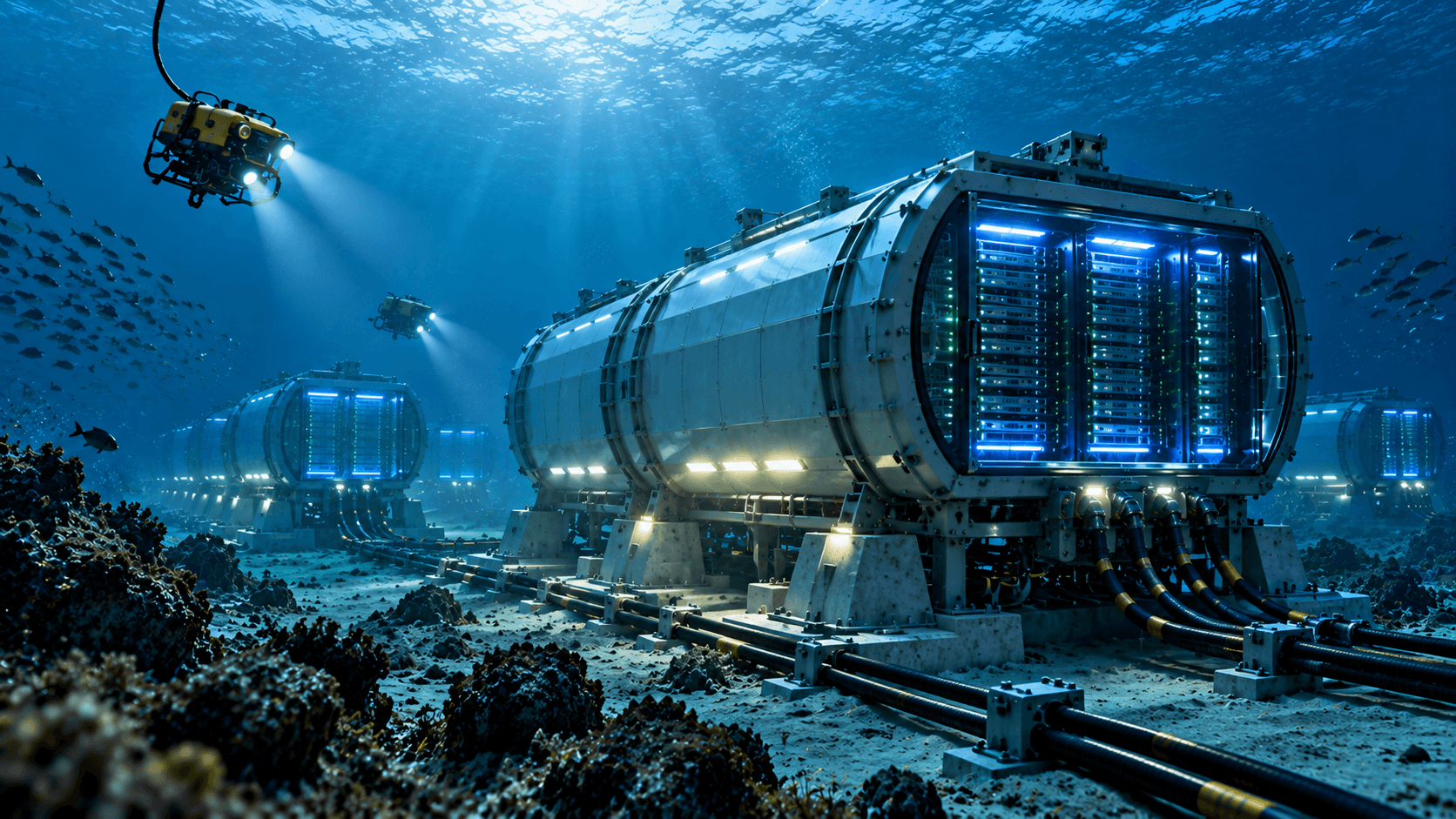
Yes, China has developed underwater data centers that place computing equipment inside sealed structures on the ocean floor. One of the most notable projects is located off the coast of Hainan, where developers have deployed underwater computing infrastructure designed to use surrounding seawater for cooling.
China is not the first country to test this technology. Microsoft previously operated an experimental underwater data center through its Project Natick research program.
The concept is straightforward: instead of housing servers in conventional buildings, operators place computing equipment inside sealed underwater modules. Seawater helps remove heat, potentially reducing the electricity required for cooling.
However, underwater data centers remain an emerging technology rather than an established alternative to conventional facilities.
For investors, the important questions are whether these facilities can operate profitably, whether the technology can scale, and which companies might benefit from wider adoption.
Is China Really Putting Data Centers on the Ocean Floor?
Yes. China has pursued commercial underwater data center development near Hainan, an island province in the South China Sea.
The project involves sealed computing modules installed underwater and connected to infrastructure on land. These connections provide electricity and allow data to travel between the servers and external networks.
Surrounding seawater helps remove heat from the equipment, potentially reducing reliance on conventional cooling infrastructure.
The Hainan project has been associated with Highlander, a Chinese marine technology company involved in underwater data center development.
The initiative is significant because it moves underwater computing beyond laboratory experiments toward commercial deployment.
However, an operating installation does not automatically demonstrate that underwater data centers are cheaper or more profitable than conventional facilities.
Investors should distinguish between three stages: technical feasibility, commercial profitability, and widespread adoption. Each requires different evidence.
How Do Underwater Data Centers Work?
An underwater data center contains servers and other computing equipment inside a sealed, pressure-resistant structure.
The equipment can perform familiar computing tasks, including data processing, storage, and cloud services. The main difference is its location and cooling method.
In conventional facilities, cooling systems transfer heat from servers to the surrounding environment. Underwater data centers use the ocean as a large heat sink, meaning a place where excess heat can be transferred.
The electronic equipment remains protected inside its enclosure. Heat moves through a cooling system toward the surrounding seawater, which does not normally circulate directly through the servers.
How Does the Equipment Receive Electricity and Internet Access?
Underwater computing modules require connections to land-based infrastructure.
Subsea cables and specialized connectors provide electricity and data transmission. These connections allow the underwater equipment to communicate with external networks and operate as part of a larger computing system.
Underwater facilities therefore still depend on reliable power generation, networking, and supporting infrastructure.
How Are the Servers Protected?
The servers operate inside sealed structures designed to withstand seawater exposure, pressure, and other underwater conditions.
Some designs use controlled internal environments to protect electronic components and improve reliability.
However, maintenance is more complicated than in a conventional server room. Replacing certain components may require recovering an entire underwater module, increasing the importance of equipment reliability and careful maintenance planning.
Why Would Companies Put Data Centers Underwater?
The main potential advantages involve cooling efficiency, land requirements, freshwater consumption, and proximity to coastal markets.
1. Lower Cooling Requirements
Conventional data centers use equipment such as chillers, fans, pumps, and cooling towers to remove heat.
Underwater facilities can transfer heat into surrounding seawater, potentially reducing the electricity required for certain cooling processes.
However, cooling does not become energy-free. Pumps and other equipment may still consume electricity. Actual savings depend on system design, seawater temperature, location, and computing workloads.
2. Reduced Land Requirements
Large data centers require land for buildings, electrical equipment, cooling infrastructure, and supporting facilities.
Underwater modules could reduce some of these requirements, particularly near densely populated coastal cities where suitable land is expensive or limited.
However, they still need shore-based connections, while marine installation introduces additional engineering and deployment costs.
3. Potentially Lower On-Site Freshwater Consumption
Some land-based data centers use evaporative cooling systems that consume freshwater.
An underwater facility transferring heat into seawater may reduce the need for this type of cooling. This could be useful in regions with limited freshwater resources.
However, lower freshwater consumption does not automatically mean a smaller environmental footprint. Heat released into the marine environment must also be considered.
4. Proximity to Coastal Cities
Many large population centers and industrial markets are located near coastlines.
Underwater data centers could potentially provide computing capacity near these markets. Shorter network distances may benefit applications that require fast communication.
However, actual performance depends on cable routes, network design, and user locations. Being underwater does not automatically make a facility faster.
Did Microsoft Build an Underwater Data Center?
Yes. Microsoft tested underwater computing through Project Natick, a research program investigating whether sealed data centers could operate reliably beneath the ocean.
In 2018, Microsoft deployed an underwater module off the coast of Scotland containing 864 servers. The module remained underwater for approximately two years before being recovered in 2020.
Microsoft reported encouraging reliability results, observing a lower server failure rate in the underwater module than in the land-based comparison group used in its research.
However, the results came from a specific experiment. They do not establish that every underwater data center will outperform conventional facilities.
Project Natick demonstrated technical feasibility, but Microsoft subsequently ended its underwater research effort rather than developing a broad commercial rollout.
For investors, this distinction matters: successful technology experiments do not necessarily become profitable businesses.
How Is China's Underwater Data Center Project Different From Microsoft's?
The two initiatives illustrate different approaches to underwater computing.
| Feature | Microsoft Project Natick | China's Hainan underwater data center |
|---|---|---|
| Main purpose | Research and technology testing | Commercial underwater computing development |
| Location | Waters near Scotland | Offshore Hainan, China |
| Approach | Sealed underwater computing module | Sealed underwater computing modules |
| Cooling concept | Use surrounding seawater to remove heat | Use surrounding seawater to remove heat |
| Development status | Research program concluded | Commercial deployment initiative |
Microsoft primarily investigated technical feasibility and reliability. China's Hainan initiative has focused on developing underwater computing as a commercial infrastructure service.
However, commercial deployment is not the same as proven profitability. Public information about the long-term economics of underwater facilities remains more limited than information about conventional data center operations.
Can Underwater Data Centers Save Electricity?
Potentially, yes, particularly by reducing the energy required for cooling.
Servers, AI processors, and networking equipment still consume substantial electricity underwater. The potential savings come mainly from supporting infrastructure rather than eliminating computing energy demand.
One useful efficiency measure is Power Usage Effectiveness (PUE), which compares total facility energy consumption with the energy used by computing equipment.
A lower PUE generally indicates that less energy is consumed by supporting infrastructure relative to the computing load.
However, PUE does not measure construction costs, equipment replacement expenses, or environmental impacts.
For investors, the key question is whether electricity savings outweigh the additional costs of marine deployment, subsea connections, and maintenance over the facility's operating life.
Are Underwater Data Centers Better for the Environment?
They may offer advantages in certain locations, but the overall environmental impact depends on facility design, electricity sources, and marine conditions.
Potential benefits include reduced land requirements, lower freshwater consumption, and less electricity used for some cooling processes.
What Happens to the Heat Released Into the Ocean?
Computing equipment produces heat regardless of where it operates. Underwater data centers transfer that heat into the surrounding marine environment.
The potential environmental effect depends on the amount of heat released, local water circulation, temperature changes, and the sensitivity of nearby ecosystems.
Environmental assessments are therefore important before expanding underwater installations.
What About Marine Construction?
Installing underwater modules requires specialized structures, vessels, cables, and marine operations.
Construction, maintenance, and eventual equipment recovery can create environmental impacts that should be included when comparing underwater and land-based facilities.
Does Underwater Cooling Eliminate Carbon Emissions?
No. Underwater data centers still require electricity. If that electricity comes from fossil fuels, their operations remain associated with greenhouse gas emissions.
Efficient cooling may reduce electricity demand, but it does not automatically make a facility carbon-neutral.
For a broader explanation of environmental trade-offs, see How AI Impacts the Environment: Water, Energy, and Carbon.
Could Underwater Data Centers Be Used for Artificial Intelligence?
Yes, provided they can support the computing equipment, electrical capacity, networking, and cooling required by AI workloads.
However, advanced AI systems can require very high power density, meaning substantial electricity consumption within a relatively small space.
Large AI installations may also require sophisticated cooling systems and frequent hardware upgrades.
These requirements can create difficulties underwater. In a conventional data center, technicians can replace processors and servers relatively easily. In a sealed underwater module, significant hardware upgrades may require recovering the equipment.
As a result, underwater facilities may be better suited to some computing workloads than others.
Whether they become competitive for large AI training systems will depend on their ability to handle high power requirements, accommodate hardware upgrades, and operate economically.
What Are the Biggest Challenges Facing Underwater Data Centers?
Several technical and financial obstacles could limit adoption.
High Installation Costs
Underwater facilities require specialized engineering, marine deployment equipment, and subsea connections. These requirements can increase initial investment costs.
Cooling savings must be evaluated against the total cost of constructing and operating the facility.
Difficult Maintenance
Replacing failed components may require recovering underwater modules. This can make maintenance more complicated and expensive than servicing equipment inside conventional buildings.
Limited Flexibility
Conventional data centers can often be expanded or upgraded without replacing entire facilities.
Underwater modules may be harder to modify after deployment, potentially creating disadvantages when computing hardware changes rapidly.
Electricity Infrastructure
Underwater facilities still require reliable, affordable electricity. Large computing installations may need substantial power capacity regardless of their location.
Environmental Approval
Marine installations may require permits, environmental assessments, and coordination with authorities.
Concerns about ecosystems, fishing activities, navigation, and coastal infrastructure could affect project approvals.
These challenges make underwater computing a specialized emerging technology rather than a proven solution for every data center requirement.
Which Companies Could Benefit From Underwater Data Centers?
Potential beneficiaries extend beyond companies operating underwater facilities.
- Marine engineering companies: Businesses designing and deploying underwater structures may provide construction and installation services.
- Subsea cable suppliers: Underwater facilities require electricity and data connections.
- Cooling technology companies: Suppliers of heat exchangers, pumps, and thermal management equipment may participate in system development.
- Electrical equipment manufacturers: Facilities require power distribution, monitoring, and supporting electrical infrastructure.
- Data center operators: Companies developing commercially viable underwater facilities could potentially sell computing services to customers.
However, the size of these opportunities remains uncertain.
Supplying equipment to an experimental installation does not necessarily generate meaningful revenue for a large industrial company.
Investors should look for measurable commercial demand, recurring revenue, and profitability rather than relying on announcements about emerging technology.
Can Investors Buy Underwater Data Center Stocks?
There is no widely established category of publicly traded companies whose primary business is operating underwater data centers.
Companies involved in the technology may be privately held or operate across several industries.
Highlander, associated with China's Hainan project, has participated in marine technology and underwater data center development. However, involvement in the project does not automatically create a straightforward investment opportunity for international retail investors.
Investors should verify any company's current listing status, financial disclosures, and actual exposure to underwater computing before considering an investment.
Broader exposure may be available through publicly traded suppliers of electrical equipment, cooling systems, subsea infrastructure, or conventional data center services.
However, owning a company that supplies these products does not necessarily provide meaningful exposure to underwater data centers specifically.
Could Underwater Data Centers Compete With Traditional Data Centers?
They could compete in selected applications, but conventional data centers retain important advantages.
Land-based facilities are generally easier to access, maintain, expand, and upgrade. They also benefit from established construction methods and operating experience.
Underwater installations may be attractive where suitable land is limited, seawater cooling is practical, and computing requirements remain relatively stable.
However, financial competitiveness depends on total lifetime costs, including construction, electricity, cooling, network connections, maintenance, hardware replacement, and eventual recovery.
A facility that reduces cooling expenses but costs substantially more to install and maintain may not deliver attractive financial returns.
Local conditions also matter. An underwater installation near a suitable coastline may have different economics from an inland data center with inexpensive electricity and favorable cooling conditions.
For a detailed explanation of conventional and advanced cooling technologies, see How AI Cooling Systems Work: A Guide for Retail Investors.
What Should Investors Watch Next?
The future of underwater data centers depends on whether developers can demonstrate commercial advantages beyond technical feasibility.
Important developments to monitor include:
- Additional commercial deployments: More operating facilities would provide evidence of scalability.
- Operating cost disclosures: Reliable figures on electricity savings, maintenance expenses, and total costs would allow better comparisons with conventional facilities.
- Customer demand: Long-term contracts and recurring revenue would indicate commercial interest.
- Equipment reliability: Extended operating data would help establish whether underwater conditions offer consistent reliability advantages.
- Environmental assessments: Research on marine impacts and cooling performance would clarify sustainability claims.
- Hardware upgrade capabilities: More efficient replacement methods could improve operating flexibility and economics.
These developments provide stronger evidence of commercial potential than announcements about planned installations alone.
Are Underwater Data Centers the Future of AI Infrastructure?
China's Hainan project and Microsoft's earlier experiments demonstrate that computing equipment can operate inside sealed structures beneath the ocean.
Potential advantages include seawater-based cooling, reduced land requirements, and lower freshwater consumption in certain designs.
However, underwater deployment introduces maintenance difficulties, specialized construction costs, environmental concerns, and limitations on equipment upgrades.
These challenges are particularly relevant to AI infrastructure, where computing requirements and hardware technologies evolve rapidly.
Underwater data centers may eventually serve specialized applications or geographic markets. However, there is not yet sufficient evidence that they will replace conventional facilities or become a dominant part of AI infrastructure.
The main takeaway for investors: Underwater data centers are a real technology, and China has pursued commercial deployment. Their investment potential depends on proven cost savings, reliable operations, paying customers, and the ability to scale. Until those advantages are consistently demonstrated, underwater computing should be viewed as an emerging infrastructure opportunity rather than an established AI investment trend.
Disclaimer: This article is for informational purposes only and does not constitute financial or investment advice. All investments involve risk, including the potential loss of capital.