
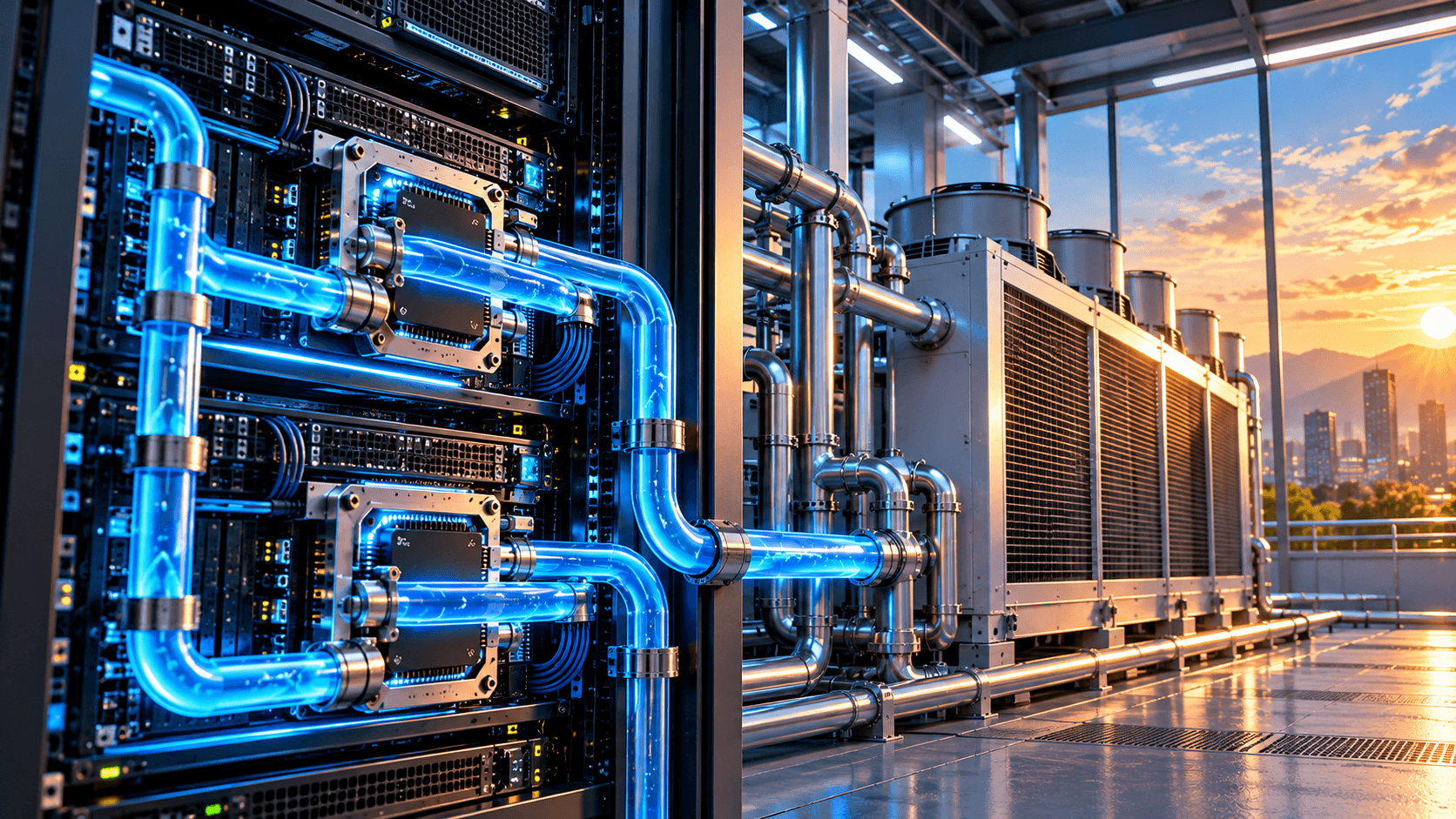
AI cooling systems remove heat generated by powerful computer chips inside data centers. They use air, liquid, or a combination of both to keep equipment operating safely and efficiently. As AI servers become more powerful and densely packed, advanced cooling is becoming an increasingly important part of AI infrastructure.
For investors, cooling matters because it influences data center construction costs, electricity consumption, and the amount of computing power a facility can support. Companies supplying cooling equipment may benefit from growing AI investment, although stronger demand does not automatically guarantee higher profits or stock returns.
Why Do AI Data Centers Need So Much Cooling?
AI data centers contain thousands of servers equipped with powerful processors. Many use graphics processing units (GPUs), specialized chips that handle AI training and other demanding computing tasks.
These chips consume substantial electricity, much of which ultimately becomes heat. As computing power increases, removing that heat becomes more difficult.
The challenge is not simply the number of servers. High-performance AI chips can be installed close together, concentrating enormous computing power within individual server racks.
Imagine two buildings of similar size. One contains conventional business servers, while the other houses densely packed AI servers. The second building may require a much more capable cooling system despite having similar floor space.
Without adequate cooling, processors can automatically reduce their performance to prevent overheating. In more serious cases, equipment may shut down and interrupt operations.
For companies investing billions of dollars in AI infrastructure, cooling helps determine how effectively their expensive computing equipment can operate.
How Do AI Cooling Systems Actually Work?
Every data center cooling system has the same basic purpose: move heat away from computing equipment and eventually release it outside the computing environment.
Three main approaches are used.
1. Air Cooling
Air cooling is the traditional method used in many data centers.
Fans move air through servers, where it absorbs heat from electronic components. The heated air is then directed toward cooling equipment before being circulated again.
This established technology works well for conventional servers and some AI installations. However, densely packed AI equipment can generate more heat than traditional airflow systems can efficiently remove.
Moving sufficient air through these racks may require additional energy, space, and more sophisticated airflow management.
2. Direct-to-Chip Liquid Cooling
Direct-to-chip liquid cooling circulates fluid through specially designed cooling plates attached to high-heat components such as GPUs and CPUs.
The liquid absorbs heat directly from these components and carries it to equipment that transfers the heat into another cooling system.
The principle resembles a car's liquid cooling system: fluid transports heat away from components that must remain within safe operating temperatures. Near the electronics, the liquid typically stays inside sealed channels.
This approach is particularly useful for powerful AI servers because liquid can remove concentrated heat more effectively than air alone.
However, direct-to-chip cooling requires additional equipment, piping, maintenance, and protection against leaks. It also does not necessarily eliminate air cooling, since other server components may still require airflow.
3. Immersion Cooling
Immersion cooling places servers or selected computing components directly into a specially designed electrically nonconductive fluid.
Instead of flowing through cooling plates, the fluid surrounds compatible electronic components and absorbs their heat.
Immersion cooling can handle high heat loads, but it requires specialized hardware, equipment, and maintenance procedures.
It remains less widely deployed than conventional air cooling. Direct-to-chip liquid cooling has attracted particular attention for high-density AI installations.
Air Cooling vs. Liquid Cooling: Which Is Better for AI?
Liquid cooling is often better suited to densely packed, high-performance AI servers, but air cooling remains practical for many installations.
The right choice depends on processor power consumption, server density, climate, existing infrastructure, and installation costs.
| Factor | Air cooling | Liquid cooling |
|---|---|---|
| Established technology | Very mature | Increasing adoption |
| High-density AI servers | More challenging | Often better suited |
| Installation | Familiar infrastructure | Additional liquid-handling equipment |
| Heat removal | Uses moving air | Uses circulating liquid |
| Maintenance | Established procedures | Requires specialized procedures |
| Upfront cost | Often lower for suitable workloads | Can require higher initial investment |
Liquid cooling can reduce the energy needed to remove heat from dense computing equipment. However, it does not guarantee lower total electricity consumption. Overall efficiency also depends on pumps, chillers, outdoor temperatures, and facility design.
For investors, the important distinction is that more powerful AI chips can change the type and value of cooling equipment required.
Upgrading a conventional data center for high-density AI servers may require cooling distribution units, liquid piping, heat exchangers, and other infrastructure. This creates potential business opportunities beyond AI chip manufacturers.
Why Is Cooling Becoming More Important as AI Grows?
AI is increasing cooling demand in two ways: companies are building more data center capacity, and individual AI servers are becoming more powerful.
New facilities need cooling infrastructure from the beginning. Existing facilities may require expensive upgrades when operators install more powerful AI equipment.
Cooling suppliers can therefore benefit from both new construction and modernization projects.
However, equipment demand depends on actual construction activity, financing, electricity availability, and customer spending decisions. Delayed data center projects can also delay cooling orders.
Investors should distinguish between announcements of future AI investment and confirmed equipment orders that eventually generate revenue.
How Much Electricity Does AI Cooling Use?
Cooling consumes part of a data center's electricity, but its share varies considerably depending on the facility's design, location, and computing equipment.
One commonly used efficiency measurement is Power Usage Effectiveness (PUE), which compares total facility electricity consumption with the electricity used by IT equipment.
Consider a hypothetical data center where servers and networking equipment consume 100 megawatt-hours of electricity. If the entire facility consumes 120 megawatt-hours, its PUE is 1.20.
The additional 20 megawatt-hours cover cooling and other supporting systems, including electrical distribution losses.
A lower PUE generally indicates less facility overhead relative to IT electricity consumption. However, PUE does not measure cooling electricity separately or show how efficiently AI processors perform useful calculations.
Even if cooling becomes more efficient, total electricity demand can continue increasing as operators install additional AI servers.
For a broader look at the numbers, see How Much Electricity Do Data Centers Consume?.
Do AI Cooling Systems Consume Water?
Some AI cooling systems consume water, while others primarily reject heat into the surrounding air. The amount depends on the cooling design and local conditions.
Evaporative cooling systems use water evaporation to remove heat. They can reduce electricity requirements under suitable conditions, but consume water during operation.
Direct-to-chip liquid cooling often uses closed loops that circulate fluid without continuously consuming significant amounts of water within those loops.
However, a closed-loop system can still transfer heat to external equipment that uses evaporative cooling.
This distinction matters: liquid cooling does not automatically mean high water consumption, and a water-cooled server does not reveal how much water the entire facility uses.
Climate and water availability also influence system design. In regions experiencing water stress, cooling requirements can affect construction costs, operating expenses, and project approvals.
For a closer look at daily consumption and the factors behind it, read How Much Water Does an AI Data Center Use Per Day?.
Which Companies Build AI Data Center Cooling Systems?
The AI cooling market includes suppliers of complete thermal management systems and manufacturers of specialized components such as pumps, heat exchangers, chillers, and cooling distribution units.
Several established publicly traded companies participate in this market.
Vertiv (NYSE: VRT) supplies critical digital infrastructure, including traditional thermal management equipment and liquid cooling solutions for data centers.
Schneider Electric (EPA: SU) provides energy management and data center infrastructure equipment, including liquid cooling technologies associated with its Motivair business.
Johnson Controls (NYSE: JCI) operates in building technologies and HVAC equipment, including large-scale cooling solutions relevant to data centers.
Trane Technologies (NYSE: TT) supplies commercial cooling and climate-control equipment, including technologies used to manage heat in large computing facilities.
These businesses have different levels of exposure to AI infrastructure.
A specialized data center infrastructure supplier may benefit more directly from AI construction spending. A diversified industrial manufacturer may generate most of its revenue from other markets, limiting the financial impact of additional AI cooling orders.
Investors should therefore examine how much of each company's business actually depends on data center cooling.
Explore their business models and market positions in The Biggest Data Center Cooling Companies.
How Can Investors Evaluate AI Cooling Stocks?
Investors evaluating AI cooling stocks should focus on four factors: revenue exposure, order growth, profitability, and valuation.
Revenue exposure: Determine how much of a company's sales come from data center infrastructure rather than unrelated industrial activities. A growing AI cooling market may have only a modest impact on a highly diversified business.
Orders and backlog: Rising orders can indicate stronger demand. Backlog represents orders received but not yet fulfilled and can provide visibility into future revenue. However, contracts may be delayed, modified, or canceled.
Profit margins: Higher sales do not guarantee higher profits. Competition, manufacturing costs, and installation expenses can reduce the financial benefits of growing demand.
Stock valuation: A strong business can still be a disappointing investment if its share price already reflects overly optimistic growth expectations.
For a more detailed discussion of investment considerations, see Cooling Stocks for Data Center Investments: What Retail Investors Should Know.
What Are the Biggest Risks for AI Cooling Companies?
Despite growing demand for AI infrastructure, cooling suppliers face several important risks.
Slower AI investment: Cloud providers and data center operators may postpone construction or upgrades, reducing near-term equipment demand.
Greater competition: Established industrial companies and specialized suppliers may compete for the same liquid cooling projects, putting pressure on prices and profit margins.
Technology changes: Improvements in chip efficiency or alternative cooling designs could reduce demand for certain products.
Supply chain and execution problems: Component shortages, manufacturing constraints, and installation delays can affect delivery schedules and profitability.
Excessive stock valuations: Even successful cooling companies can experience share-price declines when earnings fall short of investor expectations.
These risks make financial performance and competitive positioning more important than simply identifying companies associated with AI.
Who Owns the Data Centers That Need Cooling?
Cooling suppliers sell equipment and services to companies building or operating data centers, including major cloud platforms, specialized AI infrastructure businesses, and data center real estate operators.
Microsoft Azure, Amazon Web Services, and Google Cloud operate extensive computing infrastructure. Equinix and Digital Realty also manage large data center portfolios serving enterprise and technology customers.
However, owning more facilities does not necessarily mean purchasing more advanced AI cooling equipment.
A conventional enterprise data center and a facility designed for densely packed AI servers can have very different cooling requirements.
For investors, the type of computing capacity being developed is often more informative than the total number of buildings.
For a comparison of major operators, see Which Companies Own the Most Data Centers?.
What Is the Environmental Impact of AI Cooling?
AI cooling affects the environment primarily through electricity consumption, water use, and the infrastructure required to operate data centers.
More efficient cooling can reduce electricity overhead, but total energy consumption may still increase when facilities install additional high-powered AI processors.
The source of electricity also matters. A facility using predominantly low-carbon power has a different operational emissions profile from one relying heavily on fossil-fuel generation.
Water creates another trade-off. Evaporative cooling can reduce electricity requirements under suitable conditions, while alternative systems may conserve water but consume more energy.
These considerations can influence operating costs, environmental approvals, and community acceptance of new data center projects.
Explore these trade-offs in How AI Impacts the Environment: Water, Energy, and Carbon.
Could Underwater Data Centers Change the Cooling Industry?
Underwater data centers are an experimental approach that uses the surrounding marine environment to help remove heat from computing equipment.
Microsoft explored this concept through Project Natick, demonstrating the technical feasibility of operating a sealed data center underwater. Chinese companies have also pursued underwater data center projects.
However, underwater facilities face challenges involving installation, maintenance, equipment replacement, environmental conditions, and commercial viability.
They remain an emerging infrastructure approach rather than a proven replacement for conventional land-based AI data centers.
Read Underwater Data Centers: What Investors Should Know for a closer examination of the technology and its commercial prospects.
What Should Retail Investors Watch Next?
AI cooling is becoming increasingly important as data centers install more powerful computing equipment. For investors, the key question is whether rising demand will translate into sustainable revenue and earnings growth.
Five developments are worth monitoring:
- AI server power density: More powerful processors can increase demand for advanced heat removal.
- Liquid cooling adoption: Wider adoption can create opportunities for specialized equipment and installation suppliers.
- Data center construction: New facilities and modernization projects can generate additional cooling orders.
- Financial performance: Revenue growth, profit margins, backlog conversion, and cash flow reveal whether demand is producing profitable business.
- Electricity and water constraints: Resource availability and permitting requirements can influence project locations, costs, and construction schedules.
The central lesson is that AI infrastructure requires much more than advanced processors. Those chips also depend on reliable electricity, networking equipment, physical facilities, and cooling systems capable of removing their heat.
As AI computing demands increase, cooling can become a more significant engineering and financial consideration for data center operators.
For retail investors, the opportunity is not simply to identify companies associated with liquid cooling. It is to find businesses capable of converting growing infrastructure demand into durable profits while avoiding stock prices that already assume exceptional future growth.
Disclaimer: This article is for informational purposes only and does not constitute financial or investment advice. All investments involve risk, including the potential loss of capital.