
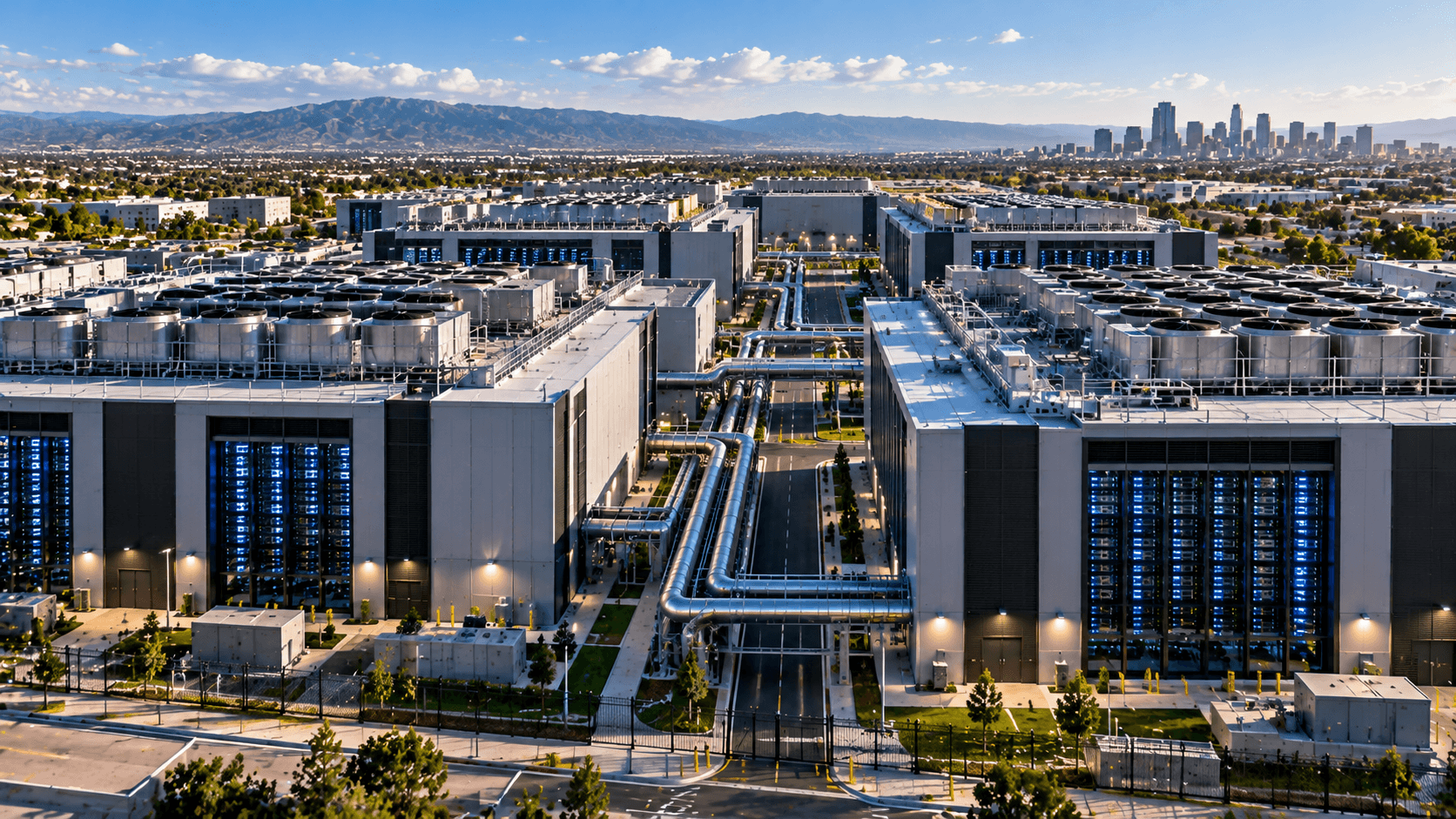
Equinix and Digital Realty are among the largest publicly traded data center owners and operators in the world. However, technology giants such as Amazon, Microsoft, and Google also operate enormous computing infrastructures.
Which company has the most data centers depends on how they are counted. Some companies operate hundreds of facilities serving multiple customers. Others run massive cloud computing campuses, own buildings directly, or lease space from specialized operators.
There is no universally reliable ranking that compares every company's individual data center buildings.
For investors, the distinction matters because owning data center real estate and selling cloud computing services are different business models, with different revenue sources, costs, and financial risks.
What Company Has the Most Data Centers in the World?
Equinix is one of the largest global data center operators by publicly reported facility count. It operates hundreds of data centers across multiple continents, serving businesses that need computing space, network connections, and access to cloud services.
Digital Realty is another major global operator, with an extensive international portfolio of data center properties.
However, identifying the company with the most data centers is difficult because operators report their infrastructure differently.
- Equinix: Operates a large network of interconnected data centers serving multiple customers.
- Digital Realty: Owns and operates data center properties, including facilities designed for large cloud customers.
- Amazon, Microsoft, and Google: Operate extensive cloud infrastructure but do not publish directly comparable counts of every individual facility.
- Other technology companies: May lease space from specialized operators rather than owning every building.
A company with fewer facilities may control substantially more computing capacity than one operating hundreds of smaller locations.
Therefore, building count alone does not establish which company controls the greatest amount of data center infrastructure.
Who Are the Biggest Data Center Owners and Operators?
The industry includes specialized data center companies, cloud providers, and technology businesses operating infrastructure for their own services.
| Company | Stock ticker | Main business model | Data center exposure |
|---|---|---|---|
| Equinix | NASDAQ: EQIX | Data center REIT | Global colocation and interconnection |
| Digital Realty | NYSE: DLR | Data center REIT | Data center properties and infrastructure |
| Amazon | NASDAQ: AMZN | Cloud computing and technology | Amazon Web Services |
| Microsoft | NASDAQ: MSFT | Cloud computing and technology | Azure and AI infrastructure |
| Alphabet | NASDAQ: GOOGL | Technology and cloud computing | Google Cloud and internal computing |
| Meta Platforms | NASDAQ: META | Digital platforms and AI | Large-scale internal computing infrastructure |
| Oracle | NYSE: ORCL | Enterprise technology and cloud | Oracle Cloud Infrastructure |
This table identifies major industry participants, not a verified ranking by facility count, ownership, or computing capacity.
Equinix and Digital Realty generate revenue by providing data center infrastructure to customers. Amazon, Microsoft, Google, and Oracle primarily use computing facilities to deliver cloud and technology services. Meta operates substantial infrastructure to support its digital platforms and AI development.
1. Equinix: One of the Largest Global Data Center Operators
Equinix is a real estate investment trust (REIT) specializing in digital infrastructure. A REIT is a company that owns or operates income-producing real estate under specific tax and distribution rules.
Equinix provides data center space, power, cooling, and network connectivity. Its facilities are particularly valuable to businesses that need direct connections with cloud providers, telecommunications networks, and other organizations.
This business is known as colocation. Customers install their computing equipment inside professionally operated data centers instead of constructing and managing their own facilities.
How Does Equinix Make Money?
Equinix earns revenue from providing infrastructure and related services, including computing space, power arrangements, connectivity, and interconnection services.
Many customer relationships involve recurring contracts, which can provide relatively predictable revenue.
However, operating and expanding data centers requires substantial investment in buildings, electrical equipment, cooling, maintenance, and additional capacity.
Investors should examine revenue growth, occupancy, operating cash flow, capital expenditure, and returns on new developments.
Why Does AI Matter for Equinix?
AI can increase demand for computing capacity, network connectivity, and supporting infrastructure.
However, not every AI workload is suitable for every Equinix facility. Large AI training clusters may require exceptionally high power density and specialized cooling.
The investment opportunity depends on whether Equinix can provide suitable capacity and generate attractive returns from growing customer demand.
2. Digital Realty: A Major Owner of Data Center Real Estate
Digital Realty is another large publicly traded data center REIT with properties across multiple geographic markets.
Its customers include businesses requiring computing space, cloud connectivity, and large amounts of data center capacity.
Digital Realty participates in both colocation and larger-scale arrangements. Some customers need limited space, while major cloud providers may require extensive facilities with substantial electrical capacity.
How Does Digital Realty Make Money?
Digital Realty generates revenue primarily through data center leasing and related infrastructure services.
The company invests in properties and equipment, then seeks to generate returns through rental income and customer agreements.
Its profitability depends on attracting tenants, controlling development costs, securing electricity, and maintaining competitive financing arrangements.
Important indicators include occupancy, leasing activity, rental rates, development spending, and financing costs.
Could AI Increase Digital Realty's Revenue?
AI infrastructure expansion can increase demand for data center space and electrical capacity.
Digital Realty may benefit when cloud providers and other businesses need additional facilities. However, new capacity must be constructed, connected to the power grid, and leased before it can generate meaningful revenue.
For investors, signed customer agreements and expected returns on new developments are more useful than announcements about potential future demand.
3. Amazon: A Major Operator Through AWS
Amazon operates Amazon Web Services (AWS), one of the world's largest cloud computing platforms.
AWS provides computing power, storage, databases, AI services, and other technologies to businesses. Delivering these services requires extensive data center infrastructure.
Unlike Equinix or Digital Realty, Amazon primarily earns cloud revenue by selling computing services rather than renting physical data center space.
Why Does Data Center Ownership Matter for Amazon?
Operating large computing facilities allows AWS to manage important parts of its infrastructure, including servers, networking equipment, and computing efficiency.
AI creates demand for specialized processing capacity, but expansion requires substantial capital investment.
Amazon must balance infrastructure spending with customer demand and the profitability of its cloud services.
For shareholders, AWS revenue growth, operating income, capital expenditure, and returns on invested capital matter more than the number of data center buildings.
4. Microsoft: Azure and AI Infrastructure
Microsoft operates Azure, a major cloud computing platform serving businesses, developers, and organizations worldwide.
Its data centers also support Microsoft software products and AI services. Growing demand for AI computing has increased the strategic importance of this infrastructure.
How Does Microsoft Benefit From Data Centers?
Data centers allow Microsoft to sell cloud computing resources, software platforms, and AI services.
However, expanding capacity requires investment in land, electricity, cooling, networking, and computing hardware. Microsoft may own facilities directly or obtain capacity through leasing arrangements.
Investors should examine Azure growth, cloud profitability, capital expenditure, and how quickly new computing capacity generates revenue.
A rapidly expanding data center footprint does not necessarily produce equally rapid earnings growth.
5. Google: Cloud Computing and Internal Data Centers
Alphabet, Google's parent company, operates extensive data center infrastructure supporting Google Search, YouTube, Google Cloud, and other services.
Google also develops AI models and specialized computing technologies, using its infrastructure for both internal applications and external customers.
Why Is Google's Data Center Strategy Important?
Google relies on computing infrastructure to deliver services to billions of users and business customers.
AI can increase computing requirements across search, cloud services, and other products. Google also invests in specialized hardware and software designed to improve computing efficiency.
For investors, data centers represent essential infrastructure supporting revenue-generating businesses rather than a separate real estate investment.
Google Cloud revenue, operating profitability, capital expenditure, and AI-related infrastructure demand are important indicators.
6. Meta Platforms: Data Centers Built for Its Own Services
Meta operates large computing facilities supporting Facebook, Instagram, WhatsApp, and its AI initiatives.
Unlike specialized data center operators, Meta primarily uses this infrastructure for its own digital platforms rather than renting computing space to outside customers.
Why Does Meta Invest in Data Centers?
Meta uses computing resources for advertising systems, content recommendations, AI development, and other applications.
More computing capacity may improve its services and support future revenue opportunities. However, expanding infrastructure also increases capital expenditure and operating costs.
Investors should evaluate whether these investments improve business performance and profitability over time.
7. Oracle: Expanding Cloud Infrastructure
Oracle operates Oracle Cloud Infrastructure (OCI), providing computing, database, and enterprise technology services.
The company also supplies cloud capacity for customers requiring substantial computing resources, including AI workloads.
What Makes Oracle Relevant to Data Center Investors?
Oracle's cloud business depends on computing equipment, electricity, network connections, and suitable facilities.
Growing demand for AI infrastructure can create expansion opportunities, but large capacity commitments also introduce financial risks.
Building or leasing additional facilities requires capital, while customer contracts and operating economics determine whether those investments generate attractive returns.
Investors should examine cloud revenue growth, remaining performance obligations, capital expenditure, debt, and free cash flow.
Remaining performance obligations represent contracted revenue that has not yet been recognized. They can indicate future business, but do not guarantee immediate profitability or cash generation.
Who Owns More Data Centers: Amazon, Microsoft, or Google?
There is no straightforward public comparison establishing which of these three companies owns the most individual data center buildings.
All operate extensive global computing infrastructure, but they describe their facilities using different measures.
- Amazon AWS: Reports infrastructure through cloud regions and availability zones.
- Microsoft Azure: Describes its infrastructure through geographic regions and cloud capacity.
- Google Cloud: Reports cloud regions and zones.
These measures do not directly correspond to individual buildings. A cloud region can contain multiple data centers, while an availability zone may involve more than one physical facility.
Ownership also complicates comparisons. A cloud provider may operate servers inside buildings owned by specialized data center companies.
Therefore, the company operating the computing equipment is not necessarily the company owning the real estate.
For investors, cloud revenue, operating profitability, capital spending, and computing capacity generally provide more useful information than building counts alone.
What Is the Difference Between a Data Center Owner and a Cloud Provider?
The distinction is similar to owning commercial real estate versus operating a business inside it.
A data center REIT provides specialized physical infrastructure. A cloud provider uses computing infrastructure to deliver digital services.
For example, a data center owner may provide space, electricity infrastructure, cooling, and connectivity. A cloud provider may install servers inside that facility and sell computing capacity to customers.
| Factor | Data center REIT | Cloud provider |
|---|---|---|
| Main revenue source | Leasing space and infrastructure services | Computing and software services |
| Key assets | Properties and supporting infrastructure | Computing equipment, software, and infrastructure |
| Important growth driver | Leasing demand and new capacity | Customer usage and cloud service revenue |
| Major costs | Construction, financing, power infrastructure, maintenance | Computing hardware, infrastructure, software, operations |
| Main investment risk | Property economics and capital costs | Technology competition and returns on computing investment |
Both business models can benefit from growing demand for digital infrastructure, but their financial results may differ.
A data center owner can receive contracted rental income while its cloud customer faces changes in computing demand. Conversely, a cloud provider may generate substantial revenue growth from AI services while paying higher infrastructure costs.
Does Owning More Data Centers Mean a Company Is More Valuable?
Not necessarily. Facility count is only one measure of physical infrastructure.
The economic value of a data center depends on several factors:
- Electricity capacity: Available power determines how much computing equipment a facility can support.
- Location: Proximity to customers and important network connections can provide advantages.
- Customer demand: Leased facilities generate revenue, while unused capacity creates costs without equivalent income.
- Cooling capabilities: Advanced AI workloads may require specialized thermal management.
- Operating costs: Electricity, maintenance, taxes, and financing influence profitability.
- Expansion potential: Available land and electrical capacity can support future development.
Consider a hypothetical example: Company A operates 100 small data centers, while Company B operates 20 much larger facilities.
If Company B has significantly more electrical capacity and higher customer revenue, it may control more economically valuable infrastructure despite having fewer buildings.
Why Is Electricity Availability Becoming More Important Than Building Count?
Large data centers require substantial electricity, and advanced AI processors can increase power requirements considerably.
A company may own suitable land and buildings but still struggle to obtain enough electricity to operate new computing equipment.
Connecting facilities to the grid can require substations, transformers, transmission infrastructure, and regulatory approvals. These projects may take considerable time.
As a result, a facility with secured electrical capacity can have an advantage over a proposed data center still waiting for a grid connection.
However, power availability alone does not guarantee profitability. Operators must also secure customers and control development costs.
Investors should examine available power capacity, contracted customer demand, construction progress, and expansion costs.
Why Does Cooling Matter for the Biggest Data Center Owners?
Data centers generate heat as computing equipment operates. More powerful AI systems can increase the need for advanced cooling.
Traditional facilities often use air cooling. Some high-density AI installations increasingly require liquid cooling or other specialized thermal management technologies.
For example, a facility originally designed for conventional computing may need substantial upgrades before supporting powerful AI servers.
These upgrades can involve cooling systems, electrical distribution, and other infrastructure.
For data center owners, the investment may create opportunities to serve customers requiring more advanced computing capacity. However, the financial return depends on whether customers pay enough to justify the additional spending.
Equipment suppliers such as Vertiv and Schneider Electric also participate in this market through cooling and electrical infrastructure technologies.
For a closer look at the companies supplying these systems, see The Biggest Data Center Cooling Companies.
Are Data Center REITs Good Investments for AI Growth?
Data center REITs can provide exposure to digital infrastructure demand, but they are not guaranteed beneficiaries of AI expansion.
Equinix and Digital Realty generate revenue through data center properties and related services. Their financial performance depends on customer demand, rental agreements, operating expenses, development costs, and financing conditions.
REIT investors commonly examine funds from operations (FFO), a measure that adjusts reported earnings for certain real estate accounting items.
Another measure is adjusted funds from operations (AFFO), which companies may use to assess recurring cash generation. However, AFFO definitions can vary between companies, so direct comparisons require care.
Interest rates also matter because data center development often requires significant borrowing. Higher financing costs can reduce returns on new projects.
AI demand may support leasing activity, but investors must still consider cash flow, capital requirements, and stock valuation.
What Are the Biggest Risks of Investing in Data Center Owners?
Data center ownership involves several financial and operational risks.
High Construction Costs
Developing large facilities requires substantial investment in land, buildings, electrical equipment, and cooling infrastructure. Cost overruns can reduce expected investment returns.
Electricity Constraints
Limited grid capacity can delay construction or prevent facilities from operating at their intended scale, postponing revenue and increasing financing costs.
Customer Concentration
Some developments depend heavily on a small number of cloud customers. Reduced spending or changes in a major customer's strategy can affect future revenue.
Technology Changes
New computing technologies may require higher power density or different cooling systems. Older facilities can need expensive upgrades to remain competitive.
Financing and Interest Rates
Capital-intensive development creates exposure to borrowing costs. Higher interest rates can affect both project economics and property valuations.
Excessive Investor Expectations
AI infrastructure companies may attract high stock valuations. If financial results fall short of expectations, share prices can decline even when the underlying business continues growing.
How Can Retail Investors Compare Data Center Companies?
Start by identifying whether the company primarily owns data center real estate, sells cloud services, or operates infrastructure for its own digital platforms.
Then evaluate the financial indicators most relevant to its business model.
| What to examine | Why it matters |
|---|---|
| Data center capacity | Indicates the scale of available infrastructure |
| Customer contracts | Helps assess future revenue visibility |
| Revenue growth | Shows whether demand is producing sales |
| Operating profitability | Indicates whether the business generates earnings |
| Capital expenditure | Reveals the cost of expansion |
| Free cash flow | Helps assess cash generation after investment |
| Debt and financing costs | Shows exposure to financial obligations |
| Stock valuation | Helps determine whether growth expectations are already priced in |
For REITs, occupancy, leasing activity, FFO or AFFO, and development returns are especially relevant.
For cloud providers, investors should focus on cloud revenue growth, operating margins, and returns on infrastructure investment.
A large portfolio does not guarantee attractive returns if facilities are underutilized or expensive to operate. Similarly, a company with fewer data centers can generate substantial profits when its infrastructure supports valuable services.
Which Data Center Companies Should Investors Watch?
For investors interested in data center real estate, Equinix and Digital Realty are two major publicly traded companies to research. Their business models provide relatively direct exposure to demand for data center space, power, and connectivity.
For exposure to cloud computing and AI services, Amazon, Microsoft, Alphabet, and Oracle offer different investment opportunities.
Meta also operates extensive computing infrastructure, although its financial performance primarily depends on its digital platforms and related services.
The appropriate choice depends on whether an investor wants exposure to physical infrastructure, cloud services, or businesses using AI computing. Valuation, financial strength, capital spending, and risk remain essential considerations.
The main takeaway: Equinix and Digital Realty are among the largest specialized publicly traded data center owners and operators, while Amazon, Microsoft, and Google operate enormous computing infrastructures. There is no universally reliable ranking based solely on facility count. For investors, electricity capacity, customer demand, profitability, and returns on infrastructure spending matter more than the number of data centers a company operates.
Disclaimer: This article is for informational purposes only and does not constitute financial or investment advice. Mentioned companies are examples for research, not buy or sell recommendations. All investments involve risk, including the potential loss of capital.