
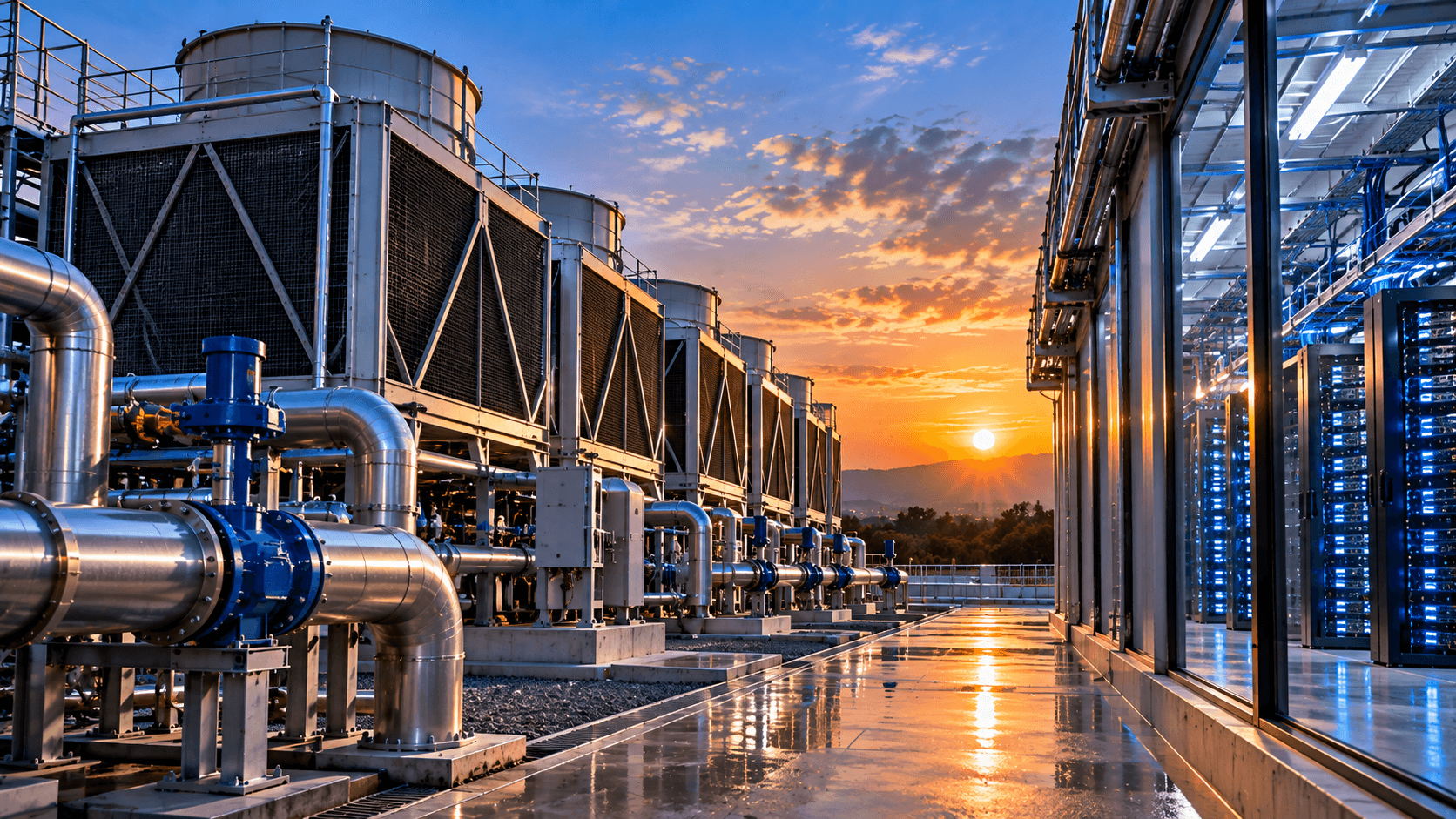
The biggest data center cooling companies include Vertiv, Schneider Electric, Johnson Controls, Trane Technologies, and Carrier Global. These publicly traded businesses supply cooling equipment and infrastructure that help data centers manage heat generated by servers and increasingly powerful artificial intelligence processors.
However, there is no universally accepted ranking by data center cooling revenue or market share. Some companies specialize in critical digital infrastructure, while others operate diversified industrial businesses where data center cooling represents only part of their operations.
For retail investors, the important question is which companies have meaningful exposure to AI cooling demand and can turn that demand into sustainable revenue and profits.
Who Are the Biggest Data Center Cooling Companies?
Five established publicly traded companies participate in the data center cooling market, although their products and business models differ considerably.
| Company | Stock ticker | Main cooling exposure |
|---|---|---|
| Vertiv | NYSE: VRT | Data center thermal management and liquid cooling |
| Schneider Electric | EPA: SU | Data center infrastructure and cooling systems |
| Johnson Controls | NYSE: JCI | Industrial cooling, chillers, and building systems |
| Trane Technologies | NYSE: TT | Commercial cooling and thermal management |
| Carrier Global | NYSE: CARR | Commercial HVAC and cooling equipment |
These are major industry participants, not a verified ranking by cooling revenue or market share.
Total company revenue can be misleading when comparing cooling suppliers. A diversified industrial manufacturer may generate more overall revenue than a specialized infrastructure company while earning a much smaller share of its sales from data centers.
For investors, the distinction matters because AI cooling growth will not affect every company equally.
1. Vertiv: A Major Supplier of Data Center Cooling Infrastructure
Vertiv (NYSE: VRT) is one of the more directly exposed publicly traded companies in critical data center infrastructure.
Its portfolio includes thermal management, power management, and equipment designed to keep computing facilities operating reliably.
Vertiv supplies conventional cooling technologies and liquid cooling equipment for high-density computing environments. Its solutions include cooling distribution units, heat exchangers, and systems that transfer heat away from servers.
Why Does Vertiv Matter for AI?
Powerful AI processors generate substantial heat, making effective cooling essential for reliable operation.
As data centers install more powerful equipment, operators may need to replace or upgrade existing cooling systems. Vertiv can potentially benefit from both new construction and modernization projects.
Its broader data center infrastructure portfolio also creates opportunities beyond cooling alone.
However, strong demand does not guarantee higher profits. Manufacturing costs, competition, delivery schedules, and project execution can affect financial performance.
Investors should monitor order growth, backlog conversion, operating margins, and cash flow. A growing backlog can indicate future business, but orders must ultimately translate into profitable revenue.
Vertiv's relatively direct exposure makes it particularly relevant to the AI cooling investment theme, although stock valuation remains an important consideration.
2. Schneider Electric: Cooling and Power Infrastructure
Schneider Electric (EPA: SU) is a global energy management and industrial technology company supplying electrical distribution, automation, software, and data center infrastructure.
Unlike businesses focused primarily on cooling, Schneider Electric participates in several parts of the data center market.
Its products help distribute electricity, monitor equipment, manage energy consumption, and control temperatures. Its cooling portfolio also includes liquid cooling technologies associated with Motivair.
Why Does Schneider Electric Matter for AI?
AI data centers require both reliable electrical infrastructure and advanced heat management.
Schneider Electric can supply multiple systems within the same project. For example, a new AI computing facility may need electrical distribution equipment alongside liquid cooling infrastructure.
This broader portfolio creates opportunities as operators build larger and more complex computing facilities.
However, Schneider Electric also serves industrial automation, commercial buildings, energy management, and other markets.
Investors should examine data center-related orders, segment profitability, and management disclosures rather than assuming AI cooling growth will translate directly into equivalent growth in total company earnings.
3. Johnson Controls: Industrial Cooling for Large Facilities
Johnson Controls (NYSE: JCI) supplies building technologies, heating and cooling equipment, and systems used to manage large facilities.
Its portfolio includes commercial and industrial chillers, which remove heat from circulating fluids. These systems can form part of the cooling infrastructure used in data centers.
Why Does Johnson Controls Matter for AI?
AI data centers need more than cooling equipment attached directly to processors. Heat must also be transferred away from the building.
Large-scale chillers and supporting equipment can play an important role in this process.
Johnson Controls has experience supplying cooling technologies for demanding commercial and industrial environments.
However, the company serves many markets beyond data centers, including offices, healthcare facilities, and industrial buildings.
Investors should determine how much data center demand contributes to orders, revenue growth, and profitability.
A strong position in industrial cooling does not automatically mean leadership in specialized direct-to-chip liquid cooling. These are related but distinct markets.
4. Trane Technologies: Commercial Cooling and Thermal Management
Trane Technologies (NYSE: TT) is a global climate-control company supplying commercial heating and cooling equipment.
Its products include chillers, air-handling systems, controls, and technologies used to manage temperatures in large facilities.
Why Does Trane Technologies Matter for AI?
Expanding AI infrastructure increases the need for equipment capable of managing substantial heat loads.
Trane Technologies can participate through commercial and industrial cooling systems used in large data center facilities.
Its experience in energy efficiency and climate-control technology is also relevant as operators seek to manage electricity costs.
However, data centers represent only part of its potential market. Commercial buildings, industrial facilities, and other customers also influence financial performance.
Investors should examine whether data center-related demand is becoming a meaningful contributor to orders and earnings, while considering profitability, capital requirements, and stock valuation.
5. Carrier Global: Cooling Equipment for Data Center Infrastructure
Carrier Global (NYSE: CARR) operates in climate-control technologies, including commercial HVAC equipment, chillers, controls, and related systems.
Some of these products are used in facilities requiring substantial cooling capacity, including data centers.
Why Does Carrier Global Matter for AI?
Large computing facilities need dependable equipment to remove heat and maintain stable operating conditions.
Carrier can participate in the broader data center cooling market through its commercial and industrial cooling technologies.
However, its exposure to AI infrastructure must be evaluated separately from its other operations.
A company can have extensive experience in commercial cooling without generating a large share of its revenue from specialized AI data center projects.
Investors should look for data center-related orders, customer activity, and financial disclosures rather than treating all cooling revenue as AI exposure.
What Is the Difference Between Traditional Cooling Companies and Liquid Cooling Specialists?
Traditional cooling suppliers and liquid cooling specialists operate in related but different parts of the data center infrastructure market.
Traditional systems often use chillers, air-handling equipment, cooling towers, and other technologies to remove heat from buildings.
Liquid cooling for powerful AI processors introduces specialized components such as cooling plates, liquid distribution units, connectors, and heat exchangers.
A large industrial supplier may focus on equipment that removes heat from an entire facility. A liquid cooling specialist may concentrate on transferring heat directly away from GPUs inside server racks.
Both can participate in the same project.
For example, an AI data center might use direct-to-chip liquid cooling to capture heat from processors and larger cooling equipment to release that heat outdoors.
This creates business opportunities across different parts of the cooling supply chain.
A smaller specialist may have greater exposure to a rapidly expanding technology, while a diversified industrial supplier may offer broader products and more stable revenue sources. Neither model automatically guarantees better investment returns.
Are There Smaller Companies Specializing in AI Liquid Cooling?
Yes. Beyond large industrial suppliers, the market includes specialized companies developing direct-to-chip liquid cooling, immersion cooling, and thermal management components.
These businesses focus on technologies designed to remove heat from increasingly powerful computing equipment.
Some operate independently, while others are subsidiaries or divisions of larger publicly traded companies.
Specialists may benefit from growing demand for advanced cooling, but they can face challenges involving manufacturing capacity, financing, competition, and dependence on a limited number of major customers.
For retail investors, it is important to distinguish between a promising technology and an attractive investment.
A company may develop effective cooling equipment without achieving sustainable profitability. Similarly, a privately held specialist may be commercially important without offering investors a direct opportunity to buy its shares.
Why Is AI Increasing Demand for Data Center Cooling Companies?
AI infrastructure expansion creates two main sources of demand for cooling suppliers: new data center construction and upgrades to existing facilities.
New construction: Technology companies and infrastructure operators need cooling systems when building facilities designed for powerful computing equipment.
Modernization: Traditional data centers may not have sufficient cooling capacity for densely packed AI processors. Upgrades can require new cooling equipment, piping, controls, and supporting infrastructure.
This means cooling suppliers can potentially benefit from both expansion and replacement spending.
However, demand depends on actual investment activity. Electricity shortages, financing constraints, or delayed technology projects can postpone equipment purchases.
Investors should distinguish announced AI spending plans from confirmed orders, recognized revenue, and cash flow.
How Does Electricity Consumption Affect Cooling Companies?
Electricity consumption and cooling demand are closely connected because most of the energy used by computing equipment eventually becomes heat.
As AI processors become more powerful and server racks more densely packed, cooling systems must handle increasingly concentrated heat loads.
This can create demand for advanced liquid cooling equipment and larger facility-wide thermal management systems.
However, cooling equipment also consumes electricity. Data center operators therefore consider both heat-removal performance and energy efficiency when choosing systems.
A more efficient cooling design may reduce operating expenses, but its financial value depends on installation costs, electricity prices, maintenance, and operating conditions.
For a closer look at the scale of power demand, read How Much Electricity Do Data Centers Consume?.
How Can Investors Compare Data Center Cooling Companies?
Investors should compare cooling suppliers using financial fundamentals and their actual exposure to data center infrastructure.
Revenue Exposure to Data Centers
Determine how much of a company's revenue depends on data center customers.
A specialized infrastructure supplier may benefit more directly from AI investment, while a diversified industrial manufacturer may generate only a small portion of its sales from this market.
Greater exposure can increase growth potential but also create greater dependence on technology spending cycles.
Orders and Backlog
Order growth can indicate increasing customer demand.
Backlog represents orders received but not yet fulfilled. A growing backlog may provide visibility into future revenue, although orders can be delayed, modified, or canceled.
Investors should examine whether orders are converting into actual sales and cash flow.
Profit Margins
Higher revenue does not always mean higher earnings.
Manufacturing costs, installation expenses, competition, and product mix can influence profitability.
Companies with differentiated technology or strong customer relationships may have advantages, but those advantages should eventually appear in financial results.
Customer Concentration
Large technology companies account for substantial infrastructure spending.
Cooling suppliers dependent on a small number of customers may experience volatility if those customers delay projects or change purchasing decisions.
A broader customer base can reduce some of this risk, although it does not eliminate exposure to industry-wide spending cycles.
Stock Valuation
A strong company is not automatically an attractive investment at every price.
Investors should consider whether expected AI-related growth is already reflected in the stock's valuation.
If a share price assumes exceptionally rapid earnings growth, even modest disappointments can lead to substantial declines.
For a more detailed investment-focused comparison, see Cooling Stocks for Data Center Investments: What Retail Investors Should Know.
What Are the Biggest Risks Facing Data Center Cooling Suppliers?
Cooling companies face several risks despite growing interest in AI infrastructure.
Slower AI spending: Technology companies may postpone construction or reduce infrastructure investment if demand develops more slowly than expected.
Increasing competition: More suppliers entering the liquid cooling market could put pressure on equipment prices and margins.
Technology changes: Improvements in processor efficiency or alternative cooling designs may shift demand between suppliers.
Project execution: Manufacturing delays, component shortages, and installation challenges can affect revenue and profitability.
Customer concentration: Dependence on a few major data center operators can increase business volatility.
High valuations: Strong demand does not guarantee attractive stock returns when share prices already reflect optimistic expectations.
These risks make it important to examine actual financial performance rather than relying solely on AI infrastructure growth forecasts.
Which Data Center Cooling Company Is Best Positioned for AI Growth?
There is no single best choice for every investor, but the five companies offer different types of exposure to AI cooling demand.
Vertiv provides relatively direct exposure to critical data center infrastructure, including thermal management and liquid cooling.
Schneider Electric combines cooling technologies with a broad portfolio of electrical distribution and energy management equipment.
Johnson Controls, Trane Technologies, and Carrier Global participate through commercial and industrial cooling equipment, although their diversified operations make them less direct ways to gain exposure to AI cooling.
These differences matter because revenue diversification, profitability, competitive positioning, and valuation influence investment outcomes.
A specialized supplier may experience stronger growth during an AI infrastructure expansion but could face greater volatility if spending slows. A diversified company may offer more revenue sources but a smaller direct benefit from rising AI cooling demand.
For retail investors, the most useful comparison involves actual data center exposure, order trends, profit margins, cash flow, and stock valuations.
The main takeaway: Major data center cooling companies operate across several parts of the industry, from facility-wide chillers to advanced liquid cooling infrastructure. AI is creating additional demand for these technologies, but long-term investment results depend on which businesses can turn that demand into sustainable profits without excessive stock valuations.
Disclaimer: This article is for informational purposes only and does not constitute financial or investment advice. All investments involve risk, including the potential loss of capital.