
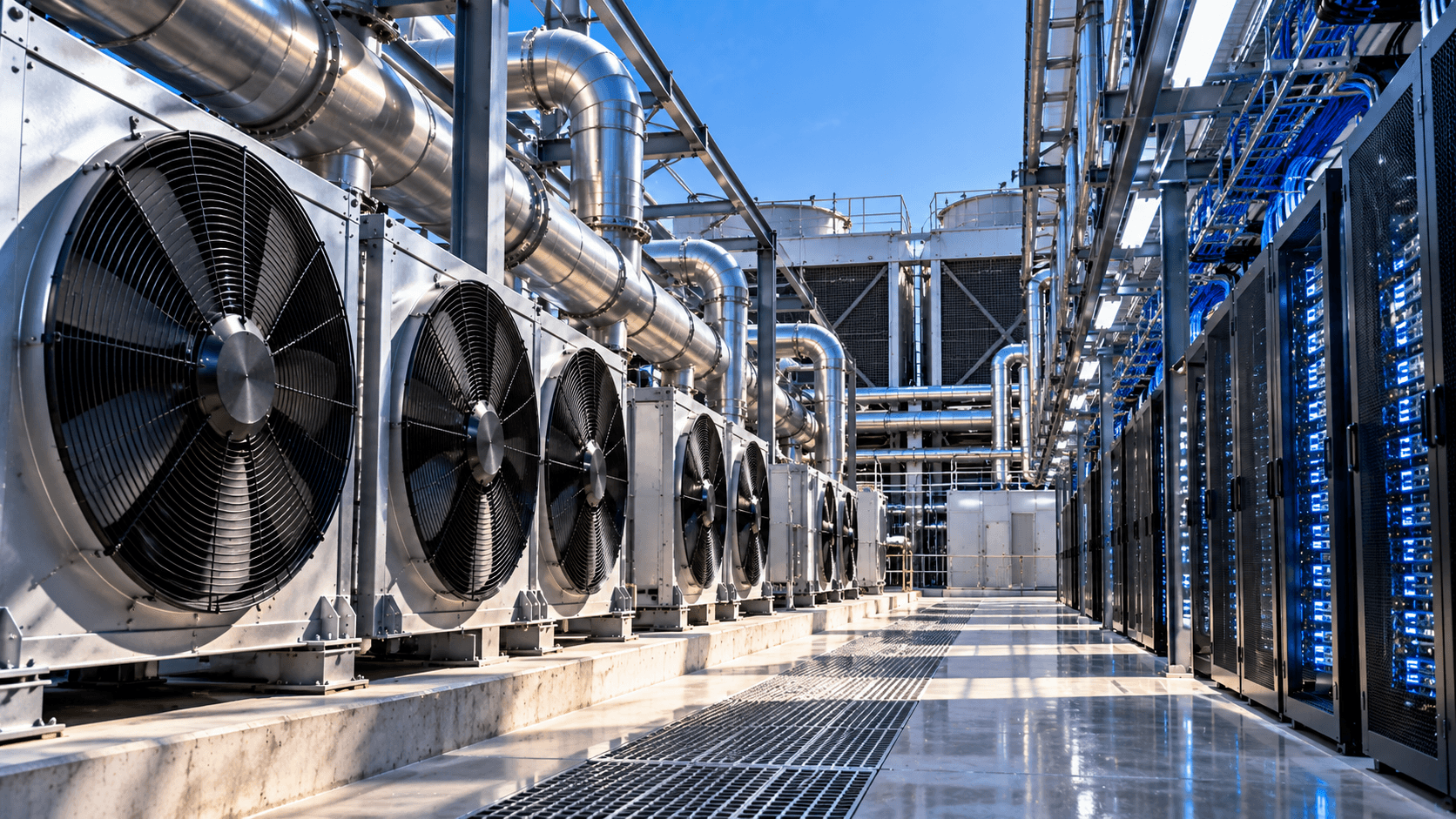
The most relevant publicly traded data center cooling stocks to research include Vertiv (VRT), Schneider Electric (SU), Johnson Controls (JCI), Trane Technologies (TT), and Carrier Global (CARR).
These companies supply cooling equipment and related infrastructure used in data centers. As artificial intelligence increases computing power requirements, managing heat becomes more important.
However, their exposure to AI cooling differs. Vertiv offers relatively direct exposure to critical data center infrastructure. Schneider Electric combines cooling with electrical distribution and energy management. Johnson Controls, Trane Technologies, and Carrier Global serve broader commercial and industrial markets.
For investors, the best choice depends on data center exposure, financial performance, business risks, and stock valuation. A company can benefit from AI infrastructure growth without necessarily being an attractive investment at its current share price.
Which Cooling Stocks Offer Exposure to AI Data Centers?
Investors can gain exposure to data center cooling through several publicly traded companies.
| Company | Ticker | Investment exposure | Main consideration |
|---|---|---|---|
| Vertiv | VRT | Critical data center infrastructure and cooling | Relatively direct exposure to data center spending |
| Schneider Electric | SU (Euronext Paris) | Cooling, electrical distribution, and energy management | Diversified infrastructure business |
| Johnson Controls | JCI | Commercial and industrial cooling equipment | Broader building technologies exposure |
| Trane Technologies | TT | Chillers and commercial thermal management | Diversified climate-control operations |
| Carrier Global | CARR | Commercial HVAC and cooling equipment | Data centers are part of a wider market |
This comparison shows business exposure, not expected stock returns.
A company with a larger share of revenue tied to data centers may be more sensitive to AI infrastructure spending than a diversified industrial company. That sensitivity can create greater growth opportunities but also greater risk if spending slows.
Is Vertiv One of the Best AI Cooling Stocks to Research?
Vertiv supplies critical digital infrastructure, including thermal management and electrical power systems. Its equipment helps data centers operate reliably by distributing electricity and removing heat from computing systems.
The company offers cooling technologies for conventional data centers and high-density AI environments, including liquid cooling solutions. This makes Vertiv one of the more direct publicly traded ways to gain exposure to data center infrastructure investment.
Why Could Vertiv Benefit From AI Growth?
AI processors can generate substantial heat, particularly when thousands operate together. As operators install more powerful computing equipment, they may need advanced cooling systems or upgrades to existing facilities.
Vertiv can potentially benefit from both new construction and equipment upgrades. Its electrical infrastructure products also give it exposure to additional spending within data center projects.
However, strong demand does not guarantee strong investment returns. If the stock already reflects expectations of rapid growth, Vertiv must deliver sufficient revenue and earnings improvements to justify its valuation.
Investors should examine order growth, backlog, operating margins, and free cash flow. Backlog represents orders that have not yet been recognized as revenue. Rising orders can indicate demand, but investors should verify that they become profitable sales.
Investor takeaway: Vertiv is particularly relevant for investors seeking direct exposure to data center infrastructure, but its valuation and sensitivity to AI capital spending deserve attention.
Is Schneider Electric a Good Alternative to Vertiv?
Schneider Electric provides electrical distribution equipment, energy management technologies, automation systems, and data center infrastructure. Its cooling portfolio includes liquid cooling technologies associated with Motivair.
A new AI data center needs more than cooling. It also requires electrical distribution, power management, and monitoring systems. Schneider Electric can potentially supply equipment across several of these areas.
What Makes Schneider Electric Different?
The main distinction is diversification. Schneider Electric serves multiple industries, meaning its financial performance does not depend exclusively on AI data center construction.
This can reduce dependence on a single growth market. However, even strong growth in AI cooling may have a smaller effect on total company revenue than it would for a more specialized supplier.
Investors should compare data center-related orders with the performance of Schneider Electric's broader operations. Industrial demand, operating margins, currency movements, and capital allocation also influence financial results.
Investor takeaway: Schneider Electric may appeal to investors seeking exposure to AI cooling alongside broader electrical infrastructure and energy management markets.
Are Johnson Controls, Trane, and Carrier AI Cooling Stocks?
Yes, but their exposure is generally less specialized than that of companies focused more heavily on data center infrastructure.
These businesses supply cooling equipment used across commercial and industrial facilities. Products such as chillers, building controls, and thermal management systems can support data centers, depending on facility design.
Johnson Controls (JCI)
Johnson Controls provides building technologies and commercial cooling systems. Its YORK equipment includes cooling technologies relevant to large facilities, including data centers.
Data center demand may create additional opportunities, but investors should examine whether related orders are producing meaningful revenue growth and stronger profitability.
Trane Technologies (TT)
Trane Technologies manufactures commercial heating and cooling systems, including large chillers that can help remove heat from data center facilities.
Its broader business serves commercial and industrial customers. The investment case therefore depends on overall demand for climate-control technologies, not only AI computing growth.
Carrier Global (CARR)
Carrier Global provides commercial HVAC equipment and related technologies. Some products are suitable for facilities requiring substantial cooling capacity.
However, Carrier operates across markets beyond data centers. Investors should not treat its entire cooling business as AI infrastructure revenue.
Investor takeaway: These companies offer diversified exposure to commercial cooling, with data centers representing a potential growth opportunity rather than the entire investment thesis.
For a broader comparison of industry participants and their technologies, see The Biggest Data Center Cooling Companies.
Which Is Better for Investors: Specialized Cooling Stocks or Diversified Companies?
Neither category is automatically better. The main difference is how strongly a company's financial results depend on data center investment.
Consider two hypothetical companies:
- Company A: Generates 60% of its revenue from data center infrastructure.
- Company B: Generates 10% of its revenue from the same market.
If data center-related revenue increases by 30% while all other revenue remains unchanged, Company A's total revenue would grow by 18%, compared with 3% for Company B.
These figures are illustrative calculations, not actual revenue shares for the companies discussed.
The example shows why business exposure matters. However, Company A is not necessarily the better investment. Company B might have stronger margins, lower debt, more consistent cash flow, or a more attractive valuation.
Specialized suppliers may benefit more directly from AI infrastructure expansion but can also face greater volatility when projects are delayed. Diversified companies have additional revenue sources that may help offset weakness in the data center market.
How Can Investors Tell Whether a Cooling Stock Is Overvalued?
A cooling company can have excellent growth prospects and still be an expensive investment if its share price already reflects overly optimistic expectations.
One common valuation measure is the price-to-earnings ratio (P/E), which compares a stock's price with its earnings per share.
For example:
- A stock trading at $100 with annual earnings of $4 per share has a P/E ratio of 25.
- A stock trading at $100 with annual earnings of $2 per share has a P/E ratio of 50.
The second stock is more expensive relative to its current earnings. However, that does not automatically mean it is overvalued. Investors may expect faster future earnings growth.
For cooling stocks, compare valuation with expected revenue growth, operating margins, free cash flow, and business risks. Historical valuation ranges and comparable companies can provide additional context.
Even when a company reports strong earnings growth, its stock can decline if investors become unwilling to pay the same high valuation.
What Financial Metrics Matter Most for AI Cooling Stocks?
Investors do not need complicated financial models to begin comparing cooling companies. A few key measures provide a useful starting point.
| Metric | What it tells investors | What to watch |
|---|---|---|
| Revenue growth | Whether sales are expanding | Growth supported by actual customer demand |
| Orders and backlog | Potential future business | Conversion into completed sales |
| Operating margin | Profitability from operations | Stable or improving margins |
| Free cash flow | Cash remaining after capital spending | Consistent cash generation |
| Debt levels | Financial obligations | Ability to finance operations and expansion |
| Valuation | Price relative to financial performance | Expectations that may be too optimistic |
These measures work best when considered together.
For example, a company may report strong sales growth but weak free cash flow because it needs additional inventory and working capital to fulfill orders. Another may grow more slowly while maintaining higher profitability and consistent cash generation.
Investors should also examine management commentary about demand from hyperscalers, meaning large cloud and technology companies operating extensive computing infrastructure.
Not every order from a major technology customer necessarily involves AI. When companies disclose data center-related orders or revenue, those figures are more useful than broad claims about market opportunities.
Why Is Liquid Cooling Important for Cooling Stock Investors?
Liquid cooling is increasingly relevant because high-density AI computing systems can generate substantial heat in relatively small spaces. Traditional air cooling may become less efficient or impractical for some configurations.
Liquid cooling uses fluids to transfer heat. Two approaches include:
- Direct-to-chip cooling: Liquid circulates through specialized components attached to processors, carrying heat away from the chips.
- Immersion cooling: Electronic equipment is placed in a specially designed cooling fluid that absorbs heat.
However, liquid cooling is not a single equipment market. Complete systems may require cooling distribution units, heat exchangers, pumps, piping, controls, and facility-level cooling equipment.
Different suppliers serve different parts of this market. A manufacturer of large industrial chillers does not necessarily compete directly with a specialist producing cooling plates for AI processors.
For an explanation of these technologies and their financial implications, read How AI Cooling Systems Work: A Guide for Retail Investors.
For investors, the important questions are which products customers actually need, how much demand those products generate, and whether suppliers can earn attractive margins or recurring service revenue.
What Could Drive Cooling Stock Prices Higher?
Several developments could improve the financial performance of data center cooling suppliers:
- Continued data center construction: New facilities create demand for cooling equipment and supporting infrastructure.
- Higher server power density: More powerful processors can require advanced thermal management systems.
- Upgrades to existing facilities: Operators may replace or expand cooling equipment to accommodate AI workloads.
- Growing service revenue: Installation, maintenance, monitoring, and upgrades can create opportunities beyond initial equipment sales.
- Improved profitability: Higher production efficiency and sales of higher-value equipment may strengthen operating margins.
These developments can support earnings growth, but they do not guarantee higher share prices. Stock performance also depends on whether actual results meet or exceed investor expectations.
What Are the Biggest Risks of Investing in Data Center Cooling Stocks?
The main risks involve AI infrastructure spending, competition, technology changes, project execution, and valuation.
AI Spending Could Slow
If AI adoption grows more slowly than expected, technology companies may delay data center construction or equipment purchases. This could reduce orders and revenue for cooling suppliers, particularly those with concentrated exposure to AI infrastructure.
Competition Could Reduce Profit Margins
Established industrial companies and specialized suppliers compete for cooling contracts. As more businesses enter the market or expand their product offerings, pricing pressure could reduce profitability.
Cooling Technology Could Change
Different computing systems require different thermal management solutions. Suppliers may need to invest in new products as customers adopt more demanding hardware or alternative cooling technologies.
Equipment Orders May Be Delayed
Data center construction depends on electricity availability, permitting, financing, and project schedules. Delays can postpone equipment deliveries, revenue recognition, and cash collection, even when customer orders remain in place.
Stock Prices May Reflect Excessive Expectations
Companies associated with AI infrastructure can attract high valuations. If financial growth disappoints, their share prices may decline significantly even when the underlying businesses remain profitable.
Should Investors Buy Individual Cooling Stocks or Use an ETF?
Individual stocks offer exposure to specific companies, while exchange-traded funds (ETFs) can spread investments across multiple businesses.
Buying a cooling stock allows investors to participate directly in that company's financial performance. However, it also creates exposure to company-specific risks such as competition, management decisions, and valuation.
Some technology, industrial, and infrastructure ETFs may hold companies involved in data center cooling. However, an ETF marketed around AI does not necessarily provide meaningful exposure to cooling equipment.
Its largest holdings may instead be semiconductor manufacturers, software companies, or technology platforms.
Before investing, examine the ETF's actual holdings and portfolio weights. Diversification can reduce dependence on one company, but it does not eliminate market risk, particularly when several holdings depend on the same AI infrastructure spending cycle.
How Should Retail Investors Choose a Data Center Cooling Stock?
A practical approach is to answer four questions before considering an investment.
1. How much of the business benefits from data center growth?
Look for reported data center-related revenue, orders, or customer demand. Avoid assuming that all industrial cooling products benefit equally from AI.
2. Is demand producing stronger financial results?
Review revenue growth, operating margins, backlog conversion, and free cash flow. Rising orders are encouraging, but sustainable profitability matters more over time.
3. What could go wrong?
Consider customer concentration, competition, construction delays, technology changes, and financial obligations. Strong products do not eliminate business risks.
4. Is the stock reasonably valued?
Compare valuation with earnings, cash flow, growth expectations, and relevant competitors. A promising company can still deliver disappointing returns when purchased at an excessive price.
Finally, consider existing portfolio exposure. Owning several AI infrastructure stocks may provide less diversification than expected if their performance depends on the same technology spending cycle.
Which Cooling Stock Is Worth Watching Most Closely?
For investors specifically interested in AI data center cooling, Vertiv is one of the most directly relevant publicly traded companies to research because of its thermal management and critical infrastructure businesses.
Schneider Electric offers broader exposure to cooling, electrical distribution, and energy management. Johnson Controls, Trane Technologies, and Carrier Global provide opportunities to participate in commercial and industrial cooling demand, with data centers representing part of their wider businesses.
There is no single best cooling stock for every investor. The appropriate choice depends on business exposure, financial quality, valuation, risk tolerance, and existing investments.
The main takeaway: AI data center cooling is an important infrastructure investment theme, but the strongest business opportunity does not always produce the best stock return. Investors should prioritize actual financial exposure, profitability, competitive advantages, and the price they pay.
Disclaimer: This article is for informational purposes only and does not constitute financial or investment advice. Mentioned securities are examples for research, not buy or sell recommendations. All investments involve risk, including the potential loss of capital.