
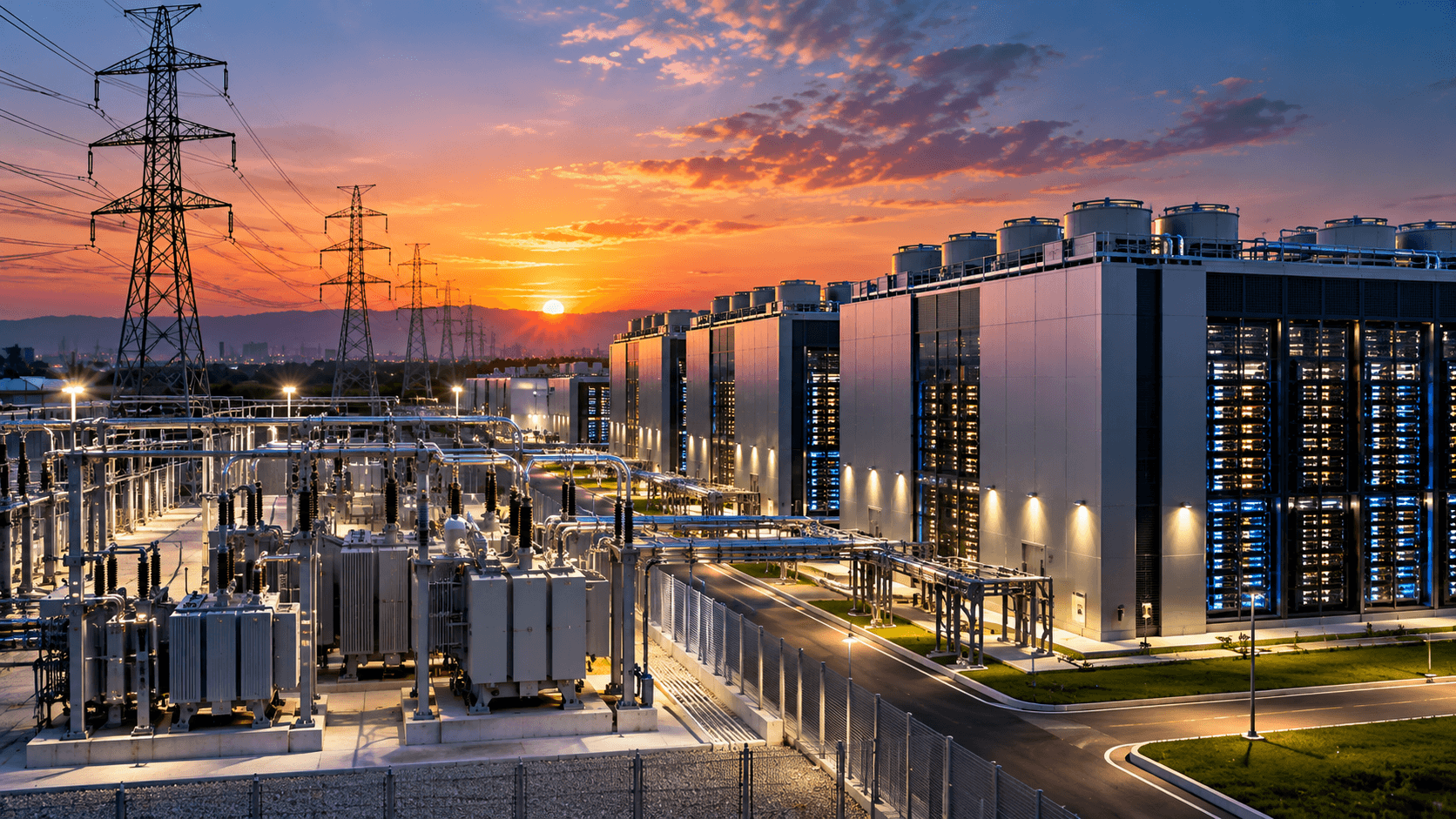
Data centers consumed approximately 415 terawatt-hours (TWh) of electricity worldwide in 2024, representing around 1.5% of global electricity consumption, according to the International Energy Agency (IEA). In the United States, data centers consumed approximately 176 TWh in 2023, or 4.4% of national electricity use, according to a report prepared for the U.S. Department of Energy.
These figures include traditional data centers and facilities supporting artificial intelligence. AI is becoming an important driver of electricity demand as companies deploy more powerful processors and expand their computing infrastructure.
For retail investors, growing electricity requirements create opportunities and risks across utilities, power generation, electrical equipment, cooling infrastructure, and data center operations.
How Much Electricity Does a Typical Data Center Use Per Day?
A data center can consume anywhere from tens to thousands of megawatt-hours of electricity per day, depending on its size, equipment, and operating conditions.
The simplest way to understand consumption is through average electrical demand, measured in megawatts (MW). One megawatt equals one million watts of power.
A facility continuously drawing 1 MW consumes 24 megawatt-hours (MWh) over a full day.
The following table illustrates electricity consumption at different average power levels.
| Average power demand | Daily electricity use | Annual electricity use |
|---|---|---|
| 1 MW | 24 MWh | 8.76 GWh |
| 10 MW | 240 MWh | 87.6 GWh |
| 50 MW | 1,200 MWh | 438 GWh |
| 100 MW | 2,400 MWh | 876 GWh |
| 500 MW | 12,000 MWh | 4.38 TWh |
These are mathematical examples assuming continuous operation at the stated average power demand, not measured averages for specific data center categories.
The figures represent total facility electricity consumption, including servers, cooling, and supporting infrastructure.
For perspective, a 100 MW facility operating continuously consumes 2.4 million kilowatt-hours per day, making large data centers significant customers for electricity providers.
Why Do AI Data Centers Consume So Much Electricity?
AI data centers use substantial electricity because they operate powerful processors that perform demanding calculations, often across thousands of connected chips.
Training a large AI model involves processing enormous quantities of information. Running the model afterward, known as inference, also requires computing resources. Inference includes generating chatbot responses, analyzing images, and processing automated requests.
Three factors drive AI electricity consumption:
Powerful processors: High-performance GPUs and specialized AI accelerators can consume substantially more electricity than conventional processors designed for less demanding workloads.
Large computing clusters: AI training and other intensive tasks can involve thousands of processors operating together, increasing total electricity demand.
Continuous operations: Cloud and AI facilities often operate around the clock, although individual processors do not necessarily run at maximum capacity continuously.
Newer processors can perform more calculations per unit of electricity than previous generations. However, rapidly growing AI usage may outweigh these efficiency improvements, pushing total electricity consumption higher.
How Much Electricity Is Used for Cooling?
Cooling is an important part of data center electricity consumption because computing equipment generates heat that must be removed.
Other supporting systems include power distribution equipment, facility controls, lighting, and backup infrastructure.
A common efficiency measurement is Power Usage Effectiveness (PUE), which compares total facility electricity consumption with electricity used by IT equipment.
For example, imagine a facility where servers and networking equipment consume 100 MWh. If the entire data center consumes 120 MWh, its PUE is 1.20.
The additional 20 MWh covers cooling and other supporting systems, including electrical distribution losses. It does not represent cooling consumption alone.
A lower PUE generally indicates less facility overhead relative to computing electricity use. However, PUE does not measure the efficiency of individual AI calculations.
A facility can improve its PUE while total electricity consumption increases because additional servers are installed.
High-density AI installations increasingly use liquid cooling to remove heat from powerful processors. Depending on system design and operating conditions, liquid cooling can reduce certain cooling energy requirements compared with conventional air cooling.
For a broader explanation, see How AI Cooling Systems Work: A Guide for Retail Investors.
How Much Electricity Do U.S. Data Centers Consume?
According to research prepared by Lawrence Berkeley National Laboratory for the U.S. Department of Energy, American data centers consumed approximately 176 TWh in 2023, representing about 4.4% of total U.S. electricity consumption.
The same report projected annual consumption of approximately 325–580 TWh by 2028, equivalent to around 6.7%–12% of projected U.S. electricity use.
These figures are projections, not guaranteed outcomes. Actual demand will depend on AI adoption, computing efficiency, data center construction, and electricity availability.
Nevertheless, the projected increase helps explain why electricity infrastructure is becoming a major consideration for technology companies planning new facilities.
For investors, the important question is whether power generation and electrical networks can expand quickly enough to support planned computing capacity.
How Much Electricity Do Data Centers Consume Worldwide?
The International Energy Agency estimated global data center electricity consumption at approximately 415 TWh in 2024.
In its 2025 Energy and AI analysis, the IEA projected consumption could reach approximately 945 TWh by 2030 in its base-case scenario, more than double the 2024 level.
This projection depends on assumptions about AI adoption, hardware efficiency, infrastructure development, and economic conditions.
Although data centers account for a relatively modest share of global electricity consumption, their impact can be much greater on individual regional power grids.
A large AI facility may require substantial electricity capacity in one location, creating pressure on local generation, transmission, and distribution infrastructure.
This geographic concentration matters for investors evaluating utilities and electrical infrastructure companies.
How Much Does Electricity Cost a Data Center?
Electricity is a major operating expense for many data centers. The total cost depends on consumption, electricity prices, and contractual arrangements.
Consider a hypothetical facility drawing an average of 100 MW continuously. Its annual electricity consumption would be approximately 876 million kWh.
At an illustrative electricity price of $0.08 per kWh, its annual energy cost would be:
876 million kWh × $0.08 = $70.08 million.
At $0.12 per kWh, the same facility would spend approximately $105.12 million annually.
| Electricity price | Illustrative annual energy cost |
|---|---|
| $0.06/kWh | $52.56 million |
| $0.08/kWh | $70.08 million |
| $0.10/kWh | $87.60 million |
| $0.12/kWh | $105.12 million |
These calculations assume continuous average demand of 100 MW and a constant electricity price. They exclude separate demand charges, transmission costs, taxes, backup generation expenses, and other contractual considerations.
Large operators may negotiate long-term power agreements rather than paying standard retail electricity rates.
Even so, the example shows why small differences in electricity prices can translate into millions of dollars in annual operating costs.
Why Is Electricity Availability Becoming a Problem?
Building a data center requires more than constructing a facility and purchasing servers. Operators must also secure enough electrical capacity to run the equipment.
Large AI computing campuses may require new substations, transformers, transmission connections, and other electrical infrastructure.
These projects can take years to plan, approve, and complete. In some regions, electricity infrastructure development may not keep pace with demand for new data centers.
This can create several consequences:
- Construction delays: Projects may wait for grid connections or additional electricity capacity.
- Higher development costs: Operators may need to fund additional electrical infrastructure.
- Location changes: Technology companies may favor regions where sufficient power is already available.
- Utility investment: Electricity providers may need to expand generation, transmission, and distribution systems.
For investors, this creates potential demand for electrical equipment and infrastructure services.
However, higher electricity demand does not automatically produce higher utility profits. Regulated utilities must follow rules governing customer rates, capital investment, and allowed returns. Large infrastructure projects can also increase financing requirements and execution risks.
Which Companies Could Benefit From Rising Data Center Electricity Demand?
Growing data center electricity requirements can affect several industries, but the financial benefits vary by business model.
Electric Utilities
Utilities supply electricity and develop infrastructure to serve customers.
Companies such as Southern Company, Duke Energy, and American Electric Power operate electricity networks where demand growth and infrastructure investment can influence long-term financial performance.
Potential benefits depend on regional demand, regulatory approvals, capital costs, and the ability to recover investments through customer rates.
Electrical Equipment Manufacturers
Data centers require transformers, switchgear, electrical distribution equipment, backup power systems, and power management technologies.
Eaton, Schneider Electric, and ABB supply products used in electrical infrastructure.
As AI facilities become larger and more power-intensive, demand for certain equipment categories may increase.
However, investors should examine how much of each company's revenue comes from data center projects rather than unrelated industries.
Power Generation Companies
Electricity producers may benefit from additional demand, depending on regional market conditions, generation capacity, and contractual arrangements.
Companies operating in competitive wholesale electricity markets face different opportunities and risks from businesses with regulated generation assets.
Higher electricity demand can support prices in some circumstances, but profitability also depends on fuel costs, available capacity, contracts, and regulation.
Data Center Operators
Data center operators can benefit from growing demand for computing capacity, but electricity availability may limit their ability to expand.
For these businesses, securing reliable power at competitive prices can be as important as attracting customers.
Across these industries, the central investment question is which companies can convert additional infrastructure demand into sustainable earnings.
Does Water Consumption Increase When Electricity Demand Rises?
It can, particularly when cooling systems rely on evaporation.
Higher computing activity generally generates more heat. If a facility uses evaporative cooling, removing that heat may increase water consumption.
However, electricity and water use do not necessarily increase at the same rate.
Data centers using dry cooling can consume relatively little water on-site, even with substantial electricity demand. Liquid-cooled servers may also use closed fluid loops, although the facility's external cooling equipment could still consume water.
This creates trade-offs between electricity consumption, water requirements, and equipment costs.
For a detailed explanation of daily water consumption, see How Much Water Does an AI Data Center Use Per Day?.
Can AI Data Centers Reduce Their Electricity Consumption?
Yes. Data centers can improve efficiency and reduce the electricity required for a given amount of computing work.
Several approaches can help:
- More efficient AI processors: New hardware can perform more calculations per unit of electricity.
- Improved cooling systems: Better heat removal can reduce electricity consumed by cooling equipment.
- Higher server utilization: Better workload distribution can reduce unnecessary idle computing capacity.
- Software optimization: More efficient AI models and algorithms can reduce the computing resources needed for certain tasks.
- Better power management: Improved electrical distribution can reduce avoidable energy losses.
These improvements can lower the electricity cost of providing AI services.
However, cheaper and more efficient computing may encourage additional AI usage. As a result, electricity consumption across the industry can continue increasing even while individual computing tasks become more efficient.
Investors should distinguish between lower electricity use per calculation and reductions in total electricity demand.
What Are the Biggest Investment Risks?
Rising electricity demand from AI creates potential opportunities, but several risks deserve attention.
Overestimated demand: Electricity forecasts depend on assumptions about AI adoption and infrastructure development. Actual growth may be lower than expected.
Project delays: Grid connections, permitting, equipment shortages, and financing constraints can postpone construction.
Higher capital costs: Utilities and infrastructure businesses may need substantial investment before generating additional revenue.
Regulatory uncertainty: Electricity prices, infrastructure approvals, and cost recovery can depend on government and regulatory decisions.
Technology improvements: More efficient processors and software could reduce future electricity requirements relative to earlier forecasts.
Stock valuations: Companies associated with AI infrastructure may already trade at prices reflecting optimistic growth expectations.
Even when a company benefits from rising electricity demand, attractive investment returns are not guaranteed. Profitability, financial execution, and the price paid for the stock remain essential.
What Should Retail Investors Watch Next?
Data center electricity consumption is becoming an increasingly important part of AI infrastructure investment. However, actual project development and company financial results are more useful than demand forecasts alone.
Investors should monitor whether announced data center projects secure electricity connections, obtain approvals, and move into construction.
Utility capital expenditure plans can reveal expected infrastructure requirements, although planned investment does not guarantee attractive returns.
Electrical equipment manufacturers may report changes in orders, backlog, and data center-related revenue. Technology companies may also disclose infrastructure spending and identify electricity availability as a constraint on expansion.
Improvements in processor efficiency, software, and cooling technology could also change how much electricity future AI systems require.
For investors researching companies directly involved in cooling infrastructure, The Biggest Data Center Cooling Companies provides a closer look at important industry participants.
The main takeaway for investors: Data centers already consume substantial electricity, and AI is increasing pressure on power infrastructure. Potential opportunities extend beyond technology companies to utilities, electrical equipment manufacturers, and infrastructure providers. However, rising demand must be evaluated alongside construction costs, regulation, profitability, and stock valuations.
Disclaimer: This article is for informational purposes only and does not constitute financial or investment advice. All investments involve risk, including the potential loss of capital.