
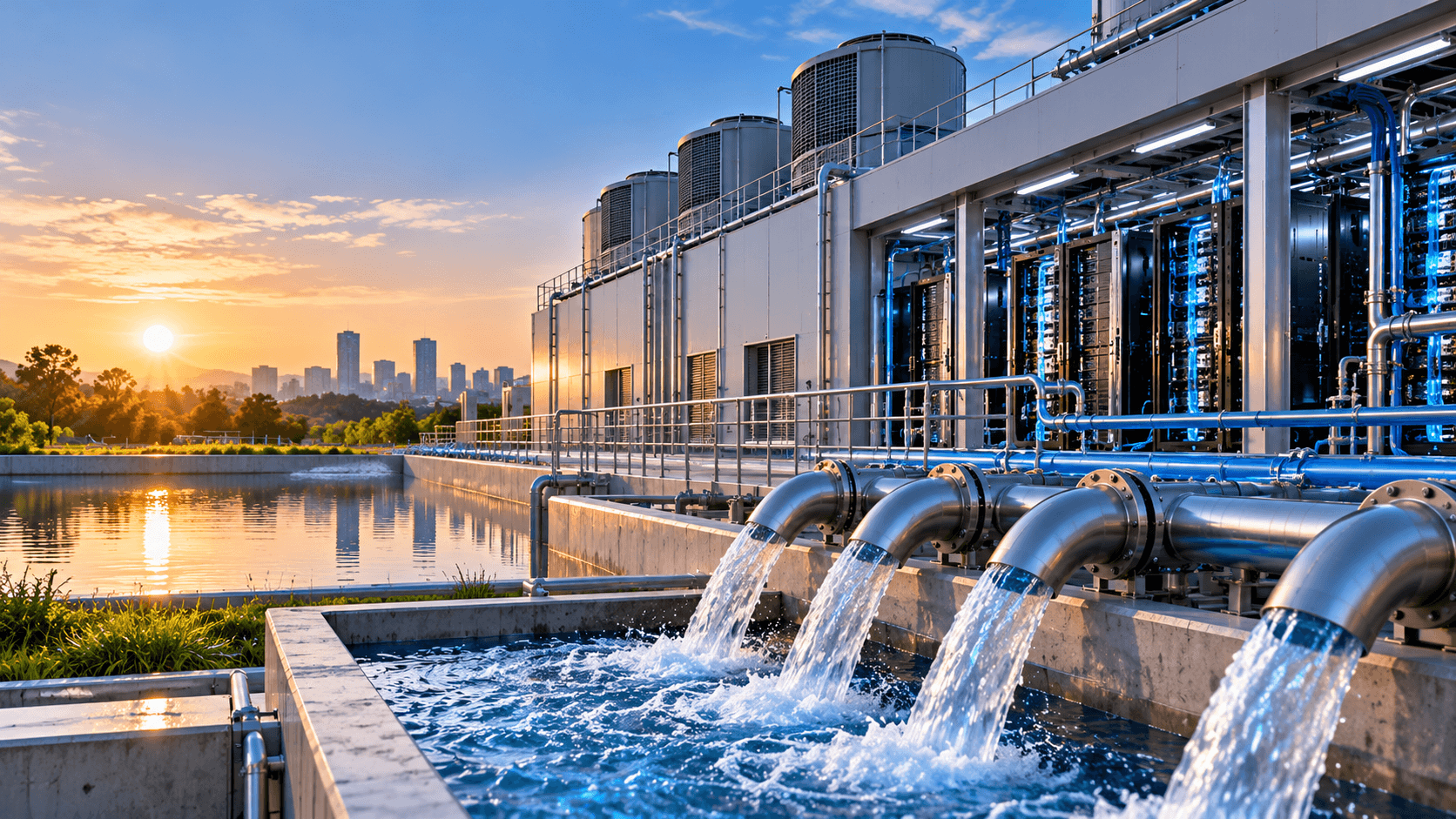
An AI data center can consume hundreds of thousands or even millions of gallons of water per day, depending on its size, cooling technology, climate, and operating conditions. However, some facilities use very little water on-site, so there is no single daily consumption figure that applies to every AI data center.
The biggest difference comes from how a facility removes heat. Evaporative cooling systems consume water, while dry cooling systems release heat primarily into the air. These approaches involve different trade-offs in electricity consumption, equipment costs, and water requirements.
For investors, water consumption matters because it can influence data center operating expenses, construction approvals, infrastructure spending, and where companies choose to build new facilities.
How Much Water Does a Typical AI Data Center Use?
Daily water consumption varies widely. A large AI data center using evaporative cooling may consume hundreds of thousands of gallons per day, while a facility using dry cooling may require substantially less water on-site.
To understand the scale, consider a hypothetical AI data center with 100 megawatts of IT equipment operating continuously.
Over 24 hours, that equipment consumes 2.4 million kilowatt-hours of electricity. Most of that energy eventually becomes heat that must be removed.
Assume the facility consumes 0.5 liters of water for every kilowatt-hour used by its IT equipment.
Its estimated daily water consumption would be:
2.4 million kWh × 0.5 liters/kWh = 1.2 million liters per day.
That equals approximately 317,000 US gallons per day.
This is an illustrative calculation, not a measured industry average. Actual consumption could be considerably higher or lower depending on the cooling system, weather, and operating conditions.
A facility using dry cooling could consume much less water directly, while an evaporative system operating under demanding conditions might require substantially more.
The important distinction is that water consumption depends on infrastructure design, not simply whether a data center operates AI servers.
Why Do AI Data Centers Need Water?
AI servers generate substantial heat while processing information. Powerful GPUs and other processors consume electricity, much of which becomes heat. Without effective cooling, equipment may reduce performance or shut down to prevent damage.
Some data centers use water because evaporation removes heat efficiently.
Cooling towers and other evaporative systems take advantage of this process. As water evaporates, it absorbs heat and carries it away from the cooling system.
That evaporated water must be replaced. Additional water may also be discharged to prevent excessive mineral buildup in the circulating supply.
However, evaporation is not the only way to remove heat. Dry coolers and air-cooled equipment can release heat into the atmosphere without relying heavily on water evaporation.
For a broader explanation of these technologies, see How AI Cooling Systems Work: A Guide for Retail Investors.
Does Liquid Cooling Use More Water Than Air Cooling?
Not necessarily. Liquid-cooled AI servers do not automatically consume more water than air-cooled servers.
Liquid cooling describes how heat is removed from computing components. Water consumption depends largely on how the facility ultimately releases that heat outdoors.
For example, a direct-to-chip liquid cooling system circulates fluid through cooling plates attached to powerful processors. The fluid absorbs heat and carries it away.
In a closed-loop system, the same fluid circulates repeatedly, requiring relatively little routine replacement.
However, the collected heat still needs to be released. If the facility uses an evaporative cooling tower, water may be consumed. If it uses a dry cooler, direct water consumption can be much lower.
Similarly, servers cooled with air may still depend on water-consuming equipment elsewhere in the building.
The key distinction is between the system cooling the servers and the system releasing heat outside the facility.
This matters as AI operators increasingly adopt liquid cooling for powerful, high-density computing equipment.
What Determines How Much Water a Data Center Consumes?
Five main factors influence daily water consumption.
1. Data Center Size
Larger facilities generally generate more heat when operating at similar utilization levels. A 200-megawatt computing installation can require substantially more cooling than a 20-megawatt facility.
However, a large facility using dry cooling may consume less water than a smaller one relying heavily on evaporation. Size alone does not determine water consumption.
2. Cooling Technology
Evaporative systems consume water to remove heat. Dry cooling systems generally require much less water directly, although they can consume more electricity under certain conditions.
Hybrid systems combine different approaches and can adjust their operation according to weather and cooling requirements.
The cooling technology selected is therefore one of the most important factors affecting water consumption.
3. Local Climate
Outdoor temperature and humidity influence cooling performance.
Cooler conditions may allow facilities to use outdoor air or dry cooling for more of the year. Hotter environments can require more intensive cooling, although actual water consumption still depends on the system design.
Two otherwise similar data centers in different climates may have very different water requirements.
4. Server Utilization
Servers do not always operate at maximum capacity. Intensive AI training and inference workloads can generate more heat than lighter computing activity.
Higher heat output increases cooling demand and may increase water consumption when the cooling system relies on evaporation.
5. Water Management
Operators can improve water efficiency through better controls, recycling, and the use of reclaimed water where appropriate.
Reclaimed water can reduce demand for drinking-quality supplies, but it does not necessarily reduce total water consumption. Water lost through evaporation must still be replaced.
How Is Data Center Water Efficiency Measured?
One commonly used metric is Water Usage Effectiveness (WUE).
WUE measures annual site water consumption relative to the electricity consumed by IT equipment. It is typically expressed in liters per kilowatt-hour.
For example, a WUE of 0.5 liters/kWh means a facility consumes half a liter of water for every kilowatt-hour used by its computing equipment.
A lower WUE generally indicates less direct water consumption relative to IT electricity use.
However, WUE does not capture the entire water footprint of computing. A facility using very little water on-site might consume more electricity for cooling, and electricity generation can also require water.
Investors should therefore examine both water efficiency and energy consumption rather than relying on a single measurement.
For more on the energy side of the equation, read How Much Electricity Do Data Centers Consume?.
Do AI Data Centers Consume More Water Than Traditional Data Centers?
AI data centers can consume more water, but that is not always the case.
AI workloads often rely on powerful processors installed in densely packed server racks. These systems can generate more heat per rack than conventional computing equipment, creating greater cooling requirements.
However, total water consumption depends on computing capacity, utilization, and cooling design.
A large conventional data center using evaporative cooling could consume more water than a smaller AI facility using dry cooling.
Advanced liquid cooling can also improve heat removal and allow operators to consider alternative cooling configurations.
As AI infrastructure expands, industry-wide water demand may increase even if individual facilities become more efficient.
Where Does the Water Come From?
Data centers can obtain water from municipal supplies, groundwater, surface water, or treated wastewater, depending on local infrastructure and regulations.
Some facilities use reclaimed wastewater to reduce demand for drinking-quality water. This can be particularly valuable in regions where freshwater resources are limited.
However, alternative water sources still involve treatment requirements, infrastructure costs, and potential environmental impacts.
Geography matters. Consuming a large volume of water in a drought-prone region may create greater local challenges than similar consumption in an area with abundant water resources.
For data center operators, access to reliable water supplies can therefore influence site selection and long-term operating costs.
Why Is Water Consumption a Financial Issue for Data Center Operators?
Water is not necessarily one of a data center's largest operating expenses. Electricity, computing equipment, construction, and financing often represent much larger costs.
However, water availability can determine whether a new facility is practical in a particular location.
Operators planning large AI projects may need to secure reliable supplies, negotiate utility arrangements, or install more expensive cooling systems.
In water-stressed regions, local restrictions and permitting requirements can also delay construction.
For investors, the financial consequences extend beyond water bills. Delayed projects can postpone new computing capacity, customer revenue, and equipment purchases.
Choosing water-efficient cooling may also increase initial construction costs while potentially reducing water-related operating expenses and development constraints.
The financial impact depends on how these trade-offs affect the project's overall economics.
Which Companies Could Benefit From Water-Efficient AI Cooling?
Growing demand for water-efficient cooling can create opportunities for suppliers of dry coolers, liquid cooling equipment, heat exchangers, pumps, and control systems.
Established companies with relevant cooling businesses include Vertiv, Schneider Electric, Johnson Controls, and Trane Technologies.
However, these companies have different products, customers, and levels of exposure to AI infrastructure.
A diversified industrial manufacturer may generate only a small portion of its revenue from data center cooling. As a result, rising demand may have a limited effect on its overall financial performance.
Investors should examine data center revenue exposure, order growth, profit margins, and management disclosures rather than assuming every cooling supplier will benefit equally.
Some water savings also come from better operating practices or improvements to existing equipment, rather than entirely new cooling installations.
The investment opportunity depends on which suppliers can capture additional spending and convert it into sustainable earnings.
Can AI Data Centers Reduce Their Water Consumption?
Yes. Several technologies and operating practices can reduce water consumption or dependence on freshwater supplies.
- Dry cooling: Releases heat through air-cooled equipment rather than relying primarily on evaporation, reducing direct water consumption.
- Closed-loop liquid cooling: Recirculates fluid through computing equipment with limited routine replacement, although water use still depends on the final heat-rejection system.
- Hybrid cooling: Combines cooling methods and adjusts operating modes according to weather and facility requirements.
- Reclaimed water: Uses treated wastewater instead of some drinking-quality supplies, reducing freshwater demand without necessarily lowering total consumption.
- Improved controls: Uses monitoring and automated adjustments to reduce unnecessary water and energy consumption.
Each approach involves trade-offs. Dry cooling can require additional electricity or higher equipment investment in certain climates. Hybrid systems can increase complexity, while reclaimed water may require treatment infrastructure.
No single cooling solution minimizes water consumption, electricity use, and construction costs under every operating condition.
What Should Retail Investors Watch?
Water availability is becoming an important consideration for AI infrastructure expansion, particularly in regions facing resource constraints.
For investors, several developments deserve attention.
Cooling technology adoption: Watch whether major data center operators increasingly choose dry cooling, hybrid systems, or other water-efficient technologies for new projects.
Supplier financial performance: Examine whether cooling equipment manufacturers report stronger orders, revenue growth, and profitability from data center projects.
Construction and permitting: Monitor whether water availability, local regulations, or infrastructure requirements delay planned facilities.
Operating efficiency: Look for measurable improvements in water consumption and energy efficiency rather than relying solely on corporate environmental commitments.
Water is only one part of the larger AI infrastructure challenge, alongside electricity availability, construction costs, and environmental impacts.
For a broader view of these interconnected issues, see How AI Impacts the Environment: Water, Energy, and Carbon.
The main takeaway for investors: AI data centers do not have a fixed daily water requirement. Consumption depends primarily on facility size, cooling technology, climate, and operating conditions. As AI infrastructure expands, companies helping operators manage water constraints may benefit from additional demand. However, sustainable investment returns will still depend on profitability, competitive positioning, execution, and stock valuation.
Disclaimer: This article is for informational purposes only and does not constitute financial or investment advice. All investments involve risk, including the potential loss of capital.