
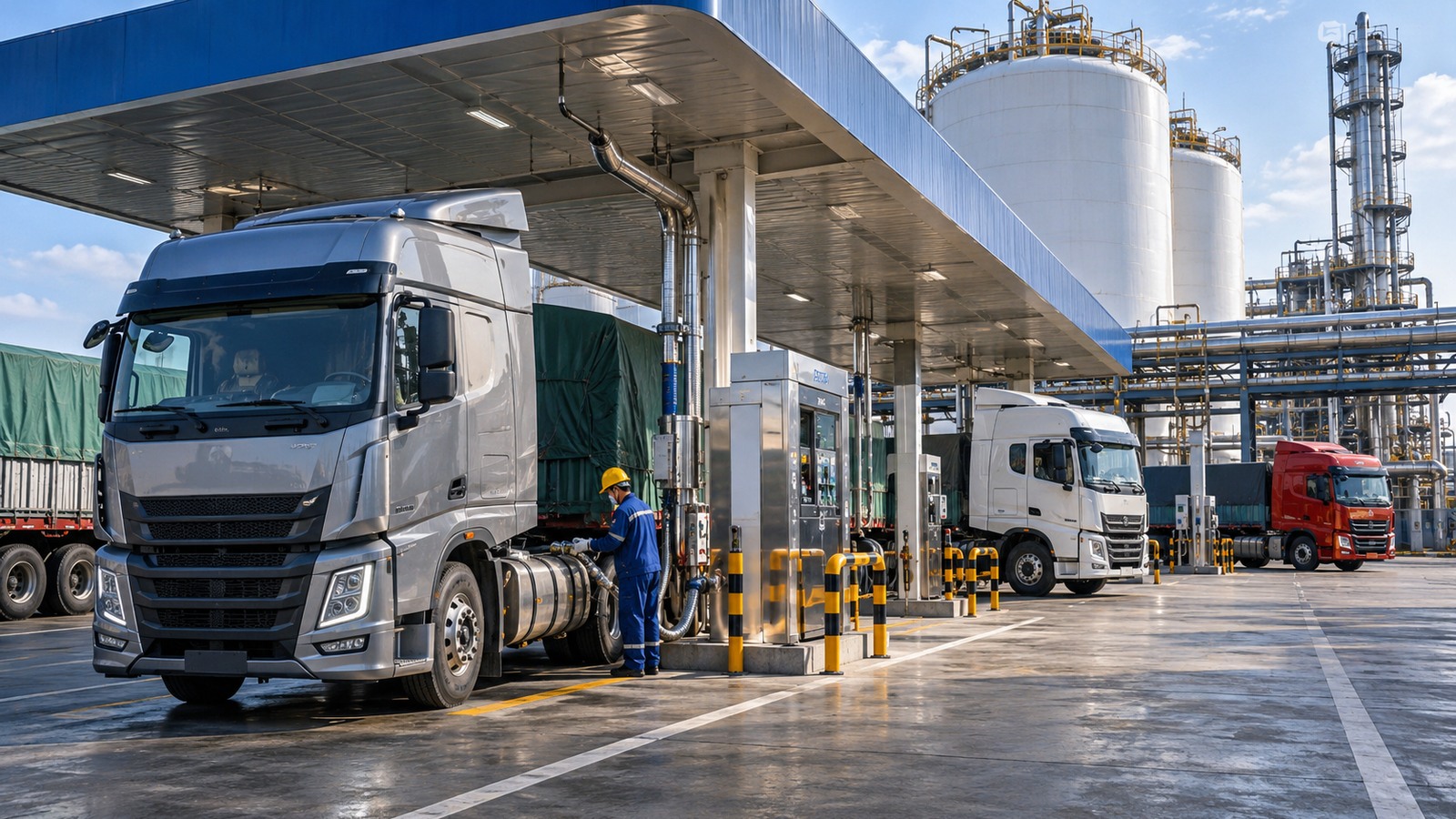
Chinese trucks use liquefied natural gas (LNG) primarily because LNG can be significantly cheaper than diesel, reducing fuel expenses for heavy-duty transportation.
For trucking companies operating large fleets or covering long distances, fuel is one of the largest operating expenses. When natural gas prices are sufficiently low relative to diesel, LNG-powered trucks can generate substantial savings.
China has developed a significant LNG heavy-duty truck market, supported by natural gas supplies, refueling infrastructure, and commercial demand for lower transportation costs.
However, LNG is not always the cheaper option. Vehicle purchase prices, maintenance, fuel costs, and competition from battery-electric trucks can change the economics.
For energy investors, China's LNG trucking market matters because transportation creates additional natural gas demand. But more LNG-powered trucks do not automatically mean more imported LNG.
China can supply transportation fuel through domestic natural gas production, pipeline imports, and internationally traded LNG.
Why Are LNG Trucks Popular in China?
The main reason LNG trucks have become popular in China is their potential operating cost advantage over diesel vehicles.
Heavy-duty trucks consume substantial amounts of fuel, particularly when transporting freight over long distances.
Even a modest difference in fuel expenditure per kilometer can become financially significant over tens of thousands of kilometers.
Several factors support LNG truck adoption in China:
- Potentially lower fuel costs than diesel.
- Availability of domestic and imported natural gas.
- Development of LNG refueling stations.
- Demand for cost-efficient long-distance freight transportation.
- Government policies influencing vehicle emissions and fuel choices.
- Improvements in LNG truck engines and fuel systems.
These factors have helped establish LNG as an alternative fuel in China's heavy-duty transportation sector.
However, adoption depends on total vehicle economics, not fuel prices alone.
How Much Cheaper Is LNG Than Diesel for Trucks?
LNG can offer substantial savings compared with diesel, but the actual difference depends on local fuel prices and vehicle efficiency.
A meaningful comparison must calculate the cost of traveling the same distance.
Comparing one kilogram of LNG with one liter of diesel is insufficient because the fuels have different energy contents and vehicles may consume them at different rates.
A Simplified Fuel Cost Example
Consider two hypothetical heavy-duty trucks operating over the same distance.
| Operating factor | Diesel truck | LNG truck |
|---|---|---|
| Distance traveled | 100 km | 100 km |
| Fuel consumption | 32 liters | 28 kg |
| Illustrative fuel price | ¥7.00 per liter | ¥4.50 per kg |
| Fuel cost per 100 km | ¥224 | ¥126 |
In this hypothetical example, the LNG truck saves ¥98 per 100 kilometers, equivalent to approximately 44% lower fuel expenditure.
Over 100,000 kilometers, the illustrative difference would reach ¥98,000.
However, these figures are illustrative assumptions, not current Chinese fuel prices or representative fleet averages.
Actual consumption depends on vehicle model, engine technology, cargo weight, terrain, driving conditions, and maintenance.
Fuel price differences also fluctuate.
For fleet operators, the correct comparison is total operating cost rather than fuel expenditure alone.
Why Does Fuel Cost Matter So Much for Heavy-Duty Trucks?
Fuel is a major expense for commercial trucking companies, especially those operating high-mileage vehicles.
A relatively small reduction in fuel cost per kilometer can produce substantial annual savings across a large fleet.
LNG becomes financially attractive when these savings compensate for higher vehicle purchase costs, maintenance, and infrastructure requirements.
High-Mileage Operations
LNG trucks can be particularly attractive for long-distance freight operations.
A truck covering substantial annual mileage has more opportunities to recover its additional purchase cost through lower fuel expenses.
By contrast, a vehicle used infrequently may not consume enough fuel to justify the investment.
Fleet Economics
Large trucking companies may negotiate fuel purchasing arrangements or operate dedicated refueling facilities.
These advantages can improve LNG vehicle economics.
However, operators must also account for downtime, reliability, maintenance requirements, and resale value.
Payback Period
The payback period measures how long operating savings take to recover the additional cost of purchasing an LNG truck.
For example, suppose an LNG truck costs ¥100,000 more than a comparable diesel vehicle.
If annual fuel savings reach ¥50,000, the simplified payback period would be approximately two years.
However, this excludes differences in maintenance, financing, insurance, downtime, and resale value.
Actual payback periods depend on the vehicles and operating conditions.
For investors, payback economics help explain whether LNG truck adoption is likely to remain commercially attractive.
How Do LNG Trucks Work?
LNG trucks use natural gas cooled to approximately minus 162 degrees Celsius, or minus 260 degrees Fahrenheit.
At this temperature, natural gas becomes liquid.
Liquefaction reduces its volume by roughly 600 times compared with its gaseous state under standard reference conditions.
This allows trucks to store more fuel in a relatively compact tank.
LNG Storage
LNG trucks use insulated cryogenic tanks designed to maintain extremely low temperatures.
The fuel is stored as a liquid and delivered through a specialized fuel system.
Depending on engine design, LNG is converted into gaseous form before combustion.
The engine then burns natural gas to generate mechanical power.
Why Liquefaction Matters
Natural gas has relatively low energy density by volume in gaseous form.
Liquefaction allows a truck to carry more energy than it could with an equivalent volume of uncompressed gas.
This supports longer driving ranges.
However, LNG tanks require specialized insulation, safety equipment, and maintenance.
These additional requirements contribute to the higher purchase costs of some LNG trucks.
Are LNG Trucks Better Than Diesel Trucks?
LNG trucks can offer advantages in fuel costs and certain emissions, but they are not universally better than diesel vehicles.
The outcome depends on fuel prices, operating conditions, vehicle technology, and infrastructure availability.
| Factor | LNG trucks | Diesel trucks |
|---|---|---|
| Fuel cost | Can be lower when natural gas is competitively priced | Depends on diesel prices |
| Purchase price | Often higher due to specialized equipment | Generally established and competitive |
| Refueling infrastructure | Requires LNG stations | Extensive diesel network |
| Driving range | Suitable for many long-distance applications | Strong long-distance capability |
| Local air pollution | Can reduce certain pollutants depending on engine technology | Modern emissions systems can also achieve low pollutant levels |
| Greenhouse gas emissions | Depends heavily on methane leakage and engine performance | Produces carbon dioxide through diesel combustion |
| Maintenance | Specialized fuel systems and cryogenic components | Established servicing infrastructure |
Fuel Economy
An LNG truck may have lower fuel expenditure even when its energy efficiency differs from that of a diesel vehicle.
The relevant measure is the cost of traveling a given distance under comparable conditions.
Vehicle Purchase Cost
LNG trucks often cost more because of specialized fuel storage and engine systems.
The additional investment must be recovered through operating savings.
When LNG prices rise relative to diesel, the payback period can become longer.
Infrastructure
Diesel is widely available through established refueling networks.
LNG requires dedicated facilities capable of storing and dispensing cryogenic fuel.
China's investment in LNG refueling infrastructure has helped make the technology practical along certain transportation routes.
However, limited infrastructure remains an obstacle in other markets.
Are LNG Trucks Cleaner Than Diesel Trucks?
LNG trucks can reduce certain air pollutants compared with older diesel vehicles, but their overall environmental advantage depends on engine technology and the full fuel supply chain.
Natural gas combustion generally produces less carbon dioxide per unit of energy than diesel combustion.
However, LNG's climate impact must also account for production, processing, liquefaction, transportation, refueling, and vehicle operation.
Methane Emissions
Methane is the primary component of natural gas and a powerful greenhouse gas.
It can escape during production, transportation, storage, or vehicle operation.
Some natural gas engines also release unburned methane, known as methane slip.
If methane emissions are sufficiently high, they can substantially reduce or eliminate the climate advantage of natural gas vehicles compared with diesel.
Local Air Pollution
Natural gas engines can reduce certain pollutants, including particulate matter, depending on engine technology.
However, modern diesel engines equipped with advanced emissions controls can also achieve low regulated pollutant levels.
Environmental comparisons should therefore consider actual vehicle technologies rather than assuming every LNG truck is cleaner than every diesel truck.
LNG Is Not a Zero-Emission Fuel
Conventional LNG remains a fossil fuel.
Its combustion releases carbon dioxide, while production and transportation require energy.
For investors, environmental regulations could influence the long-term competitiveness of LNG trucks, particularly as battery-electric alternatives develop.
Why Does China Use LNG Trucks Instead of Electric Trucks?
China uses both LNG and electric trucks because each technology offers advantages under different operating conditions.
Battery-electric trucks can be attractive for predictable routes with suitable charging infrastructure.
LNG trucks can remain competitive in some long-distance, high-mileage applications, particularly when natural gas is inexpensive.
Long-Distance Transportation
Long-distance freight requires vehicles capable of transporting heavy loads while minimizing downtime.
LNG trucks can provide substantial driving range and relatively rapid refueling.
Battery-electric trucks may require larger battery packs and high-power charging infrastructure.
However, battery technology and charging systems continue improving, changing the economic comparison.
Regional and Urban Transportation
Electric trucks can be attractive for urban deliveries and regional freight operations.
Vehicles returning regularly to a depot may be able to recharge overnight or during scheduled stops.
Electric drivetrains can also provide high energy efficiency and lower maintenance requirements in certain applications.
Total Cost of Ownership
Fleet operators compare the total cost of ownership, including:
- Vehicle purchase price.
- Fuel or electricity expenses.
- Maintenance costs.
- Refueling or charging infrastructure.
- Vehicle downtime.
- Financing.
- Resale value.
- Regulatory requirements.
LNG may be cheaper in some circumstances, while electric trucks may offer better economics in others.
For investors, this competition creates uncertainty about the long-term growth of transportation-related natural gas demand.
How Much Natural Gas Do LNG Trucks Consume in China?
China's LNG truck fleet represents a meaningful source of transportation-related natural gas demand.
However, estimating total annual consumption requires reliable information about the active fleet, annual mileage, fuel efficiency, and operating conditions.
Truck sales alone cannot establish total fuel demand because vehicles purchased in previous years may remain in operation.
A Hypothetical Fleet Calculation
Consider an illustrative fleet of 100,000 LNG trucks.
Assume each vehicle travels 100,000 kilometers annually and consumes 28 kilograms of LNG per 100 kilometers.
Annual consumption per truck would be:
100,000 ÷ 100 × 28 = 28,000 kilograms.
For 100,000 trucks, total annual consumption would reach approximately 2.8 million metric tons of LNG.
This demonstrates how heavy-duty transportation can generate substantial fuel demand.
However, it is not an estimate of China's actual LNG truck fleet or current annual consumption.
Real consumption depends on fleet utilization, engine efficiency, fuel prices, and the number of active vehicles.
For investors, the example illustrates why transportation can contribute meaningfully to natural gas demand.
Does China Import LNG Specifically for Trucks?
China's LNG trucking sector consumes natural gas, but not all of that fuel originates from imported LNG.
This distinction is essential when evaluating international LNG demand.
China obtains natural gas from three broad sources:
- Domestic natural gas production.
- Pipeline imports from neighboring countries.
- LNG imports delivered by ship.
Natural gas from domestic production or pipeline imports can also be liquefied within China for use as vehicle fuel.
Therefore, a truck purchasing LNG at a Chinese refueling station is not necessarily consuming gas delivered by an international LNG carrier.
Domestic Natural Gas
China produces natural gas from its own resources.
Some of this gas can be transported through domestic pipelines and liquefied at facilities serving regional markets.
This provides transportation fuel without requiring direct international LNG imports.
Pipeline Imports
China also receives natural gas through pipelines from neighboring countries.
Where infrastructure permits, pipeline gas can supply domestic liquefaction facilities.
Imported LNG
China imports LNG from countries including Australia, Qatar, Russia, Malaysia, and other exporters.
These cargoes can enter the broader natural gas supply system.
However, determining exactly how much imported LNG is ultimately consumed by trucks is difficult because gas from different sources can serve interconnected markets.
For investors, LNG truck growth should not be translated directly into equivalent growth in seaborne LNG imports.
How Does China's LNG Truck Market Affect Global LNG Demand?
The effect is indirect but potentially important.
If LNG truck adoption increases China's total natural gas consumption, the country may require additional supply.
However, that supply could come from domestic production, pipeline imports, or internationally traded LNG.
Scenario 1: Truck Demand Grows and Imports Increase
Suppose transportation-related natural gas consumption increases while domestic production and pipeline imports remain relatively stable.
China may need additional imported LNG to satisfy demand.
This could support international LNG trade.
However, the magnitude would depend on trucking consumption growth relative to China's overall gas market.
Scenario 2: Domestic Production Meets Additional Demand
China could increase LNG truck consumption while expanding domestic natural gas production.
Transportation demand would rise without necessarily requiring additional imported LNG.
Domestic producers might benefit, while the effect on international exporters could remain limited.
Scenario 3: Pipeline Imports Expand
Additional pipeline deliveries could satisfy some of the increased transportation demand.
This would reduce the incremental demand that must be supplied by seaborne LNG.
Scenario 4: Electric Trucks Gain Market Share
If electric trucks become more competitive, future LNG truck sales could weaken.
This might slow transportation-related natural gas demand growth.
However, existing LNG trucks could continue operating for years, depending on fleet replacement cycles.
For investors, the key is to evaluate vehicle adoption alongside total gas consumption and the availability of alternative supply sources.
Which Countries Supply the LNG Used in China?
China imports LNG from several international suppliers.
Australia, Qatar, Russia, and Malaysia have been important sources, alongside other exporters.
However, imported LNG is not necessarily assigned to specific end uses such as trucking.
Natural gas delivered through import terminals can serve electricity generation, industry, heating, and transportation.
China also produces gas domestically and receives pipeline imports.
It would therefore be inaccurate to assume that a particular supplier's LNG is used primarily by Chinese trucks.
China's international purchasing relationships are examined in Where Does China Buy LNG? Suppliers and Trade Patterns.
For investors, supplier diversification influences China's ability to satisfy growing natural gas demand at competitive prices.
Why Are LNG Prices Important for Truck Sales?
The relative cost of LNG and diesel is one of the most important drivers of LNG truck adoption.
When LNG is substantially cheaper, fleet operators have a stronger financial incentive to purchase natural gas vehicles.
When the advantage narrows, recovering the additional purchase cost becomes more difficult.
Low LNG Prices
Lower LNG prices improve operating economics.
Fleet operators may purchase additional LNG trucks when expected savings justify the investment.
Existing LNG truck operators may also benefit from reduced fuel expenses.
High LNG Prices
Higher LNG prices weaken the financial advantage over diesel.
Some operators may delay purchases or consider alternative technologies.
However, existing LNG trucks may continue operating because replacing vehicles involves additional costs.
Diesel Price Movements
Diesel prices also affect LNG competitiveness.
If diesel becomes more expensive while LNG prices remain stable, natural gas trucks may become more attractive.
Conversely, falling diesel prices can weaken the incentive to switch.
For investors, the LNG-to-diesel cost relationship is often more informative than the absolute LNG price alone.
Could LNG Truck Demand Help Prevent a Global LNG Oversupply?
Transportation demand could contribute to natural gas consumption growth, but it is unlikely to determine the global LNG balance by itself.
International LNG demand also depends on electricity generation, industrial activity, heating, economic growth, and energy policy.
Large export projects can add substantial new supply capacity.
Whether global markets absorb that supply depends on demand across multiple countries and sectors.
Why Additional Truck Demand Helps
More LNG-powered trucks can increase natural gas consumption, creating an additional source of demand.
This can support the broader gas market when fuel prices are competitive.
Stronger domestic consumption may also increase import requirements under certain supply conditions.
Why the Impact Has Limits
China's trucking sector is only one component of its natural gas market.
Additional truck fuel demand may be satisfied through domestic production or pipeline imports.
Therefore, higher LNG truck adoption does not guarantee an equivalent increase in international LNG imports.
The risks associated with expanding export capacity and weaker-than-expected consumption are explored in Is There an LNG Oversupply? Market Risks Explained.
For investors, trucking demand should be treated as one supporting factor rather than a solution to potential global oversupply.
Which Companies Could Benefit From China's LNG Truck Market?
Growth in LNG-powered transportation can create opportunities across several industries.
However, the financial benefits depend on individual business models and market conditions.
Natural Gas Producers
Higher transportation demand can support natural gas consumption.
Domestic producers may benefit through additional sales volumes or stronger market conditions.
However, profitability depends on production costs, realized prices, and company-specific factors.
LNG Fuel Suppliers
Companies involved in natural gas liquefaction, distribution, and retail fuel sales may benefit from higher LNG truck usage.
Earnings depend on fuel margins, infrastructure utilization, operating expenses, and competition.
Refueling Infrastructure Operators
LNG trucks require specialized refueling stations.
Companies developing or operating this infrastructure may benefit from additional adoption.
However, station profitability depends on traffic volumes, capital investment, and regional demand.
Truck Manufacturers
Manufacturers offering competitive LNG-powered models may benefit from higher vehicle demand.
However, sales growth does not automatically produce higher profits.
Manufacturing costs, pricing, competition, and after-sales service influence financial performance.
International LNG Exporters
American and other international LNG exporters could benefit indirectly if China's total natural gas consumption rises and additional imports are required.
However, this relationship is less direct than for domestic fuel suppliers.
An increase in LNG truck sales does not guarantee higher export volumes for any particular company.
What Are the Biggest Risks for LNG Truck Growth?
Several factors could slow LNG truck adoption in China.
| Risk | Potential effect |
|---|---|
| Higher LNG prices | Reduces fuel cost savings relative to diesel |
| Lower diesel prices | Weakens the incentive to switch |
| Electric truck competition | Could reduce demand for new LNG vehicles |
| Refueling infrastructure limitations | Restricts where LNG trucks can operate |
| Higher vehicle purchase costs | Extends the payback period |
| Environmental regulation | May favor lower-emission alternatives |
| Slower freight activity | Reduces demand for heavy-duty vehicles |
| Maintenance and reliability issues | Can increase total ownership costs |
Fuel Price Volatility
LNG truck adoption is sensitive to fuel economics.
A prolonged period of expensive natural gas could reduce demand for new vehicles.
Electric Truck Development
Battery-electric technology continues improving.
Better charging infrastructure, lower battery costs, and improved vehicle performance could make electric trucks more competitive.
This is particularly relevant for routes with predictable charging schedules.
Government Policy
Regulations affecting vehicle emissions, transportation fuels, and infrastructure investment can influence purchasing decisions.
Policies may support natural gas vehicles in some circumstances while encouraging electrification in others.
Investors should not assume that past policy support will continue unchanged.
Will Electric Trucks Eventually Replace LNG Trucks in China?
Electric trucks could capture a growing share of China's heavy-duty vehicle market, but the pace of replacement remains uncertain.
The outcome depends on technological progress and operating economics.
For regional transportation, battery-electric trucks may offer attractive efficiency and operating costs.
For long-distance routes, LNG trucks may remain competitive where fuel is inexpensive and refueling infrastructure is established.
However, improvements in battery energy density, charging speed, vehicle efficiency, and infrastructure could change this comparison.
Different freight categories may transition at different speeds.
Some fleets could electrify relatively quickly, while others continue using LNG or diesel for longer periods.
This broader competition is part of the energy transition discussed in What Will Replace Natural Gas? Future Energy Alternatives.
For investors, LNG truck forecasts should be evaluated alongside battery technology and commercial vehicle economics.
What Should Investors Monitor in China's LNG Truck Market?
Several indicators can help investors determine whether LNG-powered transportation is supporting natural gas demand.
| Indicator | Why it matters |
|---|---|
| LNG heavy-duty truck sales | Indicates demand for new vehicles |
| Active LNG truck fleet | Helps estimate the number of vehicles consuming fuel |
| LNG versus diesel fuel costs | Influences vehicle operating economics |
| Average truck mileage | Affects total transportation fuel consumption |
| LNG refueling station development | Supports adoption and route availability |
| Battery-electric truck sales | Shows competition from alternative technologies |
| Chinese natural gas consumption | Measures broader gas demand |
| Domestic gas production | Influences the need for imported supply |
| Pipeline gas imports | Provides an alternative source of natural gas |
| Total LNG imports | Reveals whether international purchasing is increasing |
Investors should avoid relying on truck sales alone.
Strong LNG truck sales may indicate that operators expect favorable fuel economics, but actual consumption also depends on how intensively those vehicles are used.
Similarly, higher transportation gas demand may not increase LNG imports if domestic production or pipeline deliveries expand.
The most useful analysis combines transportation trends with China's broader natural gas supply and demand balance.
Will China's LNG Truck Market Continue Growing?
China's LNG trucking market could continue expanding if natural gas remains competitively priced relative to diesel.
High-mileage freight operators have a strong incentive to reduce fuel expenses, while established refueling infrastructure supports adoption.
However, future growth is uncertain.
Battery-electric trucks, changing fuel prices, environmental regulations, and freight activity could all influence demand.
It is also important to distinguish new vehicle sales from the existing fleet.
Even if annual LNG truck sales slow, vehicles already operating can continue consuming natural gas.
Conversely, strong sales in one year do not guarantee sustained growth if fuel economics deteriorate.
For investors, the long-term outlook depends on whether LNG trucks maintain a competitive total cost of ownership.
Why Do Chinese Trucks Use LNG, and What Does It Mean for Investors?
Chinese heavy-duty trucks use LNG primarily because it can offer lower fuel costs than diesel, especially for vehicles traveling long distances.
China's natural gas supplies and established refueling infrastructure have helped make LNG a practical transportation fuel.
However, the economic advantage depends on fuel prices, vehicle purchase costs, maintenance, and operating conditions.
Battery-electric trucks are also becoming an increasingly important competitor.
For energy investors, China's LNG trucking market represents an additional source of natural gas demand.
Yet growth in LNG truck adoption should not be confused with equivalent growth in imported LNG demand.
China can meet transportation fuel requirements through domestic production, pipeline imports, and international LNG purchases.
The impact on global exporters therefore depends on China's broader natural gas supply-demand balance.
Ultimately, the investment significance of LNG trucks lies in their contribution to total natural gas consumption, not simply in the number of vehicles sold.
Monitoring fuel price competitiveness, fleet activity, electrification, and import requirements provides a stronger foundation for evaluating long-term opportunities and risks.
Disclaimer: This article is for informational and educational purposes only and does not constitute financial or investment advice. Energy investments involve commodity price, technological, operational, regulatory, and geopolitical risks. Investors should conduct independent research before making investment decisions.