
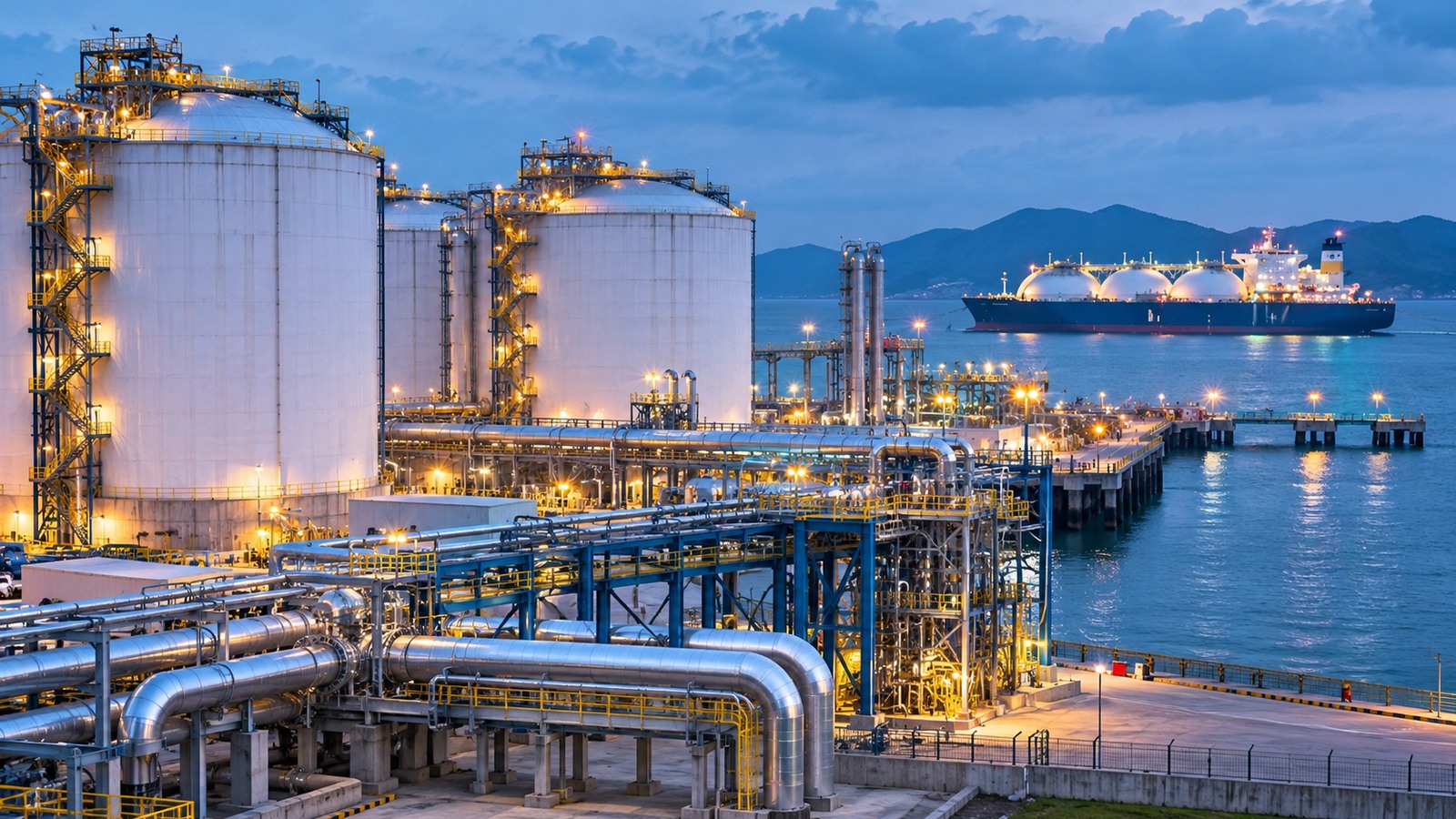
China buys liquefied natural gas (LNG) from several countries, with Australia, Qatar, Russia, and Malaysia among its major suppliers. Indonesia, Papua New Guinea, and the United States also participate in China's LNG market.
Australia and Qatar have historically been particularly important sources, supported by established export infrastructure and long-term supply agreements. However, supplier rankings change as prices, contracts, trade policies, and shipping conditions evolve.
China also produces natural gas domestically and imports pipeline gas from neighboring countries. These supplies are separate from LNG delivered by ship.
For investors, China's purchasing decisions matter because changes in its import volumes and supplier relationships can influence global LNG prices, shipping routes, and the financial performance of energy companies.
Which Countries Supply the Most LNG to China?
China imports LNG from a diversified group of suppliers across the Asia-Pacific region, the Middle East, Russia, and other producing areas.
Australia and Qatar have historically been major suppliers, while Russia and Malaysia also contribute significant volumes.
The exact ranking varies with annual deliveries, contract commitments, spot purchases, and geopolitical conditions.
The following table summarizes established supplier relationships rather than presenting an unverified ranking for 2026.
| Supplier country | Role in China's LNG market | Main advantage |
|---|---|---|
| Australia | Major established supplier | Geographic proximity and mature export infrastructure |
| Qatar | Major long-term supplier | Large gas reserves and expanding export capacity |
| Russia | Important regional supplier | Geographic proximity and broader energy relationships |
| Malaysia | Established Asian supplier | Relatively short shipping routes |
| Indonesia | Regional LNG supplier | Existing infrastructure and regional trade links |
| Papua New Guinea | Established supplier to Asian markets | Access to Asia-Pacific importers |
| United States | Significant potential supplier with variable direct trade | Large production base and flexible export infrastructure |
China can increase purchases from one supplier while reducing imports from another without significantly changing total LNG consumption.
This distinction matters because changing supplier market share does not necessarily indicate stronger or weaker overall demand.
The broader demand outlook is examined in LNG Market Trends and Demand: Supply, Growth and Risks.
Why Is Australia an Important LNG Supplier to China?
Australia has long been one of China's major LNG suppliers because of its natural gas resources, established export terminals, and relatively favorable shipping distances.
Australian LNG facilities can deliver cargoes to China without the longer voyages required from North American export terminals.
This geographic advantage can reduce transportation costs and shipping requirements.
Established Long-Term Supply Relationships
Australian LNG projects have maintained commercial relationships with major Asian energy companies for many years.
Long-term agreements help Chinese buyers secure contracted volumes while supporting the financing of capital-intensive export facilities.
Depending on their pricing formulas, these contracts can also reduce exposure to short-term market fluctuations.
However, contracted supply is not risk-free. Maintenance, unexpected outages, production declines, and changing commercial terms can affect deliveries.
Australia's Competitive Position
Australia competes with Qatar, Russia, the United States, and other exporters.
Although proximity to China is an advantage, delivered LNG costs also depend on production expenses, contract prices, facility reliability, and shipping availability.
Some Australian LNG projects face relatively high development or operating costs.
For investors, Australia demonstrates why established suppliers can retain important customer relationships even as new global export capacity becomes available.
Why Does China Buy So Much LNG From Qatar?
Qatar is a major LNG exporter with substantial natural gas resources, large-scale liquefaction facilities, and extensive commercial relationships with Asian buyers.
China has entered into major long-term purchasing agreements with Qatari suppliers, supporting energy security and commercial relationships extending beyond individual cargo deliveries.
Qatar's Long-Term Contracts
QatarEnergy has signed LNG supply agreements with Chinese energy companies, including contracts lasting approximately 27 years.
These agreements illustrate the importance of long-term planning in the LNG industry.
For Chinese importers, contracted deliveries can provide supply visibility over many years.
For exporters, long-term purchasing commitments can support financing and investment in new liquefaction projects.
However, contract duration alone does not guarantee favorable economics.
Pricing formulas, delivery obligations, flexibility provisions, and counterparty credit quality also matter.
Qatar's Export Expansion
Qatar has been developing major projects intended to expand its LNG production capacity.
Additional output could strengthen its position in Asian markets, including China.
However, the timing and commercial impact depend on construction progress, infrastructure availability, and geopolitical conditions.
Supply disruptions affecting the Gulf region during 2026 have also highlighted the operational and transportation risks facing even established exporters.
For investors, Qatar's expansion represents potential supply growth, but project timing and reliability remain important considerations.
How Important Is Russia to China's Natural Gas Supply?
Russia is an important natural gas supplier to China, but Russian pipeline deliveries and LNG shipments must be evaluated separately.
China receives Russian gas through both transportation systems, which have different infrastructure requirements and commercial characteristics.
Russian Pipeline Gas
The Power of Siberia pipeline delivers Russian natural gas directly to China.
Pipeline transportation avoids liquefaction, maritime shipping, and regasification.
This infrastructure supports a substantial energy relationship between the two countries.
However, Russian pipeline imports should not be counted as LNG imports when comparing China's LNG suppliers.
Russian LNG Exports
Russia also operates LNG export facilities serving international markets.
Some Russian LNG cargoes reach Chinese import terminals, competing with shipments from Australia, Qatar, Malaysia, and other suppliers.
The attractiveness of Russian LNG depends on prices, transportation costs, contracts, and geopolitical restrictions.
Geopolitical Considerations
Sanctions, trade restrictions, financing limitations, and political developments can affect Russian LNG projects and transactions.
These risks may influence shipping, insurance, project development, and access to international customers.
For Chinese buyers, Russian gas provides an additional supply option. For investors, geopolitical uncertainty can complicate the outlook for individual projects.
Why Does China Import LNG From Malaysia and Indonesia?
Malaysia and Indonesia are established participants in Asian LNG trade.
Their proximity to China can reduce shipping distances and transportation requirements compared with more distant exporters.
However, domestic natural gas consumption and existing export commitments influence how much LNG each country can supply internationally.
Malaysia's Role
Malaysia operates established LNG export infrastructure and has supplied Asian customers for decades.
Its regional relationships and transportation experience make it a useful source for Chinese importers seeking diversified supplies.
Future export availability depends on production, domestic consumption, infrastructure reliability, and continued investment.
Indonesia's Role
Indonesia has a long history of LNG production and exports, particularly within Asia.
However, the country also needs natural gas for domestic electricity generation and industrial activity.
Increasing domestic consumption can limit the volumes available for export.
For investors, this demonstrates that significant natural gas reserves do not automatically translate into unlimited LNG export capacity.
Does China Still Buy LNG From the United States?
The United States remains an important global LNG exporter, but direct shipments to China have been affected by tariffs and geopolitical tensions.
During parts of 2025, direct American LNG deliveries to China stopped as trade restrictions made those purchases less attractive.
However, interruptions in physical shipments do not necessarily mean all commercial relationships have ended.
Some Chinese energy companies hold long-term purchasing agreements with American LNG exporters.
Depending on contractual terms, these cargoes can be resold or redirected to buyers in other countries.
For November 2026, the current status of direct shipments should be established from recent customs and trade data rather than inferred from the 2025 interruption.
Why Trade Policies Matter
Import tariffs increase the delivered cost of LNG from affected suppliers.
When tariffs make American cargoes less competitive, Chinese buyers may favor alternatives from Qatar, Australia, or other exporters.
Meanwhile, US LNG can be redirected to Europe or other Asian markets.
This can change international shipping routes without producing an equivalent decline in global LNG consumption.
The distinction between direct shipments, contracts, and trade policies is explored in Did China Stop Buying US LNG? Trade and Demand Risks.
For investors, the central question is whether trade restrictions reduce overall demand or simply change which suppliers serve particular customers.
How Does China Choose Its LNG Suppliers?
Chinese LNG buyers evaluate suppliers using a combination of delivered cost, reliability, contract terms, geopolitical risk, and diversification.
1. Delivered LNG Cost
Importers compare the total cost of receiving LNG from different countries.
This includes purchase prices, transportation expenses, and contractual charges.
A supplier with inexpensive natural gas does not necessarily offer the lowest delivered LNG price because liquefaction, shipping, and contract terms can change the economics.
2. Supply Reliability
China requires dependable natural gas supplies for industry, electricity generation, heating, and other uses.
Importers therefore consider export facility performance and transportation route security.
Unexpected outages or shipping disruptions can make an otherwise attractive supplier less reliable.
Diversification reduces dependence on individual facilities and routes.
3. Long-Term Contract Terms
Long-term LNG agreements can include pricing formulas, minimum purchase obligations, delivery schedules, and flexibility provisions.
These contracts provide supply visibility but can become less attractive when market prices move against their terms.
Investors should distinguish between contracted volume security and the actual price paid for that supply.
4. Geopolitical Relationships
Tariffs, sanctions, regulatory restrictions, and diplomatic relationships can influence supplier selection.
Even a commercially competitive exporter may become less attractive if future trade conditions appear uncertain.
5. Flexibility and Diversification
Maintaining relationships with several exporters allows Chinese buyers to adjust purchasing strategies and reduce reliance on individual supply routes.
However, diversification cannot eliminate exposure to worldwide LNG price movements.
When global supply becomes constrained, prices can increase across multiple supplier countries simultaneously.
Does China Buy LNG Through Long-Term Contracts or Spot Markets?
China uses both long-term LNG contracts and shorter-term purchases, with some large energy companies also participating in international portfolio trading.
| Purchasing method | Main advantage | Main limitation |
|---|---|---|
| Long-term contracts | Greater supply visibility | Reduced flexibility and possible unfavorable pricing |
| Spot purchases | Ability to respond to current market conditions | Exposure to short-term price volatility |
| Portfolio trading | Flexibility to redirect or exchange cargoes | Depends on contracts and available trading opportunities |
Long-Term Contracts
LNG projects require substantial capital investment, and long-term purchasing commitments can help exporters obtain financing.
For Chinese importers, these agreements secure access to future supplies.
However, contract prices are not always lower than spot prices. The financial outcome depends on pricing formulas and market conditions.
Spot-Market Purchases
Spot transactions allow buyers to respond to near-term changes in consumption and prices.
For example, a Chinese importer may purchase additional cargoes during strong industrial activity or unusually cold weather.
Conversely, high international prices may discourage discretionary spot purchases.
This flexibility is valuable but creates exposure to sudden price increases during supply shortages.
Portfolio Trading
Some large energy companies manage LNG portfolios involving multiple suppliers and destinations.
They may purchase contracted cargoes and resell or redirect them when market conditions make alternative deliveries attractive.
However, destination flexibility depends on contractual rights, vessel availability, and terminal access.
Why Does China Import LNG When It Produces Natural Gas Domestically?
China imports LNG because domestic production alone does not meet every requirement of its large and geographically diverse natural gas market.
Natural gas is used for electricity generation, manufacturing, heating, chemical production, and transportation.
China combines three main supply channels:
- Domestic natural gas production.
- Pipeline imports from neighboring countries.
- LNG imports delivered by specialized vessels.
The balance changes with production growth, infrastructure development, consumption, and prices.
If domestic production or pipeline imports expand faster than overall demand, China may need fewer additional LNG cargoes.
Conversely, stronger industrial or electricity demand can increase LNG import requirements.
For investors, growth in China's total natural gas consumption does not automatically mean equivalent growth in LNG imports.
How Do China's LNG Imports Affect Global Gas Prices?
China's LNG purchases influence international prices because it is one of the world's largest importing markets.
When Chinese import demand increases, buyers may compete more aggressively for available cargoes.
When demand weakens, additional LNG may become available to other importing regions.
However, the price effect depends on global supply conditions.
Strong Chinese Demand
If China's LNG imports rise while export capacity is constrained, international prices may increase.
Exporters with exposure to market prices could benefit, although higher selling prices do not guarantee stronger profits for every company.
Production costs, shipping expenses, and contract structures still determine financial outcomes.
Weak Chinese Demand
If Chinese imports decline while new LNG production enters the market, international prices may face downward pressure.
Other buyers could benefit from greater cargo availability, while exporters exposed to spot prices may experience weaker margins.
Supplier Switching
China can change suppliers without significantly changing total LNG consumption.
For example, increased purchases from Qatar combined with fewer direct American cargoes could alter trade routes without reducing global demand.
Investors should therefore distinguish changes in total import volumes from changes in supplier market share.
Why Do Chinese Trucks Matter for LNG Demand?
China's natural gas demand extends beyond electricity generation and industrial production.
Heavy-duty transportation also contributes to consumption, with LNG-powered trucks used in freight operations.
The primary attraction is fuel economics.
When LNG is sufficiently cheaper than diesel, truck operators may reduce operating expenses.
However, the advantage depends on fuel prices, vehicle costs, refueling infrastructure, and usage patterns.
A growing LNG truck fleet can increase natural gas demand, but not all transportation fuel necessarily comes from imported LNG.
Domestic production and pipeline imports can also supply the gas used in transportation.
The economics and market implications are explained in Why Do Chinese Trucks Use LNG? Demand and Market Impact.
For investors, trucking demand is one component of China's overall natural gas consumption rather than a direct measure of LNG imports.
Could China Reduce Its Dependence on Imported LNG?
Yes. China could reduce its reliance on imported LNG through higher domestic production, additional pipeline supplies, and changes in its energy mix.
However, reduced dependence does not necessarily mean eliminating LNG imports.
Higher Domestic Natural Gas Production
Additional domestic production could reduce import requirements, depending on extraction costs, infrastructure, and consumption growth.
More Pipeline Imports
Expanded pipeline capacity could provide additional gas from neighboring countries.
Pipeline transportation may offer cost advantages, although new projects require substantial investment and long-term agreements.
Renewable Energy and Electrification
Solar, wind, battery storage, and electrification could reduce gas consumption in certain sectors.
Additional renewable electricity generation may reduce the need for gas-fired power plants, while electric vehicles could compete with natural gas vehicles.
However, industrial gas consumption and other applications may be more difficult to replace.
Nuclear Power
Additional nuclear electricity generation could reduce demand for gas-fired power production.
The impact depends on electricity consumption growth and the overall energy mix.
For investors, the key question is how quickly these alternatives expand relative to China's total energy requirements.
What Does China's Supplier Diversification Mean for LNG Investors?
China's diversified purchasing strategy creates different opportunities and risks across the LNG industry.
| LNG business | Potential opportunity | Main risk |
|---|---|---|
| LNG exporters | Access to a major importing market | Competition and changing purchasing relationships |
| Natural gas producers | Demand from international export markets | Commodity price volatility |
| LNG shipping companies | Transportation demand across multiple routes | Charter-rate volatility and fleet oversupply |
| LNG infrastructure operators | Long-term demand for terminals and related services | Underutilization and financing costs |
| LNG trading companies | Opportunities to optimize cargo destinations | Price volatility and contractual exposure |
Competition Among Exporters
China's ability to purchase LNG from multiple countries increases competition among suppliers.
Exporters must offer competitive prices, reliable deliveries, and commercially attractive contracts.
Companies with lower costs and dependable infrastructure may be better positioned during periods of intense competition.
Long-Term Contracts Can Support Revenue
Some LNG companies earn revenue through long-term agreements that provide greater financial visibility.
However, investors should examine whether a company receives fixed liquefaction fees, sells LNG at market-linked prices, or operates under another commercial arrangement.
These differences determine how strongly earnings respond to Chinese demand and international gas prices.
Shipping Patterns Can Change
Changes in China's supplier mix can alter LNG transportation routes.
Longer voyages may increase demand for shipping capacity, while shorter routes may reduce transportation requirements.
However, shipping profitability also depends on vessel supply, charter rates, and operating costs.
A shift in suppliers does not guarantee higher earnings for LNG carriers.
What Should Investors Monitor in China's LNG Market?
Investors can evaluate China's influence on global LNG trade through several indicators.
| Indicator | Why it matters |
|---|---|
| China's total LNG imports | Shows actual demand for imported LNG |
| Imports by supplier country | Reveals changes in trading relationships |
| Domestic natural gas production | Indicates how much demand can be met internally |
| Pipeline gas imports | Helps assess competition with LNG |
| Chinese industrial activity | Influences energy consumption |
| Asian LNG spot prices | Reflects regional market conditions |
| New long-term LNG contracts | Provides insight into future purchasing commitments |
| International trade policies | Can redirect cargoes and change import costs |
| LNG import terminal utilization | Indicates how actively infrastructure is being used |
These indicators should be evaluated together.
For example, declining Chinese imports from the United States may appear negative for American exporters.
However, if China continues purchasing similar volumes from other suppliers and US exporters redirect their cargoes elsewhere, the effect on global demand may be limited.
By contrast, a sustained decline in China's total LNG imports could have broader implications for international prices.
Will China Remain a Major LNG Buyer?
China is likely to remain an important LNG importer because of its large economy, industrial base, and substantial natural gas requirements.
However, future import volumes will depend on domestic production, pipeline supplies, industrial activity, electricity demand, and transportation consumption.
Renewable electricity, nuclear power, electrification, and energy efficiency could also influence how much LNG China needs.
International prices and trade relationships will remain important.
When LNG becomes more affordable, additional purchases may be economically attractive. When prices rise sharply, Chinese buyers may reduce spot imports or rely more heavily on alternative supplies.
For exporters, China represents a substantial market but also intense competition among Australia, Qatar, Russia, Malaysia, the United States, and other suppliers.
For retail investors, the most important factor is not simply which country sells the most LNG to China, but how China's total import demand develops relative to global supply.
Even when China's LNG purchases increase, individual company returns will depend on costs, contracts, operational performance, financial strength, and valuation.
Understanding China's supplier relationships provides a practical foundation for evaluating opportunities and risks across the international LNG industry.
Disclaimer: This article is for informational and educational purposes only and does not constitute financial or investment advice. Energy investments involve commodity price, operational, regulatory, and geopolitical risks. Investors should conduct independent research before making investment decisions.