
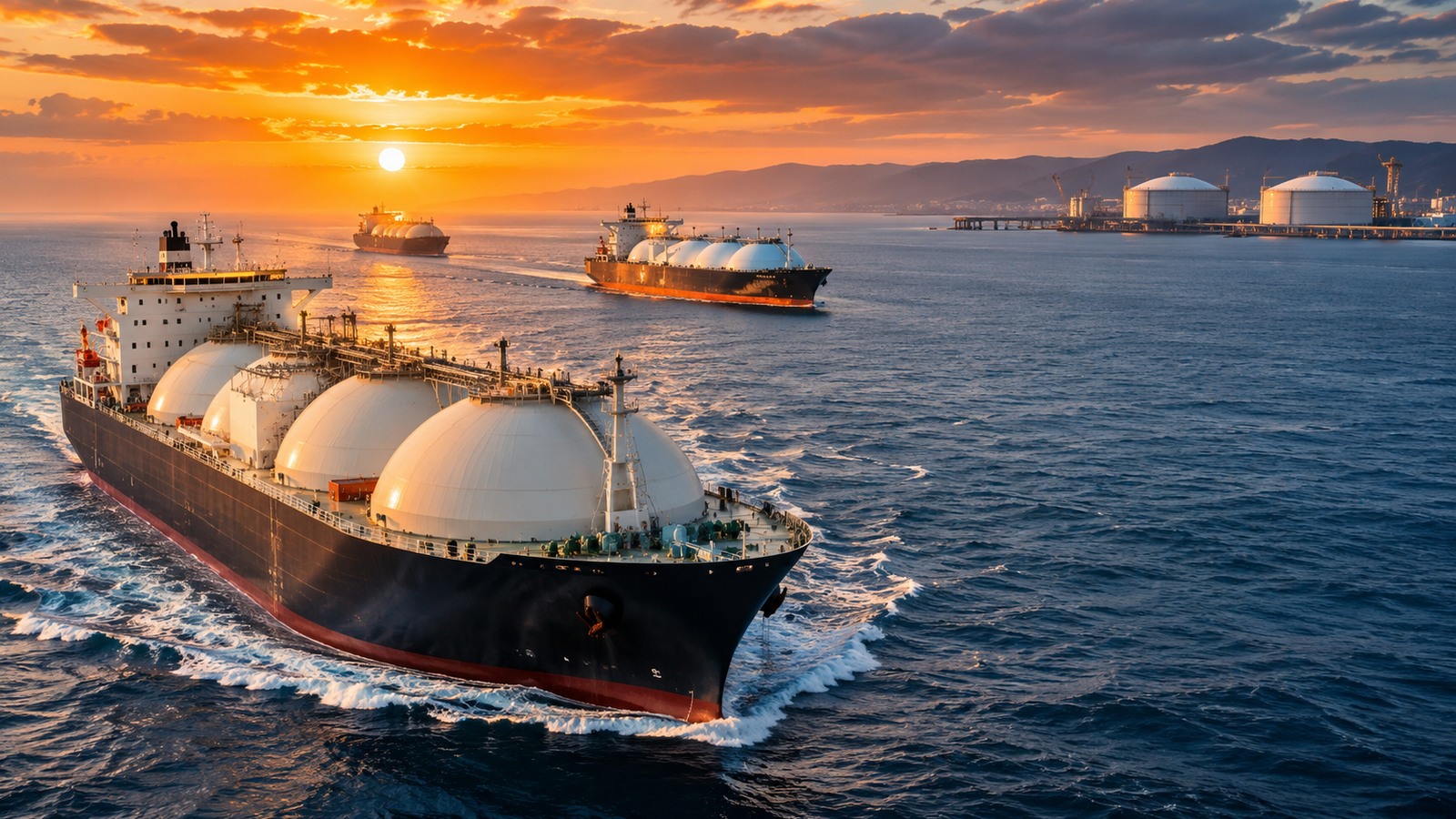
Global liquefied natural gas (LNG) demand is increasing over the long term, but growth varies significantly by region. Asia remains a major growth market, Europe continues to use LNG to diversify its energy supplies, and new export projects are expanding global supply.
For investors, rising demand does not automatically mean higher LNG prices or stronger energy stocks. The key question is whether consumption can grow fast enough to absorb new supply. If export capacity expands faster than demand, prices could fall even as global LNG trade increases.
Understanding this balance is essential for evaluating LNG producers, exporters, shipping companies, and natural gas infrastructure businesses.
Is Global LNG Demand Increasing or Decreasing?
Global LNG demand has followed a long-term upward trend, supported by electricity consumption, industrial activity, energy security concerns, and investment in import infrastructure.
Unlike pipeline gas, LNG can be transported by ship between countries without direct pipeline connections. This allows importers to diversify suppliers and exporters to reach customers across continents.
Several factors support demand growth:
- Increasing electricity consumption in developing Asian economies.
- Efforts to reduce dependence on individual energy suppliers.
- Industrial demand for natural gas in manufacturing, chemicals, and fertilizer production.
- Gas-fired power generation that supports electricity systems with variable renewable output.
- Expansion of LNG import terminals and related infrastructure.
However, growth is uneven. Some developed economies are reducing fossil fuel consumption through renewable energy, efficiency improvements, and electrification. Emerging economies may increase gas imports as their industrial and electricity needs expand.
For investors, where LNG demand grows matters almost as much as how much global consumption increases.
What Is Driving LNG Demand Growth?
Electricity Generation and Energy Security
Gas-fired power plants can adjust output relatively quickly, helping electricity grids balance changes in wind and solar generation. Natural gas can also replace coal in some power systems, although its environmental advantages depend partly on methane emissions throughout the supply chain.
Energy security provides another source of demand. Countries dependent on imported energy often seek multiple suppliers rather than relying on a single pipeline or trading partner.
LNG supports this diversification because cargoes can move between international markets, subject to contracts, shipping availability, and terminal capacity.
Industrial Consumption
Natural gas is used in fertilizer production, chemicals, food processing, and manufacturing. Some industries require high-temperature heat or use natural gas as a chemical feedstock, making substitution more difficult.
Industrial consumption can therefore support LNG demand even as other sectors electrify.
However, manufacturing activity and fuel prices matter. When gas becomes expensive or economic activity weakens, industrial users may reduce consumption, improve efficiency, or switch fuels where practical.
Transportation and Heavy-Duty Trucks
Transportation represents a smaller but notable source of LNG demand.
China has developed a substantial market for LNG-powered heavy-duty trucks, particularly in freight transportation. Their economic advantage depends on the price difference between natural gas and diesel, vehicle costs, and access to refueling stations.
When LNG offers meaningful operating savings, fleet operators may favor gas-powered trucks. When diesel becomes relatively cheaper, that advantage narrows.
This relationship is explored in Why Do Chinese Trucks Use LNG? Demand and Market Impact.
China's trucking market illustrates how fuel economics can influence LNG consumption independently of broader economic growth.
Which Regions Are Driving Global LNG Demand?
Asia: The Largest Strategic Growth Market
Asia is central to the long-term LNG outlook, but its major importing economies have different demand profiles.
Japan and South Korea are established LNG importers. Their future consumption depends on electricity demand, nuclear power availability, renewable energy deployment, and national energy policies.
China combines domestic natural gas production, pipeline imports, and LNG shipments. Its purchasing decisions depend on industrial activity, prices, energy policy, and the availability of alternative supplies.
India and emerging Southeast Asian economies offer potential growth as electricity demand and industrial activity expand. However, international LNG prices and infrastructure costs can limit their ability to increase imports.
For exporters, potential demand does not always translate into actual purchases. Customers must be able to afford delivered LNG prices.
Europe: Energy Security Versus Long-Term Decline
Europe has expanded its LNG import capabilities while seeking alternatives to Russian pipeline gas. New terminals, floating regasification facilities, and supply agreements have improved access to international markets.
The United States has become an important supplier in this transition.
However, Europe's long-term gas consumption faces pressure from renewable energy, electrification, efficiency improvements, and climate policies.
Import capacity and actual demand are different. A country may build additional LNG terminals for energy security without operating them at full capacity every year.
Investors should therefore avoid treating new terminal construction as proof of permanently increasing LNG consumption.
Emerging Markets: Opportunity With Price Sensitivity
South Asia, Southeast Asia, and other developing regions could contribute to future LNG demand growth as populations, industries, and electricity requirements expand.
Affordability remains a major constraint. When international LNG prices rise sharply, some buyers reduce spot purchases, delay contracts, or rely on alternative fuels.
Lower prices can stimulate imports by making LNG more competitive, while high prices may suppress demand.
This sensitivity can amplify LNG market cycles, particularly when several emerging economies adjust purchases simultaneously.
How Is Global LNG Supply Changing?
Global LNG supply is expanding through new liquefaction facilities and export infrastructure, particularly in the United States and Qatar, alongside established production in countries such as Australia.
Liquefaction terminals cool natural gas into liquid form for transportation by specialized vessels. These projects require substantial capital and often take years to develop, finance, construct, and commission.
Because supply cannot respond immediately to changing market conditions, projects approved during periods of strong prices may begin operating when demand or prices are weaker.
This delay helps explain why LNG markets can alternate between tight supply and excess capacity.
Why US LNG Expansion Matters
The United States has developed a major LNG export industry supported by domestic gas production, extensive pipeline networks, and access to international shipping routes.
Companies such as Cheniere Energy and Venture Global operate LNG export facilities, while other developers are expanding liquefaction capacity.
American LNG can reach European and Asian customers depending on contractual arrangements, shipping costs, and regional prices.
However, additional export capacity does not guarantee higher profits. Construction costs, financing expenses, operating reliability, domestic natural gas prices, and contract structures all affect financial performance.
Investors should distinguish between companies earning contracted liquefaction fees and businesses exposed more directly to commodity prices.
Could the LNG Market Face Oversupply?
Yes. LNG oversupply can occur when new export capacity grows faster than global consumption, even if demand continues increasing.
Several major liquefaction projects entering operation within a relatively short period could add more available cargoes than buyers need.
Weak economic activity, mild weather, slower industrial consumption, or increased renewable generation could widen that imbalance.
Potential consequences include:
- Lower international LNG prices.
- Reduced margins for suppliers with significant market-price exposure.
- Greater competition between exporters.
- More favorable purchasing conditions for importers.
- Pressure on projects with relatively high production or delivery costs.
Oversupply does not necessarily mean demand is declining. Consumption could increase while available supply grows even faster.
The timing, scale, and investment implications of additional export capacity are examined in Is There an LNG Oversupply? Market Risks Explained.
Supply disruptions, project delays, or stronger-than-expected demand could also tighten the market again.
Why LNG Prices Do Not Always Follow Demand Growth
LNG prices depend on the balance between available supply and demand, along with transportation costs, infrastructure constraints, weather, and regional market conditions.
Consider a hypothetical year in which global LNG demand rises by 3% while available supply increases by 7%. Consumption is growing, but the larger supply expansion could put downward pressure on prices.
The opposite can occur when supply is constrained. Even modest demand growth may cause sharp price increases if buyers compete for limited cargoes.
Seasonal weather and unexpected export facility outages can intensify these movements.
For investors, LNG is therefore both a long-term growth industry and a cyclical commodity market.
Regional Prices and Market Competition
Natural gas prices differ across regions because pipelines, liquefaction facilities, shipping costs, and import infrastructure limit how easily gas moves between markets.
Three important benchmarks are:
- Henry Hub: A major US natural gas pricing benchmark.
- TTF: A widely used European wholesale natural gas benchmark.
- JKM: The Japan Korea Marker, a benchmark for spot LNG delivered to Northeast Asia.
Differences between these benchmarks help determine whether transporting LNG between markets is economically attractive.
For example, a high Asian or European gas price relative to Henry Hub may favor US exports, provided the price difference covers liquefaction, shipping, and other relevant costs.
When regional price spreads narrow, some transactions become less profitable.
These relationships are particularly important for LNG traders, exporters with market-price exposure, and companies evaluating new export projects.
Is LNG More Expensive Than Pipeline Natural Gas?
LNG generally has additional processing and transportation costs compared with gas delivered through an existing pipeline over suitable distances.
LNG must be liquefied, transported by specialized ship, and usually regasified before reaching consumers. Each stage adds costs.
Pipeline transportation avoids liquefaction and regasification, but constructing long-distance pipelines can also require substantial investment.
The most economical option depends on geography, distance, existing infrastructure, available capacity, and contractual terms.
Pipeline gas may be competitive between neighboring countries with established connections. LNG may be more practical for island nations or countries seeking access to suppliers across different continents.
A detailed comparison is available in Is LNG More Expensive Than Pipeline Gas? Costs Compared.
For investors, these cost differences help explain why some suppliers remain competitive during periods of weak LNG prices while others face margin pressure.
How Important Is China to Global LNG Demand?
China is one of the world's most influential LNG markets because of its industrial activity, electricity consumption, transportation needs, and overall energy demand.
However, China does not depend exclusively on imported LNG. Domestic gas production and pipeline imports provide alternative supplies.
This flexibility allows Chinese buyers to adjust LNG purchases according to prices, economic conditions, and trade policies.
Strong Chinese imports can tighten global LNG balances. Weaker purchasing can leave additional cargoes available to other importing regions, potentially reducing international price pressure.
Did China Stop Buying LNG From the United States?
US-China LNG trade has experienced disruptions associated with tariffs, geopolitical tensions, and changing commercial relationships.
However, reduced or interrupted direct purchases do not mean China has stopped consuming LNG or that American exporters have lost access to global customers.
International LNG trade involves long-term contracts, portfolio suppliers, intermediaries, and cargoes that may be redirected between destinations.
The trade relationship and its consequences for American exporters are examined in Did China Stop Buying US LNG? Trade and Demand Risks.
For investors, direct bilateral trade flows should be considered alongside China's total LNG demand and the ability of US exporters to serve other markets.
Where Does China Source Its LNG?
China imports LNG from multiple suppliers, including Australia, Qatar, Russia, and other exporting countries.
The relative importance of individual suppliers changes with long-term contracts, international prices, shipping conditions, and government policies.
Maintaining several supply relationships can reduce dependence on individual trading partners and strengthen China's purchasing flexibility.
It also increases competition among exporters seeking access to Chinese customers.
For a closer look at these relationships, see Where Does China Buy LNG? Suppliers and Trade Patterns.
What Could Reduce LNG Demand in the Future?
Renewable electricity, nuclear power, energy storage, efficiency improvements, and electrification could reduce natural gas consumption in certain sectors.
However, the pace of substitution depends on technology costs, infrastructure, energy policies, and local economic conditions.
Renewable Electricity
Solar and wind power can reduce gas-fired electricity generation when renewable output is available.
As renewable capacity expands, some gas plants may operate fewer hours. However, natural gas can continue providing flexible generation where storage, transmission networks, or other reliable alternatives are insufficient.
Nuclear Power
Nuclear power can generate large amounts of electricity without burning natural gas.
New reactors, extensions of existing plant operations, and reactor restarts could reduce gas demand in electricity markets.
However, nuclear projects face significant construction costs, development timelines, financing requirements, and regulatory challenges.
Electrification and Energy Efficiency
Electric heat pumps, more efficient industrial equipment, and electrification can reduce direct natural gas consumption.
Electric trucks and alternative fuels could also compete with LNG-powered vehicles.
These technologies may gradually displace gas in some applications without eliminating demand across the entire economy.
The broader transition and its implications are explored in What Will Replace Natural Gas? Future Energy Alternatives.
For LNG investors, the important question is how quickly alternatives can replace natural gas at competitive costs in individual markets.
What Do LNG Market Trends Mean for Investors?
LNG offers exposure to different business models, and their financial performance does not respond to demand growth or commodity prices in the same way.
For example, Cheniere Energy operates liquefaction and export facilities with substantial long-term contractual arrangements. Natural gas producers such as EQT Corporation have more direct exposure to US gas production economics, while LNG shipping companies depend heavily on vessel demand, fleet availability, and charter contracts.
Understanding these differences is essential before evaluating an LNG-related investment.
| LNG business | Potential opportunity | Main risk |
|---|---|---|
| Natural gas producers | Higher gas demand and favorable selling prices | Commodity price declines and production costs |
| LNG exporters | Growing trade volumes and contracted liquefaction capacity | Construction costs, operational problems, and contract exposure |
| LNG shipping companies | Higher seaborne trade volumes and vessel demand | Excess vessel capacity and weaker charter rates |
| LNG infrastructure operators | Long-term demand for terminals and transportation services | Underused assets, financing costs, and changing demand |
| LNG buyers and utilities | More diversified supply and potentially lower purchasing costs | Price volatility and long-term purchasing commitments |
Contract Structure Matters
Some LNG exporters earn revenue through long-term agreements that reserve liquefaction capacity or establish contractual payment obligations.
These arrangements can provide greater revenue visibility than relying entirely on spot-market prices.
However, contracts do not eliminate risks. Counterparty credit quality, contract expiration, operating costs, financing requirements, and project execution remain important.
Other companies have greater exposure to natural gas or LNG market prices, making their profitability more sensitive to commodity cycles.
Investors should examine contract duration, pricing mechanisms, debt obligations, and cash flow generation rather than assuming every LNG company benefits equally from rising demand.
Supply Growth Can Benefit Some Companies and Hurt Others
Additional LNG supply can create different financial outcomes across the industry.
Buyers may benefit from lower purchasing costs. Exporters with strong contractual protection may maintain relatively predictable revenue. Producers exposed to commodity prices could face pressure if prices weaken.
Shipping companies may benefit from greater transportation volumes, but only when vessel availability and charter rates support profitability.
As a result, LNG market growth does not automatically translate into higher earnings or stock returns for every company.
What Should Investors Monitor in the LNG Market?
Investors can evaluate LNG fundamentals by monitoring a manageable set of supply, demand, pricing, and company-specific indicators.
| Indicator | Why it matters |
|---|---|
| Global LNG import volumes | Shows whether actual international demand is expanding |
| New export capacity | Indicates how much additional supply may enter the market |
| Asian LNG demand | Helps assess consumption in a major importing region |
| European gas storage | Influences seasonal import requirements |
| Henry Hub, TTF, and JKM prices | Reveals regional gas pricing conditions and export economics |
| LNG shipping rates | Reflects transportation demand and vessel availability |
| Long-term LNG contracts | Provides insight into future supply commitments and revenue visibility |
| Project delays and outages | Can unexpectedly tighten available supply |
These indicators should be evaluated together rather than individually.
For example, increasing LNG import volumes may support exporters, but investment returns still depend on prices, operating margins, contracts, and capital costs.
Similarly, new export capacity may increase shipping activity while putting pressure on international LNG prices.
For individual stocks, investors should also examine financial statements, debt levels, capital spending, and the relationship between market valuation and expected cash flows.
LNG Demand Outlook: Growth Does Not Eliminate Market Risks
Global LNG demand has meaningful long-term growth potential, particularly in economies where electricity consumption, industrial development, and energy security support natural gas imports.
However, new export projects could create periods of excess supply. Trade disputes may redirect cargoes between countries, while renewable energy, nuclear power, and electrification could reduce gas consumption in some markets.
These developments can occur simultaneously. Global LNG demand may continue rising even when prices weaken, regional imports decline, or individual companies face financial pressure.
For retail investors, the essential distinction is between growth in LNG consumption and profitability for LNG-related businesses.
Investment outcomes ultimately depend on production costs, contracts, competition, balance sheets, project execution, and the price paid for an asset.
Evaluating these factors alongside global supply and demand provides a more useful foundation for LNG investing than relying on demand growth forecasts alone.
Disclaimer: This article is for informational and educational purposes only and does not constitute financial or investment advice. Energy markets involve significant risks, and investors should conduct independent research before making investment decisions.