
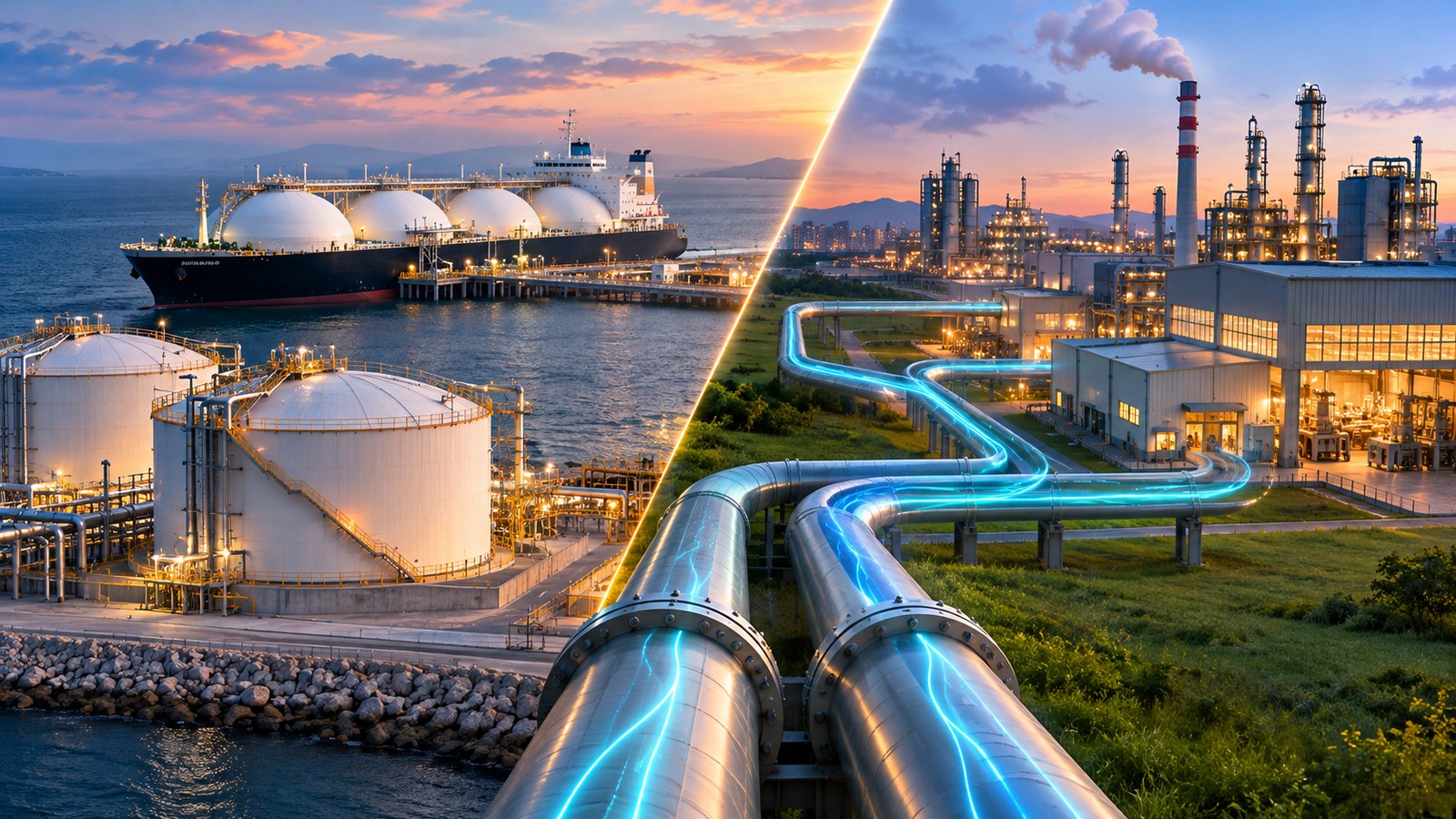
Liquefied natural gas (LNG) is generally more expensive to deliver than natural gas transported through an existing pipeline over a suitable distance. LNG requires liquefaction, specialized shipping, and usually regasification before customers can use it.
However, pipeline gas is not always the cheaper option. The total cost depends on distance, infrastructure availability, natural gas prices, shipping conditions, and the volume delivered.
For countries separated by oceans, LNG may be the most practical way to import natural gas from distant suppliers. For neighboring countries with established pipelines, pipeline gas often has a cost advantage.
For investors, these differences help explain LNG project economics, regional gas prices, and why some exporters remain competitive while others face higher costs.
Why Is LNG Usually More Expensive Than Pipeline Gas?
The main difference is the transportation process.
Pipeline gas remains in gaseous form and travels through a network connecting production areas with customers. LNG requires additional processing before and after transportation.
First, natural gas is cooled to approximately minus 162 degrees Celsius (minus 260 degrees Fahrenheit), turning it into a liquid. This reduces its volume to roughly one-six-hundredth of its gaseous volume, making large-scale shipping practical.
The LNG is loaded onto specialized carriers and transported to an importing terminal. At its destination, it is usually warmed back into gaseous form before entering local pipeline networks.
Liquefaction, shipping, storage, and regasification all add costs.
Pipeline transportation avoids several of these steps, although pipelines require construction, compression, maintenance, and operating expenses.
When both options are available under comparable conditions, LNG generally has higher processing and delivery costs.
How Much Does LNG Cost Compared With Pipeline Gas?
There is no universal price difference between LNG and pipeline natural gas.
Costs vary according to production location, transportation distance, infrastructure, and commercial agreements.
The most useful comparison separates the cost of producing natural gas from the additional cost of delivering it.
| Cost component | LNG | Pipeline gas |
|---|---|---|
| Natural gas production | Required | Required |
| Gas processing | Required | Required |
| Liquefaction | Required | Not required |
| Long-distance transportation | Specialized LNG carriers | Pipeline network |
| Regasification | Usually required | Not required |
| Compression and pumping | Required at various stages | Compression required |
| Import terminal infrastructure | Usually required | Pipeline receiving infrastructure |
| Exposure to shipping costs | High | Generally limited |
| Infrastructure investment | High | High, particularly for new long-distance routes |
An existing pipeline can deliver gas efficiently over many years. Building a new pipeline across thousands of miles, difficult terrain, or international borders can be considerably more expensive.
LNG infrastructure also requires substantial investment, but it allows exporters to serve multiple countries through maritime transportation.
For investors, comparing the full delivered cost is more meaningful than looking at natural gas production prices alone.
What Makes Up the Total Cost of LNG?
The delivered cost of LNG includes natural gas production, liquefaction, shipping, and regasification. Each stage affects the competitiveness of an export project.
1. Natural Gas Production
Natural gas must first be extracted from underground reservoirs and processed for transportation.
Production costs depend on geology, drilling efficiency, labor, equipment, infrastructure, and regulation.
For US LNG exporters, domestic natural gas prices are an important part of the cost structure. Henry Hub is a widely used benchmark for American natural gas prices.
However, the actual price paid by an export facility may differ because of regional pricing, pipeline transportation charges, and contractual arrangements.
2. Liquefaction
Liquefaction is one of LNG's largest additional cost components.
Specialized refrigeration equipment cools natural gas to extremely low temperatures. The process consumes energy and requires substantial infrastructure.
Export terminals typically represent multibillion-dollar investments involving processing equipment, refrigeration systems, storage tanks, pipelines, and marine loading facilities.
Project economics depend on construction costs, financing, operating efficiency, utilization, and maintenance.
Investors should distinguish between ongoing operating expenses and the recovery of initial construction costs.
A facility with long-term contracted capacity may generate relatively predictable revenue even when international LNG prices fluctuate.
3. LNG Shipping
After liquefaction, LNG travels on specialized vessels designed to maintain extremely low cargo temperatures.
Shipping expenses depend on:
- Distance between exporting and importing countries.
- Vessel charter rates and availability.
- Fuel consumption and operating efficiency.
- Port charges and canal transit fees.
- Shipping route restrictions and geopolitical disruptions.
For example, LNG shipped from the US Gulf Coast to Europe generally travels a shorter distance than cargo delivered to Northeast Asia.
However, shipping costs can change when vessels must take longer routes because of canal restrictions or geopolitical tensions.
A supplier with inexpensive natural gas may still face a disadvantage when delivering LNG to a distant market.
4. Regasification
Most importing countries need LNG converted back into gaseous form before it enters domestic distribution networks.
Regasification terminals provide storage, heating equipment, and connections to local pipelines.
Some countries operate permanent onshore terminals, while others use floating storage and regasification units (FSRUs).
Floating facilities can offer flexibility and may be deployed faster than conventional onshore terminals. Their costs depend on vessel availability, charter agreements, port infrastructure, and operating conditions.
These expenses contribute to the final delivered cost of LNG.
Is Pipeline Gas Always Cheaper Over Long Distances?
No. Pipeline gas can lose its cost advantage when transportation distances become very large or infrastructure is difficult to construct.
New pipeline costs can increase because of:
- Mountainous or remote terrain.
- Deepwater construction.
- International borders and permitting requirements.
- Environmental regulations and land acquisition.
- Compressor stations and maintenance.
- Security and geopolitical risks.
A pipeline connecting nearby countries with substantial long-term demand may be economical. Building one across an ocean or through politically unstable regions may be impractical.
LNG provides an alternative by allowing gas to travel between export and import terminals by ship.
The trade-off is straightforward: established pipelines often offer lower transportation costs, while LNG provides greater geographic flexibility.
For countries without practical pipeline access, the decision may be between importing LNG, developing expensive new infrastructure, or using alternative energy sources.
Why Do Countries Buy LNG if Pipeline Gas Is Cheaper?
Countries purchase LNG because energy security, supplier diversification, and geographic access can be more important than minimizing transportation costs.
Energy Security
Depending heavily on one pipeline supplier creates exposure to technical failures, political disputes, and supply interruptions.
LNG allows importing countries to purchase natural gas from multiple international exporters, reducing dependence on a single route or trading partner.
Europe's efforts to diversify away from Russian pipeline gas demonstrate why governments may prioritize reliable access to energy rather than selecting only the lowest-cost supplier.
Access to Global Suppliers
Pipeline connections are geographically limited. LNG allows countries to import natural gas from suppliers thousands of miles away.
Japan, for example, has historically depended heavily on LNG imports because it lacks international pipeline connections.
European countries can purchase LNG from the United States, Qatar, and other exporting nations.
This broader supplier base increases competition and gives buyers more options when market conditions change.
Flexible Supply Arrangements
LNG can be purchased through spot transactions, short-term agreements, or long-term contracts.
Depending on contractual terms, cargoes may be redirected between destinations.
For example, a mild European winter could reduce regional gas demand while strong Asian electricity consumption increases LNG purchasing.
Flexible cargoes may then move toward markets offering more attractive prices.
However, shipping availability, contracts, and import terminal capacity limit how quickly shipments can be redirected.
Why Are Natural Gas Prices Different in the US, Europe, and Asia?
Natural gas does not trade at a single global price because transportation requires specialized infrastructure.
Regional supply, demand, pipeline capacity, LNG shipping costs, and storage conditions influence local prices.
Three important benchmarks help investors compare markets:
| Benchmark | Main market | What it represents |
|---|---|---|
| Henry Hub | United States | Major US natural gas pricing benchmark |
| TTF | Europe | Important European wholesale natural gas benchmark |
| JKM | Northeast Asia | Benchmark for spot LNG delivered to Northeast Asia |
Henry Hub: US Natural Gas Prices
Henry Hub reflects conditions in the American natural gas market, where extensive domestic production supplies utilities, industrial customers, storage facilities, and LNG export terminals.
Prices are influenced by production volumes, weather, storage inventories, pipeline capacity, and electricity consumption.
LNG exports create additional demand for American natural gas, although their impact depends on broader domestic market conditions.
TTF: European Gas Prices
European gas markets rely on domestic production, pipeline imports, LNG shipments, and storage.
TTF prices respond to regional supply conditions, weather, storage inventories, and competition for international LNG cargoes.
When Europe requires additional imports, it may compete directly with Asian buyers, influencing global LNG trade flows.
JKM: Asian LNG Prices
The Japan Korea Marker reflects spot LNG prices for delivery to Northeast Asia.
Demand from major Asian importers, weather, shipping availability, and international supply influence this benchmark.
When Asian prices rise relative to European prices, flexible LNG cargoes may become more attractive to deliver to Asia.
However, transportation expenses and contract restrictions must be considered before redirecting shipments.
For investors, regional price spreads help explain why LNG transaction economics can change even when production costs remain relatively stable.
How Do US LNG Exporters Make Money From Price Differences?
US LNG exporters can benefit from the difference between domestic natural gas prices and international LNG selling prices.
However, the financial outcome depends on who purchases the gas, pays for liquefaction, arranges transportation, and sells the final cargo.
Consider a simplified hypothetical example.
Suppose natural gas costs $3 per million British thermal units (MMBtu), with additional expenses for liquefaction, shipping, and delivery.
| Cost component | Illustrative cost per MMBtu |
|---|---|
| Natural gas supply | $3.00 |
| Liquefaction | $2.00 |
| Shipping | $1.50 |
| Regasification and other delivery costs | $0.50 |
| Total delivered cost | $7.00 |
If the LNG sells for $10 per MMBtu, the difference between the selling price and illustrated delivered cost is $3 per MMBtu.
However, this $3 difference is not necessarily the exporter's actual profit.
The example simplifies financing, taxes, corporate expenses, contractual obligations, and infrastructure investment. It also assumes one company bears all the listed costs, which is not always the case.
Some exporters, including operators with long-term liquefaction agreements, earn contractual fees rather than retaining the full difference between US and international gas prices.
Others have greater exposure to commodity prices and trading margins.
All figures in this example are hypothetical and do not represent current market quotations or the costs of a specific LNG project.
What Happens When International LNG Prices Fall?
When international LNG prices decline, the economic advantage of exporting natural gas may narrow.
Companies exposed to spot-market prices can experience lower margins, while businesses with long-term contractual revenue may be less sensitive to immediate price movements.
Natural gas producers face different risks because their earnings depend partly on domestic supply and demand.
Lower LNG prices can also stimulate consumption. Importing countries that previously found LNG too expensive may purchase additional volumes when prices become more competitive.
If production expands faster than consumption, prices may weaken until demand increases, supply adjusts, or both.
The risks associated with expanding global export capacity are explored in Is There an LNG Oversupply? Market Risks Explained.
For investors, the important question is whether a company's cost structure and contractual arrangements allow it to remain profitable during weaker market conditions.
Does LNG Become More Competitive When Natural Gas Prices Are Low?
Yes, lower natural gas prices can improve LNG competitiveness, but the effect depends on which regional prices decline.
Lower US natural gas prices can reduce feedgas costs for American LNG exporters.
If international LNG selling prices remain relatively stable, export economics may improve. If international prices fall at the same time, the benefit may be limited.
For importing countries, cheaper LNG can make natural gas more competitive with coal, oil products, and other fuels.
This is particularly relevant in emerging markets where energy affordability strongly influences purchasing decisions.
However, switching fuels requires suitable equipment, infrastructure, and commercial arrangements. Lower prices do not guarantee an immediate increase in consumption.
How Do Shipping Distances Affect LNG Competitiveness?
Shipping distance directly influences LNG delivery costs, although freight rates and route availability can be equally important.
An exporter located closer to a major importing market may benefit from lower transportation expenses.
For example, US Gulf Coast LNG shipments to Europe generally travel shorter distances than shipments to Northeast Asia.
However, vessel availability, canal transit fees, fuel consumption, charter rates, and route restrictions can change the comparison.
A longer voyage may still be commercially attractive when the destination offers sufficiently higher prices.
Conversely, exporters may favor closer markets when regional price differences are small.
These factors help explain changes in LNG trade routes and influence demand for specialized shipping vessels.
Can LNG Compete With Renewable Energy and Nuclear Power?
LNG competes not only with pipeline gas but also with other energy sources, particularly in electricity generation.
Solar and wind power have no ongoing fuel costs, although generation varies with weather conditions.
Natural gas plants can provide flexible electricity generation when renewable output is insufficient.
Nuclear power can supply large amounts of electricity with low direct carbon emissions, but new facilities may require substantial capital and lengthy construction periods.
Battery storage, electricity transmission improvements, and energy efficiency can also reduce gas consumption in some markets.
The broader outlook is examined in What Will Replace Natural Gas? Future Energy Alternatives.
For LNG investors, long-term competitiveness depends partly on whether alternative technologies can meet electricity and industrial energy needs at attractive costs.
Which LNG Companies Are Most Exposed to Transportation Costs?
Transportation costs affect LNG businesses differently depending on their role in the supply chain and contractual responsibilities.
LNG Exporters
Companies such as Cheniere Energy and Venture Global operate LNG export facilities that require substantial construction investment, maintenance, and operating expenses.
Their direct exposure to shipping costs depends on contract terms.
Under some agreements, customers purchase LNG at the export terminal and arrange transportation. Under others, the seller is responsible for delivering cargoes.
These arrangements determine which party bears shipping costs and associated risks.
LNG Shipping Companies
LNG shipping companies are directly exposed to vessel operating expenses, fleet utilization, charter rates, and transportation demand.
Long-term charter agreements can provide revenue visibility, while greater exposure to short-term shipping markets may increase earnings volatility.
Higher LNG trade volumes do not guarantee stronger shipping profits if vessel capacity expands faster than demand.
Natural Gas Producers
Natural gas producers focus primarily on extraction costs, production volumes, and the prices received for their gas.
They may benefit indirectly from LNG exports because liquefaction facilities create additional demand for domestic production.
However, their profitability remains influenced by domestic market conditions and company-specific costs.
LNG Importers and Utilities
Importers and utilities generally seek reliable gas supplies at competitive delivered prices.
Lower LNG purchasing costs can improve their economics, although the financial impact depends on fuel cost recovery, government regulation, and electricity market structures.
For investors, understanding who bears transportation costs is often more useful than simply comparing international LNG prices.
Is LNG More Expensive Than Russian Pipeline Gas?
LNG can be more expensive than gas delivered through an established pipeline system, but the comparison depends on contracts, transportation routes, and prevailing market conditions.
Historically, Russian pipeline gas supplied substantial volumes to Europe through existing infrastructure without requiring liquefaction and maritime transportation.
However, geopolitical tensions and supply disruptions demonstrated the risks of relying heavily on a limited number of suppliers.
Replacing pipeline deliveries with LNG can increase transportation and infrastructure expenses while providing access to a wider range of international exporters.
For European energy buyers, the economic comparison therefore includes both delivered cost and supply security.
The lowest-cost supplier under normal conditions is not necessarily the most reliable during a major disruption.
What Should Investors Monitor When Comparing LNG and Pipeline Gas?
Several indicators help investors evaluate LNG competitiveness and the economics of natural gas transportation.
| Indicator | Why it matters |
|---|---|
| Henry Hub natural gas prices | Influences feedgas costs for many US LNG exporters |
| TTF and JKM prices | Shows international gas market conditions |
| Regional price spreads | Helps assess potential LNG trade economics |
| LNG shipping rates | Influences maritime transportation costs |
| Liquefaction capacity utilization | Indicates how effectively export facilities are being used |
| Pipeline transportation tariffs | Affects the delivered cost of pipeline gas |
| New infrastructure projects | Can change future transportation economics |
| Long-term LNG contracts | Provides insight into revenue stability and commercial commitments |
Investors should evaluate these indicators together rather than relying on a single price benchmark.
For example, a large difference between Henry Hub and European gas prices may appear favorable for American LNG exports.
However, liquefaction fees, shipping costs, contractual arrangements, and operational constraints can reduce the economic benefit.
Similarly, an exporter with substantial contracted capacity may have limited direct exposure to spot LNG prices.
A meaningful company analysis requires understanding how revenue is generated, which costs the business bears, and how contracts distribute market risks.
LNG Versus Pipeline Gas: Which Is Better for the Future?
Neither LNG nor pipeline gas is universally more economical.
Pipeline gas generally has a cost advantage when established infrastructure connects suppliers and customers efficiently.
LNG provides greater geographic flexibility, access to international suppliers, and opportunities to diversify energy imports.
For countries without practical pipeline connections, LNG may remain essential. Regions with extensive pipeline networks may continue benefiting from lower transportation costs.
Both face longer-term competition from electrification, renewable energy, nuclear power, and energy efficiency improvements.
For investors, LNG's higher processing and transportation costs do not automatically make it an unattractive business.
Its commercial value comes partly from allowing natural gas to reach markets that pipelines cannot serve economically or reliably.
Companies with competitive delivered costs, reliable infrastructure, favorable contracts, and disciplined capital investment may be better positioned to navigate changing energy markets.
Understanding the difference between LNG and pipeline gas costs provides a practical foundation for evaluating LNG exporters, natural gas producers, shipping companies, and infrastructure operators.
Disclaimer: This article is for informational and educational purposes only and does not constitute financial or investment advice. Energy investments involve commodity price, operational, regulatory, and geopolitical risks. Investors should conduct independent research before making investment decisions.