
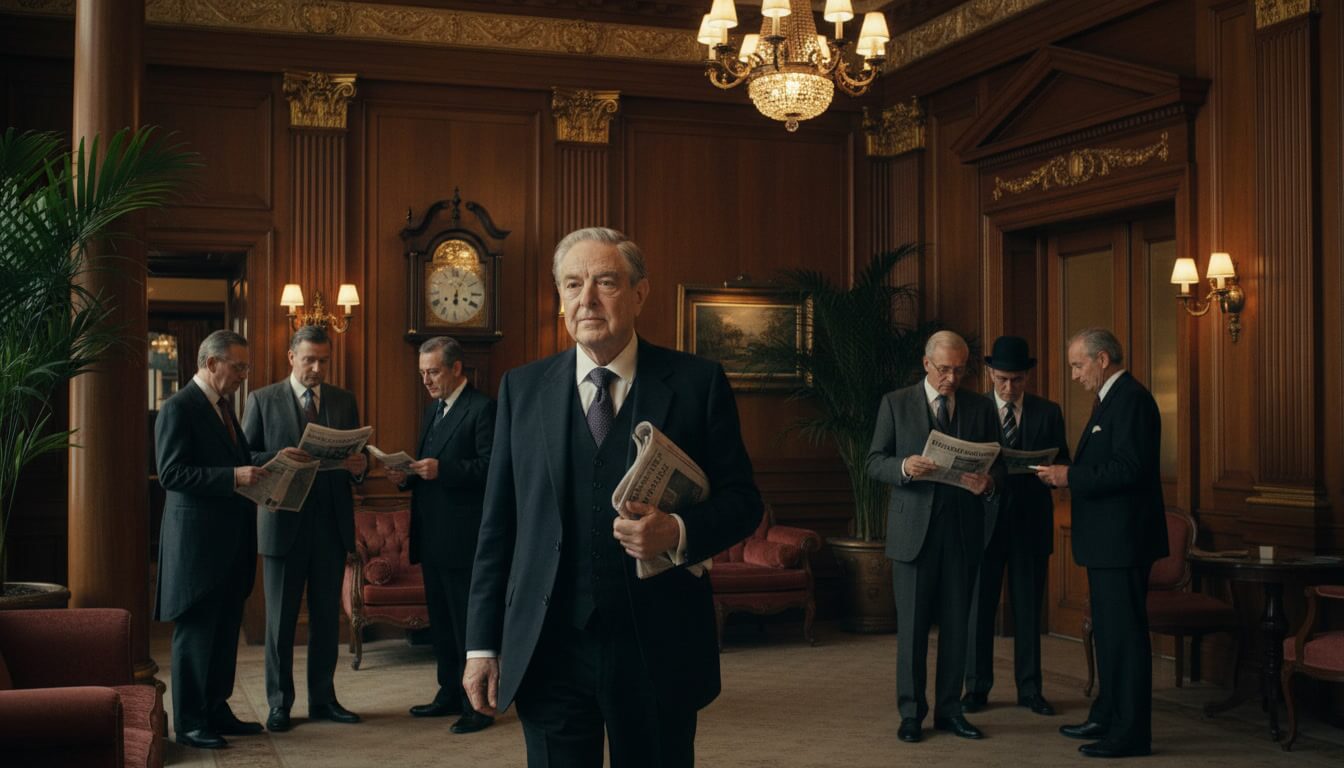
Few trades have become as deeply embedded in financial history as George Soros's massive bet against the British pound in September 1992. The episode, known as Black Wednesday, turned Soros into one of the world's most famous traders and gave him the enduring nickname "the man who broke the Bank of England."
Yet the trade was only one episode in a much longer career. Soros spent decades developing a distinctive approach to financial markets, combining macroeconomic analysis with an emphasis on market psychology, uncertainty and feedback loops between investor expectations and economic reality.
His career also demonstrates the other side of aggressive macro trading. Soros experienced substantial losses, periods of underperformance and investment decisions that did not develop as expected. His own writings repeatedly emphasize fallibility and the need to recognize when an investment thesis is wrong.
From Hungary to Wall Street
George Soros was born in Budapest in 1930. He survived the Second World War and left Hungary in 1947, eventually moving to Britain.
At the London School of Economics, Soros studied philosophy and was strongly influenced by philosopher Karl Popper. Popper's ideas about the limitations of human knowledge and the importance of recognizing fallibility later became closely connected to Soros's thinking about financial markets.
After graduating, Soros initially struggled to establish himself professionally. He worked at several financial firms in London before moving to New York in 1956.
His early Wall Street career included work as an analyst and arbitrage trader. He eventually joined Arnhold and S. Bleichroeder, where he became involved in international investing and developed experience analyzing securities across different markets.
This international perspective became one of the defining characteristics of his later career.
Building a Global Investment Operation
In 1969, Soros established the Double Eagle fund while working at Arnhold and S. Bleichroeder. Jim Rogers later joined him, and the two eventually left the firm.
In 1973, they established Soros Fund Management. The fund was subsequently associated with the name Quantum Fund and became one of the most influential hedge fund operations of its era. Contemporary biographical records describe the fund as managing approximately $12 million when the operation was established in 1973.
Unlike a traditional long-only investment portfolio, the fund operated across markets and asset classes. Soros could take positions in:
- currencies
- equities
- bonds
- commodities
This flexibility became particularly important because Soros did not approach markets primarily through individual-company analysis.
His focus was often broader: monetary policy, currencies, economic cycles, political developments, interest-rate differences and the behavior of other market participants.
The Theory of Reflexivity
One of the most distinctive elements of Soros's investment philosophy was his theory of reflexivity.
The concept emerged from his philosophical work and was later applied to financial markets.
Soros argued that market participants do not simply observe economic reality. Their perceptions and decisions can influence that reality.
For example, rising asset prices can increase confidence, encourage borrowing and stimulate investment. Those changes can then affect corporate earnings or economic activity, potentially reinforcing the original price movement.
The process can work in the opposite direction as well.
Falling prices can damage confidence, reduce access to financing and encourage defensive behavior, potentially creating additional economic weakness.
Soros described this relationship as a two-way feedback mechanism between perceptions and reality.
He developed the concept extensively in The Alchemy of Finance, published in 1987. Soros later explained that reflexivity became an important part of how he interpreted financial markets and identified situations in which market expectations could influence the fundamentals that investors were attempting to analyze.
This was different from the idea that markets simply process information and converge continuously toward equilibrium.
For Soros, markets could enter periods in which expectations, prices and economic fundamentals interacted in a self-reinforcing cycle.
The Road to Black Wednesday
The trade that made Soros internationally famous developed from Britain's participation in the European Exchange Rate Mechanism.
The United Kingdom joined the ERM in October 1990. Under the system, participating countries attempted to maintain their currencies within specified exchange-rate bands.
Sterling entered the ERM at a central rate of DM 2.95 per pound.
The arrangement became increasingly difficult as economic conditions diverged between Britain and Germany. German monetary policy remained relatively tight following reunification, while the British economy was struggling with recessionary conditions.
The Bank of England later explained that the ERM constraint increasingly limited Britain's ability to reduce interest rates in response to domestic economic conditions.
The tension created an important question for currency traders: could Britain continue defending sterling's ERM exchange rate without imposing increasingly damaging monetary conditions on its domestic economy?
Soros and his team concluded that the arrangement was becoming unsustainable.
The Sterling Trade
During 1992, Soros accumulated a large short position against the British pound.
The basic structure of the trade was straightforward: if sterling declined, positions established against the currency would generate gains.
The difficulty was determining whether the British authorities could successfully defend the exchange rate.
On September 16, 1992, pressure on sterling intensified dramatically.
The British government attempted to defend the pound by raising interest rates. The Bank of England's historical account records that two increases in official interest rates were announced during the day, but massive intervention failed to lift sterling from the floor of the ERM. The government eventually suspended sterling's membership that evening.
The date became known as Black Wednesday.
The Bank of England states that the United Kingdom's ERM membership was suspended after heavy official purchases of sterling and that the episode followed exceptionally turbulent market conditions.
Once Britain abandoned the ERM commitment, sterling depreciated sharply.
Soros's position benefited from the move.
Estimates of the profit generated by the trade generally place it at more than $1 billion. The episode was sufficiently large and visible that Soros became known worldwide as "the man who broke the Bank of England."
The nickname, however, simplifies what actually happened.
The Bank of England did not literally collapse, nor was the British currency destroyed. Britain withdrew from the ERM after authorities concluded that continuing to defend the pound's position was too costly. The Bank of England estimates that Black Wednesday cost HM Treasury more than £3 billion.
The event was therefore a confrontation between a major financial market position and an exchange-rate policy that had become increasingly difficult to maintain.
Why the Trade Became So Significant
The importance of the sterling trade went beyond the size of Soros's profit.
It demonstrated how a macro hedge fund could exploit tensions between monetary policy, exchange-rate commitments and economic conditions.
The trade also became a practical illustration of reflexivity.
As investors sold sterling, authorities had to intervene to support the currency. Higher interest rates and other defensive measures could themselves increase the economic pressure that made the exchange-rate arrangement difficult to sustain.
Soros's interpretation was therefore not simply that the pound was expensive.
The broader thesis was that the mechanism designed to defend the currency could contribute to the conditions that eventually made the defense impossible.
The Bank of England's own contemporary analysis confirms the underlying policy conflict. German monetary conditions were increasingly constraining other ERM countries even when their domestic economic circumstances were different.
Soros and Stanley Druckenmiller
Although Soros became the public face of the trade, the sterling position was not the product of one person operating in isolation.
Stanley Druckenmiller, one of the most important portfolio managers associated with Soros, played a major role in the trade.
Druckenmiller had identified vulnerabilities in sterling and developed the position before Soros pushed for a much larger commitment.
This illustrates another characteristic of Soros Fund Management: investment decisions often emerged from an interaction between portfolio managers and Soros rather than from a conventional single-manager stock-picking process.
Soros was known for being willing to increase the size of a position when his conviction became stronger, while also demanding that managers recognize when their assumptions had changed.
Beyond the Pound
The British pound was not Soros's only major macro trade.
Throughout his career, his funds operated across international currencies, bonds and equities. The strategy was based on identifying significant economic imbalances and attempting to profit from changes in those relationships.
The global nature of the Quantum Fund distinguished it from many traditional investment firms.
Soros could move between markets when he believed the opportunity set had changed.
This approach was particularly suited to periods of major macroeconomic transformation, when monetary policy, currencies and capital flows could move together.
The strategy also created substantial risks.
Large positions could generate very large gains when the underlying thesis was correct, but the same structure could produce substantial losses when the market moved against the position or when the underlying assumptions proved incorrect.
Losses and Investment Errors
Soros's career is sometimes presented primarily through spectacular victories, but losses were also an important part of his history.
In 1981, for example, the Quantum Fund suffered a loss of approximately 22%. The fund's assets declined substantially after investor redemptions.
The episode demonstrated that even a highly successful macro investment organization could experience significant drawdowns.
Soros's own philosophy places considerable emphasis on fallibility.
Rather than assuming that an investment thesis is necessarily correct, he argued that market participants operate with incomplete and imperfect knowledge. In his writings on reflexivity, he describes fallibility and reflexivity as closely connected: people form imperfect interpretations of reality, and those interpretations can influence the reality they are trying to understand.
This perspective influenced how he approached losses.
A position was not necessarily maintained simply because an investor had previously expressed strong conviction. Changing market conditions could require a change in the position itself.
The 2008 Financial Crisis
Soros continued to apply his macroeconomic framework long after Black Wednesday.
The global financial crisis of 2008 became another important episode in his intellectual and investment history.
Soros later argued that his concept of reflexivity helped him understand the dynamics of the crisis, particularly the interaction between market perceptions and financial fundamentals. He wrote that financial markets can produce distorted views of reality and that those views can subsequently influence the fundamentals themselves.
His interpretation emphasized feedback loops within credit markets and asset prices.
The crisis also reinforced one of the central ideas of his investment philosophy: markets do not necessarily move smoothly toward equilibrium. Under certain conditions, expectations and economic outcomes can reinforce one another and create increasingly unstable situations.
A Different Kind of Investor
Soros occupies a different place in investment history from investors such as Benjamin Graham or Warren Buffett.
Graham focused heavily on valuation and the relationship between price and intrinsic value. Buffett developed those ideas into a long-term ownership philosophy centered increasingly on business quality and capital allocation.
Soros instead became associated with macroeconomic trading, currencies, market psychology and changing economic regimes.
His career demonstrates that there has never been a single dominant method for participating in financial markets.
Different investors have attempted to exploit different sources of uncertainty:
- valuation discrepancies
- business economics
- market trends
- interest-rate movements
- currency regimes
- behavioral feedback loops
Soros's contribution lies particularly in his attempt to explain how market participants themselves can become part of the economic process they are trying to analyze.
The Legacy of George Soros
George Soros's place in financial history rests on more than one famous currency trade.
He helped establish the modern image of the global macro hedge fund: highly flexible, internationally focused and willing to take large positions when significant economic imbalances appeared.
His writings also gave financial markets a distinctive theoretical framework through the concept of reflexivity.
The 1992 sterling crisis remains the clearest example of that framework in action. Britain entered the ERM in an effort to maintain exchange-rate stability, but diverging economic conditions created increasing pressure on the system. On September 16, 1992, heavy intervention and higher interest rates failed to maintain sterling's position, and Britain suspended its ERM membership.
Soros's trade became one of the most famous speculative operations in financial history.
But the broader significance of his career is the way he approached uncertainty. He treated markets as environments in which expectations could affect outcomes, where participants were fallible, and where successful analysis required continuously testing assumptions against changing conditions.
That perspective helped make George Soros one of the defining figures of modern macro trading. His legacy is therefore not simply the profit generated by the pound trade, but the development of an investment philosophy that placed uncertainty, feedback loops and market participants themselves at the center of financial analysis.