
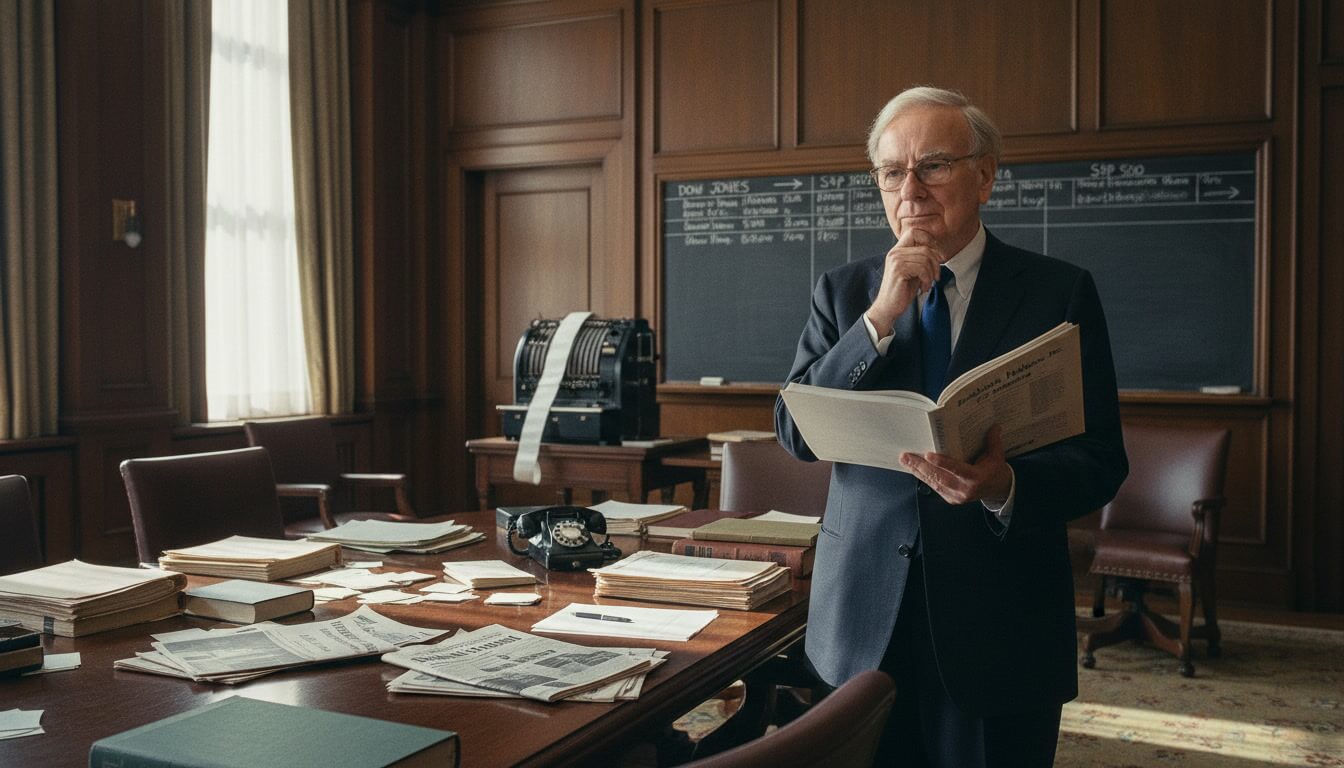
Few investors have had as much influence on modern financial markets as Warren Buffett. Over more than six decades, Buffett transformed Berkshire Hathaway from a struggling textile manufacturer into one of the world's largest conglomerates, combining insurance operations, industrial businesses and a vast portfolio of publicly traded companies.
His career became closely associated with value investing, long holding periods, disciplined capital allocation and the power of compounding. Yet Buffett's record was not built without mistakes. His investment history also includes businesses he misunderstood, opportunities he failed to pursue and decisions he later described as errors. That combination of exceptional results and openly acknowledged failures has made his career an important case study in the history of investing.
From Omaha to Wall Street
Warren Edward Buffett was born in Omaha, Nebraska, in 1930. His interest in business and markets developed early. As a child, he sold products door-to-door and began buying stocks while still a teenager.
Buffett later studied at the University of Nebraska before continuing his education at Columbia Business School, where he studied under Benjamin Graham, one of the founders of modern value investing.
Graham's influence was fundamental. His approach emphasized analyzing companies according to their underlying financial characteristics and attempting to purchase securities for less than their estimated intrinsic value. Buffett initially followed this framework closely.
In 1956, at the age of 25, Buffett established Buffett Partnership Ltd. The investment partnership became the vehicle through which he managed capital for a group of investors. During this period, he developed a reputation for identifying securities whose market prices differed substantially from his assessment of their underlying value.
One of his most famous investments was Sanborn Map Company, a business whose investment portfolio represented a significant portion of its market value. Buffett accumulated shares and eventually became involved in the company's management and capital allocation decisions.
These early experiences shaped his analytical approach, but they also prepared the ground for a major change in his investment philosophy.
The Berkshire Hathaway Transformation
In the 1960s, Buffett began accumulating shares of Berkshire Hathaway, then a struggling textile manufacturer based in New England.
The investment became complicated by Buffett's disagreement with management over the price offered to repurchase his shares. Instead of simply exiting, Buffett acquired control of the company.
The textile business ultimately proved difficult to make economically attractive. Buffett later acknowledged that purchasing Berkshire had been a mistake when viewed purely as an investment in the underlying textile operation.
Rather than abandoning the company, however, he gradually transformed Berkshire's capital structure and business model.
A crucial development came in 1967, when Berkshire acquired National Indemnity, an insurance company. Insurance became central to the future Berkshire model because insurers collect premiums before claims are paid. The resulting funds, commonly known as insurance float, could be invested while the company remained responsible for future claims.
This created a powerful capital-allocation structure. Berkshire could generate insurance float and deploy capital into businesses and securities while maintaining substantial liquidity.
From Cheap Stocks to High-Quality Businesses
Buffett's philosophy evolved considerably during the 1960s and 1970s.
The influence of Charlie Munger was particularly important. Munger encouraged Buffett to move beyond Graham's traditional focus on buying very cheap businesses and toward purchasing high-quality companies with durable competitive advantages at reasonable prices.
The transformation is visible in several of Berkshire's most important investments.
In 1972, Berkshire acquired See's Candies, a California confectionery business. The company demonstrated the characteristics Buffett increasingly valued:
- strong consumer recognition
- pricing power
- limited capital requirements
- the ability to generate substantial cash relative to the capital invested in the business
See's became an important example of how Buffett's thinking had changed. Instead of focusing exclusively on whether an asset was statistically cheap, he increasingly considered the economics and quality of the underlying business.
Coca-Cola and the Power of Long-Term Ownership
One of Berkshire's most significant investments was Coca-Cola.
Berkshire began building its position in Coca-Cola in 1988, purchasing billions of dollars worth of shares. The investment reflected several characteristics associated with Buffett's approach:
- a globally recognized brand
- a large and established distribution network
- significant consumer demand
- strong economics
The investment also demonstrated the importance Buffett placed on holding businesses for long periods rather than attempting to profit from short-term price movements.
The Coca-Cola position became one of the defining examples of Berkshire's long-term equity ownership.
Other important investments included American Express, The Washington Post Company, Gillette and GEICO. In several cases, Berkshire's involvement went beyond simply owning shares. Buffett sought companies with management teams he trusted and business models he believed could generate attractive returns over extended periods.
The Importance of Compounding
Compounding became one of the central concepts associated with Buffett's investment philosophy.
Instead of viewing investment returns primarily as isolated gains and losses, Buffett emphasized the effect of allowing capital and business earnings to accumulate over long periods.
Berkshire's historical record illustrates this principle. In its 1990 shareholder letter, Buffett reported that Berkshire's per-share book value had increased from $19.46 in 1965 to $4,612.06 at the end of 1990, representing a compounded annual growth rate of 23.2% over the period.
The figure was not achieved through a single extraordinary investment. It resulted from the accumulation of many capital-allocation decisions across decades.
This distinction is important when studying Buffett's career. The Berkshire model combined operating businesses, insurance float, retained earnings, acquisitions and investments in publicly traded companies. The resulting compounding process was therefore a corporate capital-allocation system as much as an equity-investing strategy.
Patience and Selectivity
Another defining characteristic of Buffett's approach was selectivity.
Rather than attempting to participate in every market opportunity, Buffett frequently argued that investors should wait for situations they could understand and evaluate with confidence.
This philosophy was reflected in Berkshire's relatively concentrated investments at various points in its history.
Buffett compared investing to baseball: an investor does not have to swing at every pitch. The objective is to wait for opportunities that fit one's understanding and valuation framework.
This approach also contributed to Berkshire's willingness to hold substantial amounts of cash when attractive opportunities were unavailable.
The concept was particularly relevant to Buffett's capital allocation philosophy. Holding cash could mean accepting lower short-term returns, but it also preserved flexibility when market conditions created opportunities to deploy large amounts of capital.
Major Transactions and Capital Allocation
Buffett's career includes several transactions that demonstrate the breadth of his approach.
The acquisition of GEICO was particularly important. Berkshire had invested in the insurer for years before eventually acquiring the entire company. GEICO became a major component of Berkshire's insurance operations.
Berkshire also acquired businesses such as Burlington Northern Santa Fe, the large North American railroad, and Precision Castparts, an aerospace and industrial manufacturer.
These transactions demonstrated that Buffett was not exclusively a stock picker. Berkshire increasingly became a diversified holding company whose capital could be allocated among wholly owned businesses, minority investments and insurance operations.
The result was a corporate structure that differed considerably from a traditional investment fund.
Buffett's Mistakes
Buffett has been unusually open about his investment mistakes.
One of the clearest examples was Berkshire itself. The textile business consumed capital without generating the economics Buffett ultimately wanted. He later described the decision to buy Berkshire as an error and used it as an example of how an apparently inexpensive business can remain unattractive if its underlying economics are weak.
Another well-known mistake was Berkshire's investment in USAir preferred stock.
In his shareholder communications, Buffett described the $358 million investment as an "unforced error." The airline's high costs and difficult competitive environment became major problems, and the investment performed poorly before ultimately recovering much of its value.
Buffett also acknowledged opportunities he failed to pursue.
In his 1991 shareholder letter, he discussed Berkshire's failure to invest more aggressively in Fannie Mae earlier in its development. He estimated that the missed opportunity represented approximately $1.4 billion in gains at the time.
These examples are significant because Buffett's record is often discussed primarily through his successes. His own letters provide a different perspective: successful capital allocation can coexist with substantial analytical errors and missed opportunities.
Berkshire's Changing Investment Landscape
As Berkshire grew, Buffett faced a problem that smaller investors rarely encounter: scale.
A relatively small investment can have a meaningful impact on a personal portfolio or small partnership. For Berkshire, however, investments needed to be large enough to affect a company with hundreds of billions of dollars in assets.
This increasingly limited the universe of investments that could materially influence Berkshire's results.
The company's structure nevertheless allowed Buffett to continue allocating capital across multiple areas, including:
- insurance
- railroads
- energy
- manufacturing
- consumer businesses
- publicly traded securities
By 2025, Berkshire reported shareholders' equity of approximately $717.4 billion and net earnings attributable to Berkshire shareholders of $67.0 billion. The company also continued to emphasize financial strength and substantial liquidity.
The Buffett Legacy
Buffett's influence extends beyond Berkshire's financial performance.
His annual shareholder letters became an unusual form of corporate communication, explaining investment decisions, business economics, accounting issues and capital allocation in language accessible to individual shareholders.
Berkshire's official archive maintains decades of these letters, which have become an important historical record of Buffett's evolving thinking.
His investment philosophy also helped popularize several concepts among generations of investors:
- intrinsic value
- economic moats
- disciplined capital allocation
- long holding periods
- the importance of understanding the businesses behind publicly traded securities
However, Buffett's career should not be reduced to a simple formula. His decisions were made within particular economic conditions, with access to substantial capital, insurance float, experienced managers and a corporate structure that evolved over decades.
The Berkshire model is therefore better understood as a historical example of long-term capital allocation than as a standardized investment strategy.
A Career Built on Accumulation
Warren Buffett's historical importance comes from the combination of investment analysis, business ownership and capital allocation.
His transformation of Berkshire Hathaway demonstrates how capital can compound through multiple channels over very long periods:
- insurance operations generated float
- operating businesses generated cash
- investments appreciated
- retained earnings were repeatedly redeployed
At the same time, Buffett's record shows that even one of the most successful investors in financial history made significant mistakes and missed major opportunities.
The enduring lesson of his career is therefore not simply that certain stocks produced exceptional returns. It is the broader historical example of how patience, capital allocation, business analysis and long periods of ownership can interact within a continuously evolving financial organization.
Buffett's transition from a young investor studying undervalued securities to the architect of Berkshire Hathaway represents one of the most consequential careers in modern financial markets. His results, decisions and mistakes continue to provide a detailed case study of how investment capital can be managed and compounded across generations.