
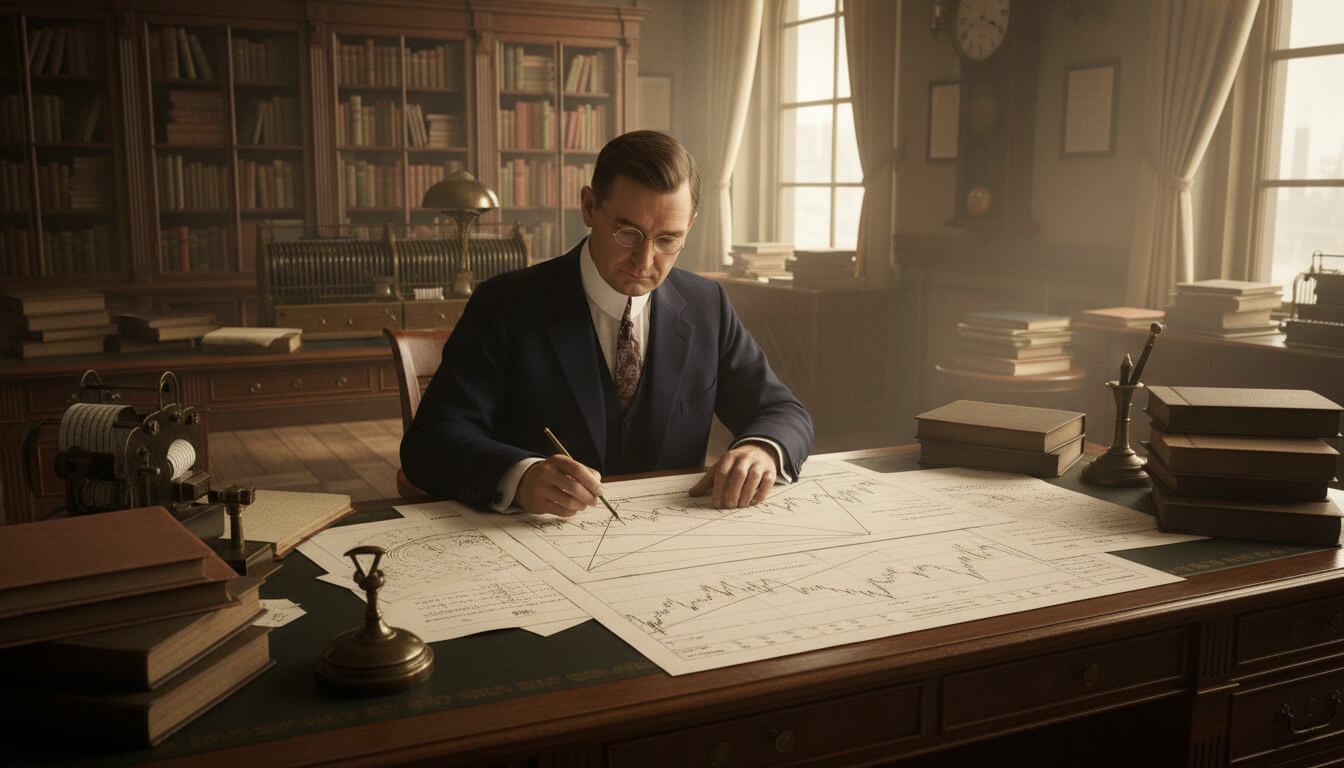
William Delbert Gann occupies a unique place in the history of financial markets. Active during the first half of the twentieth century, Gann became famous for attempting to explain market movements through the interaction of price, time, cycles and geometric relationships. His name is now associated with a collection of technical-analysis concepts known as Gann angles, Gann charts and price-and-time analysis.
Unlike many successful traders whose methods were relatively straightforward to describe, Gann left behind a deliberately complex body of work. His writings combined conventional market observations with mathematical concepts, geometry, historical cycles and, in some cases, ideas connected to astronomy and astrology. This mixture has made his career both influential and controversial.
From Texas to Wall Street
Gann was born in Texas in 1878 and grew up in a family connected to agriculture and cotton. His early exposure to commodity markets helped develop his interest in price fluctuations. He later worked in brokerage environments before moving to New York and establishing himself as a market operator and financial writer.
By the early twentieth century, Gann was developing his own theories about market behavior. Rather than treating price movements as completely random, he believed that markets exhibited recurring patterns that could be studied systematically.
This led him to investigate relationships between price and time. His central question was whether important market movements could be identified by measuring both how far prices had moved and how much time had elapsed. The concept became one of the defining characteristics of his work.
The 1909 Trading Record
Gann's reputation grew considerably after an extraordinary report published in The Ticker and Investment Digest in December 1909.
According to the contemporary account, a representative of the publication observed Gann's trading during 25 market days in October 1909. Gann reportedly executed 286 transactions, taking both long and short positions. The magazine stated that 264 trades were profitable and 22 were losses. It also reported that the capital he was operating with was doubled ten times during the period.
The same report described several individual trades in U.S. Steel and stated that Gann sometimes identified very precise price levels from which a short-term move developed. These figures have become one of the most frequently cited pieces of evidence surrounding Gann's reputation.
However, they need to be placed in historical context. The 1909 figures come from a contemporary magazine report rather than from a modern audited brokerage statement. The surviving account does not provide the complete transaction ledger, methodology for calculating the reported capital increase, commissions or other information that would allow the performance to be independently reconstructed using modern standards. The record is therefore historically important, but it should not be interpreted as a modern independently audited performance history.
The Famous Wheat Prediction
Another episode from 1909 became central to the Gann legend.
According to the contemporary account, Gann predicted that September wheat would reach $1.20 before the end of the month. On September 30, the final day, the contract was reportedly still trading below $1.08 around midday. The prediction appeared increasingly unlikely to be fulfilled.
Yet wheat subsequently reached $1.20 during the final hour of trading and closed at that level.
The episode helped establish Gann's reputation as a market forecaster capable of identifying highly specific price levels and dates.
Gann himself attributed his work to what he called the "Law of Vibration", along with cycles and what he described as natural laws governing financial markets. However, his public explanations did not provide a simple, universally reproducible formula that would allow modern readers to recreate all of his historical forecasts from the published material alone.
That gap between Gann's extraordinary reputation and the difficulty of reconstructing his complete methodology is one reason his work remains controversial.
Price, Time and Geometry
At the heart of Gann's analytical framework was the idea that price and time should be studied together.
Traditional technical analysis generally focuses on price patterns, trends, volume and support or resistance. Gann expanded this framework by assigning importance to the geometric relationship between price movement and elapsed time.
This approach eventually became associated with Gann angles. The basic concept involves drawing lines across a price chart according to predetermined relationships between price units and time units. A commonly discussed relationship is the 1×1 angle, representing an equal unit of price movement for each unit of time. Other angles represent different relationships between price and time.
Gann's broader charting system also included tools such as the Square of Nine, the Circle of 360 and various master charts. Modern descriptions of his work frequently connect these instruments with geometry, numerical relationships and cycles. For Gann, these were not merely visual patterns. They formed part of an attempt to discover an underlying structure in market behavior.
His Books and Market Philosophy
Gann was also a prolific author.
Among his best-known works is The Truth of the Stock Tape, published in the 1920s. The book dealt with stock-market analysis and included discussions of price behavior, market trends and trading principles. His later bibliography included Speculation a Profitable Profession, The Tunnel Thru the Air, Wall Street Stock Selector, New Stock Trend Detector and How to Make Profits in Commodities.
The Tunnel Thru the Air, published in 1927, was particularly unusual. Gann presented it as a fictional work, but the book contained extensive references to markets, cycles, historical events and forecasting. The book itself states that it was intended not only as a story but also as a work concerning science, preparedness and the interpretation of natural laws. This literary approach contributed further to the mystery surrounding Gann. Later readers searched his books for hidden formulas and coded references to his market methods.
The Role of Cycles
Gann's theories also emphasized the possibility that markets moved according to recurring cycles.
He studied historical price data and looked for relationships between important market events separated by specific periods of time. This led him to examine annual cycles, longer historical intervals and relationships between time and price.
Some interpretations of his work also emphasize astronomical and astrological cycles. Historical and modern sources disagree about how central these concepts were to Gann's actual trading process, partly because he did not provide a complete, transparent explanation of every element of his methodology.
This is an important distinction when studying Gann today: there is a substantial difference between techniques directly documented in his books, claims made about his private methods and interpretations developed by later followers.
The Mystery Around His Results
Gann's reputation was built partly on highly specific historical predictions. However, assessing his complete long-term trading performance is difficult.
The 1909 observation is the strongest contemporary account because it describes a defined period during which an outside publication's representative reportedly watched his transactions. But it covers only a limited period rather than Gann's entire career.
Later claims about extraordinary market predictions and profits are considerably harder to verify independently. This has produced a lasting debate among historians and market analysts about how much of Gann's legendary reputation can be demonstrated from surviving evidence.
This uncertainty does not eliminate his historical importance. Instead, it makes the distinction between documented evidence and later interpretation particularly important when examining his career.
Gann's Contribution to Technical Analysis
Whatever view one takes of his more unusual theories, Gann contributed to the development of market analysis by emphasizing several ideas that became influential among later technical traders.
- The first was the importance of studying time as well as price.
- The second was the attempt to transform market behavior into measurable geometric relationships.
- The third was the systematic examination of historical market cycles.
His work also reflected a broader development taking place during the early twentieth century: the transformation of market speculation from an activity based largely on intuition and experience into something that traders increasingly attempted to formalize through charts, statistics, rules and recurring patterns.
Modern technical analysts still use terminology derived from Gann's work, particularly Gann angles and various price-and-time charting techniques.
A Legacy of Influence and Debate
William D. Gann died in 1955 after a career spanning several decades. By then, his name had become closely associated with an alternative school of technical market analysis centered on geometry, cycles and the relationship between price and time.
His legacy is unusual because it combines documented historical material with a considerable amount of speculation about what his complete method actually was. The 1909 trading account remains an important contemporary document. His books provide substantial evidence of his ideas about markets. At the same time, many later claims about his forecasting abilities cannot be evaluated with the same degree of historical certainty.
For financial history, this distinction is valuable. Gann represents an early attempt to construct a comprehensive analytical system around market timing and price behavior, at a time when technical analysis was still developing.
His work ultimately left behind more than a collection of charting techniques. It created a lasting debate about whether financial markets contain recurring mathematical structures that can be systematically identified—and about how much confidence should be placed in historical trading records when the underlying methodology and complete performance data are no longer available.
Gann's story therefore remains less about a single secret formula than about an ambitious attempt to turn market observation into a structured analytical discipline. His combination of price, time, geometry and cycles continues to occupy a distinctive place in the history of financial market analysis.