

AWS, Microsoft Azure and Google Cloud are competing on much more than infrastructure. As AI workloads reshape the economics of cloud computing, the battle is shifting toward specialized hardware and software ecosystems.
Read article →Research, Tech & the Future Economy Research & Future Tech
DipSonar Research explores the intersection of markets, technology and the future economy.
We publish quantitative research on market behaviour, risk and statistical patterns, alongside forward-looking articles on emerging technologies, new industries and global megatrends.
From AI and space economy to the future of energy, healthcare and manufacturing — data-driven analysis, long-term perspective.

The AI race has moved beyond model benchmarks. As foundation models become embedded in software, competition is shifting to developers, APIs, enterprise workflows and cloud infrastructure.
Read article →
OpenAI, Google, Anthropic and Meta are all racing to build advanced AI, but they start from very different positions. The competition is no longer just about model quality — it is about distribution and platform control.
Read article →
The race to build the next generation of AI models is no longer just about scale. Multimodality, reasoning, computing infrastructure and distribution are becoming the real battlegrounds.
Read article →
The AI accelerator market is no longer just NVIDIA versus AMD. Google, Amazon, Cerebras, Groq and Huawei are building specialized architectures for training, inference and edge workloads.
Read article →
Updates, Stats And Research.
NVIDIA and AMD are competing not just on chip performance, but on complete computing platforms. As AI workloads diversify and cloud providers build their own silicon, the battle is becoming multi-layered.
Read article →
The AI revolution is not just about software: it is reshaping computing hardware into a strategic industry. From GPUs to custom accelerators, the competition is about controlling the platforms that will power AI.
Read article →
If launch, servicing and orbital infrastructure keep maturing, space could evolve into an industrial environment. Here is what the next layered space economy could actually become.
Read article →
From reusable rockets and satellite constellations to direct-to-smartphone connectivity and Earth observation: the companies building the infrastructure that could turn orbit into a permanent layer of the global economy.
Read article →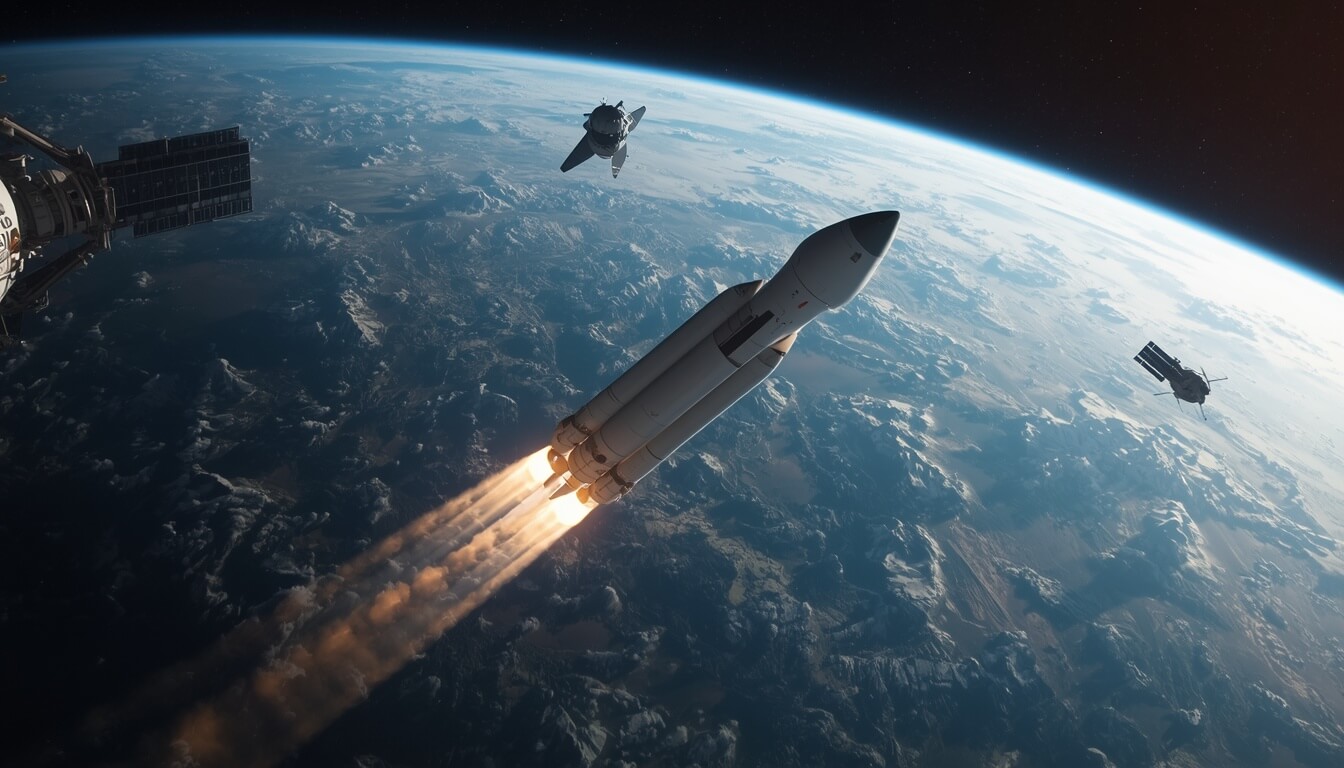
Space is shifting from a government-funded frontier to a commercial platform. Falling launch costs, reusable rockets and large constellations are turning orbit into infrastructure for communications, data and observation.
Read article →