
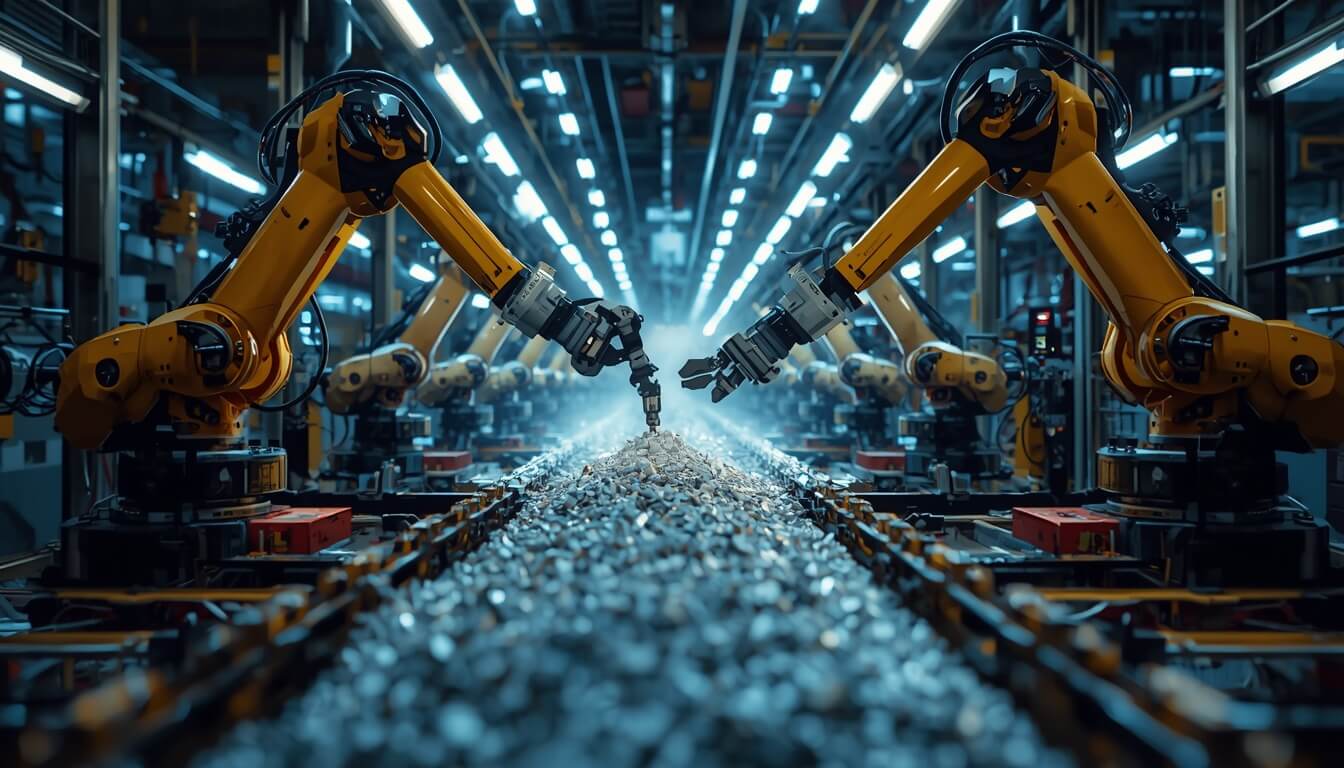
Automation is changing the economic foundations of industrial production. As companies adopt robotics, artificial intelligence, advanced software and connected manufacturing systems, the relationship between labor, capital and output is evolving. Production processes that once depended heavily on human labor can increasingly combine automated equipment, digital infrastructure and specialized technical expertise.
The implications extend beyond individual factories. Automation can influence production costs, profit margins, investment decisions, industrial competitiveness and the geographic distribution of economic activity. It can also change how productivity gains are distributed between workers, companies and consumers.
Understanding these developments requires looking beyond the number of robots installed or jobs replaced. The central economic question is how automation changes the amount of output an economy can produce with its available resources, and whether those improvements translate into sustained productivity growth.
Automation and the Economics of Production
Every industrial company must decide how to combine labor, machinery, materials, energy and technology to produce goods efficiently. Traditionally, many manufacturing processes relied on large workforces performing repetitive activities. Automation changes this combination by allowing companies to substitute some human labor with machinery, software and other forms of capital.
This does not mean that labor disappears from the production process. Instead, the relative importance of different inputs can change.
An automated factory may require fewer employees for repetitive assembly tasks but greater spending on equipment, maintenance, software, engineering and technical supervision. Its cost structure consequently shifts away from certain labor expenses toward capital investment and operating costs associated with automated systems.
Whether this change improves profitability depends on the relationship between the initial investment and the resulting economic benefits. A robot may increase production speed, reduce defects and operate for extended periods, but the investment must still cover acquisition, installation, maintenance, energy and integration costs.
Companies must also consider how frequently the equipment will be used and whether demand is sufficient to justify the additional capacity. Automation therefore represents an economic decision rather than an automatic improvement. Its value depends on the specific production process, the cost of available alternatives and the company's ability to integrate the technology effectively.
Productivity as the Main Driver
Productivity measures how efficiently resources are converted into output. In manufacturing, labor productivity is often measured as output per worker or per hour worked. Broader measures of productivity consider several inputs, including labor and capital.
Automation can improve productivity through multiple mechanisms:
- Machines can perform repetitive tasks consistently, potentially reducing production errors and material waste.
- Automated systems can increase production speed, improve equipment utilization and reduce interruptions.
- Digital monitoring can identify bottlenecks, while predictive maintenance can help companies detect equipment problems before they cause costly downtime.
These improvements can increase output without requiring a proportional increase in labor hours.
However, higher labor productivity does not necessarily mean that every aspect of production has become more efficient. A company might increase output per employee by investing heavily in expensive machinery. Whether the overall investment improves economic efficiency depends on the additional output relative to the additional capital and other resources required. This distinction is important when assessing the long-term economic impact of automation.
The Investment Cycle Behind Industrial Automation
Automation often requires substantial upfront capital expenditure. Companies must purchase equipment, redesign production lines, integrate software, train workers and potentially reorganize their operations. These investments can temporarily increase costs before the expected productivity benefits appear.
The economic return may also depend on production scale. A large manufacturer producing standardized goods in high volumes can spread the cost of an automated system across many units. A smaller company with variable demand or short production runs may find the same investment harder to justify.
As technology becomes more flexible and easier to deploy, the economics could change. Lower installation costs, simpler programming and standardized robotic platforms may make automation accessible to a wider range of businesses. This could gradually broaden the productivity effects beyond large industrial companies.
The process is closely connected to the developments discussed in How Robots Could Reshape Manufacturing and Global Labor Markets, where robotics is examined in the context of factory organization, employment and international production.
How Automation Could Influence Industrial Costs
Automation can affect several components of production costs simultaneously. Labor costs may decline for particular tasks, while spending on equipment, software, maintenance and electricity may increase. Defect rates and material waste can fall if automated processes improve consistency. Inventory costs may also decline when companies use real-time data to coordinate production more accurately with demand.
The final result depends on the balance between these changes.
Consider a manufacturer that invests in automated inspection equipment. The system may identify defects more consistently than a manual process, reducing the number of faulty products reaching customers. The company could save money through lower waste, fewer returns and reduced inspection time. Yet those savings must be weighed against the cost of purchasing and maintaining the equipment.
Automation can also increase production flexibility. If machines can switch efficiently between product variations, manufacturers may respond more quickly to changes in demand without maintaining excessive inventories.
Over time, these effects could change the competitive position of companies within an industry. Firms that integrate technology successfully may achieve lower unit costs, more consistent quality or faster delivery. Competitors that delay investment could face pressure to modernize, although the benefits will vary by industry and business model.
The Relationship Between Automation and Profit Margins
Higher productivity can support stronger profit margins, but the relationship is not guaranteed.
If automation reduces unit production costs while selling prices remain stable, a company may retain part of the difference as additional profit. Alternatively, competition may force companies to pass some of the savings to customers through lower prices. In competitive industries, productivity gains can therefore benefit consumers as well as producers.
Lower production costs may also allow businesses to enter markets that were previously difficult to serve profitably. Companies could offer more affordable products, expand their customer base or introduce new product categories.
However, automation can increase fixed costs and financial risk. A company that invests heavily in machinery may become more vulnerable if demand falls or equipment becomes obsolete before the investment is recovered. The economic advantage consequently depends on utilization rates, demand stability, financing costs and the pace of technological change.
Artificial Intelligence Expands the Scope of Automation
Traditional industrial automation focused primarily on physical tasks and predefined operating sequences. Artificial intelligence is extending automation into areas involving data analysis, quality control, planning and operational decision-making.
AI-based systems can analyze production data to identify patterns, detect anomalies and help optimize manufacturing schedules. Machine vision can inspect complex products, while predictive models can support maintenance planning. These applications may improve the coordination of entire production systems rather than simply increase the speed of individual machines.
For example, a factory could combine robotic assembly with sensors that monitor equipment performance and software that adjusts production schedules according to demand and machine availability. The resulting benefits would arise from the interaction of several technologies rather than from a single automated device.
This is one reason automation increasingly requires changes to organizational processes. Companies may need to integrate previously separate systems, improve data quality and establish new procedures for monitoring performance.
The broader transformation is part of The Global Race Toward Automation and the Future of Work, which examines how technological progress is changing the organization of work across industries.
Automation, Wages and the Distribution of Income
One of the most important economic questions concerns who benefits from productivity improvements.
Automation can reduce demand for certain routine tasks while increasing demand for workers who design, operate, maintain or supervise advanced systems. The effects on wages therefore depend partly on the skills required by the new production model and the availability of workers who possess them.
If productivity gains increase demand for specialized technical labor, wages in those occupations may rise. Workers whose tasks are easily automated may face greater pressure to retrain or move into different roles.
The distribution of gains also depends on ownership. Companies that own productive equipment may receive higher returns on capital, while employees may benefit through higher wages, improved working conditions or new opportunities. Consumers may benefit from lower prices if competition passes productivity savings through to the market.
These outcomes are not predetermined. Labor-market institutions, education, competition and corporate investment decisions can influence how the benefits of automation are distributed.
The Macroeconomic Effects of Higher Productivity
At the economy-wide level, sustained productivity growth can support higher output per person and create room for improvements in living standards.
When companies produce more efficiently, they may be able to expand output without increasing resource consumption at the same rate. Lower production costs can support investment, encourage innovation and increase the availability of goods and services.
But the transition can be uneven. Companies may invest in automation at different speeds, and productivity improvements can initially be concentrated in particular industries. Workers may need time to acquire new skills, while regions dependent on declining industrial activities may experience disruption.
There can also be a gap between technological progress and measured productivity growth. Investments in new systems may take years to generate their full benefits, particularly when companies must redesign workflows and train employees. Consequently, widespread adoption of automation does not necessarily produce an immediate acceleration in aggregate economic growth.
Energy, Infrastructure and the Cost of Industrial Competitiveness
As manufacturing becomes more dependent on advanced equipment and digital systems, energy and infrastructure can become increasingly important competitive factors.
Automated facilities require reliable electricity, communications networks, industrial software and technical support. Energy-intensive industries must also consider how electricity prices affect the economics of operating machinery at scale.
A country with access to skilled workers and advanced technology may still face constraints if its industrial infrastructure is unreliable or expensive. Conversely, strong infrastructure can help companies deploy automation more effectively and coordinate production across multiple facilities.
This creates a broader connection between industrial policy, energy investment and technological competitiveness. The location of future manufacturing capacity may increasingly depend on the combined cost of capital, energy, logistics, skilled labor and digital infrastructure rather than on wages alone.
Why Productivity Gains Are Not Guaranteed
Automation is frequently associated with efficiency, but poorly implemented systems can generate disappointing results.
Companies may underestimate integration costs, invest in equipment that does not fit their production requirements or struggle to recruit workers capable of maintaining advanced systems. Cybersecurity problems and software failures can also disrupt operations.
Furthermore, not every task benefits from automation. Processes involving highly variable materials, low production volumes or complex human interactions may remain more economical when performed manually or through a combination of human and machine work.
The relevant question is therefore not how much automation a company can introduce, but where automation generates measurable economic value.
Successful adoption requires companies to identify specific bottlenecks, compare investment alternatives and evaluate results over time. Productivity improvements must be demonstrated through operating performance rather than assumed from the presence of new technology.
The Changing Economics of Industry
Automation is gradually changing the balance between labor, capital, technology and energy in industrial production.
Its long-term significance will depend on whether companies can convert technological capabilities into sustained productivity improvements. When they can, automation may support lower unit costs, more flexible manufacturing, new products and more competitive industrial systems.
At the same time, the transition creates challenges involving investment risk, workforce adaptation and the distribution of economic gains. Some jobs and production methods may decline, while new technical activities and business opportunities emerge.
For policymakers and businesses, the central issue is how to make these changes economically sustainable. Investment in education, infrastructure, research and effective competition can influence whether productivity improvements remain concentrated among a limited number of firms or contribute to broader economic development.
Automation should therefore be understood as a structural transformation rather than a single technological event. Its effects will emerge gradually through millions of investment decisions, changes in production processes and adjustments across labor markets.
The key measure of its success will not simply be the number of machines deployed. It will be the extent to which economies can produce more value with available resources while adapting to the changing relationship between human work, capital and technology.