
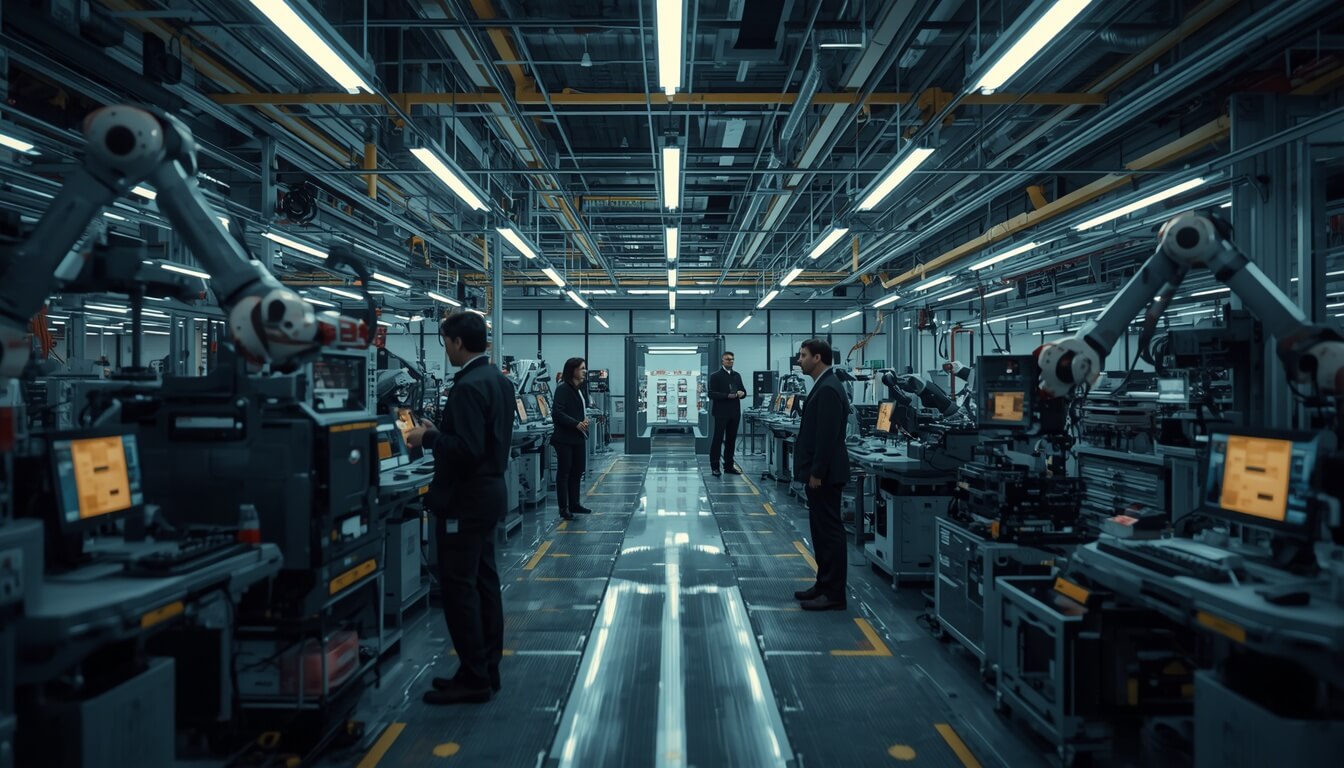
Automation is moving from a specialized industrial technology into a broader economic transformation. Advances in robotics, artificial intelligence, machine vision, software and autonomous systems are allowing companies to automate tasks that previously depended almost entirely on human labor. At the same time, falling technology costs and growing pressure to improve productivity are encouraging businesses across industries to experiment with increasingly sophisticated forms of automation.
The result is not simply a technological shift. It is a change in how economies organize production, how companies allocate capital and how workers interact with machines. Manufacturing remains one of the most visible areas of automation, but similar developments are appearing in logistics, agriculture, transportation, retail, financial services, healthcare and professional activities.
This transformation is also becoming increasingly global. Countries are competing to develop automation technologies while simultaneously trying to attract industries that can use them effectively. The future of work will therefore depend not only on how quickly individual technologies improve, but also on how businesses, workers and governments adapt to their diffusion.
Why Automation Is Accelerating
Several forces are reinforcing the global move toward automation.
One is the declining cost and increasing capabilities of technology. Industrial robots can perform repetitive tasks with high consistency, while advances in sensors and machine vision allow automated systems to operate in environments that would previously have required human supervision. Artificial intelligence is expanding these capabilities further by allowing machines and software to process large quantities of information, recognize patterns and make increasingly complex decisions.
Another factor is labor-market pressure. In many advanced economies, populations are aging and the number of working-age people is growing more slowly. Companies operating in manufacturing, logistics, construction and other labor-intensive sectors can therefore face persistent difficulties recruiting workers for repetitive or physically demanding jobs.
Automation can provide one response to these constraints. Rather than replacing an entire occupation, companies can automate specific tasks and use workers for activities that still require judgment, communication, adaptability or physical dexterity.
The economics of automation are also changing. A machine does not need to become universally capable to have an economic impact. If an automated system can perform one task reliably and at a competitive cost, companies may have an incentive to deploy it. As more tasks become technically feasible to automate, the number of potential applications expands.
From Industrial Robots to Intelligent Systems
The first major wave of industrial automation was concentrated in factories. Robots were introduced primarily for repetitive activities such as welding, painting, assembly and material handling. These systems were generally designed for structured environments where the position of objects and the sequence of operations were predictable.
Today's automation landscape is broader. Collaborative robots can work alongside human employees. Autonomous mobile robots can transport materials through warehouses and factories. Machine-vision systems can inspect products at high speed. Artificial intelligence can analyze operational data and identify anomalies that might previously have required human inspection.
This convergence between robotics and software is particularly important. Traditional automation often followed predefined instructions. Newer systems can increasingly adapt to changing conditions, interpret visual information and optimize processes using data.
The distinction between physical and digital automation is therefore becoming less clear. A modern production facility may combine robotic equipment, cloud software, sensors, predictive analytics and AI-based decision systems into one integrated production environment.
The implications for manufacturing are examined in greater detail in How Robots Could Reshape Manufacturing and Global Labor Markets.
Automation Does Not Affect All Jobs Equally
The impact of automation is often described in terms of jobs being replaced by machines. In practice, the relationship is more complicated.
Most occupations contain multiple tasks, and only some of them may be suitable for automation. A warehouse employee, for example, may spend part of the working day moving goods, part of it checking inventory and part of it solving unexpected problems. Automation could eliminate some of those tasks while leaving others dependent on human workers.
This creates the possibility of job transformation rather than simple job elimination.
Workers may increasingly operate, supervise, maintain or collaborate with automated systems. New occupations can also emerge around the design, installation, programming and maintenance of automation technologies. At the same time, demand may decline for some routine activities.
The distribution of these effects is likely to vary considerably between sectors and countries:
- Economies with large manufacturing bases may experience significant changes in factory employment.
- Economies dominated by services may see automation spread through administrative, analytical and customer-facing activities.
- The pace of change may also differ, since technical feasibility does not automatically lead to immediate adoption.
Companies must consider investment costs, integration challenges, regulatory requirements, cybersecurity, organizational changes and the availability of workers capable of managing new systems.
The Geography of the Automation Race
Automation is becoming part of international economic competition.
Countries with strong industrial bases, advanced technology sectors and substantial research capabilities have advantages when developing and deploying automated systems. At the same time, countries with large manufacturing industries have incentives to automate in order to maintain competitiveness as labor costs rise.
This can create an important feedback loop. Higher automation can increase productivity, allowing manufacturers to produce more output with fewer labor hours. Greater productivity can make domestic production more competitive, potentially encouraging companies to invest further in local manufacturing capacity.
The relationship between automation and globalization could therefore become more complex. For decades, differences in labor costs encouraged companies to locate production in countries with relatively inexpensive workers. If automation reduces the importance of labor costs for some manufacturing processes, other factors—including energy prices, infrastructure, proximity to customers, supply-chain resilience and access to technology—could become more important.
Automation could consequently contribute to a restructuring of global production networks rather than simply accelerating the existing model of globalization.
Productivity Is the Central Economic Question
Ultimately, the importance of automation depends heavily on productivity.
If automated technologies allow companies to produce more goods and services with the same amount of capital and labor, they can increase economic output. Higher productivity can support rising incomes, lower production costs or greater investment. But the benefits do not necessarily appear immediately.
Large automation investments often require substantial upfront spending. Companies may need to redesign factories, train employees, integrate software and change organizational processes before productivity improvements become visible.
There can also be a difference between technological capability and measured economic productivity. A new system may improve quality, reduce errors or increase flexibility without immediately generating a large increase in conventional output measures.
The broader economic consequences of these dynamics are explored in Automation, Productivity and the Changing Economics of Industry.
Skills Will Become Increasingly Important
As automation expands, the composition of labor demand may change.
Technical skills will remain important, but the transition is unlikely to be limited to highly specialized engineers. Companies may need workers capable of interacting with automated equipment, interpreting data, monitoring systems and identifying problems when automated processes fail.
Human skills that are difficult to codify may also become more valuable. Communication, negotiation, creativity, complex problem-solving and decision-making can remain important even when routine activities are increasingly automated.
This could create pressure on education and training systems. Workers may need to update their skills more frequently as technologies change. Employers may also have greater responsibility for retraining employees whose existing tasks are becoming automated.
The challenge is therefore not simply whether machines can perform more tasks. It is whether economies can adapt their institutions and labor markets quickly enough to redistribute workers toward activities where human capabilities remain economically valuable.
A Long-Term Transformation Rather Than a Single Event
The global transition toward automation is unlikely to occur as one sudden technological revolution. It is more likely to develop through thousands of incremental decisions made by companies, workers and governments.
A factory may introduce autonomous material handling before automating assembly. A logistics company may use AI to optimize routes before deploying autonomous vehicles. An office may automate document processing before introducing AI systems capable of handling more complex workflows.
Over time, these individual changes can accumulate into much larger economic effects.
The future of work will therefore be shaped by the interaction between technological progress and economic adaptation. Automation can reduce the amount of human labor required for particular tasks, but it can also create new forms of work, increase demand for complementary skills and change the relative importance of capital, labor and knowledge.
The key question is consequently not whether automation will change employment. It is how deeply it will change the structure of production, which industries will be affected first and how quickly workers and institutions can adapt.
As robots become more capable and increasingly integrated into industrial systems, manufacturing will be one of the clearest testing grounds for this transformation. The evolution of factories will provide an important indication of how automation could reshape employment, supply chains and the geography of global production.