
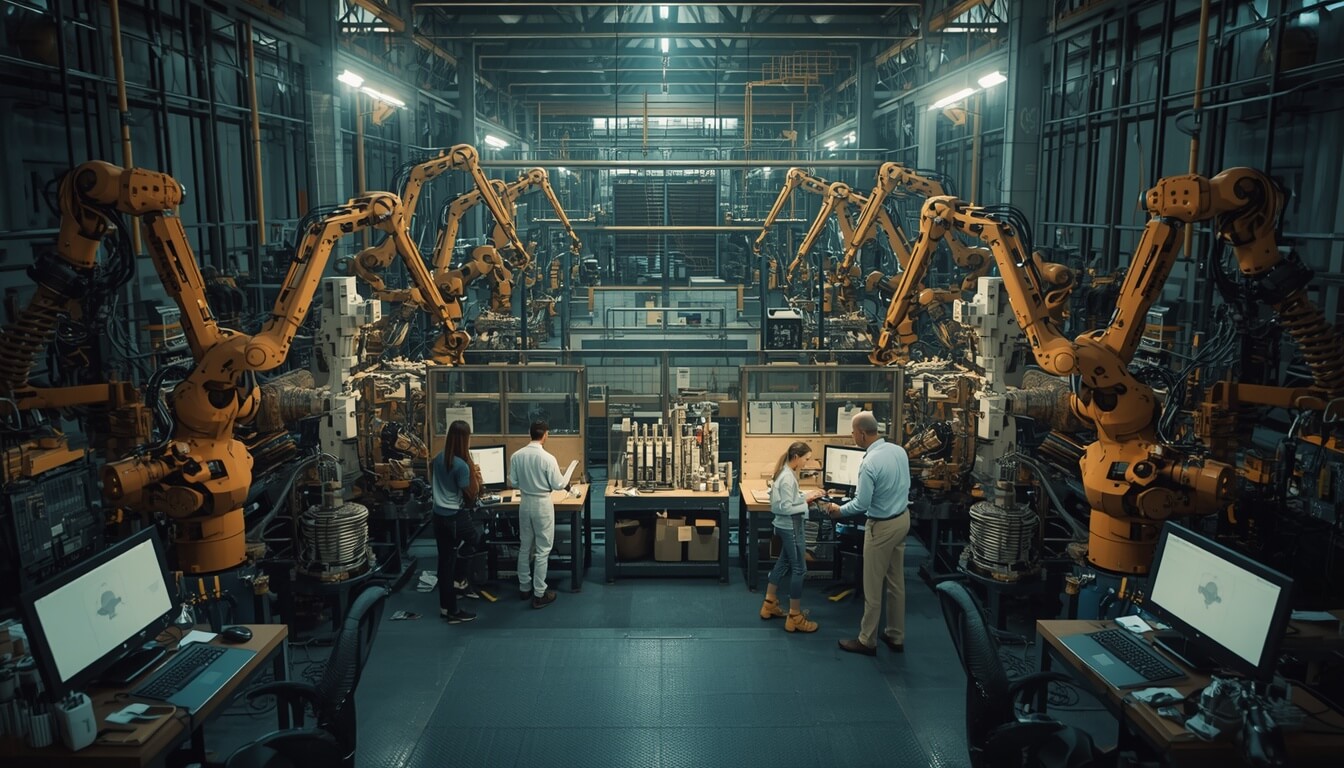
Robotics is becoming one of the most important technologies shaping the future of manufacturing. Industrial robots have been used in factories for decades, particularly in automotive production and other highly standardized industries. But advances in artificial intelligence, machine vision, sensors and autonomous systems are expanding the range of tasks that machines can perform.
This shift could have consequences far beyond individual factories. If robots become capable of performing a broader range of manufacturing activities at competitive costs, companies could rethink production processes, workforce requirements and the geographic location of factories. Countries that have traditionally competed through relatively low labor costs may face a different industrial environment, while economies with advanced technology, infrastructure and access to capital could gain new opportunities.
The transformation described in The Global Race Toward Automation and the Future of Work provides the broader context. Robotics represents one of the most visible physical forms of that transition, particularly in manufacturing.
From Fixed Automation to More Flexible Robots
Traditional industrial robots were highly effective when factories produced large quantities of standardized products. Automotive assembly lines, for example, could be designed around machines performing the same sequence of operations repeatedly.
The limitation was flexibility. Changing the production process could require significant engineering work, new equipment or reprogramming.
New generations of robots are being designed for more varied environments. Machine vision allows robotic systems to identify objects and their positions. Improved sensors allow them to interact with their surroundings. Artificial intelligence can help systems recognize patterns and adapt their actions to changing conditions.
Collaborative robots, often known as cobots, are another development. Instead of operating in isolated areas, these systems can be designed to work alongside human employees. This opens possibilities for hybrid production environments in which machines handle repetitive or physically demanding activities while workers perform tasks requiring judgment, dexterity or problem-solving.
The distinction between an automated factory and a conventional factory is therefore becoming increasingly gradual rather than absolute.
Manufacturing Could Become More Capital Intensive
Greater use of robotics changes the economics of production.
A conventional manufacturing process may rely heavily on human labor. An automated process requires more investment in machinery, software, sensors and infrastructure. This means that companies may substitute some labor costs with capital expenditure.
The economics depend on several variables:
- Robots must be sufficiently productive to justify their acquisition and maintenance costs.
- Their utilization rate matters because expensive equipment generates greater economic value when it can operate consistently.
- Companies must also account for energy consumption, maintenance, software updates and integration with existing production systems.
As technology improves and robot capabilities expand, the range of situations in which automation makes economic sense can increase. This could be particularly relevant for industries characterized by repetitive tasks, high production volumes or difficult working conditions.
But robotics does not automatically make every manufacturing process economical to automate. Products with highly variable designs, short production runs or complex manual requirements can remain more difficult to automate.
The Potential Impact on Factory Employment
One of the most important questions concerns employment.
Robots can perform tasks previously carried out by workers, meaning that fewer people may be required for certain production activities. However, this does not necessarily imply an equivalent decline in total manufacturing employment.
Automation can increase productivity and reduce production costs. Lower costs can encourage companies to sell more products, expand production or introduce new product lines. Higher output can partially offset reductions in labor requirements per unit of production. Manufacturing employment can therefore depend on both automation and the resulting change in production volumes.
There can also be a shift in the type of jobs available. As factories become more automated, demand can increase for technicians, engineers, maintenance specialists, software professionals and employees responsible for monitoring production systems. Workers may increasingly supervise automated equipment rather than perform every physical operation themselves.
This creates a distinction between labor displacement and labor transformation. Some occupations or tasks may decline while other forms of employment emerge around the new production system.
The Global Labor Market Could Change
The consequences could extend beyond individual factories because manufacturing is deeply connected to international trade.
For decades, differences in labor costs have influenced where companies locate production. Labor-intensive manufacturing has often moved toward economies where workers are relatively inexpensive. If robots reduce the importance of labor costs in certain production processes, this advantage could weaken.
A company deciding where to build a factory may increasingly consider other variables: electricity costs, transportation infrastructure, access to suppliers, proximity to customers, political stability, industrial expertise and availability of skilled technical workers.
This could contribute to a more geographically distributed manufacturing system. Some production that previously required large numbers of workers abroad could become economically viable closer to major consumer markets. At the same time, countries that successfully combine low operating costs with automation capabilities could remain highly competitive.
The result may not be a simple reversal of globalization. Instead, automation could change the factors determining where global production takes place.
Reshoring and the Changing Role of Labor Costs
The possibility of bringing manufacturing closer to consumers is often associated with reshoring.
Reshoring does not necessarily mean that companies will abandon international production. Rather, automation can change the relative importance of labor costs compared with transportation, inventory and supply-chain risks.
A highly automated factory located close to a major market may have higher wages but lower logistics costs and shorter delivery times. For some products, that combination could become economically attractive.
Recent disruptions to global supply chains have also highlighted the value of resilience. Companies may be willing to accept somewhat higher production costs in exchange for greater control over supply and shorter logistical routes. Robotics could therefore become one component of a broader restructuring of industrial geography.
Domestic manufacturing investment is also being encouraged by government policy and supply-chain security concerns. One example is Becton Dickinson's $19 billion U.S. investment commitment, which includes plans to expand domestic production of essential medical supplies. The agreement illustrates how reshoring decisions can be influenced by factors beyond labor costs and automation.
China and the Scale of Industrial Automation
China illustrates the relationship between manufacturing scale and automation.
The country has developed an enormous industrial ecosystem and has become a major market for industrial robots. Large manufacturing volumes create strong incentives to improve production efficiency, while rising wages and demographic changes can increase the appeal of automation.
For Chinese manufacturers, robotics can support competitiveness in industries where labor costs are becoming less decisive. At the same time, other economies are also investing heavily in automation. The result is a global race to combine manufacturing scale with increasingly sophisticated production technology.
This competition could influence trade patterns and the location of future industrial capacity.
Small and Medium-Sized Manufacturers
Robotics is not only relevant to large multinational manufacturers.
One important development is the attempt to make automation accessible to smaller companies. Historically, advanced robotic systems often required substantial investment and specialized engineering capabilities. More standardized robotic platforms, easier programming and improved software could lower these barriers.
This matters because small and medium-sized manufacturers account for a significant share of industrial activity in many economies. If smaller companies can deploy flexible robots without building highly specialized automation departments, adoption could spread beyond the largest factories.
Cloud-based software, remote monitoring and increasingly standardized hardware could further reduce the complexity of managing automated production systems.
The Human-Robot Factory
The future factory is unlikely to consist entirely of machines.
Many manufacturing activities still require flexibility, judgment and adaptation. Workers may remain essential for supervising systems, dealing with exceptions, maintaining equipment, managing suppliers and improving production processes.
The more realistic model may therefore be a human-robot production environment:
- A worker could oversee several automated systems rather than directly perform every operation.
- A technician might maintain robotic equipment.
- An engineer could use production data to identify bottlenecks.
- Managers could coordinate automated production across multiple facilities.
This changes the skills required inside manufacturing. Traditional mechanical knowledge may increasingly be combined with software, data analysis, electronics and systems engineering. Vocational education and industrial training may therefore need to evolve alongside factory technology.
Automation Could Reshape Global Inequality
The labor-market consequences of robotics could differ substantially between countries.
Economies heavily dependent on labor-intensive manufacturing may face greater disruption if companies can automate production without sacrificing competitiveness. Countries with stronger technology sectors and larger pools of skilled workers may be better positioned to capture new opportunities. However, automation can also reduce the cost of industrial production and make advanced manufacturing accessible to a broader range of countries.
The outcome will depend partly on education, infrastructure, investment and institutions.
The distribution of productivity gains is another important question. If automation increases output but the benefits are concentrated among owners of capital and highly skilled workers, income inequality could increase within some economies. If productivity gains translate into higher wages, lower prices and broader investment, the effects could be distributed more widely.
These questions connect directly to the wider economic consequences of automation discussed in Automation, Productivity and the Changing Economics of Industry.
Manufacturing as a Test Case for the Future of Work
Manufacturing provides an unusually clear environment in which to observe the effects of automation. Factories have measurable production processes, identifiable tasks and established relationships between labor, capital and output. This makes it easier to evaluate what happens when robots are introduced.
But lessons from manufacturing may eventually extend into other sectors. Warehouse automation, autonomous transportation, agricultural robotics and service robots could apply similar principles outside traditional factories. The central question remains the same: which tasks can machines perform economically, and what activities remain dependent on human capabilities?
The answer will change over time as technology improves.
A New Industrial Geography
Robotics could ultimately influence where goods are produced, how factories are organized and which skills economies need.
Manufacturing may become less dependent on large pools of low-cost labor and more dependent on capital, energy, software, infrastructure and technical expertise. Production could become more geographically diversified, with some companies moving facilities closer to customers while others continue to rely on highly specialized global supply chains.
For workers, the transition could involve both displacement and new opportunities. Some repetitive occupations may decline, while technical, supervisory and engineering roles expand. For governments, the challenge will include preparing workers, supporting innovation and ensuring that productivity gains translate into broader economic benefits.
Robots are therefore not simply replacing individual workers. They are becoming part of a wider transformation in the economics of production.
The long-term significance of this transformation will depend on what happens after robots enter the factory: how much additional output they generate, how companies reinvest the resulting gains and how labor markets adapt to the changing relationship between human work and capital.