
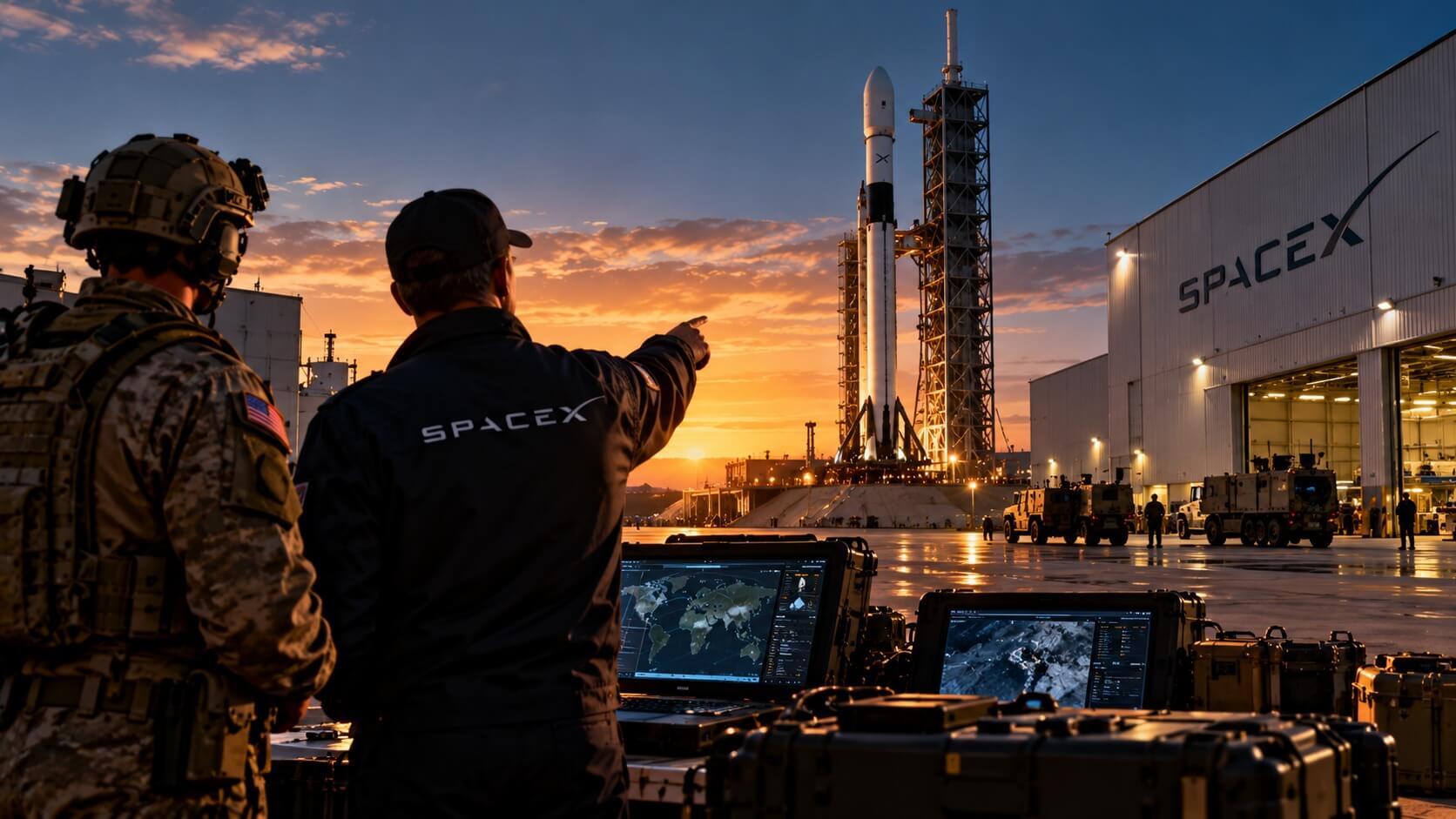
Yes, SpaceX does significant defense work for the United States government. The company launches military satellites, provides satellite communications through Starlink, and develops national security capabilities through its Starshield program.
SpaceX is not simply a commercial rocket company transporting astronauts and satellites into orbit. It has become an important supplier of infrastructure used by the US military and intelligence community.
Its defense business includes contracts with the US Space Force, the National Reconnaissance Office, and other government organizations.
For investors, the significance goes beyond individual contracts. SpaceX demonstrates how commercial space companies can compete with traditional defense contractors by combining reusable rockets, large satellite networks, and government services.
But how much defense work does SpaceX actually perform, what is Starshield, and where does the money come from?
What Kind of Defense Work Does SpaceX Do?
SpaceX participates in several parts of the military space industry.
Its activities can be divided into three main categories: launching national security spacecraft, providing satellite communications, and developing specialized government satellite systems.
| Defense activity | What SpaceX provides | Why the military needs it |
|---|---|---|
| National security launches | Falcon 9 and Falcon Heavy launch services | Deploying military and intelligence satellites |
| Satellite communications | Starlink connectivity and supporting equipment | Communications in remote or contested environments |
| Starshield | Government-focused satellite systems and services | Secure communications, Earth observation, and specialized missions |
| Spacecraft development | Satellite manufacturing and associated technologies | Supporting government-owned or government-operated space capabilities |
| Launch infrastructure | Rockets, launch facilities, and mission operations | Maintaining reliable access to orbit |
These activities have different business models.
A satellite launch is generally associated with a specific mission and contract.
Satellite communications can involve ongoing payments for access to a network.
Satellite development programs may generate revenue through engineering, manufacturing, deployment, and supporting services.
This distinction matters because recurring communications revenue and one-time launch contracts can have very different financial characteristics.
SpaceX also benefits from operating across multiple parts of the supply chain.
It can manufacture satellites, launch them using its own rockets, and operate communications networks after deployment.
That level of integration is unusual in an industry where many companies specialize in only one activity.
How Did SpaceX Become a US Military Contractor?
SpaceX's relationship with the US military developed as the company demonstrated that its rockets could reliably deliver satellites into orbit.
For many years, American national security launches were dominated by established aerospace contractors.
Military satellites are often expensive, strategically important, and difficult to replace.
Governments therefore place considerable emphasis on launch reliability, mission assurance, and the ability to meet demanding technical requirements.
SpaceX entered this market through the development of Falcon 9 and its efforts to compete for national security launch contracts.
In 2015, the US Air Force certified Falcon 9 for national security space launches.
This was a major milestone because it allowed SpaceX to compete for missions involving critical government satellites.
The company subsequently secured contracts to launch military and intelligence spacecraft.
Its reusable rocket technology also changed the competitive environment.
Reusing major rocket components can reduce certain launch costs and support higher flight frequency, although the actual economics depend on mission requirements and operational expenses.
For the government, greater competition can provide more launch options and potentially improve procurement flexibility.
For SpaceX, national security missions created an additional customer base beyond commercial satellite operators and NASA.
How Much Money Does SpaceX Receive From Military Contracts?
SpaceX has received government defense contracts worth billions of dollars in aggregate, but there is no single publicly available figure that fully captures its military-related revenue.
SpaceX became a publicly traded company in June 2026, when its Class A shares began trading on the Nasdaq under the ticker SPCX. As a public company, SpaceX is subject to financial reporting requirements, giving investors access to periodic disclosures about its overall financial performance. However, these disclosures do not necessarily provide a complete breakdown of revenue and profitability attributable specifically to classified defense programs or individual military customers.
This makes it important to distinguish between announced contract values, potential future awards, and revenue actually earned.
Several publicly disclosed agreements illustrate the scale of its national security business.
| Program or contract | Publicly disclosed value | What it covers |
|---|---|---|
| National Security Space Launch Phase 2, 2020 | Approximately $316 million initial award | Launch services for national security missions |
| Space Force Starlink contract, 2023 | Up to $70 million | Satellite communications services |
| Space Development Agency Tranche 0, 2020 | Approximately $149 million | Development of missile-tracking satellites |
| National Reconnaissance Office Starshield-related program | Reported approximately $1.8 billion contract | Classified intelligence satellite network |
The $1.8 billion figure was reported by Reuters in 2024 in connection with a classified NRO program. It should be treated as a reported contract value rather than independently verified company revenue.
The other figures also require context.
A contract ceiling represents the maximum potential value under specified conditions, not necessarily the amount already paid.
Similarly, an initial award may cover only part of a broader procurement program.
A company can win a multiyear contract without recognizing the entire amount as revenue immediately.
For investors, this distinction is essential.
Government contract announcements can demonstrate demand and customer confidence, but they do not automatically reveal profitability, cash flow, or the total size of SpaceX's defense business.
What Is SpaceX Starshield?
Starshield is SpaceX's initiative focused on government and national security applications.
It draws on technologies and experience developed through Starlink, but it is intended for specialized government requirements.
SpaceX has described three principal areas of Starshield activity:
Earth observation: Satellite systems capable of supporting government intelligence and monitoring requirements.
Communications: Satellite connectivity designed around national security needs.
Hosted payloads: The ability to integrate government equipment or specialized instruments onto spacecraft.
The concept is important because government customers often have requirements that differ from those of ordinary commercial internet users.
Military and intelligence organizations may need specialized security, greater operational control, tailored hardware, and mission-specific capabilities.
Starshield provides a framework for developing systems around those requirements.
However, Starshield should not be confused with a single publicly documented satellite network whose full capabilities are known.
Some government programs associated with SpaceX involve classified missions.
As a result, publicly available information does not establish every technical feature, operational arrangement, or financial detail.
For the broader space economy, Starshield illustrates how technology originally developed for commercial markets can support specialized defense applications.
Is Starshield the Same as Starlink?
No. Starlink and Starshield are related, but they serve different purposes.
Starlink is primarily a commercial satellite internet service.
It provides connectivity to residential, business, maritime, aviation, and government customers through a network of satellites in low Earth orbit.
Starshield focuses on government and national security applications.
The distinction is not simply a matter of branding.
Government missions may require different security arrangements, spacecraft configurations, payloads, and operational capabilities.
| Feature | Starlink | Starshield |
|---|---|---|
| Primary market | Commercial and government connectivity | Government and national security |
| Main purpose | Satellite internet services | Specialized satellite missions and services |
| Customers | Consumers, businesses, and institutions | Government agencies |
| Technology foundation | SpaceX satellite and communications infrastructure | Technologies derived partly from Starlink |
| Typical applications | Internet access and connectivity | Secure communications, observation, hosted payloads |
| Public information | Relatively extensive | Limited for certain programs |
Starlink can still support military operations.
A commercial communications network does not become irrelevant to national security simply because it was developed for civilian customers.
The experience in Ukraine has demonstrated how satellite internet can become strategically important during a conflict.
Starshield represents a more explicitly government-focused approach.
For investors, this separation helps explain how SpaceX can address multiple customer markets using related technological capabilities.
Does SpaceX Build Spy Satellites for the US Government?
SpaceX has been linked to the development of a classified satellite intelligence network for the National Reconnaissance Office, or NRO.
The NRO is responsible for developing and operating US intelligence satellites.
In March 2024, Reuters reported that SpaceX was building a network of reconnaissance satellites under a contract valued at approximately $1.8 billion.
The reported program was associated with SpaceX's Starshield activities.
The network was described as supporting intelligence collection through a distributed group of satellites.
However, the full technical specifications, operational status, and financial details of classified intelligence programs are not publicly available.
This distinction matters.
It is reasonable to identify SpaceX as a participant in national security satellite development based on publicly reported contracts and government activities.
It would not be reasonable to claim knowledge of classified capabilities that have not been officially disclosed.
From a commercial perspective, intelligence satellite programs represent a different opportunity from conventional launch services.
Instead of merely transporting a customer's spacecraft into orbit, a company may participate in designing and manufacturing the satellite infrastructure itself.
That can expand the range of services a space company provides to government customers.
Does SpaceX Help the US Military Track Missiles?
SpaceX has participated in government programs involving missile-tracking satellite technology.
In 2020, the Space Development Agency awarded SpaceX a contract worth approximately $149 million to develop satellites for its initial tracking architecture.
The program was intended to support the development of space-based sensors capable of detecting and tracking missile threats.
Missile tracking is an important part of modern defense because some advanced weapons can be difficult to monitor using traditional systems alone.
A satellite network equipped with appropriate sensors can provide information that supports warning and defensive operations.
However, tracking a missile is not the same as intercepting it.
A satellite designed to observe a missile does not necessarily carry a weapon.
Its role may be to collect information and transmit it to military systems responsible for assessing or responding to threats.
This creates opportunities for companies that manufacture spacecraft, develop sensors, provide communications links, and launch satellites.
SpaceX's participation also demonstrates that newer commercial space companies can compete for sophisticated defense programs traditionally associated with established contractors.
Why Does the US Military Use SpaceX Rockets?
Reliable access to space is essential for national security.
Military satellites support communications, navigation, intelligence gathering, missile warning, and other important functions.
When governments need to deploy new spacecraft or replace existing systems, they depend on launch providers capable of meeting demanding mission requirements.
SpaceX offers several advantages that have helped it compete for these missions.
Frequent launch operations
SpaceX has developed the infrastructure and operational experience to conduct launches at a high frequency.
Frequent operations can support government customers that need predictable access to orbit.
However, national security missions still require specific preparations, certifications, and mission assurance procedures.
Reusable launch technology
Falcon 9's reusable first stage allows SpaceX to recover and fly major rocket hardware again.
This can reduce certain costs and support operational efficiency.
But launch pricing also depends on payload requirements, orbit, integration, and contractual conditions.
Multiple launch capabilities
Falcon 9 and Falcon Heavy can support different mission requirements.
This gives SpaceX flexibility across a range of satellite sizes and orbital destinations.
Established government relationships
Successful missions and experience with national security requirements can strengthen a contractor's position in future competitions.
That does not guarantee additional awards, but it can create advantages in an industry where reliability and mission history are important.
For investors studying the broader launch market, SpaceX's position is significant because it influences pricing, competition, and expectations for other providers.
How Is SpaceX Connected to the US Space Force?
The US Space Force is one of the key government organizations involved in military space capabilities.
It was established in December 2019 as a separate branch of the US armed forces.
The Space Force is responsible for organizing, training, and equipping personnel for military space operations.
Its activities include satellite operations, missile warning, space monitoring, and maintaining access to critical space capabilities.
SpaceX participates as a commercial contractor.
It does not control the Space Force or independently determine US military space strategy.
Instead, the company provides services and technologies purchased through government procurement processes.
These relationships include national security launch contracts and satellite communications arrangements.
The broader importance of military space capabilities is examined in Is Space Being Militarized? What Investors Need to Know About the New Space Race.
For SpaceX, government relationships provide access to customers whose needs may remain important even when commercial satellite markets experience changing demand.
However, defense contracts also involve strict requirements, oversight, security considerations, and political uncertainty.
How Has Starlink Been Used in Ukraine?
Russia's full-scale invasion of Ukraine in February 2022 demonstrated the strategic importance of satellite communications.
Starlink terminals were deployed in Ukraine to support connectivity when conventional communications infrastructure faced disruption.
The network has supported civilian communications, emergency services, and military-related activities.
Its importance comes partly from the ability to provide internet access through satellite terminals rather than depending entirely on terrestrial networks.
For military users, reliable connectivity can support coordination, information sharing, and other operational activities.
However, the relationship between a commercial communications provider and an active conflict raises complicated questions.
Service availability, geographic restrictions, contractual arrangements, and government involvement can influence how a network is used.
Starlink is not automatically available for every military application or in every geographic area.
The continuing role of the network in Ukraine and the implications for SpaceX are examined in Is Ukraine Still Using Starlink? The Military Role of Satellite Internet.
For investors, Ukraine illustrates both the commercial relevance and geopolitical sensitivity of satellite communications.
A network originally developed for civilian internet access can become strategically important, but that importance may bring additional regulatory, political, and operational risks.
Is SpaceX Competing With Lockheed Martin and Northrop Grumman?
Yes, although the competition is not identical across every defense market.
SpaceX competes directly with established aerospace companies in certain launch and satellite-related activities.
Traditional defense contractors such as Lockheed Martin and Northrop Grumman have longstanding experience developing military spacecraft, sensors, communications systems, and other national security technologies.
SpaceX entered the market with a different combination of capabilities.
Its business includes reusable launch vehicles, satellite manufacturing, and a large commercial communications network.
This creates opportunities for both competition and cooperation.
A traditional defense contractor may manufacture a satellite that SpaceX launches.
At the same time, SpaceX may compete for government programs involving satellite development or related infrastructure.
The competitive landscape also includes companies such as Boeing, L3Harris Technologies, and Rocket Lab.
| Company | Public ticker | Relevant exposure |
|---|---|---|
| SpaceX | SPCX | Launch services, Starlink, Starshield, government satellites |
| Lockheed Martin | LMT | Military spacecraft, missile-warning systems, national security space |
| Northrop Grumman | NOC | Space systems, sensors, missile defense |
| Boeing | BA | Government spacecraft and satellite programs |
| L3Harris Technologies | LHX | Space sensors, communications, defense electronics |
| Rocket Lab | RKLB | Launch services, spacecraft manufacturing, satellite components |
For public-market investors, the important question is not simply which company is most technologically advanced.
It is which companies can convert government demand into profitable revenue while managing development costs, competition, and execution risks.
Can Investors Buy SpaceX Stock?
Yes. SpaceX shares have been publicly traded since June 12, 2026, under the ticker symbol SPCX. The company's Class A common stock is listed on the Nasdaq Global Select Market and Nasdaq Texas.
Investors can purchase SpaceX shares through brokerage accounts that provide access to the relevant US stock exchanges, subject to their broker's availability, applicable regulations, and trading conditions.
The company's initial public offering marked an important change for investors who previously had limited opportunities to obtain direct ownership exposure through private-market transactions.
Before the IPO, access to SpaceX equity was generally restricted to existing shareholders and certain eligible private-market investors. Public trading has made the company's shares more accessible, although liquidity does not eliminate investment risk.
SpaceX's stock provides exposure to a business spanning launch services, spacecraft development, satellite connectivity, government programs, and other activities. Investors should not assume that buying SPCX is equivalent to investing exclusively in the space defense industry.
The company's financial performance and valuation depend on multiple business segments, operating costs, capital requirements, competition, and expectations for future growth.
Investors should examine SpaceX's regulatory filings, financial disclosures, and reported business performance before making investment decisions.
Publicly traded aerospace and defense companies continue to offer alternative ways to gain exposure to different segments of the space economy.
However, owning shares of a competitor or supplier is not the same as owning SpaceX.
The same principle applies to space-themed exchange-traded funds.
Some hold diversified aerospace and defense businesses, while others focus on smaller companies involved in satellite technology, communications, or launch services.
Their risk profiles can differ significantly, and investors should check whether a particular fund actually holds SpaceX shares rather than assuming that every space-focused investment vehicle includes the company.
How Important Are Defense Contracts to SpaceX's Business?
Defense contracts are strategically important to SpaceX, but their precise contribution to total company revenue can be difficult to determine from publicly available information.
SpaceX operates several major business activities.
These include commercial launch services, NASA missions, Starlink subscriptions and services, and government-related space programs.
Since becoming publicly traded in June 2026, SpaceX has been subject to financial reporting requirements that provide investors with additional information about the company's overall results. However, the public disclosures do not necessarily identify every military customer, classified contract, or defense-related profit contribution separately.
This makes claims that defense contracts represent a specific percentage of SpaceX's business difficult to verify independently unless the company provides an appropriate breakdown.
Still, government relationships can provide several advantages.
Customer diversification: Military and intelligence agencies represent additional customers beyond commercial satellite operators.
Long-term programs: National security projects can involve multiyear development and service arrangements.
Technical experience: Government missions can help companies develop capabilities relevant to other markets.
Recurring services: Communications agreements may generate ongoing revenue rather than depending exclusively on individual launches.
There are also risks.
Government programs may be delayed, funding priorities can change, and classified contracts can limit public visibility into business performance.
A large contract award does not necessarily mean high profit margins.
For investors, the economic value of defense work depends on contract structure, delivery costs, cash flow, and the company's ability to perform successfully.
What Are the Risks of SpaceX's Military Business?
SpaceX's defense activities create opportunities but also expose the company to challenges that differ from those in ordinary commercial markets.
Government budget uncertainty
Military space programs depend on government appropriations and procurement decisions.
Changes in priorities can affect the timing and value of contracts.
Political and geopolitical exposure
Providing technology used in military operations can place a commercial company at the center of international disputes.
This may create regulatory, reputational, and operational challenges.
Security requirements
National security contracts often involve specialized cybersecurity, information protection, and operational requirements.
Meeting these requirements can increase complexity and cost.
Competition
Established defense contractors and newer commercial space companies compete for government business.
Winning one contract does not guarantee success in future procurement rounds.
Technical execution
Spacecraft manufacturing and launch operations are technically demanding.
Delays, failures, or unexpected costs can affect contract performance and profitability.
Dependence on government relationships
Strong relationships with government customers can support long-term business, but they also create exposure to changing policies and procurement requirements.
These risks are relevant not only to SpaceX but also to publicly traded companies competing in military space markets.
What Does SpaceX's Defense Business Mean for the Space Economy?
SpaceX's involvement in defense demonstrates a broader transformation of the space industry.
Historically, governments relied heavily on specialized contractors to design and build military space systems.
Commercial companies are now playing a larger role in providing launch services, satellite infrastructure, communications, and other capabilities.
This does not mean traditional defense contractors are becoming irrelevant.
Large military programs still require specialized expertise, reliability, security, and long-term support.
Instead, the market is becoming more diverse.
Governments can purchase services from companies that also serve commercial customers, while businesses can use technologies developed for one market in another.
This creates potential opportunities across several areas:
- Satellite manufacturing and specialized components.
- Reliable and responsive launch services.
- Secure communications and satellite connectivity.
- Intelligence and Earth-observation systems.
- Ground infrastructure and cybersecurity.
- Satellite network operations and maintenance.
For investors, the challenge is determining which companies can translate this demand into sustainable financial performance.
Rapid technological progress can expand an industry while simultaneously increasing competition and reducing prices.
The businesses that ultimately benefit most may not be those attracting the greatest publicity today.
Why SpaceX Is Becoming a Major Defense Industry Player
SpaceX is already an established participant in US national security space programs.
Its activities include launching military satellites, supplying satellite communications, and developing specialized government spacecraft through programs associated with Starshield.
Publicly disclosed contracts and reported classified programs demonstrate that its defense business extends beyond ordinary commercial rocket launches.
Following its June 2026 IPO, SpaceX provides investors with public financial disclosures that were not available in the same form when the company was privately held. Nevertheless, the precise revenue and profitability attributable to individual military customers or classified national security programs may remain difficult to isolate from broader company results.
For the broader investment market, SpaceX's importance lies partly in the competitive pressure it creates and the opportunities it helps establish.
Its combination of launch services, satellite manufacturing, and communications infrastructure illustrates how commercial space technology can become essential to national security.
The larger investment theme is not simply that SpaceX works with the military. It is that governments are increasingly purchasing critical space capabilities from commercial companies, reshaping competition across the entire space economy.
Disclaimer: This article is for informational and educational purposes only and does not constitute financial or investment advice. Investing involves risk, including the possible loss of principal.