
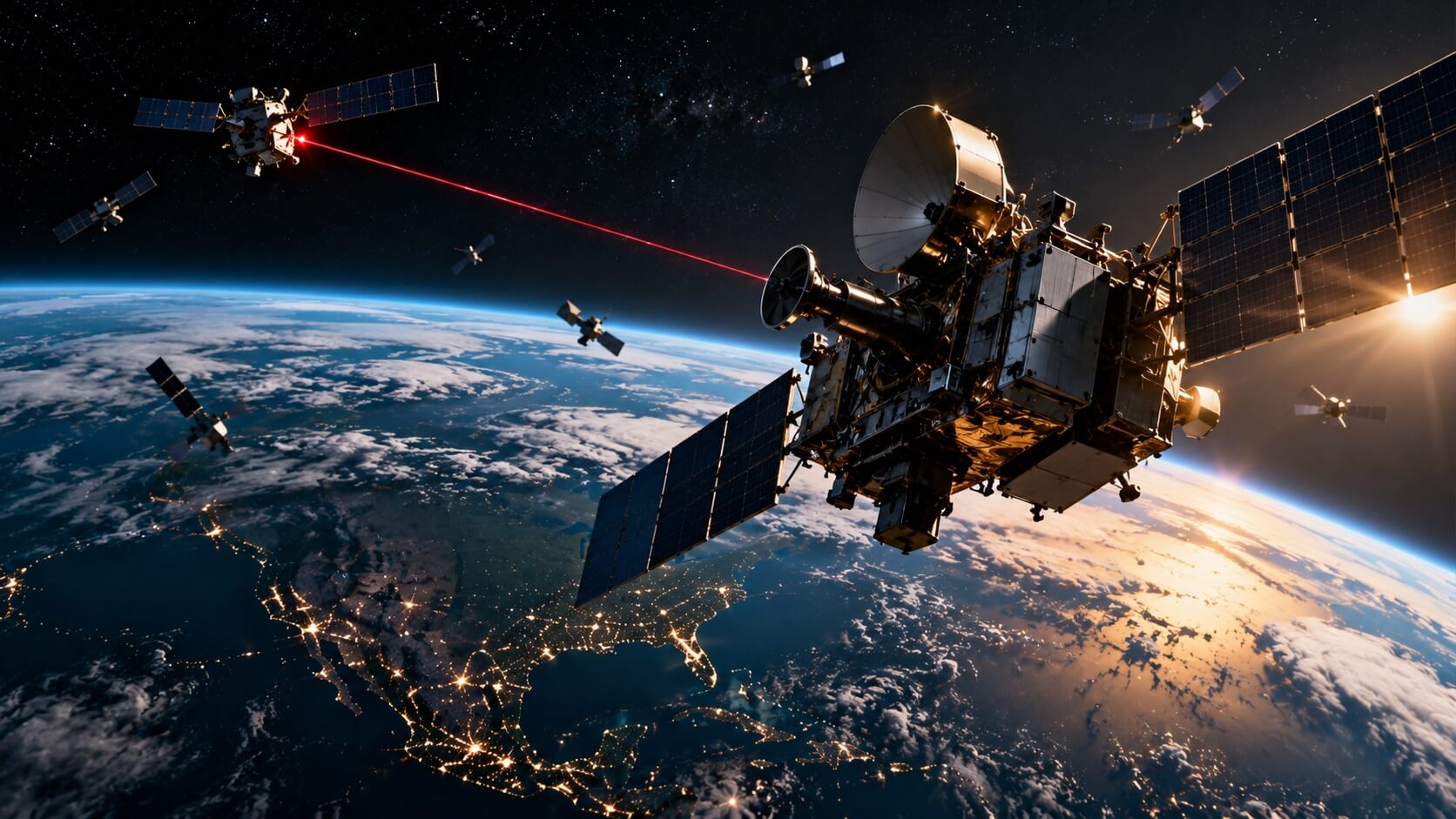
Yes, space is becoming increasingly militarized. The United States, China, Russia, and other countries are expanding military satellite networks, developing technologies to protect or disrupt spacecraft, and treating space as an essential part of national defense.
But militarization does not mean that space has suddenly become a battlefield filled with weapons. Satellites have supported military operations for decades. What is changing is their importance, the number of countries investing in military space capabilities, and the growing involvement of private-sector companies.
For investors, this new space race matters because it is creating demand for satellite manufacturing, launch services, secure communications, surveillance technology, and systems designed to protect critical infrastructure in orbit.
Understanding where that demand comes from is essential to separating genuine business opportunities from speculation.
What Does the Militarization of Space Actually Mean?
The militarization of space refers to the use of satellites, spacecraft, and space-related technologies for military purposes.
It is not a new phenomenon.
The United States and the Soviet Union began using satellites for reconnaissance and other military activities during the Cold War. Space-based systems later became increasingly important for navigation, communications, and missile warning.
Today, military satellites support several essential activities:
- Communications: Connecting military units, aircraft, ships, and command centers across long distances.
- Intelligence gathering: Monitoring military facilities, troop movements, and strategic infrastructure.
- Navigation: Providing positioning and timing information for military operations.
- Missile warning: Detecting launches and helping governments assess potential threats.
- Space surveillance: Tracking satellites, debris, and objects that could threaten spacecraft.
- Satellite protection: Maintaining operations despite interference, cyberattacks, or other disruptions.
These systems often operate far above the conflicts they support.
A satellite does not need to carry a weapon to play an important military role. Providing accurate navigation or reliable communications can influence operations on Earth.
This is why the distinction between militarization and weaponization matters.
Militarization means using space for military purposes. Weaponization generally refers to placing weapons in space or developing systems intended to attack targets in or from space.
The two concepts overlap, but they are not identical.
For a broader overview of the companies, technologies, and financial opportunities involved, see Space Defense Explained: How Militaries, SpaceX and Starlink Shape the Space Economy.
Why Is Space Becoming More Militarized Now?
Three major developments are accelerating military competition in space: dependence on satellites, competition among major powers, and the falling cost of deploying spacecraft.
Modern militaries depend on satellites
Military operations increasingly rely on fast and accurate information.
Satellites help commanders communicate with distant forces, monitor potential threats, and coordinate operations across large geographic areas.
This creates a strategic vulnerability.
If a country loses access to satellite communications, navigation, or surveillance, its military capabilities may be affected even if its aircraft, ships, and ground forces remain operational.
Protecting satellite infrastructure has therefore become a national security priority.
The United States, China, and Russia are competing
The United States has long maintained extensive military space capabilities, but other countries are investing heavily in their own systems.
China has expanded its satellite infrastructure and developed technologies relevant to military communications, reconnaissance, and space operations.
Russia maintains military satellite capabilities and has demonstrated anti-satellite technology.
These developments increase pressure on governments to protect existing systems and develop alternatives that can continue functioning during a crisis.
The result is a competition involving not only military capability but also industrial capacity, technological development, and access to orbit.
Launching satellites has become more accessible
Reusable rockets, smaller spacecraft, and advances in satellite manufacturing have changed the economics of space operations.
Historically, governments often relied on relatively small numbers of expensive satellites.
Today, some military programs are moving toward larger networks of smaller spacecraft.
This approach can distribute capabilities across multiple satellites rather than concentrating them in a few valuable assets.
For investors, that shift matters because it can increase demand for manufacturing, launch services, components, and satellite operations.
However, lower launch costs do not eliminate the expense of designing, building, securing, and maintaining a satellite network.
Which Countries Are Leading the Military Space Race?
Several countries operate military satellites, but the United States, China, and Russia are particularly important to the strategic competition.
| Country | Main military space priorities | Why it matters |
|---|---|---|
| United States | Communications, missile warning, surveillance, satellite resilience | Major source of government contracts and commercial partnerships |
| China | Satellite networks, reconnaissance, navigation, counterspace capabilities | Expanding capabilities intensify strategic competition |
| Russia | Military reconnaissance, communications, electronic warfare, anti-satellite capabilities | Demonstrated ability to threaten space infrastructure |
| European countries | Secure communications, Earth observation, navigation, space monitoring | Increasing interest in strategic autonomy and resilient infrastructure |
| India | Military satellite support, launch capabilities, space security | Growing domestic space and defense capabilities |
The United States established the U.S. Space Force in 2019 as a separate military service.
Its responsibilities include organizing, training, and equipping forces for military space operations.
The creation of a dedicated service reflected the increasing importance of space to national defense.
China has also developed extensive space capabilities, including its BeiDou navigation system and a growing number of satellites used for communications and observation.
Russia continues to operate military spacecraft and has demonstrated the ability to destroy satellites using ground-launched weapons.
European governments are pursuing secure satellite communications and other programs intended to reduce dependence on external providers.
The competition is therefore broader than a race to place more satellites in orbit.
Countries are also trying to ensure that their space infrastructure remains available during periods of political tension or military conflict.
Is Space Already a Battlefield?
Space is already an important military operating environment, but it is not a conventional battlefield in the same sense as land, sea, or air.
Most military space activity involves collecting information, maintaining communications, tracking objects, and supporting operations on Earth.
However, threats against satellites are real.
In November 2021, Russia conducted a destructive anti-satellite missile test against one of its own inactive satellites.
The test generated substantial orbital debris, demonstrating that attacks on spacecraft can create risks beyond the immediate target.
Anti-satellite weapons are only one concern.
Satellite services can also be disrupted through electronic jamming, cyberattacks, and other interference.
These methods may affect military operations without requiring a spacecraft to be physically destroyed.
There is also growing concern about technologies capable of approaching other satellites in orbit.
Such capabilities can have legitimate purposes, including inspection, servicing, and debris-related operations. But some could potentially be used to interfere with another spacecraft.
This makes intentions difficult to assess.
A satellite designed to maneuver close to another object is not automatically a weapon, but its capabilities may raise security concerns.
The difference between actual military systems and speculative orbital weapons is examined in Does the US Military Have Weapons in Space? Separating Facts From Science Fiction.
For investors, these threats create demand for technologies that improve satellite protection, monitoring, and operational resilience.
Is Militarizing Space Legal?
Military activity in space is not universally prohibited under international law.
The 1967 Outer Space Treaty established important principles governing how countries use outer space.
One of its central restrictions prohibits placing nuclear weapons or other weapons of mass destruction in orbit around Earth or stationing them in outer space.
The treaty also requires the Moon and other celestial bodies to be used exclusively for peaceful purposes.
However, it does not establish a blanket prohibition on military satellites, conventional military support activities, or every type of conventional weapon in space.
This distinction helps explain why countries have operated military communications, reconnaissance, and navigation satellites for decades.
International rules also address responsibility for national space activities and potential liability for damage caused by space objects.
But the growing number of satellites and emerging counterspace technologies create challenges that existing agreements do not fully resolve.
For companies, regulation matters because military space programs can be affected by national security rules, export controls, government licensing, and international agreements.
Technological capability alone does not guarantee that a company can sell its services to every customer or operate in every market.
How Is SpaceX Changing Military Space Operations?
SpaceX has become an important participant in military space infrastructure because it provides launch services and operates satellite communications technology.
Its Falcon 9 rocket has demonstrated the ability to launch spacecraft frequently while reusing major rocket components.
For defense agencies, access to reliable launch services is strategically important.
Governments may need to deploy new satellites, replace aging spacecraft, or restore capabilities after a disruption.
SpaceX also operates Starlink, a satellite internet network originally developed for commercial customers.
The use of Starlink in Ukraine has shown how commercially operated satellite communications can support military-related activities.
Meanwhile, SpaceX's Starshield initiative focuses on government and national security applications.
These activities demonstrate an important shift: governments no longer need to develop every part of their space infrastructure internally.
They can purchase launch services, communications capacity, and other capabilities from commercial providers.
This can create opportunities for private-sector companies, but it also introduces questions about dependence on individual suppliers, service availability, and government oversight.
SpaceX's defense relationships and military-related business are explored in Does SpaceX Do Defense Work? The Military Contracts Behind the Company.
Following SpaceX's June 2026 public listing, investors can obtain direct exposure to the company's launch services, satellite communications, and government-related activities through its publicly traded shares. However, its stock performance reflects the financial outlook of the entire business rather than military space spending alone.
SpaceX's role also influences competition across launch services, satellite manufacturing, and military communications.
Why Are Governments Building Larger Satellite Networks?
One of the most important changes in military space strategy is the move toward distributed satellite networks.
Traditional military systems often depended on a relatively small number of large spacecraft.
These satellites could provide sophisticated capabilities, but losing one might significantly affect an entire mission.
A distributed network spreads capabilities across many satellites.
If one spacecraft fails, other satellites may continue providing part of the service.
The United States has pursued this approach through the Space Development Agency, which is developing satellite networks intended to support military communications and missile tracking.
The concept is sometimes described as a proliferated architecture.
In practical terms, it means using more satellites to reduce dependence on any single spacecraft.
For the space industry, this creates several potential sources of demand.
Manufacturers may receive orders for larger numbers of spacecraft. Launch providers may benefit from repeated deployment missions. Component suppliers can sell equipment used across entire satellite networks.
But these programs also face challenges.
Operating many satellites requires reliable communications, coordination, cybersecurity, ground infrastructure, and ongoing replacement.
The financial opportunity depends on whether governments can deploy these systems efficiently and whether suppliers can manufacture them profitably.
A large number of planned satellites is not the same as guaranteed future revenue.
Where Are Governments Spending Money on Military Space?
Government spending is one of the clearest indicators of the growing importance of military space capabilities.
For fiscal year 2024, the U.S. Department of Defense requested approximately $33.3 billion for space-related activities.
That historical request covered multiple priorities, including satellite systems, launch capabilities, and supporting infrastructure.
It was not a measure of the entire global military space market, nor does a budget request necessarily equal actual spending.
Military space investments generally fall into several categories.
| Spending area | What governments need | Potential commercial beneficiaries |
|---|---|---|
| Satellite manufacturing | Communications, surveillance, and warning spacecraft | Aerospace manufacturers and component suppliers |
| Launch services | Reliable access to orbit | Rocket and launch infrastructure providers |
| Secure communications | Protected connectivity for military operations | Satellite operators and communications companies |
| Missile tracking | Sensors and networks for detecting threats | Defense electronics and satellite technology suppliers |
| Space monitoring | Systems to identify and track orbital objects | Sensor, software, and data providers |
| Cybersecurity and resilience | Protection against interference and disruption | Security and network technology companies |
Not all spending reaches publicly traded companies.
Some programs are performed by government organizations, while others involve privately held contractors or specialized suppliers.
Government procurement can also take years, and funding may change between initial proposals and final contracts.
Investors should therefore distinguish between announced budgets, funded programs, awarded contracts, and recognized company revenue.
Which Publicly Traded Companies Could Benefit?
Military space spending creates opportunities across different parts of the aerospace and defense industry.
Lockheed Martin (LMT) participates in national security space programs, including military spacecraft and missile-warning technologies.
Northrop Grumman (NOC) supplies military space systems and related defense technologies.
L3Harris Technologies (LHX) provides sensors, communications systems, and technologies used in national security applications.
Boeing (BA) has longstanding involvement in military and government space programs.
Rocket Lab (RKLB) operates in launch services and spacecraft systems, with exposure to government and commercial customers.
SpaceX provides launch services, satellite communications infrastructure, and national security-related capabilities through programs such as Starshield. Its shares offer exposure to a business operating across multiple segments of the space economy, although investors should distinguish overall company performance from revenue specifically attributable to defense activities.
These companies have different business models and levels of dependence on space-related contracts.
For a diversified defense contractor, military satellites may represent only one portion of total revenue.
For a smaller space-focused company, the success or failure of a few major programs may have a much larger financial impact.
That difference affects risk.
A company can benefit from a growing industry while still facing declining margins, delayed contracts, expensive development programs, or intense competition.
Investors should evaluate each company's actual financial exposure rather than assuming that all aerospace stocks will rise together when military space spending increases.
Does More Military Spending Mean Space Stocks Will Rise?
Not necessarily.
A growing defense budget can create additional business opportunities, but stock performance depends on more than industry demand.
Companies must win contracts, deliver products, manage costs, and generate profits.
A government may announce a major satellite program, but the financial benefits can take years to appear.
Even when a company receives a large contract, development expenses or technical difficulties may reduce profitability.
Stock valuations also matter.
If investors already expect rapid growth, a company's shares may reflect much of that optimism before additional revenue materializes.
This is particularly important in emerging space businesses where future expectations can be high relative to current earnings.
A useful approach is to examine several factors:
- Contract backlog: How much future work has already been awarded, and how much is funded?
- Revenue growth: Are space-related activities producing measurable sales?
- Profitability: Can the company earn attractive margins on its contracts?
- Cash flow: Does the business generate cash or require repeated financing?
- Customer concentration: How dependent is it on a small number of government programs?
- Valuation: How much future growth is already reflected in the stock price?
These questions help distinguish a strong long-term business from a company that is simply associated with a popular investment theme.
What Are the Risks of an Increasingly Militarized Space Economy?
The expansion of military activity in space creates commercial opportunities, but it also introduces significant risks.
Escalating geopolitical tensions
Competition between major powers can increase demand for defense technology.
However, geopolitical crises can also disrupt supply chains, international partnerships, and financial markets.
Higher military spending does not automatically produce favorable investment conditions.
Space debris and satellite collisions
Destructive anti-satellite tests can generate debris that threatens other spacecraft.
As orbital activity expands, operators must also manage collision risks and increasingly complex traffic conditions.
These challenges can increase operating costs and create demand for monitoring and protection systems.
Dependence on government contracts
Defense-related companies may rely heavily on government customers.
Budget changes, procurement delays, political decisions, or canceled programs can affect expected revenue.
Technology and execution risks
Satellite manufacturing, launch operations, and secure communications require specialized engineering.
Failures can delay programs, increase costs, and damage customer relationships.
Competition and pricing pressure
New commercial space companies are competing with established defense contractors.
Greater competition may encourage innovation and lower costs for governments, but it can also reduce supplier margins.
Investors should remember that a growing market can still produce disappointing returns for individual companies.
What Could the Next Phase of the Military Space Race Look Like?
The next phase of military space development may focus less on individual high-value satellites and more on networks that can continue operating despite disruption.
Several developments could shape that transition.
More distributed satellite systems: Governments may continue investing in networks that reduce dependence on individual spacecraft.
Greater commercial participation: Private-sector companies may supply more launch capacity, communications services, satellite hardware, and intelligence-related technology.
Improved satellite protection: Monitoring, cybersecurity, and interference-resistant communications may become increasingly important.
More responsive launch capabilities: Defense agencies may seek ways to deploy or replace spacecraft on shorter timelines.
Stronger international competition: Countries may invest in domestic satellite and launch capabilities to reduce dependence on foreign providers.
These are potential directions rather than guaranteed outcomes.
The pace of adoption will depend on government budgets, technological progress, security priorities, and the ability of companies to deliver reliable systems.
What the New Space Race Means for Investors
Space is already militarized, and its importance to national security is increasing.
The modern space race is not primarily about sending astronauts to distant destinations or placing futuristic weapons in orbit.
It is about protecting the infrastructure that allows governments to communicate, navigate, monitor threats, and coordinate military operations.
For investors, that creates potential demand across satellite manufacturing, launch services, secure communications, surveillance technology, and space infrastructure protection.
But the companies best positioned to benefit will not necessarily be those receiving the most attention.
The more important questions are whether they have real customers, funded contracts, sustainable economics, and competitive advantages.
The militarization of space may expand the market for space technology, but investment returns will still depend on financial performance and the price investors pay.
Disclaimer: This article is for informational and educational purposes only and does not constitute financial or investment advice. Investing involves risk, including the possible loss of principal.