
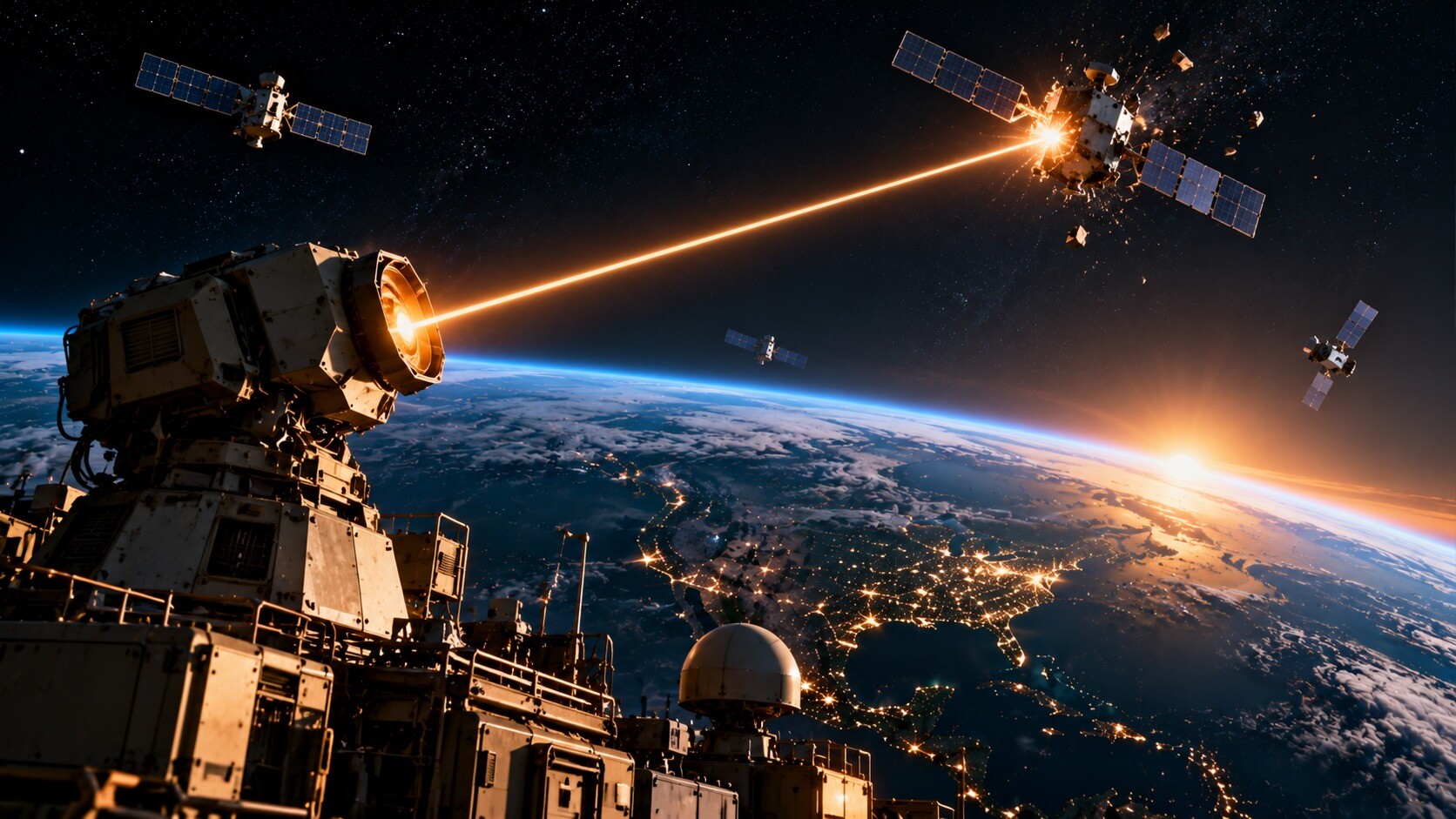
Yes, the United States has military capabilities designed to counter threats involving space systems, but that does not mean it has publicly confirmed fleets of armed satellites orbiting Earth. Most American military spacecraft support communications, surveillance, navigation, missile warning, and other national security operations rather than carrying weapons.
The distinction matters because military activity in space is often confused with the deployment of weapons in orbit.
The United States has acknowledged capabilities that can interfere with adversary satellite communications, including ground-based electronic warfare systems. It also has a history of testing anti-satellite technology.
However, publicly available information does not establish that the US military operates an orbital arsenal of lasers, missiles, or nuclear weapons.
For investors, the more immediate story is the growing demand for satellite protection, missile tracking, secure communications, and technologies designed to keep military space infrastructure operational.
What Military Capabilities Does the US Actually Have in Space?
The US military operates and uses a wide range of space-based systems, but most are not weapons.
These systems provide information and services that military forces depend on during both routine operations and conflicts.
| Military capability | What it does | Is it a space weapon? |
|---|---|---|
| GPS satellites | Provide navigation, positioning, and timing | No |
| Military communications satellites | Connect military forces and command centers | No |
| Missile-warning satellites | Detect missile launches and track threats | No |
| Reconnaissance satellites | Gather intelligence and observe activities on Earth | No |
| Space surveillance systems | Track spacecraft and potential orbital threats | No, generally monitoring systems |
| Counterspace electronic warfare | Interfere with certain satellite communications | Can function as a counterspace weapon |
| Anti-satellite interceptors | Attempt to disable or destroy spacecraft | Yes, when designed for that purpose |
This distinction is essential.
A satellite used to detect a missile launch is a military asset, but it is not necessarily a weapon.
Similarly, GPS satellites support precision-guided military operations, yet their primary function is to provide positioning and timing signals.
Military satellites can therefore contribute to combat without directly attacking anything.
The broader expansion of these capabilities is part of the trend examined in Is Space Being Militarized? What Investors Need to Know About the New Space Race.
Does the US Have Anti-Satellite Weapons?
The United States has demonstrated the ability to destroy a satellite using a missile launched from Earth.
One of the clearest examples occurred in February 2008 during Operation Burnt Frost.
A US Navy ship launched a modified Standard Missile-3 interceptor that destroyed a malfunctioning American satellite.
The government described the operation as a response to concerns about hazardous fuel aboard the spacecraft.
Regardless of that stated purpose, the operation demonstrated a capability to intercept a satellite in low Earth orbit.
That does not mean the United States maintains a publicly confirmed, routinely deployed arsenal of dedicated satellite-destroying missiles.
A successful interception test demonstrates technical capability, but it does not establish the operational status, inventory, or intended deployment of a particular weapons system.
There is another important distinction: anti-satellite weapons do not have to be stationed in orbit.
A missile launched from the ground or a ship can threaten a spacecraft while the weapon itself remains on Earth.
This is one reason discussions about space weapons can be misleading.
A country may possess technology capable of attacking satellites without placing offensive weapons aboard satellites.
In April 2022, the United States announced a commitment not to conduct destructive direct-ascent anti-satellite missile testing.
The commitment addressed a specific category of testing, not every possible counterspace capability.
Does the US Have Lasers or Missiles Orbiting Earth?
There is no publicly verified evidence establishing that the United States operates a deployed fleet of satellites carrying offensive laser cannons or missile launchers in orbit.
That does not mean such concepts have never been studied.
During the Cold War, the United States explored ambitious missile-defense concepts under the Strategic Defense Initiative, announced in 1983.
The initiative included research into advanced technologies that might intercept ballistic missiles, including potential space-based systems.
Many of those ideas faced enormous technical, financial, and operational challenges.
A concept appearing in a research program is not evidence that it became an operational weapon.
Today, the distinction remains important.
Governments can research directed-energy systems, missile interception, autonomous spacecraft, and other advanced technologies without deploying orbital weapons.
Some information about military space programs is classified, so public sources cannot establish every capability or rule out undisclosed systems.
Nevertheless, claims about secret orbital arsenals should not be treated as established facts without credible supporting evidence.
For investors, this distinction also prevents confusion between research spending, experimental programs, and actual procurement contracts.
A proposed technology may attract attention long before it becomes a commercially significant program.
Can the US Disable Enemy Satellites Without Destroying Them?
Yes. The United States has publicly acknowledged counterspace capabilities designed to interfere with satellite communications.
One example is the Counter Communications System, or CCS, developed for the US Space Force.
The system is designed to disrupt certain satellite communications through electronic warfare.
Unlike a missile that physically destroys a spacecraft, electronic interference can prevent a satellite communications system from functioning as intended without necessarily damaging the satellite itself.
This is important because military operations increasingly depend on uninterrupted access to information.
A satellite may remain physically intact while its communications become temporarily unavailable or unreliable.
Counterspace activities can involve several different methods.
Electronic jamming: Interfering with radio signals used by satellite communications or navigation systems.
Cyber operations: Targeting software, networks, or supporting ground infrastructure.
Signal deception: Attempting to mislead receivers or interfere with the integrity of transmitted information.
Physical attacks: Damaging or destroying satellites through kinetic or other destructive methods.
Not all these capabilities have the same effects, and their operational availability varies.
The US military does not publicly disclose every detail of its counterspace capabilities.
What is clear is that disabling a satellite service does not always require destroying the spacecraft.
For defense planners, protecting communications against interference can therefore be as important as protecting satellites against physical attacks.
Who Controls US Military Operations in Space?
The United States established the US Space Force in December 2019 as a separate branch of the armed forces within the Department of the Air Force.
Its creation reflected the growing importance of space systems to national security.
The Space Force organizes, trains, and equips personnel for military space missions.
These include satellite operations, space domain awareness, missile warning, and maintaining access to space-based capabilities.
US Space Command, a separate unified combatant command, is responsible for planning and conducting military operations involving the space domain.
The distinction is similar to the relationship between military services that develop and provide forces and combatant commands that employ those forces operationally.
Neither organization exists simply to place weapons in orbit.
A major part of their mission involves ensuring that American and allied forces can continue using satellites when communications, navigation, or intelligence systems are threatened.
For the space economy, this creates demand for reliable hardware, software, launch services, sensors, and supporting infrastructure.
Are Nuclear Weapons Allowed in Space?
The 1967 Outer Space Treaty prohibits countries from placing nuclear weapons or other weapons of mass destruction in orbit around Earth.
It also prohibits stationing such weapons in outer space in other ways.
The treaty is one of the central international agreements governing space activities.
However, it does not impose a blanket prohibition on all military uses of space or every type of conventional weapon.
Military communications satellites, reconnaissance systems, and navigation networks are not automatically prohibited.
This explains why countries have operated military spacecraft for decades while remaining parties to the treaty.
The legal situation is therefore more complicated than a simple statement that all space weapons are banned.
Another important distinction concerns weapons launched from Earth that travel through space temporarily, such as ballistic missiles.
Their trajectories do not necessarily mean they are weapons stationed in orbit.
For investors, international law and national security regulations can influence which technologies governments develop, how companies participate, and what equipment can be exported.
Why Are China and Russia Important to US Space Defense?
American military space planning is heavily influenced by the capabilities of other major powers.
China has expanded its military-relevant satellite infrastructure and developed counterspace technologies.
Russia maintains reconnaissance, communications, and other military spacecraft and has demonstrated destructive anti-satellite capability.
In November 2021, Russia destroyed one of its own inactive satellites using a ground-launched anti-satellite missile.
The test created substantial orbital debris, raising concerns about the safety of other spacecraft.
These developments matter because satellites are difficult to protect using traditional military defenses.
A spacecraft follows an orbital path and may be exposed to multiple types of interference or attack.
Even a relatively small disruption can affect communications, intelligence collection, or navigation services used by military forces.
Governments are therefore increasingly focused on resilience.
Rather than relying exclusively on a small number of large satellites, they are exploring networks that distribute important functions across many spacecraft.
The objective is to reduce the consequences of losing any single satellite.
This shift has direct implications for satellite manufacturers, launch companies, and suppliers of space-related technologies.
Why Is the US Building More Missile-Tracking Satellites?
Missile warning is one of the most important military applications of space technology.
Satellites equipped with infrared sensors can detect heat associated with missile launches.
This information helps military organizations identify potential threats and support warning and defensive operations.
Traditional missile-warning systems have relied on specialized satellites operating in higher orbits.
Newer programs are exploring larger networks of satellites in low Earth orbit.
The US Space Development Agency has pursued a distributed architecture designed to support missile tracking and military data communications.
One objective is to improve the ability to detect and track increasingly challenging missile threats, including certain hypersonic systems.
Hypersonic weapons can travel at very high speeds and may maneuver in ways that complicate detection and tracking.
A network of satellites can potentially provide more frequent observations and help maintain awareness as a threat moves.
However, detecting and tracking a missile is not the same as destroying it.
A missile-tracking satellite generally provides information to a wider defense system. It is not automatically an orbital weapon.
For investors, the distinction matters because much of the spending associated with missile defense may go toward sensors, satellite manufacturing, communications networks, software, and ground infrastructure.
These markets can expand even without the deployment of offensive weapons in orbit.
How Do Spy Satellites Fit Into Military Space Operations?
Reconnaissance satellites are among the most established military space capabilities.
They help governments observe military installations, monitor infrastructure, and gather information about potential threats.
These systems may use optical imaging, radar, or other sensors.
Optical satellites collect imagery using reflected light, while radar satellites can collect certain types of information at night and through cloud cover.
The capabilities vary depending on the satellite and its mission.
Because satellites orbit Earth, their paths can take them over many countries.
This is not unique to American spacecraft.
Russia, China, and other countries also operate satellites used for military-related observation.
The implications of foreign reconnaissance satellites operating over American territory are explored in Does Russia Have Spy Satellites Over the US? What Satellite Surveillance Means for Markets.
Reconnaissance satellites are generally intelligence-gathering systems rather than offensive weapons.
But the information they provide can influence military decisions, including the planning and targeting of operations.
This is another example of how a satellite can have substantial military value without carrying a weapon.
Why Does the US Want Satellites That Are Harder to Attack?
A major priority in modern space defense is resilience.
Historically, some military capabilities depended on a relatively small number of expensive spacecraft.
These satellites could provide sophisticated services, but their loss might create a significant operational gap.
One alternative is to distribute capabilities across larger networks of smaller satellites.
This is sometimes called a proliferated satellite architecture.
Instead of depending on one spacecraft, a network can spread communications, sensing, or other functions across many satellites.
The potential advantages include reduced dependence on individual assets, improved coverage, and greater flexibility when replacing spacecraft.
But there are costs.
Large satellite networks require manufacturing capacity, launch services, ground stations, communications links, cybersecurity, and ongoing maintenance.
They can also increase the complexity of managing orbital traffic.
For investors, this approach can create opportunities in multiple segments of the space industry.
A government program may generate demand not only for the satellites themselves but also for their components, launch services, software, and operational support.
The commercial opportunity depends on actual funding, contract awards, and the ability of suppliers to deliver systems efficiently.
Which Companies Could Benefit From US Military Space Spending?
The expansion of military space capabilities creates demand across established defense contractors and newer commercial space companies.
Several publicly traded businesses participate in relevant markets.
| Company | Ticker | Relevant business activities |
|---|---|---|
| Lockheed Martin | LMT | Military satellites, missile-warning systems, national security space |
| Northrop Grumman | NOC | Space systems, missile defense, military satellite technologies |
| L3Harris Technologies | LHX | Space sensors, communications, defense electronics |
| Boeing | BA | Government spacecraft and military satellite programs |
| Rocket Lab | RKLB | Launch services, spacecraft manufacturing and components |
| SpaceX | SPCX | Launch services, satellite communications, Starlink and Starshield national security activities |
These companies do not have identical exposure to military space spending.
Large defense contractors operate across multiple markets, including aircraft, missiles, electronics, and other military systems.
Smaller space-focused companies may have greater sensitivity to individual satellite contracts or launch programs.
SpaceX is an important participant through its launch services, satellite communications infrastructure, and national security activities. Following its June 2026 public listing, investors can evaluate the company's shares directly alongside other publicly traded aerospace businesses. However, its valuation reflects multiple business segments, and its stock performance should not be interpreted as a direct measure of military space spending.
Investors should also distinguish between companies that manufacture spacecraft and those that provide recurring services.
A satellite manufacturer may recognize revenue over the life of a government contract.
A communications provider may receive ongoing payments for access to its network.
Both business models can benefit from military demand, but their profitability, capital requirements, and financial risks differ.
Is Space-Based Missile Defense a Major Investment Opportunity?
Space-based missile defense attracts attention because of its potential strategic importance and technical complexity.
However, investors should distinguish among three different activities:
- Detecting a missile launch.
- Tracking a missile during flight.
- Intercepting or destroying the missile.
These functions require different technologies.
Detection and tracking can involve satellites equipped with sensors and communications systems.
Interception requires additional capabilities, which may include ground-based or other defensive systems.
Proposals involving space-based interceptors introduce further technical, operational, legal, and financial questions.
Not every proposed system becomes an approved and funded program.
Even when governments announce ambitious missile-defense initiatives, spending may be distributed over many years and across numerous contractors.
For investors, the more reliable evidence of commercial opportunity comes from funded contracts, program milestones, and company financial disclosures.
A large proposed defense architecture should not be confused with guaranteed future revenue.
What Are the Biggest Risks for Space Defense Investors?
The growing importance of military space infrastructure does not eliminate investment risk.
Government budget uncertainty: Defense programs can be delayed, modified, or canceled as priorities change.
Technical complexity: Satellite systems and missile-defense technologies can encounter development problems that increase costs.
Contract concentration: Some companies depend heavily on a small number of government customers or major programs.
Competition: Established aerospace contractors compete with newer companies offering different manufacturing and launch approaches.
High capital requirements: Developing spacecraft and launch systems can require substantial investment before generating positive cash flow.
Geopolitical uncertainty: International tensions can increase defense demand while also creating supply-chain, regulatory, and market risks.
Valuation risk: Investors may pay high prices for companies whose expected growth has not yet translated into earnings.
A company can operate in an expanding defense market and still deliver disappointing investment returns.
The important questions are whether it can win profitable contracts, manage costs, generate cash, and maintain a competitive advantage.
What Does the Future of US Space Weapons Look Like?
The future of American military space capabilities is likely to involve both defensive systems and technologies that can counter threats to satellites.
Publicly discussed priorities include more resilient satellite networks, improved missile tracking, secure communications, and greater awareness of objects and activities in orbit.
Electronic warfare and other counterspace capabilities will also remain important considerations.
More ambitious concepts, including certain space-based missile-defense technologies, may continue to receive research and development attention.
However, their eventual deployment depends on technical feasibility, cost, government decisions, and international security considerations.
It would be misleading to assume that every proposed orbital defense system will become operational.
For the commercial space industry, the more immediate opportunity is tied to the infrastructure governments already need: spacecraft, sensors, launches, secure networks, and reliable support services.
What Investors Should Understand About Weapons in Space
The United States has demonstrated anti-satellite capabilities and publicly acknowledged systems capable of disrupting satellite communications.
But there is an important difference between possessing counterspace technology and operating a publicly confirmed arsenal of offensive weapons stationed in orbit.
Most US military satellites provide essential services rather than carrying weapons.
For investors, this distinction helps identify where government spending is more likely to create commercial opportunities.
Satellite manufacturing, missile-warning sensors, launch services, secure communications, and space infrastructure protection all support military operations without requiring armed satellites.
The investment story is not simply about putting weapons in space. It is about building and protecting the infrastructure on which modern military operations increasingly depend.
Disclaimer: This article is for informational and educational purposes only and does not constitute financial or investment advice. Investing involves risk, including the possible loss of principal.