
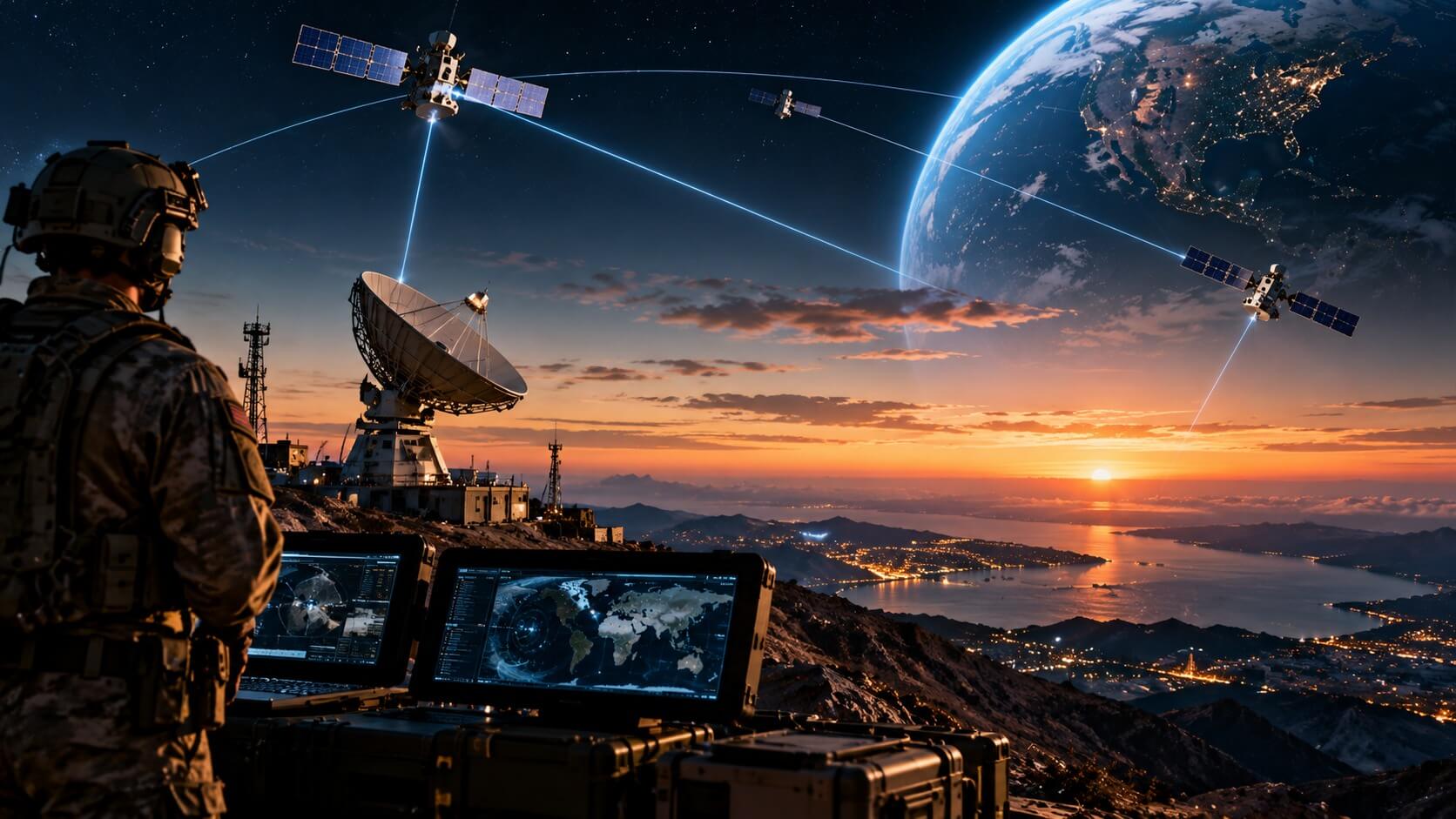
Space defense is becoming an increasingly important part of the global space economy. Governments rely on satellites for military communications, intelligence gathering, navigation, missile warning, and battlefield coordination. Private companies such as SpaceX are helping provide the launch services, satellite networks, and technology that make these capabilities possible.
For investors, the space defense industry is more than a story about military satellites or weapons in orbit. It is a growing intersection of national security, commercial space infrastructure, government spending, and technological competition.
The key question is not simply whether countries are expanding their military presence in space. It is who builds the infrastructure, who pays for it, and which companies can turn national security demand into sustainable revenue.
What Is Space Defense?
Space defense refers to the technologies, infrastructure, and military operations used to protect national security interests in space and support military activities on Earth.
Much of this infrastructure consists of satellites orbiting hundreds or thousands of miles above the planet. These satellites help military organizations communicate, navigate, monitor threats, and understand what is happening in distant regions.
The main activities include:
- Military communications: Secure satellite networks connect troops, aircraft, ships, and command centers.
- Intelligence and surveillance: Satellites collect images and other information about military movements and infrastructure.
- Missile warning: Space-based sensors can detect missile launches and provide early warnings.
- Navigation and positioning: Satellite navigation supports military operations, aircraft, ships, and precision-guided systems.
- Space surveillance: Ground and space-based systems track satellites, debris, and potentially threatening objects in orbit.
- Satellite protection: Defensive technologies help military networks withstand interference, cyberattacks, and other disruptions.
These activities are already essential to modern defense systems.
A military force operating thousands of miles from its headquarters may depend on satellites to communicate with commanders, locate equipment, and monitor changing battlefield conditions.
If those connections are disrupted, military operations can become slower, less coordinated, and more vulnerable.
This dependence explains why governments increasingly treat space infrastructure as a national security priority rather than simply a scientific or commercial resource.
Why Is Space Becoming More Important to National Security?
Modern military operations depend heavily on information.
Knowing where an aircraft is flying, where a missile was launched, or how forces are moving can influence decisions long before troops encounter one another.
Satellites provide some of that information from orbit.
Unlike aircraft, satellites can observe large geographic areas without needing to operate inside another country's airspace. Communications satellites can also connect military units separated by oceans or difficult terrain.
But growing dependence creates a new vulnerability: the more important satellites become, the more valuable they are as potential targets.
Countries can attempt to disrupt satellite services through electronic interference, cyberattacks, or anti-satellite technologies. Even without destroying a satellite, interference with communications or navigation can affect operations on Earth.
This has intensified competition among major space powers, particularly the United States, China, and Russia.
The broader question of whether space is becoming a military domain is explored in Is Space Being Militarized? What Investors Need to Know About the New Space Race.
For the space economy, this competition creates demand for more resilient networks, improved monitoring capabilities, additional satellite launches, and technologies that reduce dependence on individual spacecraft.
How Big Is the Space Defense Industry?
There is no single universally accepted figure for the size of the space defense industry.
That is because military space spending overlaps with several markets, including satellite manufacturing, launch services, communications, intelligence systems, cybersecurity, and government research.
A commercial satellite company may serve both civilian and military customers. A defense contractor may build spacecraft while also producing aircraft, missiles, and radar systems.
As a result, estimates can vary significantly depending on what is included.
One useful indicator is the United States' military space budget.
The U.S. Department of Defense requested approximately $33.3 billion for space-related activities in fiscal year 2024, reflecting the growing importance of military space infrastructure.
That figure represents a historical budget request, not the total global space defense market or the amount ultimately spent. It also does not include every commercial activity that supports military space operations.
The distinction matters because the industry includes several different sources of revenue.
| Market segment | What customers pay for | Why it matters |
|---|---|---|
| Satellite manufacturing | Building spacecraft and onboard systems | Creates demand for specialized aerospace equipment |
| Launch services | Transporting satellites into orbit | Supports deployment and replacement of military assets |
| Satellite communications | Connectivity, terminals, and network capacity | Can generate recurring service revenue |
| Intelligence and surveillance | Satellite imagery, sensors, and data analysis | Helps governments monitor threats |
| Space monitoring | Tracking satellites and orbital objects | Supports awareness and protection of space assets |
| Cybersecurity and resilience | Protecting networks against disruption | Becomes more important as military dependence increases |
For investors, these distinctions are essential.
A company manufacturing satellites may depend on large contracts awarded every few years. A satellite communications provider may receive recurring payments for network access. A launch provider may earn revenue whenever customers need spacecraft delivered to orbit.
All three can benefit from defense demand, but their business models and financial risks are different.
Who Are the Major Companies in Space Defense?
The space defense industry includes established defense contractors, specialized satellite manufacturers, launch companies, and commercial communications providers.
Some companies have decades of experience supplying military systems. Others entered the defense market through commercial space technologies.
Traditional defense contractors
Lockheed Martin develops military spacecraft, missile-warning systems, and other national security technologies. Its experience with government programs makes it an important participant in U.S. military space infrastructure.
Northrop Grumman operates across military satellites, space systems, missile defense, and related technologies. Its work includes spacecraft and systems supporting national security missions.
Boeing has a long history in military and government space programs, including communications satellites and launch-related activities.
L3Harris Technologies supplies sensors, communications equipment, and space-related defense technologies.
These companies benefit from established relationships with government customers and experience managing complex defense programs.
However, space defense represents only part of their overall businesses. Their financial performance also depends on other aerospace and military markets.
Commercial space companies
SpaceX has become particularly important because it combines satellite launch capabilities with its own satellite communications infrastructure.
Rocket Lab provides launch services and spacecraft technologies, giving it exposure to government and commercial space programs.
Planet Labs operates Earth-observation satellites and supplies imagery and related data to commercial and government customers.
Other specialized businesses develop satellite components, ground systems, sensors, and software.
The important distinction is that not every company involved in space has the same exposure to military spending.
A business selling satellite imagery to government agencies may benefit from intelligence demand, while a launch company depends more directly on mission schedules and launch contracts.
Investors therefore need to examine actual customers, contracts, and revenue sources rather than assuming that every space-related company benefits equally from defense budgets.
Why Is SpaceX Important to the Space Defense Industry?
SpaceX has changed the economics of accessing orbit.
Historically, launching satellites was expensive and involved a relatively small number of specialized aerospace providers.
SpaceX's reusable Falcon 9 rocket has helped make frequent launches possible, allowing commercial and government customers to deploy satellites on a much larger scale.
For military organizations, launch frequency and availability can be strategically important.
A government may need to replace a damaged satellite, deploy additional communications capacity, or launch a new surveillance system without waiting years for an opportunity.
SpaceX also operates Starlink, a large satellite internet network that demonstrates how commercial infrastructure can support military and government communications.
Beyond Starlink, SpaceX has developed Starshield, an initiative focused on government and national security applications.
Starshield is associated with capabilities such as secure communications, Earth observation, and hosted payloads for government missions.
This makes SpaceX unusual because it participates in several parts of the space defense supply chain: launch services, satellite infrastructure, and communications.
Its military activities, including government contracts and Starshield, are examined in Does SpaceX Do Defense Work? The Military Contracts Behind the Company.
SpaceX became a publicly traded company in June 2026, giving investors the ability to obtain direct exposure to its launch, satellite communications, and government-related activities through publicly traded shares. However, investors should distinguish the company's overall financial performance from the specific contribution of defense contracts and national security programs.
SpaceX's activities also influence other publicly traded aerospace companies, satellite operators, suppliers, and competitors.
How Does Starlink Fit Into Military Space Operations?
Starlink was developed primarily as a commercial satellite internet service.
Its network uses large numbers of satellites in low Earth orbit to provide connectivity through ground terminals.
Unlike traditional satellite systems that may rely on a relatively small number of large spacecraft, Starlink distributes network capacity across many satellites.
This architecture can offer advantages in coverage and resilience, although it does not make the network immune to interference, cyber threats, or service disruptions.
The military relevance became particularly visible during Russia's invasion of Ukraine.
Starlink terminals have supported communications in Ukraine, including military-related activities, illustrating how commercially developed satellite infrastructure can become strategically important during a conflict.
This also raises difficult questions about operational control.
A government using a commercially operated communications network may depend on decisions involving service availability, geographic restrictions, commercial agreements, and political considerations.
The distinction between commercial infrastructure and military capability becomes less clear when the same network serves civilian households, emergency responders, government agencies, and armed forces.
For a closer look at the conflict and the continuing questions surrounding the network, see Is Ukraine Still Using Starlink? The Military Role of Satellite Internet.
From an investment perspective, satellite communications can create opportunities beyond hardware sales.
Network operators may earn recurring revenue from subscriptions, enterprise agreements, and government contracts.
But these opportunities come with substantial costs for satellites, launches, replacement equipment, ground infrastructure, and ongoing operations.
A large network does not automatically translate into high profitability.
Are There Already Weapons in Space?
Military activity in space does not necessarily mean that satellites are carrying weapons.
Most military satellites perform support functions such as communications, surveillance, navigation, and missile detection.
However, countries have developed technologies capable of threatening spacecraft.
These include ground-launched anti-satellite missiles, electronic jamming, cyber operations, and systems capable of approaching other objects in orbit.
Some technologies have legitimate civilian or defensive applications while also creating potential military concerns.
The distinction between a satellite used for intelligence gathering and a weapon designed to attack another spacecraft is important.
A surveillance satellite may collect information about military installations without physically attacking anything. An anti-satellite weapon, by contrast, is intended to disable, damage, or destroy a space asset.
There are also legal constraints. The Outer Space Treaty prohibits placing nuclear weapons or other weapons of mass destruction in orbit, but it does not impose a blanket prohibition on every conventional military activity in space.
The actual capabilities of the United States, including the difference between confirmed military systems and speculative orbital weapons, are explored in Does the US Military Have Weapons in Space? Separating Facts From Science Fiction.
For investors, the more immediate commercial opportunity may be in protecting satellites rather than developing dramatic science-fiction-style weapons.
Governments need technologies that can detect interference, track orbital objects, maintain communications, and restore lost capabilities.
How Do Spy Satellites Affect Global Security?
Satellite surveillance is one of the oldest and most important military uses of space.
Governments use reconnaissance satellites to monitor military installations, observe infrastructure, and gather information about potential threats.
The United States, Russia, China, and other countries operate space-based intelligence capabilities.
Because satellites travel in orbit around Earth, their paths can take them over many countries.
This does not mean that every satellite can continuously observe every location. Coverage depends on orbital position, sensor capabilities, weather conditions for optical imaging, and other technical factors.
Satellite intelligence can help governments monitor military deployments, missile facilities, naval activity, and changes to important infrastructure.
It can also influence how governments respond to international crises.
The specific question of Russian reconnaissance capabilities and what they mean for the United States is examined in Does Russia Have Spy Satellites Over the US? What Satellite Surveillance Means for Markets.
For businesses, the growth of satellite surveillance creates demand for imaging technology, sensors, data processing, and analytical software.
Some of these services are provided by commercial companies rather than exclusively by government-owned satellites.
This allows private firms to participate in intelligence-related markets without necessarily manufacturing military weapons.
Why Do Governments Want More Satellites Instead of Just Better Satellites?
For decades, many military space systems depended on a limited number of large, expensive satellites.
These spacecraft could deliver sophisticated capabilities, but losing one could create a serious operational problem.
An alternative approach is to distribute capabilities across larger groups of smaller satellites.
This is often called a proliferated satellite architecture.
Instead of concentrating communications or sensing capabilities in a few spacecraft, a government can spread them across many satellites.
The potential advantages include greater resilience, more frequent coverage, and the ability to replace individual spacecraft.
The U.S. Space Development Agency has pursued this approach through plans for a network of satellites supporting missile tracking and military data communications.
The strategy has important implications for the commercial space economy.
More satellites can mean greater demand for manufacturing, launch services, sensors, ground infrastructure, and replacement systems.
But there are trade-offs.
Large satellite networks require coordination, reliable communications, cybersecurity, and ongoing investment. Smaller spacecraft may also have different capabilities and operating lifetimes than traditional large satellites.
The economic opportunity therefore depends on whether governments can deploy and maintain these networks within realistic budgets.
Why Are Some Countries Restricting Starlink?
Satellite internet is not only a technological issue. It is also a question of national regulation, security, and control over communications infrastructure.
Some governments require satellite operators to obtain licenses before offering services within their borders.
Others restrict or prohibit unauthorized satellite terminals because of telecommunications rules, security concerns, or policies governing foreign communications networks.
Starlink has also faced criticism involving satellite congestion, astronomical observations, environmental concerns, affordability, and the influence of a commercial company over strategically important communications.
These concerns create an important challenge for global expansion.
Even when a satellite network can technically provide coverage over a country, that does not necessarily mean the company is legally authorized to sell services there.
Government approval, local regulations, and political relationships can determine whether a market is commercially accessible.
The different reasons for opposition and restrictions are explored in Why Some Countries and Users Push Back Against Starlink.
For investors evaluating satellite communications companies, geographic coverage should not be confused with potential paying customers.
Regulatory access is a separate requirement for turning technical capability into revenue.
Where Is the Money in the Space Defense Economy?
The financial opportunity in space defense comes from several different business models.
Understanding them is more useful than treating the entire industry as a single investment theme.
Government contracts
Defense agencies purchase satellites, communications systems, sensors, software, and launch services.
These contracts can provide substantial revenue and long-term business relationships.
However, government programs are exposed to political decisions, budget changes, delays, and technical requirements.
A contract award is also not the same as immediate revenue or profit. Payments and revenue recognition may occur over several years.
Satellite manufacturing and components
Building more spacecraft creates demand for solar panels, communications equipment, propulsion systems, sensors, and other specialized components.
Suppliers may benefit from increased production even when they do not operate satellite networks themselves.
Their performance depends on production costs, manufacturing reliability, and the ability to deliver equipment on schedule.
Launch services
Every satellite must reach orbit.
Companies providing reliable launch services can benefit from commercial and government demand.
Reusable rockets and greater launch frequency can influence costs, but profitability still depends on pricing, competition, utilization, and operational performance.
Recurring communications services
Satellite internet and secure communications providers may receive recurring payments for network access.
This can create a different revenue profile from companies dependent mainly on individual spacecraft contracts.
However, recurring revenue must be weighed against the ongoing cost of maintaining and replacing satellite networks.
Space data and analytics
Satellites generate large amounts of information.
Companies that process imagery, identify changes, and deliver useful intelligence can sell services to governments and commercial customers.
The value is not always in owning the satellite. It can also come from turning collected data into timely, actionable information.
For investors, the strongest businesses will not necessarily be those launching the most satellites or announcing the largest projects.
Financial sustainability depends on contract quality, operating margins, cash generation, competitive advantages, and the cost of maintaining infrastructure.
What Are the Biggest Risks for Space Defense Companies?
Space defense may benefit from national security priorities, but the industry faces substantial uncertainty.
Government budget dependence: Many companies rely on defense spending. Changes in political priorities or procurement programs can affect future revenue.
Technical and launch failures: Satellites and rockets operate in demanding environments. Failures can cause delays, financial losses, or additional costs.
Intense competition: Established defense contractors and newer commercial space companies compete for overlapping opportunities.
High capital requirements: Developing spacecraft, launch systems, and satellite networks often requires large investments before meaningful revenue arrives.
Regulatory and geopolitical uncertainty: Export restrictions, licensing requirements, sanctions, and international tensions can affect market access.
Cybersecurity and electronic interference: Satellite systems face threats that can disrupt services and increase protection costs.
Space debris and orbital congestion: More satellites increase the importance of collision avoidance, responsible operations, and long-term orbital sustainability.
These risks are especially important when evaluating companies whose valuations depend heavily on future growth.
An expanding market does not guarantee that every participant will earn attractive returns.
How Can Investors Evaluate Space Defense Opportunities?
Investors interested in the space defense industry should look beyond headlines about military satellites, new rockets, or geopolitical tensions.
Several practical questions can help distinguish a promising business from a compelling story.
| Question | Why it matters |
|---|---|
| How much revenue actually comes from space defense? | Reveals the company's exposure to the industry |
| Are contracts funded and generating revenue? | Distinguishes confirmed business from potential opportunities |
| Does the company earn recurring revenue? | Helps assess revenue stability |
| What are its operating margins and cash needs? | Shows whether growth can become financially sustainable |
| Does it have a technological or contractual advantage? | Helps assess competitive strength |
| How dependent is it on one government customer? | Identifies concentration risk |
| How much future growth is already reflected in its valuation? | Helps avoid confusing a strong industry with an attractive investment price |
Publicly traded companies can offer exposure to different parts of the industry, but they are not interchangeable.
A diversified defense contractor may provide relatively broad business exposure, while a smaller space-focused company may be more sensitive to individual contract announcements or launch outcomes.
With SpaceX publicly traded since June 2026, investors can also evaluate its shares directly alongside other listed aerospace and satellite companies. However, the company's valuation reflects multiple business activities, and investors should not assume that its share price provides exposure exclusively to military space spending.
Investors should distinguish between industry growth, company revenue growth, profitability, and investment returns. These are related, but they are not the same thing.
What Could Shape the Future of Space Defense?
Several developments could influence the industry over the coming years.
One is the continued expansion of distributed satellite networks. Governments may increasingly favor systems that can continue operating even if individual satellites fail or are disrupted.
Another is the growing integration of commercial infrastructure into military operations.
Companies that originally focused on civilian customers may find new opportunities in secure communications, satellite imagery, and government services.
A third is the need to protect increasingly crowded and strategically important orbital environments.
Monitoring satellites, detecting interference, improving cybersecurity, and maintaining reliable communications could become more valuable as military dependence on space grows.
Finally, international competition will remain an important driver.
The United States, China, Russia, and other countries have strong incentives to maintain or improve their space capabilities.
But future spending will depend on budgets, technology performance, national priorities, and geopolitical developments.
These trends suggest that space defense could remain an important part of the space economy, although the pace of growth and the companies that benefit most remain uncertain.
Why Space Defense Matters Beyond the Military
Space defense is not an isolated military industry.
It is connected to technologies that also support everyday economic activity.
Satellite communications can connect remote communities and businesses. Navigation systems support transportation and logistics. Earth-observation satellites provide information used in agriculture, infrastructure monitoring, and disaster response.
The same launch infrastructure that deploys military satellites can carry commercial spacecraft.
This overlap means investment in space technology can produce both civilian and defense applications.
It also creates complex questions about regulation, national security, commercial independence, and the responsibilities of companies operating critical infrastructure.
For investors, the central opportunity is not simply that militaries are spending more attention and resources on space.
It is that space infrastructure is becoming increasingly important to both national security and the broader economy.
Companies capable of delivering reliable, affordable, and financially sustainable services may benefit from that demand.
But long-term investment success will depend on business fundamentals, execution, competition, and valuation—not just the growth of military activity in orbit.
Disclaimer: This article is for informational and educational purposes only and does not constitute financial or investment advice. Investing involves risk, including the possible loss of principal.