
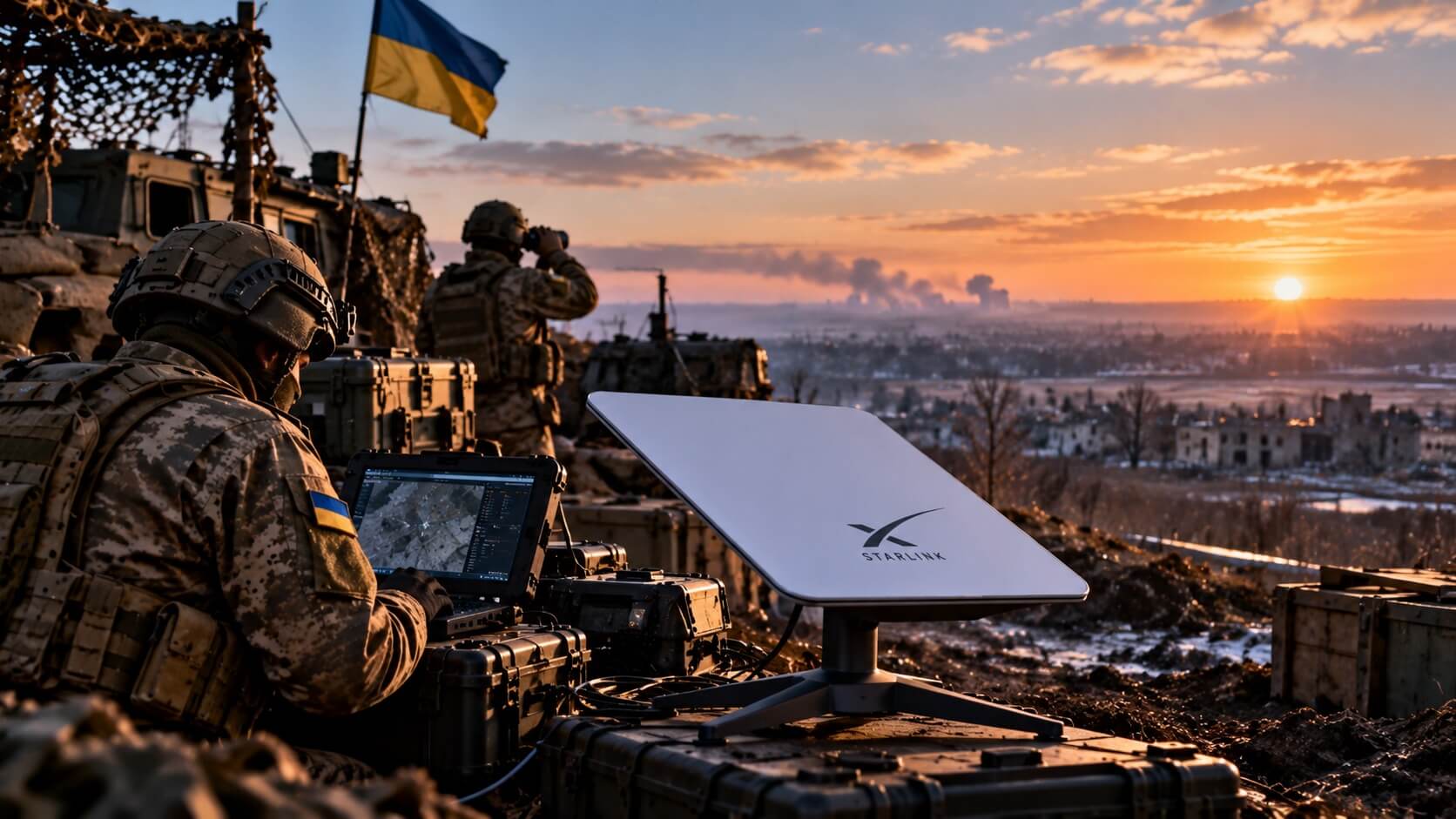
Yes, Ukraine continues to rely on Starlink as an important part of its communications infrastructure, including military-related operations. Since Russia's full-scale invasion in February 2022, SpaceX's satellite internet network has helped Ukrainian forces maintain connectivity in areas where conventional telecommunications infrastructure has been damaged, disrupted, or unavailable.
Starlink has supported battlefield communications, coordination between military units, and the transmission of information across difficult operating environments.
However, the relationship between Ukraine, SpaceX, and government organizations has evolved since the beginning of the war. Funding arrangements, operational restrictions, and concerns about the use of commercial technology in military operations have made Starlink a central example of the growing relationship between private space infrastructure and national security.
For investors, Ukraine demonstrates something important: satellite internet is no longer simply a service for rural households or remote businesses. It can become critical infrastructure during a major international conflict.
Why Does Ukraine Use Starlink?
Ukraine uses Starlink because satellite internet can provide connectivity without relying entirely on traditional ground-based communications networks.
Conventional internet infrastructure depends on physical systems such as fiber-optic cables, cellular towers, and telecommunications facilities.
During a war, these systems can be damaged by attacks, disrupted by power outages, or become unavailable in contested areas.
Starlink provides an alternative.
Its network consists of satellites operating in low Earth orbit, ground infrastructure, and user terminals that connect to the satellites.
A terminal can provide internet access when it has the necessary equipment, power supply, and service availability.
This makes satellite connectivity particularly valuable in areas where ordinary telecommunications infrastructure is unreliable.
For Ukraine, Starlink has supported several activities:
- Communications between military units and command structures.
- Connectivity in areas affected by damaged infrastructure.
- Transmission of operational information.
- Coordination of emergency and humanitarian services.
- Access to digital services in remote or disrupted locations.
- Communications supporting certain military systems and operations.
Starlink is not a replacement for every military communications technology.
It depends on functioning terminals, power, satellite coverage, network capacity, and service authorization.
Nevertheless, it has provided an important additional communications option during the conflict.
Is the Ukrainian Military Still Using Starlink in 2026?
Yes. Starlink remains an important component of Ukrainian communications, including military-related operations, in 2026.
However, the exact number of active military terminals, their deployment locations, and the operational arrangements in effect in October 2026 cannot be established comprehensively from public information.
That distinction matters because military communications are sensitive.
Governments do not necessarily disclose how many terminals are being used, where they are deployed, or which operations depend on them.
The broader relationship has involved Ukrainian government agencies, SpaceX, international partners, and the US Department of Defense.
Publicly documented arrangements have included government support for satellite communications services.
Operational restrictions and service disruptions reported during 2026 have also demonstrated that access to a commercial satellite network cannot always be assumed to remain unchanged during military operations.
The continuing strategic importance of Starlink should therefore be distinguished from claims about specific battlefield deployments or service conditions that cannot be independently verified.
For investors, the relevant development is that a commercial satellite network has demonstrated significant military utility over a prolonged conflict.
That experience can influence how governments evaluate satellite communications when planning future defense infrastructure.
How Did Starlink Become Important During the Ukraine War?
Starlink's role in Ukraine began shortly after Russia launched its full-scale invasion in February 2022.
As telecommunications infrastructure faced disruption, Ukrainian officials requested satellite internet support.
SpaceX began providing Starlink terminals and service to Ukraine.
The network helped restore connectivity in locations where conventional communications were unavailable or unreliable.
Over time, Starlink became relevant to a broader range of activities.
Civilian organizations used it to maintain internet access, while government agencies and military units relied on satellite connectivity for communications.
Its deployment also demonstrated an important difference between modern satellite networks and traditional communications infrastructure.
A terrestrial telecommunications network may depend on physical infrastructure spread across a region.
A satellite internet terminal can connect to an orbital network without requiring a functioning local fiber connection.
That does not make satellite communications immune to disruption, but it provides an alternative when terrestrial systems are damaged.
The Ukraine experience showed how quickly commercial space technology could become strategically important.
It also raised questions about who should control services used during military operations.
How Does Starlink Help Ukrainian Military Operations?
Starlink's primary military value comes from connectivity.
Modern military operations require information to move between people, equipment, and command structures.
Without reliable communications, coordination becomes more difficult.
Satellite internet can help maintain connections across locations where conventional networks are unavailable.
Battlefield communications
Military units may need to exchange information with commanders and other forces.
Satellite connectivity can support digital communications when terrestrial networks are damaged or unreliable.
This can be particularly important for units operating in remote areas.
Sharing operational information
Military organizations depend on timely information.
Satellite internet can support the transmission of reports, imagery, maps, and other digital information.
The usefulness of these services depends on network availability, security, and the systems connected to them.
Supporting mobile operations
Unlike fixed telecommunications infrastructure, satellite terminals can be moved between locations.
This flexibility can help organizations establish connectivity in changing operating environments.
However, terminals still require suitable power, equipment, and access to the satellite network.
Supporting unmanned systems
Satellite communications have also become relevant to the broader use of unmanned systems.
However, not every Ukrainian drone uses Starlink, and the network should not be described as universally available for controlling military drones.
SpaceX has publicly discussed restrictions intended to prevent certain uses of Starlink for offensive military operations.
The distinction between providing communications and authorizing particular military applications is important.
Does SpaceX Allow Ukraine to Use Starlink for Military Purposes?
Starlink has been used in Ukraine for military-related communications, but the availability of the service for particular operations depends on technical, contractual, and operational conditions.
SpaceX has historically distinguished between providing connectivity and enabling specific offensive uses of its technology.
In February 2023, SpaceX leadership publicly discussed restrictions involving the use of Starlink to control certain drones.
This created controversy because satellite connectivity had become important to Ukraine's defense efforts.
Questions about operational access continued beyond those initial disputes.
In October 2026, reports described restrictions affecting some Ukrainian military operations that depended on Starlink connectivity. Subsequent reporting indicated that normal communications speeds had been restored in affected areas, according to Ukrainian officials.
These reports should not be interpreted as proof that all Starlink services across Ukraine were deliberately disabled or that the same restrictions applied to every military user.
The precise reasons for individual disruptions, including the role of network policies, technical conditions, and operational restrictions, may not always be independently established.
The issue is complicated by the dual-use nature of satellite internet.
A communications network can support civilian emergency services, government administration, and military organizations using related infrastructure.
But the consequences of those activities are very different.
For a commercial company, providing communications during a conflict raises questions about contractual responsibilities, government oversight, export regulations, and operational control.
For governments, relying on a commercial provider creates a different concern.
A service that is strategically important may be subject to company policies, technical restrictions, or contractual conditions.
This is one reason military organizations increasingly examine dedicated government satellite networks alongside commercial services.
Did Elon Musk Turn Off Starlink During the War?
The controversy surrounding Starlink and Elon Musk has involved several different events that should not be confused.
One major dispute concerned a proposed Ukrainian operation near Crimea in 2022.
Public reporting and later statements described disagreements over Starlink coverage and the use of the network in connection with the operation.
Musk has stated that Starlink coverage had not been activated for the area in question and that he declined a request to enable it.
That is different from proving that an already operating service was deliberately switched off during an active mission.
The distinction matters because the public discussion has included conflicting descriptions of what happened.
Separately, Starlink services have experienced disruptions and interference during the war.
Reports in October 2026 raised additional questions about service restrictions affecting Ukrainian military communications. However, those incidents should be evaluated separately from the earlier Crimea controversy.
A reported reduction in connectivity or service speed does not, by itself, establish who authorized a restriction, why it occurred, or whether it resulted from a deliberate decision by an individual executive.
Satellite communications can be affected by electronic warfare, technical problems, power failures, network management, and geographic restrictions.
For investors, the larger issue is not simply the actions of one executive.
It is the dependence that can develop when governments use commercially operated infrastructure for strategically important missions.
That dependence can create both commercial opportunities and political risks.
Who Pays for Starlink in Ukraine?
Starlink's deployment in Ukraine has involved multiple funding sources and arrangements.
Early support included equipment and services provided through SpaceX and contributions from government organizations and other partners.
Over time, governments became more directly involved in supporting satellite communications.
In June 2023, the US Department of Defense confirmed that it had contracted for Starlink satellite communications services to support Ukraine.
That announcement established an important historical funding arrangement, but it should not be treated as a complete description of every contract or payment arrangement in effect in October 2026.
Other governments and organizations have also supported the provision of terminals and connectivity.
This means the network should not be described as entirely donated or entirely financed by one organization.
Different terminals and services may operate under different arrangements.
The precise total amount paid for all Starlink services used in Ukraine is not publicly established in a comprehensive and consistently updated breakdown.
For investors, these funding arrangements illustrate an important commercial model.
Satellite internet providers can serve government customers through contracts rather than relying exclusively on individual consumer subscriptions.
Government demand can create opportunities for recurring service revenue, although contract values, margins, and renewal terms remain important.
Can Russia Jam Starlink in Ukraine?
Yes. Russian electronic warfare capabilities have been used to interfere with satellite communications, including Starlink-related connectivity.
Satellite internet relies on radio signals traveling between terminals, spacecraft, and supporting infrastructure.
These signals can be vulnerable to interference.
Jamming attempts to disrupt communications by transmitting competing radio-frequency signals.
The effectiveness of interference depends on multiple factors, including equipment, signal characteristics, geography, and the defensive capabilities of the network.
Starlink's distributed satellite architecture provides certain advantages compared with systems that depend on a small number of spacecraft.
However, a large constellation does not make communications impossible to disrupt.
Electronic interference can affect service quality or availability in particular areas.
Cybersecurity and the protection of ground equipment are additional concerns.
For governments, these challenges create demand for more resilient satellite networks, secure terminals, and communications systems capable of operating in contested environments.
For investors, the relevant opportunity may extend beyond satellite operators to suppliers of communications hardware, cybersecurity technology, and specialized defense equipment.
Why Has Starlink Been Difficult to Replace?
Starlink combines several characteristics that make it useful in challenging operating environments.
Its satellites operate in low Earth orbit, allowing the network to provide relatively low-latency connectivity compared with many traditional geostationary satellite systems.
Its terminals are designed to provide internet access without requiring extensive local telecommunications infrastructure.
The network also benefits from a large constellation of satellites.
These characteristics can make it attractive when organizations need connectivity in remote or disrupted locations.
However, replacing Starlink is not necessarily a simple matter of purchasing another satellite internet subscription.
Alternatives may differ in coverage, terminal availability, network capacity, equipment requirements, latency, and regulatory access.
Governments may also need specialized security arrangements and guaranteed service conditions.
Other satellite communications providers exist, but their networks and business models are not identical.
The Ukraine experience has therefore highlighted the importance of communications redundancy.
Depending entirely on one provider can create operational risks, even when that provider offers highly capable technology.
Is Starlink a Military Network or a Civilian Network?
Starlink is primarily a commercial satellite internet network with civilian, enterprise, and government customers.
Its technology can support military-related communications, but that does not mean every Starlink satellite is a military spacecraft.
The distinction is important.
A commercial network may be used by civilians, businesses, emergency responders, and military organizations.
The same basic communications infrastructure can support very different activities.
This is known as dual-use technology.
Dual-use systems have both civilian and military applications.
Satellite navigation, Earth observation, and communications are common examples.
Starlink's role in Ukraine illustrates how dual-use infrastructure can become strategically important during a conflict.
However, commercial Starlink should also be distinguished from Starshield.
Starshield is SpaceX's initiative focused on government and national security applications.
It is intended to address specialized requirements involving secure communications, Earth observation, and government payloads.
The broader defense activities of SpaceX are examined in Does SpaceX Do Defense Work? The Military Contracts Behind the Company.
What Does Ukraine's Use of Starlink Mean for SpaceX?
Ukraine has demonstrated the strategic relevance of SpaceX's satellite communications technology.
The company originally developed Starlink primarily to provide commercial internet connectivity.
Its use during a major war showed that the same infrastructure could support government and military-related requirements.
This creates several potential business implications.
Government customer demand: Defense organizations may view satellite connectivity as an essential service rather than an optional communications solution.
Recurring service contracts: Government agreements can generate ongoing payments for network access and support.
Specialized products: Military customers may require equipment, security features, and operational arrangements different from those used by ordinary consumers.
Reputation and political exposure: Involvement in conflicts can attract scrutiny and create disputes involving governments, customers, and company leadership.
Investment in resilience: Demand for communications that can withstand interference may support additional technology development.
Public market exposure: SpaceX became publicly traded in June 2026, with its Class A common shares beginning trading under the ticker SPCX on June 12, 2026. Investors can therefore evaluate the company through its public financial disclosures and equity-market valuation.
However, publicly available financial reporting does not necessarily identify the revenue or profitability associated with every individual military contract, government customer, or Ukraine-related service arrangement.
It is therefore difficult to determine exactly how much profit SpaceX earns specifically from services supporting Ukraine.
Strategic importance should not be confused with a measurable contribution to earnings.
Could Starlink's Military Role Benefit Other Space Companies?
The growing importance of satellite communications can create opportunities beyond SpaceX.
Governments may seek alternative networks, specialized military services, additional launch capacity, and equipment designed for secure communications.
Several publicly traded companies operate in related markets.
| Company | Ticker | Relevant business exposure |
|---|---|---|
| SpaceX | SPCX | Starlink satellite communications, launch infrastructure, and government space services |
| Viasat | VSAT | Satellite communications and government connectivity |
| Iridium Communications | IRDM | Satellite communications, including government services |
| L3Harris Technologies | LHX | Military communications and space-related technologies |
| Lockheed Martin | LMT | Military satellites and secure communications systems |
| Northrop Grumman | NOC | National security space systems and communications technology |
| Rocket Lab | RKLB | Launch services and spacecraft technologies |
SpaceX differs from the other companies in this comparison because it operates Starlink directly.
The other businesses are not direct substitutes for Starlink in every application.
They operate different networks, offer different technologies, or participate in different parts of the satellite communications supply chain.
For investors, the important question is whether increased military demand produces profitable contracts.
A company may benefit from growing government interest but still face high operating costs, competition, or financial constraints.
Government procurement decisions and technical requirements also influence which suppliers can participate.
Why Do Some Governments and Users Oppose Starlink?
Starlink's role in Ukraine has increased attention on the influence of commercial satellite networks.
The controversy extends beyond military applications.
Some governments restrict satellite internet services because of telecommunications regulations, national security concerns, or policies governing foreign communications infrastructure.
Others may require local licensing or additional regulatory approvals.
Users and organizations have also raised concerns about satellite congestion, astronomical observations, affordability, and the concentration of communications infrastructure under a single commercial operator.
The military implications create another layer of complexity.
When a commercial network becomes important to national security, questions arise about who controls access, who determines acceptable uses, and what happens during political disagreements.
These issues are examined in Why Some Countries and Users Push Back Against Starlink.
For investors, regulatory access and political relationships can affect the commercial expansion of satellite communications companies.
Technical coverage does not automatically guarantee permission to operate or sell services in every country.
What Are the Risks of Relying on Starlink During a War?
Starlink provides important communications capabilities, but reliance on any commercial network creates risks.
Dependence on a commercial provider
Governments may depend on service policies, contractual terms, and operational decisions made by a commercial company.
Electronic warfare
Satellite communications can face interference and attempts to disrupt signals.
Cybersecurity threats
Terminals, ground infrastructure, and supporting networks can be targeted by cyberattacks.
Geographic and service restrictions
Connectivity may be subject to technical limitations, authorization requirements, or contractual conditions.
Infrastructure and power requirements
User terminals still need functioning equipment, power supplies, and suitable operating conditions.
Political uncertainty
International conflicts can create disputes over funding, acceptable military applications, and government responsibilities.
These risks explain why defense organizations often seek multiple communications options rather than depending on a single network.
For commercial providers, addressing these concerns can require additional investment in security, redundancy, customer support, and specialized technology.
Will Satellite Internet Become More Important to Future Wars?
The experience in Ukraine suggests that satellite internet will remain an important consideration in military communications planning.
Modern armed forces increasingly depend on digital information, coordination, and connectivity across dispersed locations.
Satellite networks can provide communications when terrestrial infrastructure is unavailable or disrupted.
Several developments could influence future demand.
More resilient constellations: Governments may seek networks that can continue operating despite the loss or disruption of individual satellites.
Greater communications redundancy: Military organizations may combine multiple satellite and terrestrial networks to reduce dependence on a single provider.
Specialized government services: Defense customers may require dedicated security, operational control, and contractual guarantees.
Improved protection against interference: Electronic warfare and cybersecurity threats may drive investment in more robust communications systems.
Closer commercial-government partnerships: Commercial companies may play a larger role in supplying infrastructure previously developed primarily by governments.
However, future military adoption will depend on procurement budgets, technical performance, security requirements, and political decisions.
The use of satellite internet in one conflict does not guarantee that every military organization will adopt the same systems.
What Ukraine's Starlink Experience Means for Investors
Ukraine's use of Starlink demonstrates how commercial satellite internet can become essential infrastructure during a major military conflict.
The network has supported communications in difficult operating environments and highlighted the strategic importance of reliable connectivity.
It has also exposed the challenges that arise when governments depend on commercially operated technology during wartime.
For SpaceX, the experience reinforces the relevance of satellite communications to national security customers.
Following the company's public listing in June 2026, investors can also evaluate its broader space infrastructure business through public financial disclosures, while recognizing that individual military service arrangements may not be reported separately.
For the broader space industry, the experience creates interest in secure networks, satellite manufacturing, launch services, communications equipment, and technologies designed to resist interference.
But the investment opportunity should not be exaggerated.
SpaceX's precise Ukraine-related military revenue and profitability are not necessarily identifiable from publicly available financial disclosures, and increased government demand does not guarantee high profitability for every satellite company.
The central lesson is that satellite internet has become part of modern defense infrastructure. The long-term commercial opportunity will depend on which companies can provide reliable, secure, and financially sustainable communications services.
Disclaimer: This article is for informational and educational purposes only and does not constitute financial or investment advice. Investing involves risk, including the possible loss of principal.