
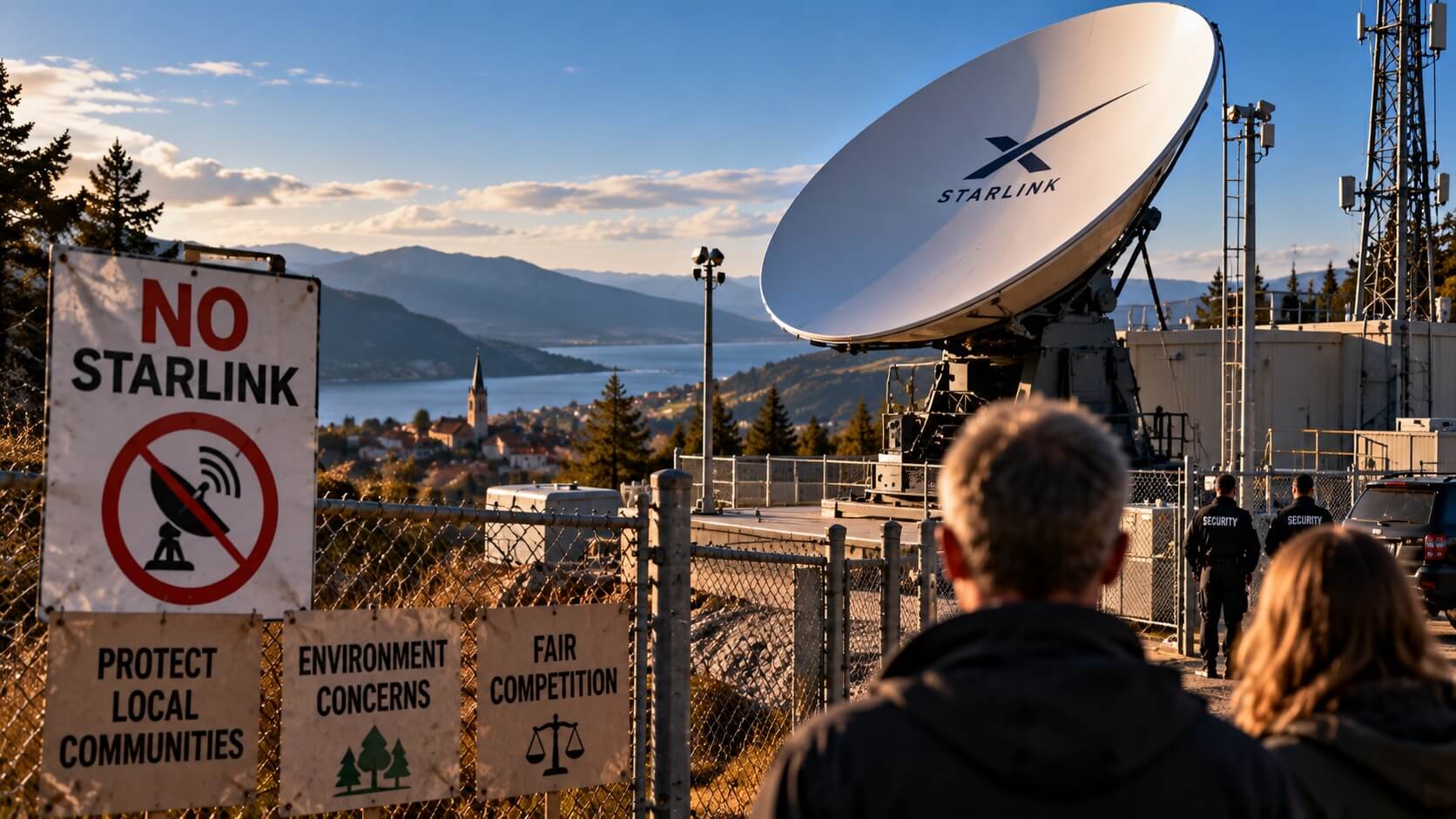
Some countries and users oppose Starlink because of concerns about national security, government control, telecommunications regulations, satellite congestion, and the growing influence of SpaceX over global communications. Although Starlink can deliver internet access to remote areas, its expansion has created political, economic, and technological controversies.
Not every country permits Starlink to operate commercially. Some governments require additional licenses, while others restrict foreign satellite internet providers or maintain tighter control over telecommunications infrastructure.
Users have different concerns. Some criticize the cost of equipment and subscriptions, while astronomers worry about satellite interference with observations of the night sky. Others question whether essential communications infrastructure should depend so heavily on one company.
For investors, these disagreements matter because Starlink's long-term growth depends on more than launching satellites. Regulatory approvals, customer demand, competition, and geopolitical relationships can influence how much revenue SpaceX can generate from its global network.
Why Don't Some People Like Starlink?
Starlink has attracted criticism for several reasons, but opposition does not come from a single group or concern.
The network offers important advantages, particularly in locations where fiber-optic and cellular infrastructure are limited. However, its expansion also creates trade-offs.
The most common criticisms involve:
- High costs: Equipment and subscription prices can be expensive compared with local internet alternatives.
- Satellite congestion: Large constellations increase the number of spacecraft operating in low Earth orbit.
- Astronomical interference: Satellites can affect observations made by ground-based telescopes.
- Environmental concerns: Launch activity, atmospheric effects, and satellite disposal raise scientific questions.
- Government sovereignty: Countries may object to foreign-controlled communications networks operating within their borders.
- Corporate control: Customers and governments may become dependent on infrastructure managed by one company.
- Military applications: Starlink's involvement in conflicts has raised questions about the responsibilities of commercial technology providers.
These concerns vary considerably.
A rural customer may primarily care about price and reliability. A telecommunications regulator may focus on licensing and national security. An astronomer may be more concerned about satellite brightness and interference.
Understanding these different perspectives helps explain why Starlink can be welcomed in one market while facing resistance in another.
What Countries Do Not Allow Starlink?
Starlink is not authorized to provide commercial service in every country.
The reasons vary, and regulatory conditions can change as governments approve new services, revise telecommunications policies, or negotiate with satellite operators.
Countries that have historically restricted, blocked, or not authorized Starlink include China, Russia, Iran, and North Korea.
Other countries have experienced regulatory disputes, delayed approvals, or restrictions on the use and importation of terminals.
However, there is an important distinction between a government explicitly banning Starlink and a country where Starlink has simply not received authorization.
A service may be unavailable because of licensing requirements rather than a formal prohibition.
| Country | Regulatory or political situation | Main consideration |
|---|---|---|
| China | Starlink is not authorized for ordinary domestic commercial service | Telecommunications control and national security |
| Russia | Starlink is not authorized for domestic commercial operation | Regulatory restrictions and geopolitical conflict |
| Iran | Starlink is not authorized as an ordinary domestic telecommunications service | Government controls and licensing restrictions |
| North Korea | No authorized commercial Starlink service | Strict government control over communications |
| India | Starlink has obtained major regulatory approvals, including telecommunications and space-sector authorizations, but commercial rollout remains subject to remaining requirements | Final regulatory compliance, security requirements, and commercial launch |
India illustrates why country-level restrictions should not be treated as permanent.
By October 2026, Starlink had secured important Indian regulatory approvals, including authorization from the Department of Telecommunications and IN-SPACe.
However, receiving major licenses does not necessarily mean that commercial service has already launched nationwide. Additional regulatory, technical, and operational requirements may still apply.
It would therefore be misleading to describe India simply as a country that has refused to license Starlink.
Similarly, the presence of terminals in a country does not prove that commercial service is legally authorized there.
Equipment may enter through unofficial channels, be used under exceptional circumstances, or operate in ways that conflict with local regulations.
Because licensing decisions change, investors should verify current authorization through Starlink's official availability information and the relevant national telecommunications regulator before treating a market as open or closed.
Why Do Governments Restrict Starlink?
Governments regulate telecommunications because communications networks affect national security, economic activity, public services, and access to information.
Starlink introduces additional challenges because its infrastructure operates across national borders.
A conventional telecommunications company may depend heavily on domestic towers, cables, and facilities.
A satellite internet provider can deliver connectivity through spacecraft operating above multiple countries.
This creates questions about how national regulations apply to a network managed by a foreign company.
National security concerns
Governments may worry about foreign access to communications infrastructure or dependence on technology controlled outside their jurisdiction.
Some countries require telecommunications providers to meet specific security, data-handling, or operational requirements.
Licensing requirements
Satellite internet providers may need permission to use radio frequencies, provide telecommunications services, import equipment, or operate ground infrastructure.
A company cannot assume that having satellite coverage automatically grants it the legal right to sell internet access.
Data and information controls
Some governments impose restrictions on how internet traffic is handled and what services are accessible.
Satellite internet can complicate those controls if its architecture differs from domestic telecommunications networks.
Protection of domestic telecommunications markets
Local operators may argue that foreign satellite providers should face comparable taxes, licensing obligations, and regulatory costs.
Governments may also consider the economic impact on domestic telecommunications businesses.
These factors help explain why Starlink's global expansion depends partly on negotiations with national regulators.
Why Is China Opposed to Starlink?
China has several strategic reasons to view Starlink cautiously.
The country maintains extensive regulation of telecommunications and internet access.
A foreign-operated satellite network does not fit easily into that framework.
There are also national security considerations.
Starlink has demonstrated that commercial satellite internet can support military-related communications, particularly during the war in Ukraine.
For governments concerned about foreign military capabilities, a large satellite constellation may be viewed as more than ordinary civilian infrastructure.
China is also developing its own satellite communications capabilities.
Domestic satellite networks could support commercial connectivity while reducing dependence on foreign providers.
This creates a combination of regulatory, economic, and strategic considerations.
However, it would be misleading to suggest that China's position is based on only one factor.
National telecommunications policy, military competition, technological independence, and industrial development all contribute to the broader context.
For investors, China's approach illustrates an important limitation of Starlink's addressable market.
A country may have substantial demand for internet connectivity without permitting SpaceX to serve that demand directly.
Why Has Starlink Been Controversial in Russia and Ukraine?
Starlink's role in Ukraine has made the network politically significant.
After Russia's full-scale invasion in February 2022, Starlink terminals helped maintain communications in areas affected by damaged or disrupted infrastructure.
The network has supported civilian organizations, emergency services, and military-related activities.
This demonstrated how commercial satellite internet could become important during an armed conflict.
However, it also raised difficult questions.
Should a commercial company decide which military applications its network supports?
What happens when a government depends on a commercial communications provider during a war?
Who is responsible for maintaining service availability in strategically important locations?
SpaceX has publicly discussed restrictions on certain offensive military uses of Starlink.
Those restrictions have contributed to debates about the responsibilities of commercial technology companies.
Reports of further operational restrictions and connectivity problems in October 2026 renewed attention to the reliability and control of communications used during military operations.
Such incidents should not automatically be attributed to a deliberate shutdown by SpaceX, because satellite communications can also be affected by electronic warfare, technical problems, network management, and geographic limitations.
Russia has also viewed satellite communications supporting Ukraine through the broader context of military competition.
At the same time, reports about unauthorized use of Starlink terminals have highlighted the challenge of controlling equipment once it enters a conflict environment.
The continuing importance of the network is examined in Is Ukraine Still Using Starlink? The Military Role of Satellite Internet.
For investors, the Ukraine experience demonstrates both the strategic value of satellite communications and the geopolitical risks associated with providing them.
Why Are Astronomers Concerned About Starlink?
Astronomers have raised concerns about the growing number of satellites in low Earth orbit.
Starlink operates a large constellation designed to provide widespread internet coverage.
As the number of satellites increases, so does the possibility that spacecraft will interfere with astronomical observations.
Satellite brightness
Satellites can reflect sunlight and appear as moving points of light across the night sky.
During long-exposure astronomical observations, these objects can create visible streaks in telescope images.
This can complicate the collection and processing of scientific data.
Radio interference
Radio astronomers study signals from distant objects in the universe.
Satellite communications systems operate using radio frequencies, creating concerns about interference with sensitive observations.
The severity depends on frequency use, equipment characteristics, and mitigation measures.
Growing orbital activity
Large satellite constellations increase the number of objects that observatories must account for.
SpaceX has introduced measures intended to reduce satellite brightness and mitigate certain impacts.
However, scientific organizations continue studying the effects of large constellations.
The issue is not simply whether satellites should exist.
It concerns how to balance expanding global communications with preserving the conditions needed for astronomical research.
For satellite operators, mitigation measures may create additional engineering and compliance requirements.
Does Starlink Create More Space Debris?
Starlink contributes to the growing number of objects operating in low Earth orbit.
However, an operational satellite is not automatically space debris.
Space debris generally refers to nonfunctional human-made objects, including inactive satellites, spent rocket stages, and fragments from collisions or explosions.
The concern is that more orbital activity can increase collision risks if spacecraft are not properly managed.
A collision can generate fragments that threaten other satellites.
This creates a potential chain of consequences because debris can remain in orbit and endanger additional spacecraft.
Starlink satellites are designed with propulsion and operational procedures intended to support collision avoidance and end-of-life disposal.
Many operate at relatively low altitudes, where atmospheric drag can help remove inactive spacecraft over time.
Nevertheless, collision avoidance depends on reliable tracking, maneuvering capability, coordination, and spacecraft performance.
Large constellations also create operational complexity.
For investors, orbital safety is a business issue as well as an environmental concern.
Collisions, regulatory requirements, or changes to disposal standards could affect satellite operating costs and future deployment plans.
Companies that provide space monitoring, tracking, and collision-avoidance services may also benefit from increased demand.
Is Starlink Too Expensive for Some Users?
Starlink's affordability depends heavily on location and the alternatives available.
In rural areas without reliable broadband infrastructure, satellite internet may provide substantial value.
A household that previously depended on slow or unreliable connectivity may find Starlink attractive despite higher equipment costs.
In cities with widespread fiber-optic coverage, the comparison can be different.
Traditional broadband providers may offer competitive speeds, lower prices, or more predictable service conditions.
Starlink customers may face several costs:
- Initial equipment purchase or other hardware arrangements.
- Monthly subscription charges.
- Potential additional charges for specialized plans.
- Installation or mounting equipment.
- Electricity required to operate the terminal.
Prices and service plans vary by country and can change over time.
This makes a single global price comparison misleading.
Affordability also depends on income levels and local purchasing power.
A subscription that is competitive in one country may be expensive in another.
For investors, this creates a challenge.
Starlink's technical coverage can extend across large geographic areas, but not every potential customer can afford or justify the service.
The commercially addressable market is therefore smaller than the total population living beneath the satellite constellation.
Why Do Some People Prefer Fiber Internet Over Starlink?
Starlink offers advantages where terrestrial broadband is limited, but it is not necessarily the best choice everywhere.
Fiber-optic internet can provide high capacity, low latency, and consistent performance when reliable infrastructure is available.
Starlink depends on satellite connectivity and shared network resources.
Its performance can vary with network congestion, equipment placement, environmental conditions, and service availability.
| Feature | Starlink | Fiber-optic broadband |
|---|---|---|
| Infrastructure | Satellite constellation and user terminal | Physical fiber network |
| Rural availability | Can serve areas without extensive local cabling | Depends on network deployment |
| Installation | Requires terminal and suitable sky visibility | Requires access to a fiber connection |
| Performance | Depends on satellite network conditions | Depends on provider and connection |
| Weather sensitivity | Can be affected by severe conditions | Generally less exposed to weather at the access link |
| Mobility | Available through eligible mobile or specialized plans | Usually fixed-location service |
Neither technology is universally superior.
Fiber can be highly attractive in densely populated areas where infrastructure already exists.
Starlink may be more valuable in remote locations where installing new cables would be expensive or impractical.
For SpaceX, this means its strongest competitive position may differ substantially across markets.
Demand is influenced not only by population but also by the quality and price of existing broadband alternatives.
Does Starlink Have Too Much Control Over Global Communications?
Some critics are concerned about the concentration of communications infrastructure under a single commercial operator.
Starlink combines satellite manufacturing, launch services, network operations, and customer connectivity within the SpaceX business.
This vertical integration provides operational advantages.
SpaceX can develop spacecraft, launch them using its own rockets, and operate the resulting network.
However, the same structure raises questions about dependence.
Governments, businesses, and emergency organizations may rely on a service whose technical and commercial decisions are made by one company.
This can become especially important when the service supports critical infrastructure.
Potential concerns include changes in pricing, service restrictions, network availability, contractual conditions, and geopolitical disagreements.
These issues are not unique to Starlink.
Similar questions arise whenever a small number of companies control infrastructure that large populations or institutions depend upon.
SpaceX's growing relationship with military and intelligence agencies is explored in Does SpaceX Do Defense Work? The Military Contracts Behind the Company.
For governments, the response may involve diversification, regulation, domestic alternatives, or dedicated communications systems.
For investors, the implications are mixed.
A strong market position can support customer growth and competitive advantages.
But concentration can also attract regulatory scrutiny and encourage governments to support competing networks.
Which Companies Compete With Starlink?
Starlink is not the only company providing satellite communications.
However, competitors use different technologies and business models.
Some operate satellites in low Earth orbit, while others rely on geostationary or medium Earth orbit systems.
Their customer markets also differ.
| Company or network | Main focus | Public-market access |
|---|---|---|
| Starlink / SpaceX | Broadband satellite internet and government connectivity | SpaceX is publicly traded on Nasdaq under SPCX |
| Eutelsat OneWeb | Low Earth orbit connectivity, including enterprise and government markets | Eutelsat is publicly traded in France |
| Viasat | Satellite communications for aviation, government, and other customers | Nasdaq: VSAT |
| SES | Satellite connectivity and government services | Publicly traded in Europe |
| Iridium Communications | Global satellite communications and specialized services | Nasdaq: IRDM |
| Amazon Leo, formerly Project Kuiper | Developing and deploying a low Earth orbit broadband network | Exposure through Amazon (AMZN) |
SpaceX's public listing in June 2026 changed how investors can obtain exposure to Starlink's parent company.
Investors can now evaluate SpaceX as a publicly traded business, although buying SpaceX shares provides exposure to its broader operations rather than a separate investment in Starlink alone.
These companies should not be treated as interchangeable.
Their satellite networks, capacity, coverage, pricing, and target customers differ.
A provider specializing in government communications may not compete directly for every residential customer.
Similarly, a broadband constellation still expanding its operations may face substantial capital costs before achieving mature commercial scale.
Competition could benefit customers through more choices and potentially lower prices.
But it may also place pressure on satellite operators' profit margins.
For investors, the important questions include capital requirements, customer acquisition costs, recurring revenue, and the ability to finance ongoing satellite replacement.
Can Governments Build Alternatives to Starlink?
Yes. Governments can develop their own satellite systems, purchase services from competing providers, or support partnerships with domestic and international companies.
However, building a large satellite communications network is expensive and technically demanding.
A functioning system requires much more than satellites.
It also needs launch services, ground infrastructure, user terminals, network software, spectrum coordination, and ongoing operations.
Large constellations require repeated launches and eventual satellite replacement.
Governments may therefore choose different approaches.
Some may fund domestic satellite networks to strengthen technological independence.
Others may purchase commercial services from multiple providers.
Military organizations may seek specialized networks with security features and operational arrangements tailored to defense requirements.
Europe's IRIS² initiative is an example of efforts to develop secure satellite connectivity with a strategic autonomy objective.
Such programs demonstrate that governments view satellite communications as infrastructure with economic and national security importance.
However, announcing a satellite program is not the same as deploying a fully operational network.
Development timelines, financing, technical performance, and procurement decisions can affect outcomes.
How Do Starlink Restrictions Affect SpaceX's Growth?
Starlink's potential market is enormous, but technical coverage does not automatically translate into paying customers.
The company must obtain regulatory approvals, provide suitable equipment, maintain network capacity, and offer services at prices customers are willing to pay.
Restrictions can influence growth in several ways.
Limited market access: Countries that do not authorize Starlink may remain unavailable to ordinary commercial customers.
Delayed expansion: Licensing negotiations can postpone service launches.
Compliance costs: Different national rules may require additional investment in legal, technical, and operational processes.
Competition from domestic providers: Governments may encourage local satellite or terrestrial communications networks.
Political risk: International disputes may affect service availability and business relationships.
Customer affordability: Even authorized markets may have limited demand at prevailing prices.
These factors make Starlink's long-term revenue potential difficult to estimate using population coverage alone.
Investors also need to consider the cost of maintaining and expanding the constellation.
Satellites have finite operating lives, and replacement launches require continuing investment.
Since SpaceX became publicly traded in June 2026, investors have gained access to public financial disclosures that were not available under its previous private ownership structure.
However, public financial reporting does not necessarily provide a complete standalone breakdown of Starlink's profitability, capital expenditure, or customer economics.
Investors should distinguish between information disclosed for SpaceX as a whole and financial details specifically attributable to Starlink.
Therefore, forecasts about Starlink's long-term financial performance should be treated as estimates unless supported by identifiable financial disclosures.
Could Opposition to Starlink Benefit Other Space Companies?
Regulatory concerns and the desire for alternative communications networks could create opportunities for competing providers.
Governments may seek suppliers that offer greater operational control, specialized security arrangements, or domestic partnerships.
Companies involved in satellite manufacturing, communications equipment, and launch services may also benefit when new networks are developed.
However, competition does not automatically create profitable opportunities.
Developing satellite infrastructure requires substantial capital, and government-backed projects can face delays or budget changes.
For publicly traded companies, investors should examine several factors.
Contract backlog: Does the company have funded work rather than only potential opportunities?
Recurring revenue: Are customers paying for ongoing services?
Operating margins: Can the company provide connectivity profitably?
Capital expenditure: How much investment is required to maintain and expand its network?
Debt and financing: Can the company fund its operations without excessive financial pressure?
Customer concentration: Does revenue depend on a small number of government or enterprise contracts?
These measures provide a more useful foundation for investment analysis than assuming that every competitor will benefit from criticism of Starlink.
What Does the Starlink Debate Mean for the Space Defense Industry?
Starlink's controversies are part of a broader discussion about the militarization and commercialization of space.
Governments increasingly depend on satellite systems for communications, navigation, intelligence gathering, and other critical activities.
Commercial companies are becoming important suppliers of those capabilities.
This creates new opportunities but also new dependencies.
A satellite network designed for civilian customers may become strategically important during a conflict.
A government may welcome commercial innovation while remaining concerned about foreign control over essential infrastructure.
A company may benefit from defense contracts while facing criticism over how its technology is used.
These developments are connected to the broader transformation examined in Space Defense Explained: How Militaries, SpaceX and Starlink Shape the Space Economy.
For investors, the key issue is not whether commercial satellite networks will face controversy.
It is how companies and governments respond to the challenges of regulation, security, competition, and infrastructure resilience.
Will More Countries Ban or Approve Starlink?
Both outcomes are possible.
Some governments may approve Starlink because it can improve connectivity in underserved regions, support economic activity, and provide communications resilience.
Others may impose restrictions because of national security concerns, regulatory requirements, or a preference for domestic infrastructure.
Approval may also come with conditions involving licensing, equipment certification, spectrum use, or local partnerships.
There is no single regulatory model that applies to every country.
The future availability of Starlink will depend on national policies, negotiations, technological developments, and market demand.
Investors should avoid treating today's restrictions as permanent.
A country that currently lacks authorization may approve service later.
Conversely, a market that permits Starlink may introduce additional rules or modify existing conditions.
Regulatory uncertainty is therefore an ongoing business risk rather than a one-time obstacle.
What Investors Should Understand About Opposition to Starlink
Starlink has transformed satellite internet by making broadband connectivity available in locations where traditional infrastructure can be difficult or expensive to deploy.
But its success has also created concerns about government sovereignty, military applications, orbital congestion, astronomy, pricing, and dependence on commercial infrastructure.
Some countries restrict or do not authorize Starlink, while others see it as a valuable tool for expanding connectivity.
For SpaceX, these differences influence market access and long-term growth.
Its public listing in June 2026 also means investors can obtain direct equity exposure to the parent company, although its valuation reflects activities beyond Starlink.
For competitors, regulatory restrictions and demand for alternative networks may create opportunities to offer communications services and specialized government solutions.
However, regulatory opposition alone does not guarantee that competing businesses will become profitable.
The central investment lesson is that satellite internet is both a technology market and a geopolitical market. Commercial success depends not only on network performance but also on regulatory approval, customer affordability, capital efficiency, and trust.
As satellite communications become more important to the global economy and national security, these factors will increasingly shape which companies succeed.
Disclaimer: This article is for informational and educational purposes only and does not constitute financial or investment advice. Investing involves risk, including the possible loss of principal.