
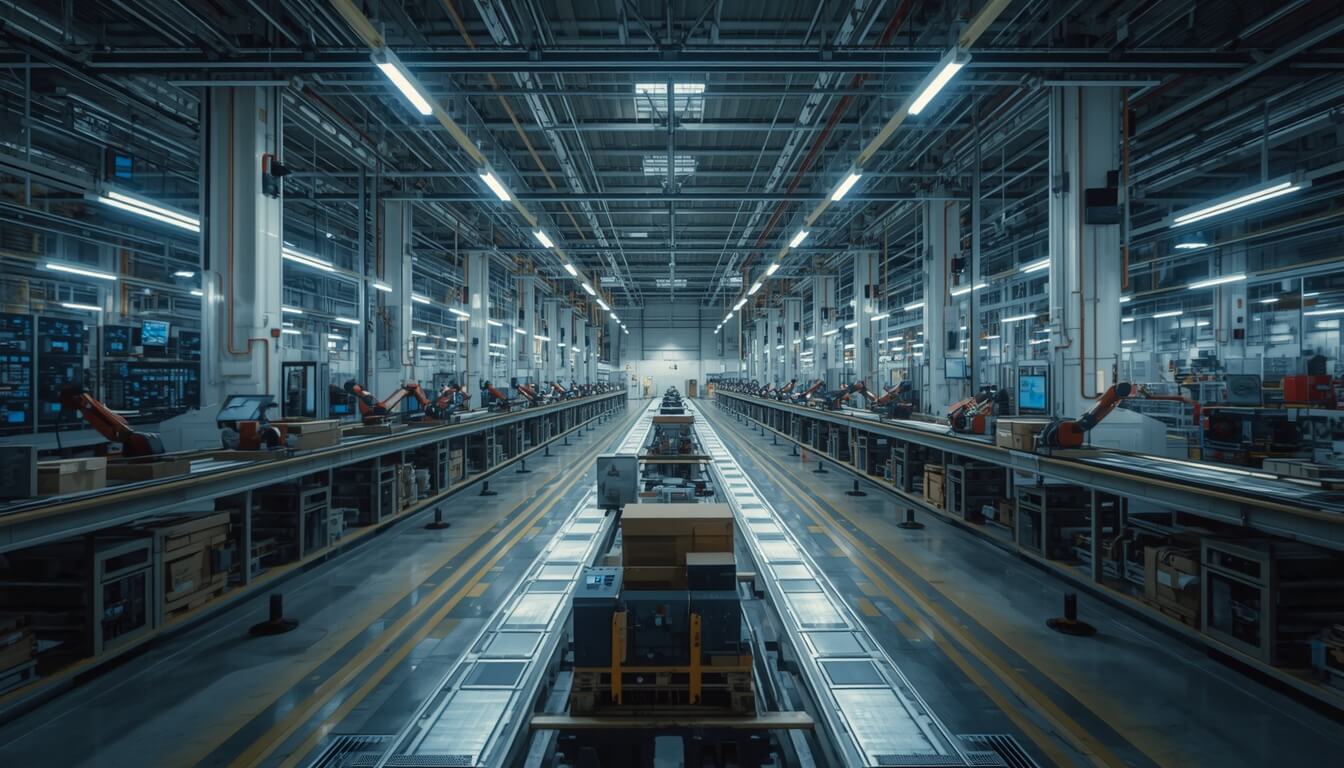
Automation has been transforming manufacturing for decades, but advances in robotics, artificial intelligence, machine vision, and industrial software could accelerate that transformation.
For much of the industrial era, manufacturers relied heavily on human labor for assembly, material handling, inspection, packaging, and other production activities. Machines gradually replaced or assisted workers in many repetitive processes, while increasingly sophisticated production systems allowed factories to manufacture larger quantities of goods with greater consistency.
The next phase could be different.
Modern automation is becoming more flexible, connected, and capable of responding to changes in the production environment. Instead of simply repeating predefined movements, robotic systems can increasingly interact with sensors, software, databases, and artificial intelligence.
This development could influence not only individual factories but also the organization of global manufacturing.
The effects will not be uniform. Different industries have different production requirements, while countries differ in labor costs, energy prices, infrastructure, regulations, and access to capital. Nevertheless, increasingly capable automation could change the economic calculations behind where and how products are manufactured.
The next era of global manufacturing may not be defined by factories without people. It may instead be defined by factories in which people, machines, software, and data operate together in increasingly integrated production systems.
From Labor-Intensive Production to Automated Production
For decades, labor costs have been an important factor in determining where companies locate manufacturing operations.
Industries requiring large numbers of workers have often developed substantial production capacity in countries where labor costs were comparatively low. Global supply chains subsequently evolved around these manufacturing centers.
Automation could change part of this equation.
If machines can perform a larger proportion of production activities economically, the relative importance of labor costs may decline for certain manufacturing processes.
This does not mean labor will become irrelevant. Factories will still require engineers, technicians, operators, managers, maintenance specialists, and other workers. However, the number and type of workers required for a given level of production could change.
A highly automated factory may require fewer workers directly involved in repetitive production while requiring more employees with technical and engineering skills.
The result could be a shift in the composition of industrial employment rather than a simple disappearance of manufacturing jobs.
Reshoring and Regional Manufacturing
One potential consequence of increased automation is a greater ability to manufacture products closer to their final markets.
When labor represents a large proportion of total production costs, companies may have strong incentives to locate factories in lower-cost regions.
If automation reduces the labor component of production, transportation costs, supply-chain risks, energy availability, and proximity to customers could become relatively more important.
This could support increased regional manufacturing in some industries.
Companies may find it economically attractive to operate smaller, highly automated facilities closer to major consumer markets rather than relying entirely on very large production centers located thousands of kilometers away.
Such a transition would not eliminate international trade. Global supply chains would remain important for raw materials, components, specialized equipment, and many other products.
Instead, manufacturing networks could become more geographically diversified.
Supply Chains Could Become More Flexible
The disruptions experienced by global supply chains in recent years have increased attention on resilience.
Manufacturers have had to consider shortages, transportation disruptions, geopolitical risks, energy costs, and unexpected changes in demand.
Automation could contribute to supply-chain resilience by making it easier to adjust production capacity.
A factory capable of rapidly changing production processes may be able to respond more efficiently to changes in demand. Flexible robotic systems can potentially be reprogrammed for different products or tasks without requiring a completely new production line.
This is particularly relevant for industries where product lifecycles are becoming shorter.
Instead of designing a factory around one product for many years, manufacturers could increasingly seek production systems capable of adapting to multiple products.
Smaller Production Runs Could Become More Economical
Traditional mass production benefits from scale.
Producing millions of identical products allows companies to distribute the cost of specialized machinery across a very large number of units.
Automation that is easier to program and reconfigure could change this relationship.
If robots can switch between different tasks with limited downtime and engineering intervention, manufacturers may be able to produce smaller batches economically.
This could support more customized manufacturing.
For example, instead of producing large quantities of one standardized product, a factory could manufacture several variations according to changing customer requirements.
The combination of robotics, digital manufacturing, automated inspection, and software-controlled production could make this flexibility increasingly practical.
The Factory of the Future Could Be More Software-Driven
Another major change could involve the role of software in manufacturing.
Traditional factories are built around physical equipment. Machines perform specific operations, while production planning and monitoring systems coordinate those activities.
Modern factories are increasingly integrating software into almost every stage of production:
- Robotic systems can generate operational data.
- Sensors can monitor equipment conditions.
- Manufacturing execution systems can track production.
- Artificial intelligence can analyze patterns.
- Digital twins can simulate production processes before physical changes are introduced.
This creates a more interconnected manufacturing environment.
The factory increasingly becomes a combination of physical machines and digital systems.
That development could make software expertise strategically important for manufacturers. Companies may need to manage not only machinery and production processes but also industrial networks, data infrastructure, cybersecurity, AI systems, and software integration.
Productivity and Capital Investment
Automation can increase productivity by allowing machines to operate continuously, perform repetitive tasks consistently, and reduce certain forms of production variability.
However, automation also requires investment.
Robotic equipment, sensors, software, integration, maintenance, and employee training all involve costs. The economic benefits therefore depend on whether the additional productivity and flexibility justify the investment.
This calculation can vary significantly between companies.
Large manufacturers with substantial production volumes may be able to justify sophisticated automation more easily than smaller manufacturers. At the same time, falling costs and easier deployment could gradually make automation accessible to smaller companies.
This is one reason developments in collaborative robotics and simplified programming are important.
Automation does not have to mean constructing an entirely automated factory. Companies can gradually automate individual processes where the economic case is strongest.
The Workforce Will Change
The effect of automation on employment is one of the most closely watched aspects of industrial robotics.
Automation can reduce the need for human labor in some repetitive tasks while increasing demand for other types of work.
A factory introducing advanced robotics may need fewer employees performing manual handling but more technicians capable of maintaining robotic systems. It may also require software specialists, engineers, data analysts, and employees responsible for integrating automated equipment with existing production systems.
This creates a workforce transition.
The challenge for manufacturers and governments is not simply the number of jobs affected but whether workers can move into the new roles created by increasingly automated production.
Training and technical education could therefore become increasingly important components of industrial policy.
Manufacturing Skills Could Become More Technical
As factories become more automated, industrial skills may increasingly combine mechanical knowledge with software and electronics.
A modern maintenance technician may need to understand:
| Skill area | Why it matters |
|---|---|
| Robotics | Maintaining and programming robotic systems |
| Sensors | Monitoring equipment and production conditions |
| Industrial networks | Connecting machines and data systems |
| Programmable controllers | Controlling automated machinery |
| Diagnostic software | Troubleshooting and maintaining systems |
Similarly, production engineers may need to work with data and simulation tools in addition to traditional manufacturing processes.
This does not mean traditional industrial skills will disappear. Mechanical engineering, machining, electrical systems, and practical production knowledge will remain essential.
Instead, manufacturing roles could become increasingly interdisciplinary.
The ability to understand both physical production and digital systems could become particularly valuable.
Automation and Emerging Markets
Automation could also influence the development of manufacturing in emerging economies.
Countries that have historically competed primarily through relatively low labor costs may face pressure to increase productivity through technology.
At the same time, automation could create opportunities.
If manufacturing becomes less dependent on very large pools of low-cost labor, countries with reliable infrastructure, energy supplies, technical education, and access to capital could potentially attract investment even when their labor costs are higher.
The outcome will depend on many factors, including access to technology and the ability of local industries to develop the necessary technical workforce.
Automation could therefore alter the competitive landscape between manufacturing regions, but it will not produce identical outcomes everywhere.
Energy Could Become More Important
Highly automated factories depend on electricity.
Robots, industrial computing systems, automated storage, machine vision, climate-control systems, and other equipment all consume energy.
If automation expands substantially, energy availability and electricity prices could become increasingly important factors in industrial location decisions.
This creates an interesting interaction between automation and the energy transition.
Manufacturers seeking to reduce operating costs and emissions may have incentives to locate facilities where reliable and competitively priced low-carbon electricity is available.
As a result, energy infrastructure could become an increasingly important component of industrial competitiveness.
The Importance of Industrial Infrastructure
Automation cannot operate independently of the surrounding infrastructure.
Factories require:
- Reliable electricity
- Telecommunications networks
- Industrial suppliers
- Transportation infrastructure
- Skilled technical workers
They also require access to components and spare parts.
A highly automated factory may have fewer workers on the production floor, but it can become more dependent on sophisticated equipment and digital systems.
A failure involving a critical robot, controller, network component, or software system can interrupt production.
This means that resilience in automated manufacturing requires not only redundancy in physical production but also robust digital and technical infrastructure.
Cybersecurity Becomes More Important
As factories become increasingly connected, cybersecurity becomes an important part of industrial operations.
Robots and industrial control systems that were once relatively isolated can increasingly communicate with enterprise networks, cloud services, remote monitoring platforms, and other systems.
Connectivity creates opportunities for efficiency and visibility, but it also increases the importance of protecting industrial environments.
Manufacturers may therefore need to invest in:
- Network segmentation
- Access controls
- Monitoring
- Software updates
- Backup systems
- Other security measures
The more important software becomes to physical production, the more important digital security becomes to manufacturing continuity.
Automation Could Change Factory Design
The physical design of factories could also evolve.
Traditional production facilities often contain long production lines organized around a sequence of specialized machines.
More flexible robotics could allow manufacturers to design production areas around modular cells.
A production cell could contain robotic arms, vision systems, automated material handling, and other equipment configured for a particular group of products. Software could coordinate these cells and dynamically allocate production tasks.
Such a model could make factories easier to reconfigure when products or demand change.
The factory would become less dependent on a single rigid production sequence and more capable of adapting its configuration over time.
The Role of Human Workers Will Not Disappear
Despite rapid technological progress, the idea of a completely autonomous factory is not necessarily applicable to every manufacturing environment.
Many industrial tasks involve exceptions, unexpected conditions, complex decision-making, maintenance, and physical situations that remain difficult to automate economically.
Human workers can also provide flexibility that machines may struggle to reproduce.
The more realistic development in many industries may therefore be increased collaboration between people and machines.
Robots can handle repetitive or physically demanding activities while humans supervise processes, resolve exceptions, perform maintenance, manage quality, and make decisions requiring broader context.
This model can combine the consistency of automation with human adaptability.
A More Distributed Manufacturing System
Taken together, these developments could lead toward a more distributed manufacturing model.
Instead of concentrating production almost entirely in a small number of very large factories, companies could operate networks of smaller and highly automated facilities closer to important markets.
The economic feasibility of this model will depend on automation costs, energy prices, transportation expenses, demand patterns, and the availability of technical expertise.
It will also depend on the products themselves.
Some industries will continue to benefit from enormous centralized factories because their production processes depend heavily on scale. Others may find greater flexibility valuable.
The result is likely to be a mixture of manufacturing models rather than a single global pattern.
Automation Will Not Affect Every Industry Equally
The potential impact of automation differs considerably between sectors.
Automotive manufacturing has already achieved high levels of industrial automation. Electronics production also relies heavily on sophisticated machinery and precision systems.
Other industries, particularly those involving highly variable products or complex manual tasks, may face greater challenges.
Food production, construction-related manufacturing, textiles, and certain forms of assembly can involve physical variability that makes automation more difficult.
Technological progress could gradually address some of these challenges, but adoption will depend on the technical and economic characteristics of each application.
A New Manufacturing Equation
The global manufacturing system has historically been shaped by a combination of labor costs, transportation, access to raw materials, infrastructure, market size, and economies of scale.
Automation adds another important variable.
As robotic systems become more capable and flexible, companies may increasingly evaluate production locations according to a different set of factors.
Technical skills, electricity, software infrastructure, automation expertise, supply-chain resilience, and proximity to customers could become increasingly important alongside traditional labor costs.
This does not guarantee a global manufacturing revolution, but it creates the possibility of gradual structural change.
The companies developing these technologies are part of a rapidly expanding industrial ecosystem. The technologies and businesses behind that transition are examined in The Companies Building the Next Generation of Industrial Robots.
The broader technological shift behind these developments is discussed in Why Industrial Robotics Is Entering a New Era.
The Long-Term Outlook for Global Manufacturing
Automation could reshape global manufacturing through several interconnected changes: greater production flexibility, more sophisticated factories, changing workforce requirements, increased demand for technical skills, and potentially more geographically distributed production.
However, the scale and speed of these changes remain uncertain.
Technology alone does not determine industrial outcomes. Capital availability, regulation, energy infrastructure, labor markets, supply chains, consumer demand, and geopolitical conditions will all influence how quickly manufacturers adopt new automation technologies.
For manufacturers, the central question may therefore become less about whether automation is possible and more about where it creates a measurable economic advantage.
Some processes will become highly automated. Others will continue to depend heavily on human workers. Many factories will likely combine both approaches.
What is changing is the range of possibilities available to manufacturers.
Robotics, artificial intelligence, sensors, software, and connected industrial systems are giving companies new ways to organize production. As these technologies mature, they could gradually alter the economics and geography of manufacturing around the world.