
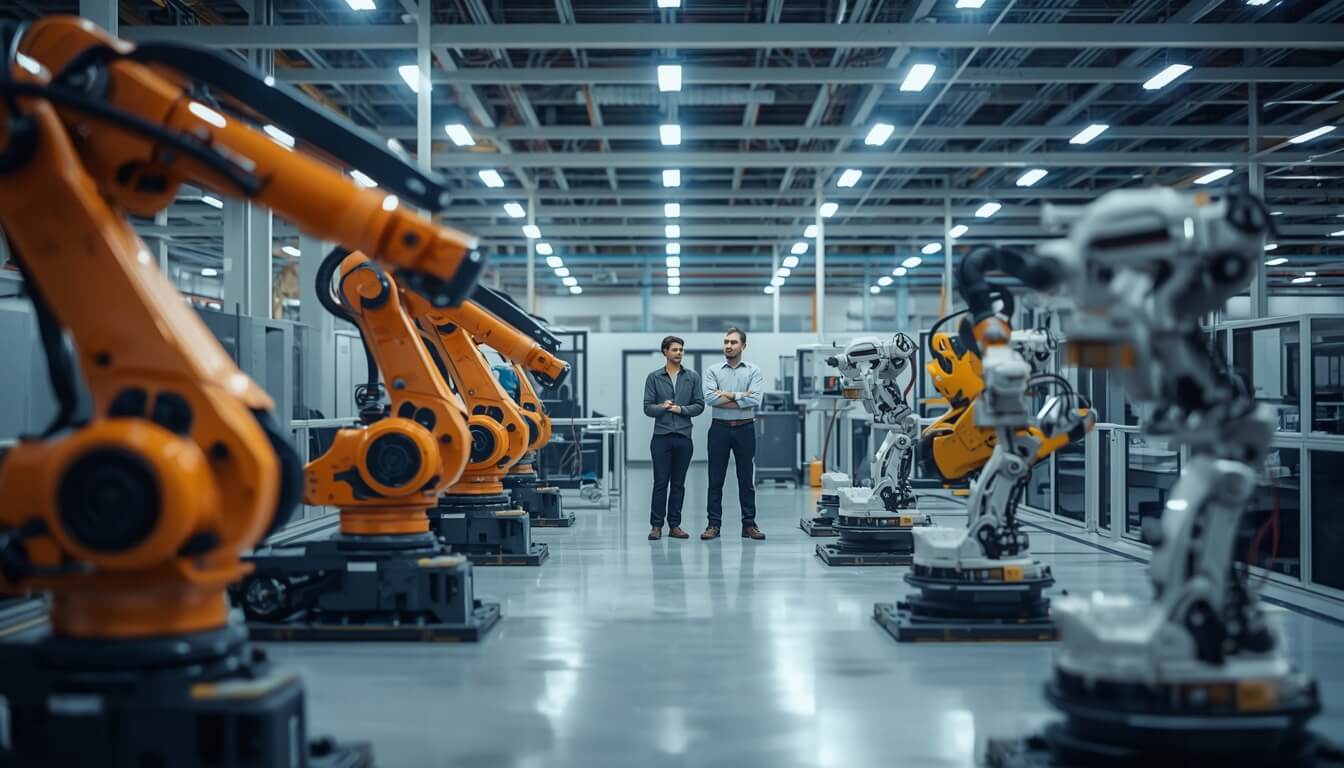
The industrial robotics industry is undergoing a broad technological transition. Established manufacturers continue to develop faster and more precise robotic systems, while a new generation of companies is combining robotics with artificial intelligence, computer vision, autonomous navigation, and advanced software.
The result is an increasingly diverse robotics ecosystem.
Industrial robots are no longer limited to traditional robotic arms operating behind safety barriers. Modern automation can include collaborative robots, autonomous mobile robots, vision-guided systems, warehouse robots, robotic inspection platforms, and software designed to coordinate entire fleets of machines.
The companies developing these technologies are therefore competing across several different layers of the industrial automation market.
Some have decades of experience in factory automation. Others come from the fields of artificial intelligence, autonomous systems, or advanced computing. Together, they are contributing to a new generation of industrial robotics.
The key shift: industrial robotics is moving from standalone machines toward interconnected systems where hardware, software, AI, and data operate together.
ABB and the Evolution of Industrial Automation
ABB is one of the established names in industrial robotics and automation. The company has developed robotic arms and automation systems for industries including automotive, electronics, logistics, food and beverage, and general manufacturing.
Its robotics business illustrates how traditional industrial automation is expanding beyond mechanical systems.
Modern robotic installations increasingly depend on software, simulation, machine vision, connectivity, and data analysis. This means that the value of a robotic system is no longer determined solely by the mechanical performance of the arm.
ABB has invested in collaborative robotics, autonomous mobile robots, machine vision, and software platforms designed to integrate robots into broader production environments.
This reflects a wider change across the industry: established robotics companies are increasingly positioning their machines as components of connected automation systems rather than standalone equipment.
FANUC and High-Volume Manufacturing
Japan's FANUC is another major player in industrial robotics.
The company has built a global presence around industrial robots, computer numerical control systems, and factory automation. Its robotic systems are widely associated with applications requiring precision, repeatability, and high production volumes.
Automotive manufacturing remains an important application for industrial robotics, but modern systems are also used in electronics, food production, logistics, and other sectors.
FANUC's position highlights an important characteristic of the robotics market.
The future of robotics is not necessarily about replacing conventional industrial robots with completely different machines. Many of the world's most productive factories will continue to rely on highly specialized robotic systems designed for speed and repeatability.
Instead, the industry is expanding in two directions simultaneously: increasingly sophisticated conventional automation and more flexible robotic platforms.
Yaskawa and the Convergence of Robotics and Motion Control
Yaskawa Electric is another Japanese company with a long history in industrial automation.
Its activities span industrial robots, motion control, drives, and automation technologies. This combination is important because modern manufacturing increasingly depends on coordination between mechanical systems and electronic control.
Robotic arms need precise motion control. Production lines require synchronization between machines. Automated handling systems need to coordinate movement with sensors and other equipment.
The convergence of these technologies allows manufacturers to build increasingly integrated production environments.
Yaskawa's robotics portfolio includes systems for welding, assembly, material handling, painting, and other industrial applications, demonstrating the continuing importance of specialized automation alongside newer AI-driven approaches.
KUKA and Flexible Manufacturing
Germany's KUKA is particularly associated with industrial robots and automated manufacturing systems.
The company has developed robotic solutions for automotive production, electronics, logistics, healthcare, and other industries. Its portfolio includes conventional industrial robots as well as collaborative and mobile systems.
KUKA is also an example of how robotics is becoming increasingly connected to manufacturing software.
As factories become more complex, the ability to simulate production processes, coordinate robots, and integrate machines into existing industrial infrastructure becomes increasingly important.
Digital simulation can allow manufacturers to evaluate robotic production cells before physical installation. This can reduce commissioning time and help identify potential problems earlier in the deployment process.
Universal Robots and Collaborative Automation
Universal Robots helped popularize the collaborative robot category.
Collaborative robots are designed to work in environments where people and machines operate in closer proximity, subject to appropriate safety requirements and risk assessments. Their relatively compact designs and emphasis on easier deployment have made them attractive to companies seeking flexible automation.
One of the important characteristics of collaborative robotics is accessibility.
Traditional industrial automation can require substantial engineering work. Collaborative robot platforms are often designed to simplify programming and deployment, allowing companies to automate individual processes without building an entirely new production line.
This can be particularly relevant for small and medium-sized manufacturers.
Instead of automating an entire factory, a company can introduce a robot into a specific process, evaluate the results, and expand automation gradually.
The Rise of Autonomous Mobile Robots
Industrial robotics is also expanding beyond stationary robotic arms.
Autonomous mobile robots, or AMRs, are designed to transport materials through factories, warehouses, and other industrial facilities. Rather than following fixed paths, modern systems can use sensors and software to navigate dynamic environments.
Companies such as Mobile Industrial Robots have developed autonomous mobile platforms for material transportation and internal logistics.
This represents a different approach to industrial automation.
| Type of robot | What it changes |
|---|---|
| Robotic arm | How a particular task is performed |
| Autonomous mobile robot | How materials move between different parts of a facility |
When combined with robotic arms and automated storage systems, mobile robots can contribute to a more automated material flow throughout the factory.
Boston Dynamics and Mobile Robotics
Boston Dynamics represents another branch of the robotics industry.
The company's development of highly mobile robotic platforms has demonstrated how advances in mechanical engineering, sensing, control systems, and autonomous movement can produce machines capable of operating in environments designed for humans.
Its industrial efforts have included robotic systems for inspection and data collection.
The importance of this technology extends beyond a single application. Robots capable of navigating complex environments could potentially perform tasks in facilities where fixed automation would be difficult or expensive to install.
This could include industrial inspection, infrastructure monitoring, inventory operations, and other activities where mobility is important.
NVIDIA and the Computing Infrastructure Behind Robotics
Not every company shaping industrial robotics manufactures robots.
NVIDIA has become an important technology provider for the robotics ecosystem through its work in GPUs, artificial intelligence computing, simulation, and robotics software platforms.
Modern robots require increasingly sophisticated computing capabilities. Vision processing, machine learning, simulation, perception, and autonomous decision-making can require substantial computational resources.
The industrial robotics market increasingly depends on technologies originating outside traditional robotics manufacturing.
Graphics processors originally developed for high-performance computing and visual applications can now support AI models and robotic perception systems.
Simulation is particularly important because training and testing robotic systems in physical environments can be expensive and time-consuming. Virtual environments can provide an additional way to develop and evaluate robotic behavior before deployment.
AI-Native Robotics Companies
Alongside established manufacturers, newer companies are attempting to build robots around artificial intelligence from the beginning.
Companies such as Figure are developing humanoid robotic systems designed to operate in environments created for human workers. Others are working on general-purpose robotic platforms intended to perform multiple tasks rather than a single highly specialized operation.
This approach is significantly different from traditional industrial robotics.
A conventional robot is typically optimized for a clearly defined industrial process. An AI-oriented general-purpose robot aims to provide greater adaptability, potentially allowing one platform to perform several different activities.
The technology remains an evolving field, and commercial capabilities vary considerably between companies and applications. Nevertheless, the development of these systems demonstrates how artificial intelligence is expanding the definition of industrial robotics.
The Importance of Vision and Perception
Computer vision companies are also becoming increasingly relevant to robotics.
A robot can only respond intelligently to its environment if it can obtain useful information about that environment. Cameras, depth sensors, force sensors, and other perception technologies therefore play a central role in modern robotic systems.
Companies developing machine vision hardware and software can provide technologies that allow robots to identify components, inspect products, locate objects, and detect changes in their surroundings.
This creates an increasingly modular robotics ecosystem.
A robot manufacturer may provide the mechanical platform, another company may supply the vision system, another may provide the computing hardware, and specialized software companies may provide the applications connecting everything together.
Software Is Becoming a Competitive Layer
One of the most important changes in the industry is the growing importance of software.
Robots need software to control movement, interpret sensor data, plan tasks, communicate with other machines, and interact with manufacturing systems.
As artificial intelligence becomes more sophisticated, software could become an increasingly important differentiator between robotic platforms.
The physical structure of a robotic arm can be highly engineered and difficult to change quickly. Software, however, can be updated, optimized, and expanded over time.
This creates a technology model in which a robot installed today could potentially gain new capabilities through software improvements rather than requiring complete hardware replacement.
An Increasingly Competitive Ecosystem
The industrial robotics market is therefore becoming more complex.
Established companies such as ABB, FANUC, Yaskawa, and KUKA continue to provide the hardware and automation expertise required by large industrial customers. Collaborative robotics companies are making automation more accessible to smaller operations. Mobile robotics companies are addressing internal logistics, while AI and computing companies are developing technologies that could enable more adaptable machines.
These categories are increasingly overlapping.
A future industrial automation system could combine robotic arms, mobile robots, machine vision, AI computing, digital simulation, and cloud or edge software within a single coordinated environment.
This makes partnerships and technological integration increasingly important.
From Individual Robots to Robotic Systems
The next generation of industrial robotics is therefore unlikely to be defined by one company or one type of machine.
Instead, the industry is moving toward interconnected robotic systems in which hardware, sensors, software, artificial intelligence, and industrial infrastructure operate together.
That transition could affect how factories are designed.
Rather than building production lines around fixed machines performing isolated tasks, manufacturers could increasingly design facilities around flexible robotic cells and software-controlled production processes.
The economic implications of this development extend beyond robotics manufacturers themselves. Equipment suppliers, semiconductor companies, software developers, logistics providers, system integrators, and manufacturers could all become part of the expanding automation ecosystem.
The question is consequently no longer simply which companies manufacture the most robots.
It is which companies can provide the technologies required to make increasingly capable robots useful, reliable, and economically viable at industrial scale.
The Next Stage of Manufacturing
The companies developing industrial robotics are approaching the market from different directions.
Some specialize in precision and high-speed automation. Others focus on collaboration, mobility, artificial intelligence, perception, or computing infrastructure. Their technologies may compete in some areas while complementing each other in others.
This diversity is one of the defining characteristics of the current robotics industry.
As these technologies mature, their combined impact could extend far beyond individual robotic installations. Factories may increasingly use automation not simply to perform repetitive operations but to coordinate production, movement, inspection, maintenance, and other processes across the entire facility.
The consequences could reach global manufacturing itself.
If flexible automation becomes increasingly capable and economically viable, manufacturers may reconsider production strategies, workforce requirements, supply chains, and the geographic distribution of industrial activity.
The broader implications of that transition are examined in How Automation Could Reshape Global Manufacturing.
At the same time, understanding the technological foundations of this transformation requires looking back at the broader shift taking place inside industrial robotics itself. Why Industrial Robotics Is Entering a New Era provides that wider context.
The industrial robotics industry is therefore evolving from a market centered primarily on robotic machines into a broader technology ecosystem.
The companies that succeed in this environment will not necessarily be those that build robots alone. They may also be the companies capable of combining robotics with artificial intelligence, perception, computing, software, and industrial connectivity.
That convergence could define the next generation of automation.