
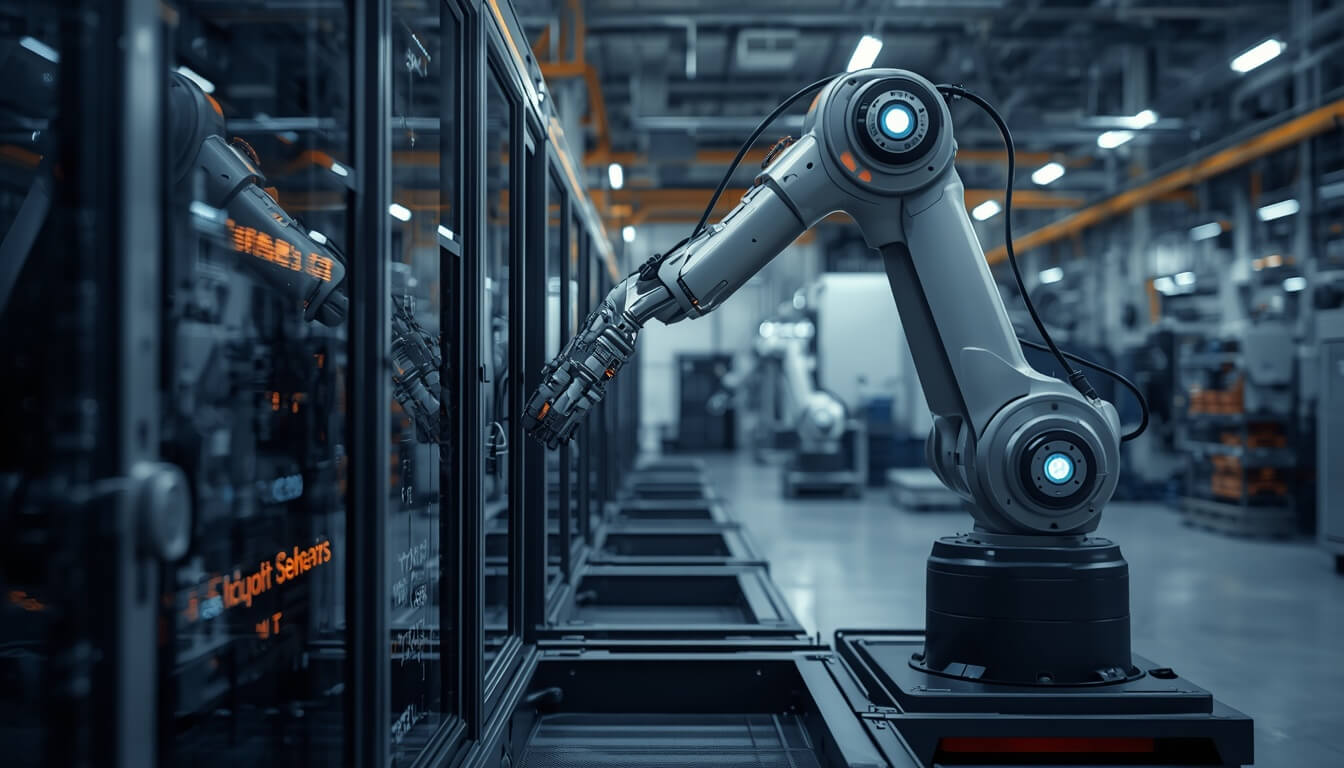
Industrial robotics is entering a new phase of development. For decades, robots in factories were primarily associated with repetitive, highly structured tasks such as welding, painting, assembly, packaging, and material handling. These systems transformed manufacturing by improving consistency, productivity, and workplace safety.
Today, however, industrial robotics is evolving beyond traditional automation. Advances in artificial intelligence, computer vision, sensors, software, connectivity, and collaborative robotics are making machines more adaptable to changing production environments. Instead of performing only a fixed sequence of movements, newer robotic systems can increasingly perceive their surroundings, respond to variations, and work alongside human operators.
This transition could have significant implications for the future of global manufacturing.
Industrial robotics is shifting from fixed automation toward intelligent, connected systems that can adapt to their environment and collaborate with humans.
From Fixed Automation to More Flexible Robots
Traditional industrial robots were designed around predictability. A robot installed on a production line would normally repeat the same programmed movements thousands or millions of times. This approach remains highly effective for large-scale manufacturing. When products, components, and production conditions remain stable, dedicated automation can provide exceptional precision and reliability.
The limitation is flexibility.
Modern manufacturing increasingly requires shorter production runs, greater product variety, and faster changes between different configurations. A robotic system that needs extensive reprogramming every time the production process changes can become less attractive in environments where flexibility is important.
New generations of robots are being developed with this challenge in mind. Improved software and sensing technologies allow machines to interact with more variable environments and perform tasks that previously required a greater degree of human intervention.
The result is a shift from automation based almost entirely on predetermined instructions toward systems capable of responding to information collected from their surroundings.
Artificial Intelligence Is Changing Robot Capabilities
Artificial intelligence is becoming an increasingly important component of modern robotics.
Machine learning can help robotic systems recognize objects, identify patterns, detect anomalies, and improve their ability to perform complex tasks. Computer vision allows robots to interpret visual information from cameras and other sensors, while AI-based software can help determine how a robot should respond to changing conditions.
For example, a conventional robotic arm may be programmed to pick up an object from a precise location. If the object moves several centimeters, the system may require additional programming or a different mechanism to locate it.
A more advanced robotic system can use cameras and computer vision to identify the object and calculate its position before attempting to pick it up.
This distinction is important because it changes the economics of automation. If robots can handle greater variability, automation could become practical for a wider range of manufacturing processes.
The Rise of Collaborative Robotics
Another important development is the growth of collaborative robots, often referred to as cobots.
Traditional industrial robots are generally separated from workers by physical barriers because their speed, force, and operating patterns can create safety risks. Collaborative robots are designed with technologies that can allow them to operate in closer proximity to people under appropriate conditions and safety systems.
Cobots are particularly relevant for smaller manufacturers that may not have the resources or production volumes required for highly customized robotic cells.
They can potentially assist workers with tasks such as assembly, machine tending, inspection, packaging, and material handling while allowing humans to remain responsible for activities that require judgment, dexterity, or adaptation.
This does not necessarily mean that collaborative robots will replace conventional industrial robots. Instead, the two approaches can serve different manufacturing requirements.
| Approach | Best suited for |
|---|---|
| Traditional industrial robots | High-speed, highly structured production |
| Collaborative robots (cobots) | Flexible production environments and smaller manufacturers |
Sensors and Machine Perception
Robotics is also benefiting from improvements in sensing technology.
Cameras, force sensors, proximity sensors, lidar, and other technologies provide robots with increasingly detailed information about their environment. These capabilities are important because physical interaction with the real world is much more complicated than executing a predefined sequence of movements.
A robot assembling a component, for example, may need to determine whether two parts are correctly aligned. A machine-tending robot may need to identify the position of a component before handling it. An inspection robot may need to detect small differences that indicate a manufacturing defect.
Better sensing allows robots to move from simple repetition toward more responsive operation.
The combination of sensing, software, and artificial intelligence is therefore becoming just as important as the mechanical structure of the robot itself.
Robotics Is Becoming More Connected
The modern factory is also becoming increasingly connected.
Industrial robots can be integrated with manufacturing execution systems, industrial networks, sensors, databases, and cloud or edge computing infrastructure. This creates opportunities to collect operational information from robotic equipment and combine it with data from other parts of the production process.
Connectivity can help manufacturers:
- Monitor equipment performance
- Identify abnormal operating conditions
- Analyze production efficiency
- Schedule maintenance
Edge computing can also allow certain data-processing tasks to take place close to the machines themselves. This can reduce latency and limit the need to transmit every piece of operational data to a remote system.
As a result, industrial robotics is increasingly becoming part of a broader digital manufacturing architecture rather than functioning as an isolated machine.
The Economics of Automation Are Changing
The business case for industrial robotics has traditionally depended heavily on production volume.
When a factory produces large quantities of standardized products, the cost of designing and installing automation can be distributed across millions of units. Smaller production runs can make this calculation more difficult.
More flexible robots could change that equation.
If programming becomes easier, robot deployment becomes faster, and machines can be adapted to multiple tasks, the economic threshold for automation could fall. This could make robotic systems relevant to a larger number of factories, including facilities producing customized or lower-volume products.
The development of easier programming interfaces is particularly important. Instead of requiring specialist engineers to manually program every movement, some newer systems are being designed to allow operators to configure tasks through simplified software interfaces, demonstrations, or higher-level instructions.
A Broader Industrial Transformation
The evolution of robotics should therefore be understood as part of a wider transformation in manufacturing.
Robots are becoming more intelligent, more connected, and potentially more flexible. At the same time, factories are adopting digital twins, predictive maintenance, advanced analytics, machine vision, autonomous mobile robots, and increasingly sophisticated production software.
These technologies can reinforce one another:
- A robotic arm with advanced vision becomes more useful when it can communicate with other machines.
- A mobile robot becomes more effective when it can navigate a connected facility.
- Predictive maintenance becomes more valuable when equipment continuously generates operational data.
The next generation of industrial automation is consequently not defined by a single technological breakthrough. It is the result of several technologies converging around the factory floor.
The Companies Driving the Next Stage
As this transformation develops, the industrial robotics market is attracting both established automation companies and newer technology firms.
Manufacturers of robotic arms are investing in software, artificial intelligence, sensing, and collaborative systems. At the same time, companies specializing in computer vision, autonomous mobile robots, industrial software, and AI are becoming increasingly important parts of the robotics ecosystem.
The competitive landscape is therefore broader than the traditional industrial robot market.
The companies building these systems, and the technologies they are developing, will help determine how quickly flexible automation becomes commercially viable across different industries. A closer examination of these businesses provides a useful way to understand where the industry is heading.
For an overview of the companies involved, see The Companies Building the Next Generation of Industrial Robots.
From Factory Automation to Global Manufacturing
The implications of more capable robots extend beyond individual production lines.
If automation becomes easier to deploy and more adaptable, manufacturers could reconsider how they organize factories, manage labor-intensive processes, and distribute production across different regions.
Robotics could influence decisions involving production costs, supply chains, reshoring, workforce requirements, and factory location. However, the impact will vary considerably between industries and countries.
Capital requirements, energy costs, labor availability, technical infrastructure, regulation, and the complexity of individual manufacturing processes will all influence the adoption of automation.
The long-term question is therefore not simply whether robots will become more capable.
It is how manufacturers will integrate those capabilities into their broader production strategies.
The potential consequences for global manufacturing are substantial, particularly if flexible automation becomes affordable and reliable across a much wider range of industrial applications. The relationship between robotics, labor, productivity, supply chains, and factory investment could gradually change as adoption expands.
For a broader examination of these potential effects, see How Automation Could Reshape Global Manufacturing.
A New Era of Industrial Robotics
Industrial robotics is moving beyond the model of machines performing isolated, repetitive tasks in highly controlled environments.
The combination of artificial intelligence, computer vision, advanced sensors, connectivity, collaborative technologies, and improved software is creating a new generation of robotic systems with greater potential for flexibility and adaptation.
The transition will not happen uniformly. Traditional industrial robots will remain essential in many high-volume applications, while collaborative and AI-enabled systems may open new opportunities in more variable production environments.
What is changing is the range of tasks that machines can potentially perform and the ease with which they can be integrated into modern factories.
Industrial robotics is consequently becoming less about programming a machine to repeat one task and more about building intelligent, connected systems capable of participating in an increasingly digital manufacturing environment.
That shift could define the next chapter of industrial automation.