
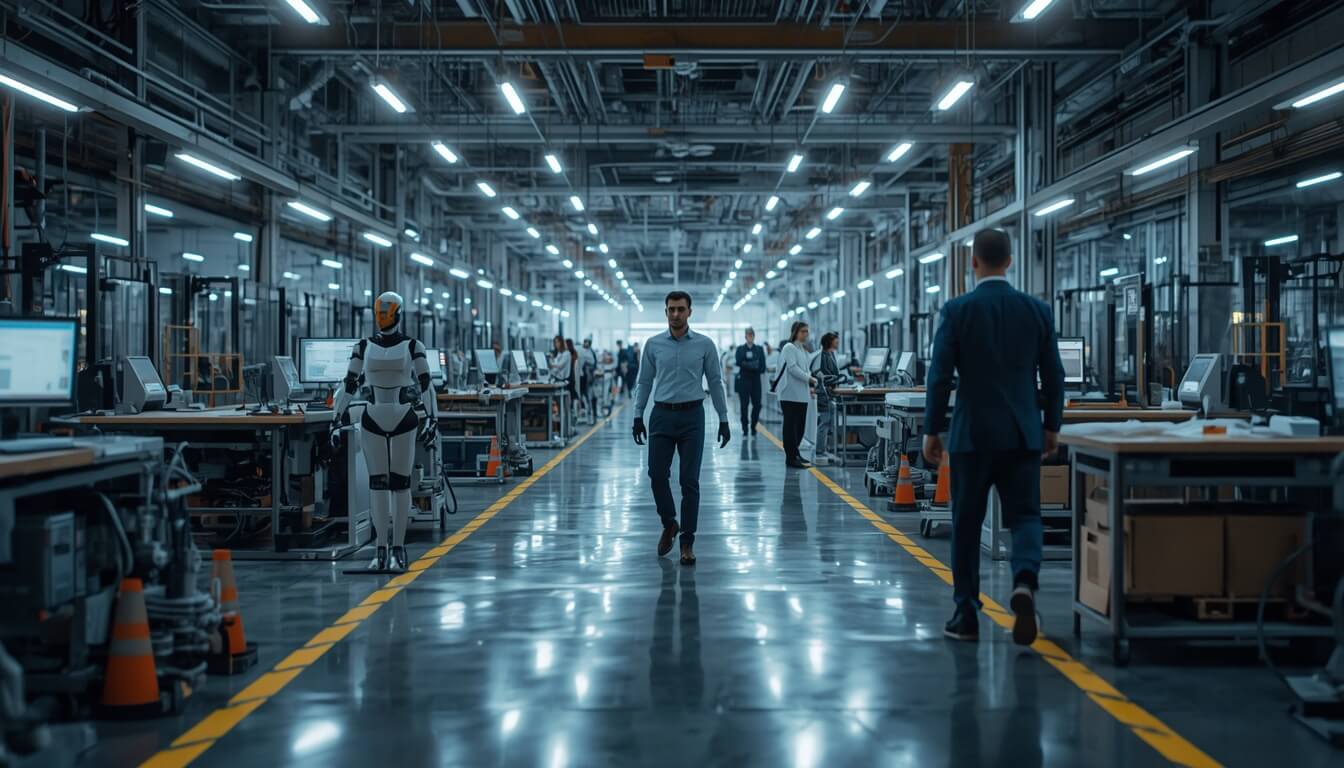
Humanoid robots are moving from research laboratories toward real-world industrial applications. As discussed in The Rise of Humanoid Robots: Why They Are Becoming a New Technology Frontier, advances in artificial intelligence, sensors, batteries, computer vision, and robotics are making machines capable of interacting with physical environments increasingly sophisticated.
At the same time, a growing number of technology companies, automotive manufacturers, and robotics startups are developing their own humanoid platforms. The different approaches being pursued by these companies are explored in The Companies Building Humanoid Robots.
The next question is what could happen if these machines become reliable and affordable enough to operate at large scale.
The answer could extend far beyond robotics. Humanoid robots could potentially influence manufacturing costs, productivity, labor markets, supply chains, and the geographical distribution of industrial production.
The key milestone will not simply be a robot performing an impressive demonstration. It will be the ability to operate reliably, safely, and economically in real industrial environments — at scale.
Why Manufacturing Could Be an Early Market
Manufacturing is one of the most obvious environments for humanoid robots because factories already contain many repetitive physical tasks.
Workers may need to move components, transport materials, load equipment, inspect products, or perform repetitive assembly activities. Many of these tasks require physical movement but not necessarily highly specialized machinery.
A humanoid robot could potentially perform several different activities within the same facility.
This flexibility could be particularly valuable compared with traditional automation systems, which are often designed around a specific production process.
If a factory changes the products it manufactures, conventional automation may require significant reconfiguration. A general-purpose humanoid robot could potentially be reassigned to different tasks through changes in software, training, or instructions.
That possibility could change how manufacturers think about automation.
Productivity and the Cost of Production
One of the most important potential effects of humanoid robotics is increased productivity.
If a robot can perform a task continuously and with consistent performance, companies may be able to produce more goods with the same physical infrastructure.
However, productivity gains depend on the economics of deployment.
The total cost of operating a robot includes much more than its purchase price. Companies need to consider:
- Electricity
- Maintenance
- Software
- Supervision
- Downtime
- Repairs
- Integration
- Infrastructure required to operate the machines safely
For humanoid robots to become widely adopted, their economic value will therefore need to exceed these costs.
If that happens, manufacturers could have an incentive to increase automation in areas that were previously difficult or expensive to automate.
The Changing Role of Human Workers
The impact on employment is one of the most significant questions surrounding humanoid robotics.
Automation does not necessarily mean that every task performed by humans will disappear. In many industries, technology changes the composition of jobs rather than eliminating all human work.
Humanoid robots could initially take over specific repetitive, physically demanding, or hazardous activities while human workers continue to perform tasks involving supervision, decision-making, maintenance, quality control, engineering, and customer interaction.
New occupations could also emerge around robotic systems. Companies may require technicians, engineers, software developers, AI specialists, safety professionals, and operators capable of managing fleets of robots.
The transition could therefore involve both substitution of certain tasks and creation of new forms of work.
The scale and speed of these changes would depend on how capable the technology becomes and how quickly businesses adopt it.
Manufacturing Could Become More Flexible
Another potential effect is greater flexibility in production.
Traditional automation often works best when companies manufacture large quantities of standardized products. Humanoid robots could potentially make automation more practical in environments where tasks change more frequently.
For example, a robot might move between different stations and perform different activities depending on production requirements.
If robots can learn new tasks through software or AI-based systems, manufacturers may not need to build completely new automation systems every time production changes.
This could be particularly relevant as consumer demand becomes more diverse and product cycles become shorter.
Implications for Global Supply Chains
Humanoid robots could also influence where goods are produced.
For decades, companies have distributed manufacturing across different countries based on factors such as:
- labor costs
- infrastructure
- access to raw materials
- transportation
- taxes
- proximity to customers
If automation significantly reduces the importance of labor costs, some companies could have greater incentives to locate production closer to their customers.
This could contribute to the expansion of highly automated factories in countries where labor costs are relatively high.
At the same time, countries with large manufacturing ecosystems could benefit from the growing demand for robots, components, batteries, sensors, and industrial AI systems.
The result could be a gradual restructuring of global supply chains rather than a simple shift of manufacturing from one country to another.
The Potential Impact on Manufacturing Costs
If humanoid robots become cheaper and more productive, they could reduce the cost of certain manufacturing activities.
Lower production costs could have several possible consequences.
Companies could retain some of the savings as higher margins. They could also invest the savings in additional capacity, research and development, or new products.
In competitive markets, part of the productivity improvement could eventually be reflected in lower prices.
The overall economic effect would therefore depend on how companies, workers, and consumers respond to increased productivity.
Capital Investment Could Increase
The transition toward humanoid robotics could also create significant demand for capital investment.
Factories may need new robotic systems, software infrastructure, charging systems, sensors, networking equipment, and maintenance capabilities.
This could benefit companies operating in several related industries.
Demand could increase for electric motors, batteries, semiconductors, sensors, artificial intelligence computing infrastructure, industrial software, and specialized manufacturing equipment.
Humanoid robotics therefore represents more than a single technology market. It sits at the intersection of several major technology industries.
A Possible Shift From Labor to Capital
One broader economic question concerns the relationship between labor and capital.
Traditional manufacturing relies on a combination of human labor, machinery, buildings, energy, and raw materials. Greater use of autonomous robots could increase the role of capital in production.
This could change how companies allocate investment and how productivity gains are distributed.
The effects would not necessarily be identical across countries or industries. Economies with different wage levels, labor regulations, industrial structures, and levels of technological development could experience different outcomes.
This makes the economic impact of humanoid robots difficult to predict precisely.
Energy Could Become More Important
Large-scale robotics could also increase demand for electricity.
Humanoid robots require energy for movement, computing, charging, and potentially continuous operation.
If millions of robots eventually operate in factories, warehouses, and other environments, electricity consumption could become an increasingly important part of the economics of automation.
This could create additional demand for efficient batteries, charging infrastructure, electricity generation, and energy-management systems.
Energy efficiency may therefore become an important factor when companies compare different robotic platforms.
The Importance of Scale
The economic impact of humanoid robots will ultimately depend on scale.
A small number of highly advanced robots could have limited effects on the global economy. A large fleet of affordable and reliable machines would be very different.
At sufficient scale, robotics could influence production capacity across entire industries.
However, reaching that point requires overcoming several challenges, including manufacturing costs, reliability, safety, software development, battery performance, maintenance, and regulatory requirements.
The companies discussed in The Companies Building Humanoid Robots are effectively competing to solve many of these problems.
From Robotics to Physical AI
Humanoid robots could represent a broader transition toward what is sometimes called physical AI.
Artificial intelligence has already transformed activities involving information, communication, search, software, and digital content.
Humanoid robotics introduces another dimension: applying AI to the physical world.
A sufficiently capable robot could perceive an environment, make decisions, manipulate objects, and execute physical tasks.
This could make AI increasingly relevant to factories, warehouses, construction sites, logistics operations, and potentially other areas of the economy.
What Could Prevent a Major Transformation?
The potential economic impact should not be confused with certainty.
Humanoid robotics remains an emerging technology. Technical limitations, high costs, safety concerns, regulatory requirements, and difficulties operating reliably in complex environments could slow adoption.
Companies may also discover that specialized robots remain more efficient for many individual tasks.
The future could therefore involve a combination of humanoid robots, conventional industrial robots, autonomous vehicles, software systems, and human workers rather than a single technology replacing everything else.
A New Phase of Industrial Automation
Humanoid robots could eventually become an important part of manufacturing, but their ultimate role will depend on their ability to deliver measurable economic value.
If that happens at large scale, the consequences could extend well beyond robotics.
Manufacturers could gain new flexibility, factories could become more automated, supply chains could change, and some forms of physical work could increasingly be performed by machines.
At the same time, new industries and occupations could emerge around robotics, artificial intelligence, energy systems, and automation.
This is why humanoid robots represent an important technology frontier. Their significance is not only that machines may eventually look and move more like humans. It is that artificial intelligence could become directly integrated into the physical production of goods and services.
The first stage of this transformation is already being explored by the companies developing humanoid platforms. The next stage will depend on whether those systems can move from promising prototypes to economically viable machines operating at scale.