
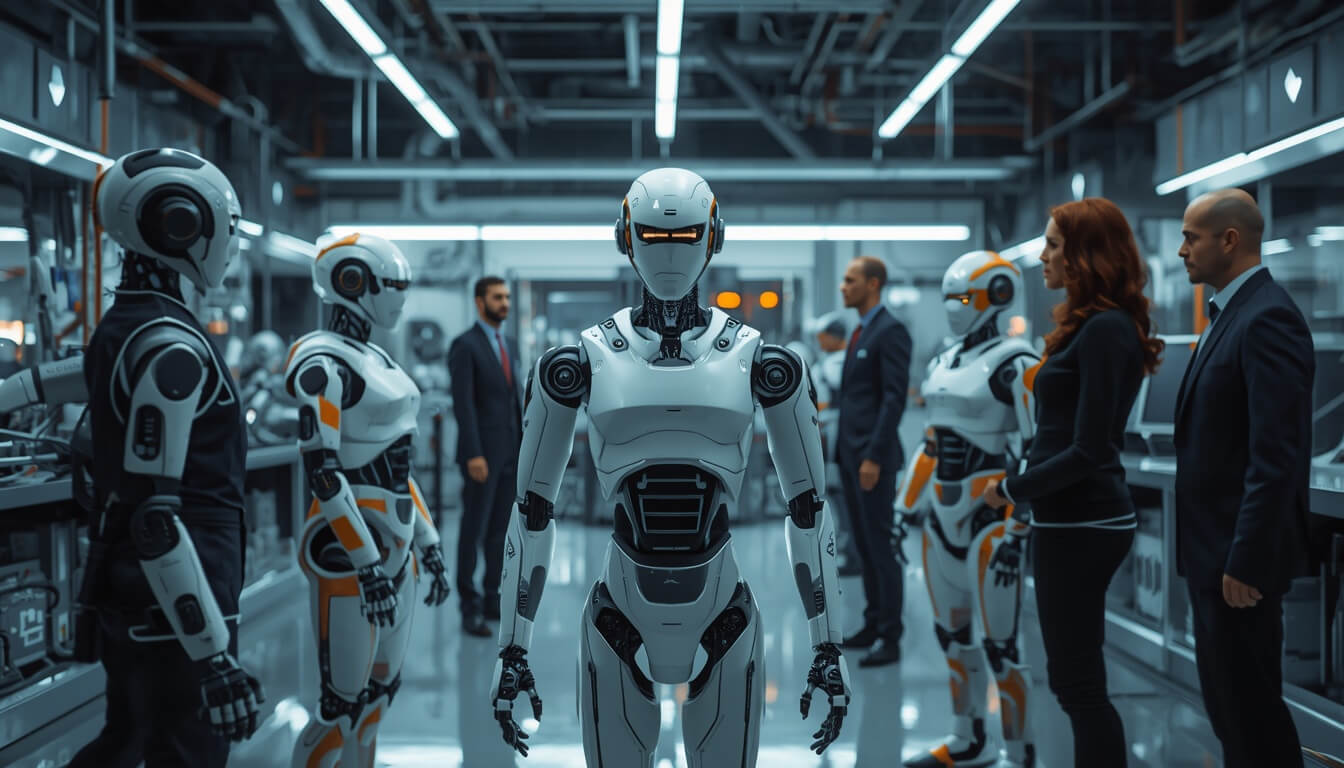
The development of humanoid robots is becoming one of the most competitive areas in robotics and artificial intelligence. As discussed in The Rise of Humanoid Robots: Why They Are Becoming a New Technology Frontier, advances in artificial intelligence, sensors, batteries, computer vision, and motion control are making humanoid machines increasingly capable of operating in environments designed for people.
A growing number of companies are now working to turn that technological progress into commercial products.
The industry includes established technology and automotive companies, specialized robotics firms, and startups developing new approaches to hardware and artificial intelligence. Although their strategies differ, many are targeting a similar long-term objective: creating robots capable of performing a wide range of physical tasks.
Hardware is only one part of the equation. The winning platforms will likely depend on a combination of mechanical reliability, battery performance, AI capabilities, manufacturing costs, software, safety, and the ability to operate continuously in real-world environments.
Tesla and Optimus
Tesla is one of the most prominent companies working on humanoid robots through its Optimus project.
The company has connected the development of Optimus to technologies it already uses in its vehicles, including computer vision, artificial intelligence, electric motors, batteries, and large-scale manufacturing.
Tesla's approach is particularly notable because the company already has extensive experience producing electric vehicles and operating automated manufacturing facilities.
The potential strategy is to combine robotics with the company's existing expertise in AI and mass production. If humanoid robots eventually become sufficiently reliable and economical, manufacturing scale could become an important competitive factor.
Optimus is primarily associated with industrial applications, where robots could potentially perform repetitive or physically demanding tasks.
Figure AI
Figure is another company focused specifically on general-purpose humanoid robots.
The company has developed the Figure robot platform with the goal of creating machines capable of performing useful work in environments such as factories and warehouses.
One of the central challenges for Figure and other companies in this sector is not simply making a robot move. The machine needs to understand its surroundings, identify objects, follow instructions, and coordinate physical movements.
Figure has also emphasized the connection between humanoid robotics and artificial intelligence. This reflects a broader trend in the industry: companies increasingly view the robot's physical hardware and its AI system as parts of the same platform.
Boston Dynamics
Boston Dynamics has been developing advanced mobile robots for years and is one of the best-known names in robotics.
The company is particularly recognized for robots such as Spot and Atlas. Atlas has demonstrated advanced capabilities in balance, movement, object manipulation, and dynamic physical tasks.
Boston Dynamics has historically focused heavily on mobility and sophisticated mechanical engineering. Its work demonstrates how difficult it is to create robots that can move effectively in unpredictable physical environments.
The company has also developed commercial robotic systems for industrial applications, giving it experience with the transition from research demonstrations to practical deployment.
Agility Robotics
Agility Robotics is developing Digit, a humanoid robot designed with logistics and industrial applications in mind.
Digit is particularly interesting because logistics environments contain many tasks that require repetitive physical movement. Robots could potentially move containers, transport materials, or support warehouse operations.
The company's strategy illustrates one of the central ideas behind humanoid robotics: instead of building a specialized machine for every individual task, a humanoid platform could potentially be adapted to multiple workflows.
This could become important if companies begin deploying robots across different areas of their operations.
Apptronik
Apptronik is another company developing humanoid robots for industrial applications.
Its Apollo robot is designed as a general-purpose humanoid platform and has attracted attention because of its focus on commercial and industrial use.
The company has worked with industrial partners to explore potential applications in manufacturing and logistics.
This approach highlights an important characteristic of the emerging humanoid market. The first successful applications may not necessarily involve robots performing complex tasks independently. Instead, companies may initially use them for relatively structured activities where the economic benefit can be measured clearly.
Sanctuary AI
Sanctuary AI is pursuing another approach to general-purpose robotics, combining humanoid hardware with artificial intelligence designed to control physical tasks.
Its Phoenix robot has been developed with the objective of performing a broad range of work.
The company has focused heavily on the relationship between AI and robotic control. A general-purpose robot needs more than mechanical strength: it needs the ability to perceive its environment, understand instructions, manipulate objects, and adapt its actions.
This makes software and AI increasingly important parts of the competitive landscape.
Hyundai and Robotics
The automotive industry is also becoming involved in humanoid robotics.
Hyundai Motor Group owns Boston Dynamics and therefore has exposure to advanced robotics through one of the world's best-known robotics companies.
Automotive manufacturers have several potential advantages in this field, including experience with automation, manufacturing, supply chains, electric motors, batteries, and large-scale industrial production.
The involvement of automotive companies could therefore accelerate the transition from experimental robots to machines designed for commercial manufacturing environments.
Chinese Humanoid Robot Companies
China has also become an important center for humanoid robotics development.
Companies such as Unitree Robotics, UBTECH Robotics, and AgiBot are developing humanoid platforms and targeting applications ranging from industrial automation to research and commercial use.
China's large manufacturing ecosystem provides a significant environment for testing and producing robotic hardware.
The competition between Chinese, American, European, and other international companies could become increasingly important as the technology develops.
Different regions may also develop different strengths across components, manufacturing, artificial intelligence, and deployment.
A Competition Between Different Approaches
Although many companies are building humanoid robots, they are not necessarily pursuing exactly the same strategy.
Some companies are emphasizing industrial automation. Others are focusing on general-purpose robots, artificial intelligence, logistics, research, or long-term consumer applications.
| Company | Primary focus |
|---|---|
| Tesla (Optimus) | Industrial applications, mass production |
| Figure AI | General-purpose humanoid robots, AI integration |
| Boston Dynamics | Mobility, mechanical engineering, commercial deployment |
| Agility Robotics (Digit) | Logistics and warehouse operations |
| Apptronik (Apollo) | Industrial and commercial use |
| Sanctuary AI (Phoenix) | AI-driven general-purpose robotics |
| Chinese companies | Industrial automation, research, commercial platforms |
Another important factor will be data.
A robot operating in a factory can potentially collect information about how physical tasks are performed. That data may help improve the robot's AI systems and enable better performance over time.
This creates a potential feedback loop between deployment, data collection, software improvement, and hardware development.
Why the Business Model Matters
The economics of humanoid robots may ultimately be just as important as their technical capabilities.
A robot that can perform a task but costs too much to purchase or operate may not be commercially attractive. Companies therefore need to demonstrate measurable productivity improvements.
Possible business models could include:
- direct robot sales
- leasing
- robotics-as-a-service
- combinations of hardware and software
The choice of business model could influence how quickly companies adopt humanoid robots.
For manufacturers, the decision will depend on factors such as labor costs, productivity, maintenance, safety, capital expenditure, and the ability of robots to operate reliably.
What Happens Next?
The humanoid robotics industry is still developing, and it is too early to know which companies or technological approaches will ultimately dominate.
The important development is that multiple companies are now attempting to solve the same fundamental problem from different directions: how to build a machine that can interact with the physical world while using increasingly sophisticated artificial intelligence.
As these systems move from demonstrations into real industrial environments, the focus will increasingly shift from impressive prototypes to measurable performance.
Can a robot work for an entire shift? Can it safely interact with human workers? Can it perform multiple tasks without extensive reprogramming? Can it operate at a cost that makes economic sense?
These questions will determine whether humanoid robots become a major industrial technology or remain primarily a research and development field.
The consequences could extend far beyond the robotics industry itself. If humanoid robots become economically viable at scale, they could affect factory automation, logistics, labor demand, productivity, supply chains, and the geographical distribution of manufacturing.
These broader implications are examined in How Humanoid Robots Could Transform Manufacturing and the Global Economy.
For now, the industry remains highly competitive and rapidly evolving. The companies developing humanoid robots are effectively testing different combinations of hardware, artificial intelligence, manufacturing, and business models.
The next stage will be to determine which of these approaches can move successfully from technological demonstrations to widespread commercial deployment.