
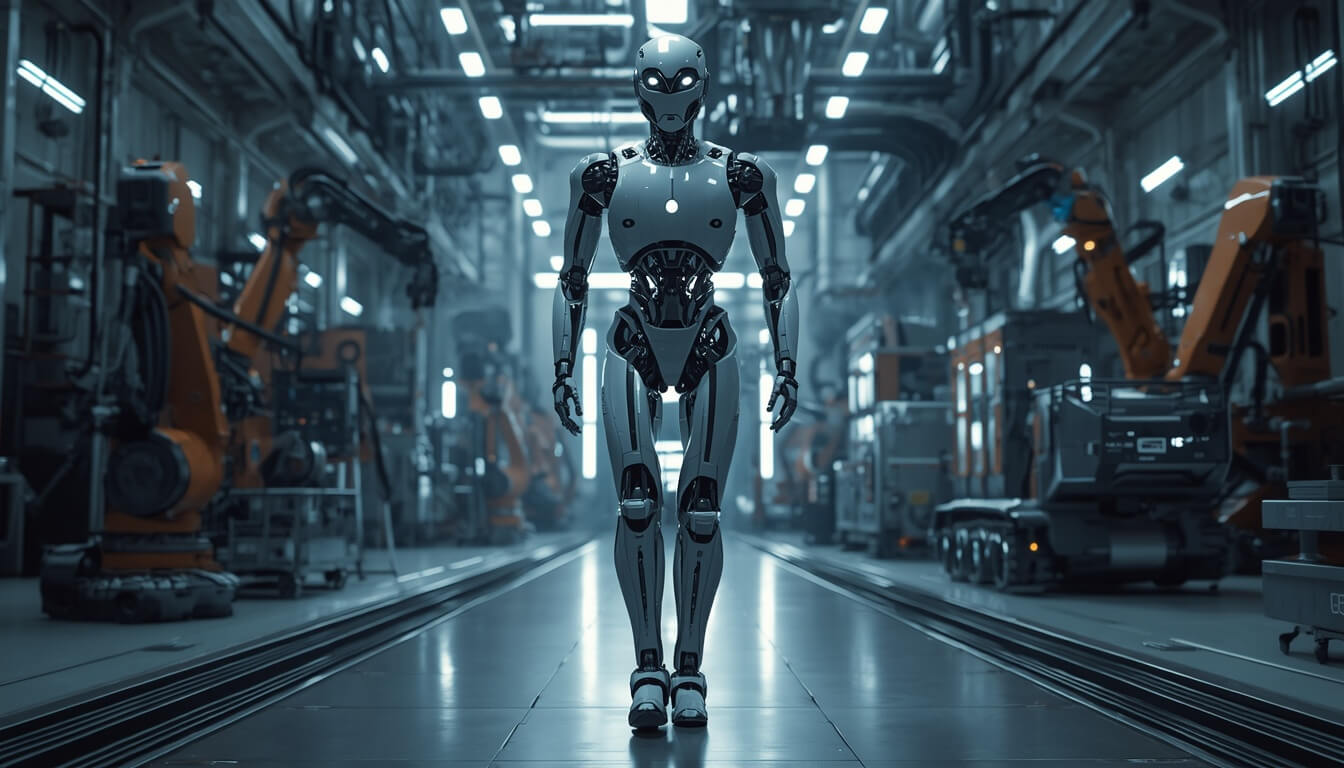
Humanoid robots are moving from science fiction into a new phase of technological development. For decades, robots were primarily designed for specific industrial tasks, such as welding, assembling components, transporting materials, or operating in environments that were difficult or dangerous for people. Today, a growing number of companies are pursuing a different idea: robots with a human-like body that can operate in environments originally designed for humans.
The development of humanoid robots is becoming one of the most closely watched areas of robotics and artificial intelligence. Advances in artificial intelligence, computer vision, sensors, batteries, and electric motors are making it increasingly possible to build machines capable of moving, perceiving their surroundings, learning tasks, and interacting with people.
The technology is still at an early stage, but the potential applications are broad.
Humanoid robots represent a potential new technology frontier in which artificial intelligence moves beyond computers and begins to interact directly with the physical economy.
Why Humanoid Robots?
One of the main reasons companies are interested in humanoid robots is simple: the world is already designed around the human body.
Factories, warehouses, offices, staircases, tools, vehicles, and many other environments have been constructed for people. A robot with two arms, two legs, and a human-like body could potentially use many of the same spaces and tools without requiring companies to completely redesign their infrastructure.
Traditional industrial robots are extremely effective when they perform repetitive tasks in controlled environments. However, they are often built around a fixed position and a specific function. Humanoid robots are being developed with a different objective: greater flexibility.
A single machine could potentially perform different tasks depending on the software it is running and the environment in which it operates.
This flexibility is particularly important as artificial intelligence becomes increasingly integrated with robotics. Modern AI systems can process large amounts of visual and sensory information, recognize objects, interpret instructions, and generate actions.
Combining these capabilities with a physical robot creates what some researchers describe as a bridge between digital intelligence and the physical world.
Artificial Intelligence Meets Robotics
The recent progress in generative AI has increased interest in physical AI, where intelligent systems interact directly with the real world.
A chatbot can generate text, while an AI-powered humanoid robot could eventually use its intelligence to manipulate objects, move through an environment, and respond to changing conditions.
This is significantly more difficult than operating in a purely digital environment.
The physical world is unpredictable. Objects can be positioned differently, surfaces can be uneven, lighting can change, and people can move unexpectedly.
A humanoid robot therefore needs to combine several technologies, including:
- cameras and other sensors
- motion control
- machine learning
- computing power
- sophisticated mechanical systems
Progress in each of these areas is gradually improving the overall capabilities of humanoid robots.
A New Technology Industry
The rise of humanoid robots is also creating a new competitive landscape.
Technology companies, automotive manufacturers, robotics specialists, and startups are investing in humanoid platforms. Some are focusing primarily on industrial applications, while others are exploring logistics, healthcare, domestic environments, or general-purpose robotics.
The companies developing these machines differ considerably in their approaches, hardware designs, AI systems, and commercial strategies.
For an overview of the main players and their approaches, see The Companies Building Humanoid Robots.
The emergence of multiple competing platforms could eventually resemble earlier technology markets, where companies experimented with different architectures before a smaller number of approaches became widely adopted.
However, humanoid robotics faces challenges that do not exist to the same extent in traditional software industries.
The Challenges Ahead
Building a humanoid robot that can walk reliably is already a significant engineering challenge. Building one that can safely perform useful work for many hours, operate autonomously, and remain economically competitive is much harder.
| Challenge | Why it matters |
|---|---|
| Battery life | Motors and actuators consume significant energy, particularly when a robot needs to walk or continuously move its arms. |
| Reliability | Industrial customers require machines that operate consistently with minimal downtime. A humanoid robot must function safely and predictably in demanding environments. |
| Cost | A robot can demonstrate impressive capabilities in a laboratory, but commercial adoption depends on whether it delivers enough economic value to justify its purchase or operating cost. |
The development of humanoid robots is not simply a race to create machines that look increasingly human. It is also a race to make them useful, reliable, safe, and economically viable.
Why Manufacturing Could Be the Starting Point
Manufacturing may become one of the first major markets for humanoid robots.
Factories already contain structured environments, repetitive processes, and clearly defined tasks. These characteristics make them potentially suitable for early deployment.
Humanoid robots could eventually perform activities such as:
- moving materials
- handling components
- loading machines
- inspecting products
- supporting workers with physically demanding tasks
The economic implications could be substantial if robots become capable of performing a wide range of tasks at competitive costs.
The possible effects extend beyond individual factories. Changes in automation could influence labor demand, productivity, supply chains, manufacturing locations, and the cost of producing goods.
The broader economic implications are explored in How Humanoid Robots Could Transform Manufacturing and the Global Economy.
From Specialized Machines to General-Purpose Robots
The most important distinction between humanoid robots and many traditional industrial robots may ultimately be flexibility.
A specialized robot can be extremely efficient at one task. A general-purpose humanoid robot aims to perform many tasks and potentially learn new ones through software.
If this approach succeeds, robotics could become less dependent on designing a separate machine for every individual application.
Instead, companies could deploy a common physical platform and adapt its capabilities through software and AI models.
That possibility is one reason humanoid robotics is attracting attention from both technology investors and industrial companies.
A Technology Frontier Still in Its Early Stages
Despite the rapid development of the sector, humanoid robots remain an emerging technology. Large-scale commercial adoption is not guaranteed, and significant technical and economic obstacles remain.
The key questions are no longer simply whether robots can walk or perform impressive demonstrations. The more important questions concern reliability, safety, autonomy, cost, productivity, and scalability.
If these challenges can be addressed, humanoid robots could become an important new category of automation.
The coming years will therefore be less about proving that humanoid robots are possible and more about determining where they can create measurable value.
For investors, technology companies, manufacturers, and policymakers, this makes humanoid robotics an area worth monitoring closely. The industry is developing at the intersection of artificial intelligence, advanced manufacturing, semiconductors, energy storage, and automation.