
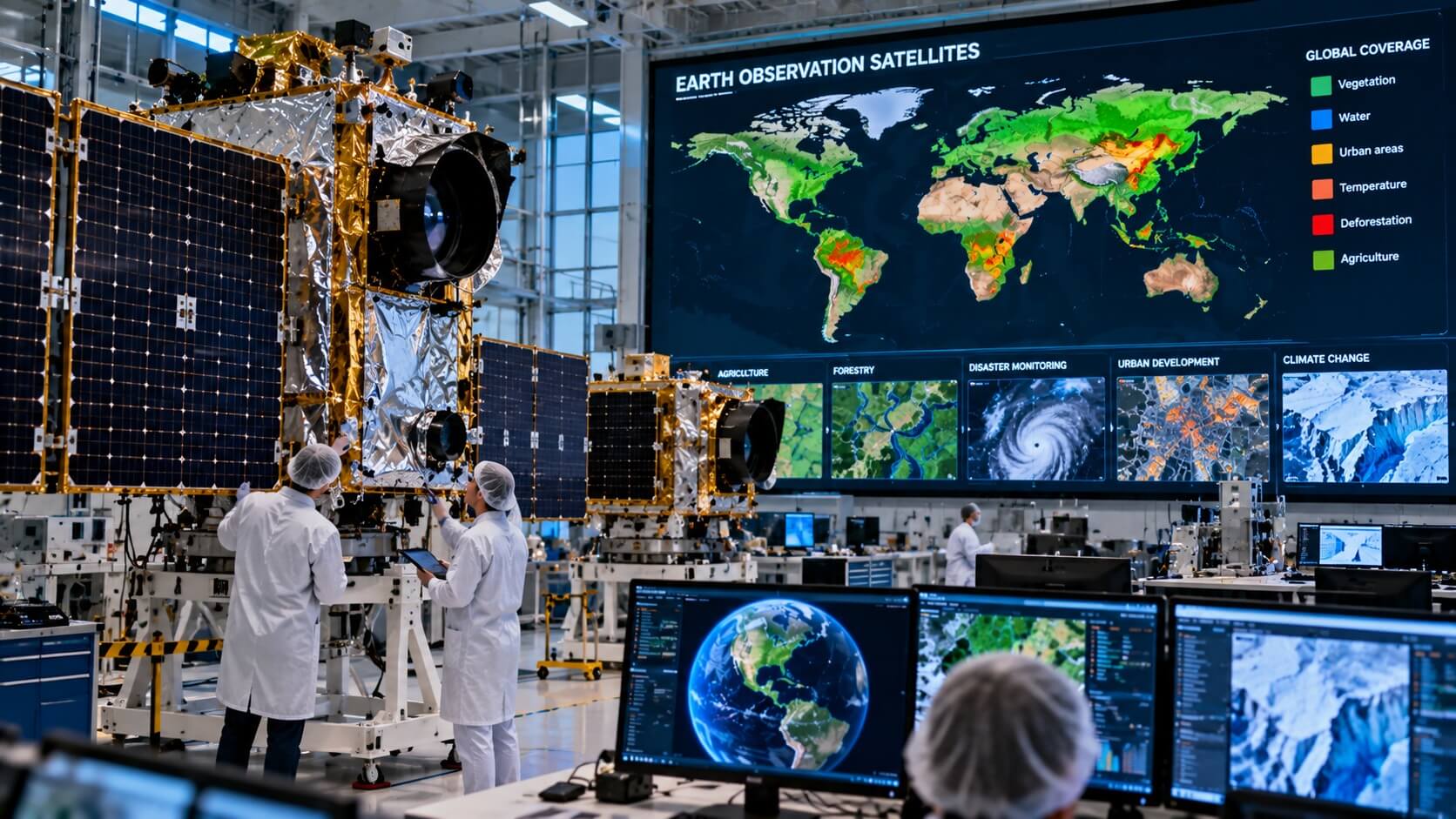
How Many Earth Observation Satellites Are There? A Look at the Growing EO Market
There are thousands of satellites orbiting Earth, but only a portion of them are dedicated to Earth observation. These spacecraft monitor our planet's surface, atmosphere, oceans, and changing environmental conditions.
The exact number of active Earth observation (EO) satellites is difficult to establish because different databases classify spacecraft differently. Some count only dedicated imaging satellites, while others include weather, scientific, environmental, and multi-purpose satellites.
What is clear is that Earth observation has evolved from a field dominated by government space programs into a growing commercial industry.
Private companies operate satellite constellations that provide imagery and analytical information to customers in agriculture, insurance, infrastructure, energy, and national security.
For investors, the important question goes beyond how many satellites are in orbit. It is how this expanding infrastructure translates into demand, revenue, and potentially sustainable businesses.
How Many Earth Observation Satellites Are Currently in Orbit?
There is no single universally accepted figure for the number of active Earth observation satellites.
The answer depends primarily on three factors:
- Classification: Whether the count includes only dedicated Earth imaging spacecraft or also meteorological, scientific, and environmental monitoring satellites.
- Operational status: Whether inactive, failed, or retired satellites are excluded.
- Reporting date: Satellite counts change as new spacecraft launch and older ones leave service.
The Union of Concerned Scientists historically maintained a satellite database that distinguished spacecraft by their primary purpose. However, its publicly available database is a historical reference rather than a continuously updated source for current satellite counts.
Organizations involved in space surveillance, satellite tracking, and orbital data analysis maintain other datasets, but their classifications and coverage can differ.
For example, a satellite designed to measure atmospheric conditions may be classified as Earth observation in one database and meteorology in another.
A spacecraft performing both scientific research and environmental monitoring can create similar classification problems.
Consequently, a precise figure should always be accompanied by a reporting date and a clear definition of which spacecraft are included.
Without those details, presenting a single number as the definitive global count would be misleading.
Why the Number of Active Satellites Matters
An operational satellite can collect observations and contribute to a service.
A retired satellite that remains in orbit generally cannot.
For commercial analysis, active spacecraft are therefore more relevant than the total number of objects ever launched.
However, even an active satellite count does not fully describe the industry's capacity.
A modern satellite may collect better information, cover a larger area, or transmit observations faster than an older spacecraft.
The number of satellites is only one measure of the industry's capabilities.
Why Are More Earth Observation Satellites Being Launched?
Several technological and commercial developments have made Earth observation more accessible.
Smaller and Less Expensive Satellites
Historically, Earth observation missions often depended on large, expensive spacecraft developed by government agencies.
Advances in electronics, sensors, and satellite manufacturing have enabled smaller satellites to perform useful monitoring tasks.
Small satellites generally offer lower manufacturing costs and can sometimes be developed more quickly.
However, smaller does not automatically mean better or cheaper over the entire mission.
Some applications still require larger spacecraft with more powerful instruments, while smaller satellites may have shorter operating lives or limited capabilities.
More Accessible Launch Services
Commercial launch providers have expanded opportunities to place satellites into orbit.
Rideshare missions allow multiple customers to launch spacecraft together, spreading certain launch costs across several payloads.
This has helped reduce barriers for smaller satellite operators.
Lower launch costs can support constellation expansion, but operators must still finance manufacturing, ground infrastructure, software, and ongoing operations.
Growing Demand for Repeated Observations
A single satellite may observe a particular location only periodically.
A constellation of multiple satellites can provide more frequent coverage.
This matters when customers need to monitor changes rather than simply obtain one image.
An agricultural business might want repeated measurements throughout a growing season.
An insurance company may need updated information immediately after a natural disaster.
A government agency may require frequent monitoring of strategically important locations.
In these situations, observation frequency can be as important as image quality.
What Types of Earth Observation Satellites Exist?
Not all Earth observation satellites perform the same functions.
Different instruments collect different kinds of information, creating distinct applications and commercial markets.
| Satellite type | What it measures | Common applications |
|---|---|---|
| Optical imaging | Reflected visible light | Land use, agriculture, construction |
| Radar imaging | Reflected radar signals | Floods, ground movement, maritime monitoring |
| Thermal imaging | Surface temperature patterns | Wildfires, heat monitoring, water conditions |
| Multispectral imaging | Reflected light across multiple bands | Vegetation health, environmental monitoring |
| Atmospheric monitoring | Gases and atmospheric conditions | Weather, pollution, climate research |
These categories can overlap because some satellites carry multiple instruments.
For example, a spacecraft may collect both visible and infrared observations.
A large constellation of relatively simple optical satellites also serves a different purpose from a smaller group of advanced radar satellites.
This is why comparing companies solely by the number of spacecraft they operate can be misleading.
Which Companies Operate Earth Observation Satellites?
The commercial Earth observation industry includes businesses with different technologies, customer bases, and financial models.
Some operate their own satellite constellations, while others specialize in processing and selling information collected from space.
Planet Labs
Planet Labs (NYSE: PL) is one of the most recognizable publicly traded Earth observation companies.
Its satellite operations focus on collecting repeated images of Earth's surface.
Frequent observations allow customers to monitor changes in agriculture, infrastructure, land use, and other activities.
Planet's business illustrates the commercial value of repeated global coverage.
Rather than treating satellite imagery as a one-time product, the company offers data and services that can support ongoing monitoring.
For investors, relevant factors include subscription demand, customer retention, operating costs, and the company's ability to convert data collection into sustainable cash flow.
BlackSky Technology
BlackSky Technology (NYSE: BKSY) combines satellite imagery with monitoring and analytical capabilities.
Its services are designed to help customers observe changes and activities at locations of interest.
Government and defense-related applications are particularly relevant to its business.
BlackSky demonstrates how Earth observation companies can compete through information delivery and analytics rather than satellite numbers alone.
Satellogic
Satellogic (NASDAQ: SATL) has developed Earth observation capabilities using its own satellite technology.
Its business illustrates both the potential benefits and challenges of operating commercial imaging spacecraft.
Investors evaluating such companies should examine actual satellite availability, customer contracts, financing requirements, and operating performance rather than relying exclusively on announced constellation plans.
ICEYE
ICEYE is a privately held company specializing in synthetic aperture radar satellites.
Radar technology allows useful observations at night and through clouds, making it valuable for applications such as flood monitoring and infrastructure assessment.
Its business highlights an important distinction within Earth observation: specialized capabilities can matter more than the total number of satellites.
Government Programs
Government agencies remain major participants in Earth observation.
NASA, NOAA, the U.S. Geological Survey, and the European Space Agency support satellite missions and data programs.
Examples include the Landsat program and Europe's Copernicus program, which provide important environmental observations.
Publicly available satellite data supports scientific research and commercial innovation.
At the same time, free government datasets can create competitive pressure for companies selling less differentiated imagery.
How Does the Number of Earth Observation Satellites Compare With Starlink?
Earth observation satellites are only one part of the much larger satellite population.
Communication satellites account for a substantial share of operational spacecraft, particularly because of the expansion of large broadband constellations.
SpaceX's Starlink system is designed primarily to deliver satellite internet connectivity.
Its satellites are not classified as dedicated Earth observation spacecraft.
This distinction matters when interpreting headlines about record numbers of satellites in orbit.
An increase in the total satellite population does not necessarily mean the Earth observation market is growing at the same rate.
The two industries also have different economic models.
Starlink primarily sells connectivity services.
Earth observation companies generally sell imagery, monitoring services, analytical information, or access to datasets.
For a broader explanation of the global satellite population and SpaceX's role in its expansion, read How Many Satellites Orbit Earth Today? And How Many Belong to SpaceX?.
Does Having More Satellites Mean Better Earth Observation?
Not necessarily.
Satellite quantity can improve coverage, but several other factors determine the usefulness of an Earth observation system.
Spatial resolution: How much detail the satellite can distinguish on Earth's surface.
Revisit frequency: How often a satellite or constellation can observe the same location.
Observation conditions: Whether sensors can collect useful information at night or through cloud cover.
Data delivery speed: How quickly collected information reaches the customer.
Analytical quality: How effectively raw measurements are converted into reliable information.
Operational reliability: Whether satellites consistently deliver the expected service.
Consider two hypothetical companies.
Company A operates a large constellation of small optical satellites that frequently photograph Earth's surface.
Company B operates a smaller number of radar satellites capable of collecting observations during cloudy conditions and at night.
Company A might be better suited for applications requiring broad, repeated visual coverage.
Company B might offer greater value for customers monitoring floods or infrastructure in regions where clouds frequently obstruct optical imaging.
Neither business is automatically superior.
The more important question is whether its capabilities match customer requirements.
How Big Is the Earth Observation Market?
The Earth observation economy includes several connected activities, making its total market size difficult to define.
Some estimates focus on revenue from satellite imagery and data services.
Others include satellite manufacturing, ground infrastructure, analytics software, and related downstream applications.
These differences can produce substantially different market estimates.
It is therefore important not to confuse the value of the entire space economy with the much narrower market for commercial Earth observation data.
The sector can be divided into several economic layers.
Satellite Manufacturing and Launch
This includes companies that build spacecraft, instruments, components, and launch systems.
Their revenue depends on equipment orders, production programs, and launch demand.
Satellite Operations
These businesses operate spacecraft and collect observations.
They must maintain their constellations, manage satellite lifespans, and deliver reliable information.
Data Processing and Analytics
These companies transform imagery and measurements into products customers can use.
Applications include agricultural monitoring, disaster assessment, environmental analysis, and infrastructure intelligence.
Industry-Specific Services
Some businesses combine satellite data with other information to provide specialized services.
For example, an agricultural analytics platform might combine satellite measurements with weather forecasts and historical crop information.
This can create value without requiring the company to own satellites.
From an investment perspective, the most attractive segment is not necessarily the one launching the greatest number of spacecraft.
It may be the segment that consistently delivers the highest customer value relative to its operating costs.
Why Does Earth Observation Matter for Investors?
The growing number of Earth observation satellites reflects expanding technical capabilities and interest in space-based information.
But more satellites do not automatically produce more revenue or higher profits.
Investors should distinguish between the growth of the underlying infrastructure and the financial performance of individual businesses.
Several indicators can help assess whether an Earth observation company is developing a sustainable commercial position.
Revenue Growth
Is the company increasing sales through actual customer demand?
Revenue growth is more meaningful when it comes from customers repeatedly purchasing useful services rather than temporary or experimental contracts.
Recurring Revenue
Subscriptions and long-term service agreements can provide greater revenue visibility.
However, recurring contracts still need to generate sufficient margins to support the business.
Customer Diversification
Companies serving multiple industries may be less exposed to the spending decisions of a single customer.
Businesses heavily dependent on government contracts can benefit from substantial orders but also face procurement delays and budget uncertainty.
Cash Flow and Financing
Satellite operators often require significant upfront investment.
A company may report strong demand while continuing to spend more cash than it generates.
Investors should examine operating cash flow, capital expenditure, liquidity, and the potential need for additional financing.
Competitive Advantage
A company needs a reason for customers to choose its services.
That advantage might involve image quality, observation frequency, radar capabilities, historical datasets, or specialized analytics.
Simply owning satellites is not necessarily a durable competitive advantage.
For a broader explanation of how the industry works and its investment implications, see Earth Observation Explained: What It Is, How It Works and Why Investors Should Care.
What Happens When Earth Observation Satellites Reach the End of Their Lives?
Satellite constellations require ongoing maintenance and eventual replacement.
Spacecraft can stop operating because of equipment failures, degraded components, depleted fuel, or changing mission requirements.
For satellites in low Earth orbit, operators must also consider how spacecraft will be removed from orbit after their missions end.
This is increasingly important as more commercial constellations operate in similar orbital regions.
Historically, a widely referenced international debris mitigation guideline recommended removing spacecraft from protected low Earth orbit regions within 25 years after the end of their missions.
However, the 25-year guideline is not a universal legal requirement, and newer standards can impose shorter disposal periods.
In the United States, the Federal Communications Commission adopted a five-year post-mission disposal requirement for covered spacecraft ending their missions in or passing through low Earth orbit below 2,000 kilometers and planning disposal through uncontrolled atmospheric reentry.
The FCC rule requires disposal as soon as practicable and no later than five years after the end of the mission, subject to its applicable provisions.
The European Space Agency also introduced updated Space Debris Mitigation Requirements in November 2023, reducing the maximum disposal phase in protected low Earth orbit to five years for covered ESA missions.
ESA's framework places additional emphasis on disposal reliability, collision avoidance, and measures that can support the removal of failed spacecraft.
These developments do not mean every satellite worldwide is subject to an identical five-year deadline. Regulatory requirements depend on the relevant jurisdiction, orbit, mission, and disposal method.
For satellite operators, stricter requirements can influence spacecraft design, propulsion systems, fuel reserves, and mission planning.
They also matter to investors because disposal obligations can affect the economics of operating large constellations.
For a detailed explanation, see Satellite Reentry Rules Explained: From the 25-Year Guideline to New Standards.
Will the Number of Earth Observation Satellites Keep Growing?
Further growth is possible, but it should not be treated as guaranteed.
Demand for environmental monitoring, infrastructure intelligence, agricultural data, and national security applications could support additional satellite deployments.
Advances in sensors, artificial intelligence, and launch technology may also make some applications more commercially attractive.
However, the industry faces constraints.
Launching additional satellites requires capital, and companies must generate enough revenue to justify their investment.
Orbital congestion, regulatory requirements, competitive pricing, and access to financing may also influence expansion.
Some operators may prioritize more capable satellites rather than larger constellations.
Others may focus on improving software and analytical services instead of increasing the number of spacecraft they own.
As a result, the future of Earth observation may be measured less by the number of satellites launched and more by the economic value generated from the information they collect.
What Satellite Growth Really Tells Us About the EO Industry
The number of Earth observation satellites is an important indicator of how space-based monitoring capabilities are expanding.
Yet satellite counts alone provide an incomplete picture.
A larger constellation can improve coverage and observation frequency, but its commercial value depends on sensor capabilities, data quality, customer demand, and operating economics.
For investors, the most meaningful question is not which company owns the most satellites.
It is which businesses can turn Earth observation data into reliable services that customers need, repeatedly purchase, and are willing to pay enough for.
That distinction will help determine which companies benefit financially as Earth observation becomes a more established part of the global data economy.
Disclaimer: This article is for informational and educational purposes only and does not constitute financial or investment advice. Space-related investments can be volatile and involve substantial financial risk, including the possible loss of principal. Investors should conduct independent research before making investment decisions.